
Short on time? If so, jump straight down to what I see as MY TAKE-AWAYS from today’s queries!
People the world over are noting how superior Large Language Models (LLMs) are to search engines like Google when it comes to summarizing vast amounts of data. As explained in this article by IBM Think Staff Editor Cole Stryker:
LLMs work as giant statistical prediction machines that repeatedly predict the next word in a sequence. They learn patterns in their text and generate language that follows those patterns.
LLMs represent a major leap in how humans interact with technology because they are the first AI system that can handle unstructured human language at scale, allowing for natural communication with machines.Where traditional search engines and other programmed systems used algorithms to match keywords, LLMs capture deeper context, nuance and reasoning. LLMs, once trained, can adapt to many applications that involve interpreting text, like summarizing an article, debugging code or drafting a legal clause.
Popular LLMs have become household names, bringing generative AI to the forefront of the public interest. LLMs are also used widely in enterprises, with organizations investing heavily across numerous business functions and use cases.
Stryker’s article goes on to describe the machine learning process in detail. Essentially LLM’s are “fed” large amounts of text. Text is broken down into units or tokens, consisting of words or even parts of words. The relationships between words are mathematically analyzed. For example, as Stryker points out,
The goal in this process is for the model to learn semantic associations between words, so that words like “bark” and “dog” appear closer together in vector space in an essay about dogs than “bark” and “tree” would, based on the surrounding dog-related words in the essay.
Each question I have been asking Grok-4, for example, has involved the
“three distinct vectors using learned weight matrices: a query, a key, and a value. The query represents what a given token is “seeking,” the key represents the information that each token contains, and the value “returns” the information from each key vector, scaled by its respective attention weight.”
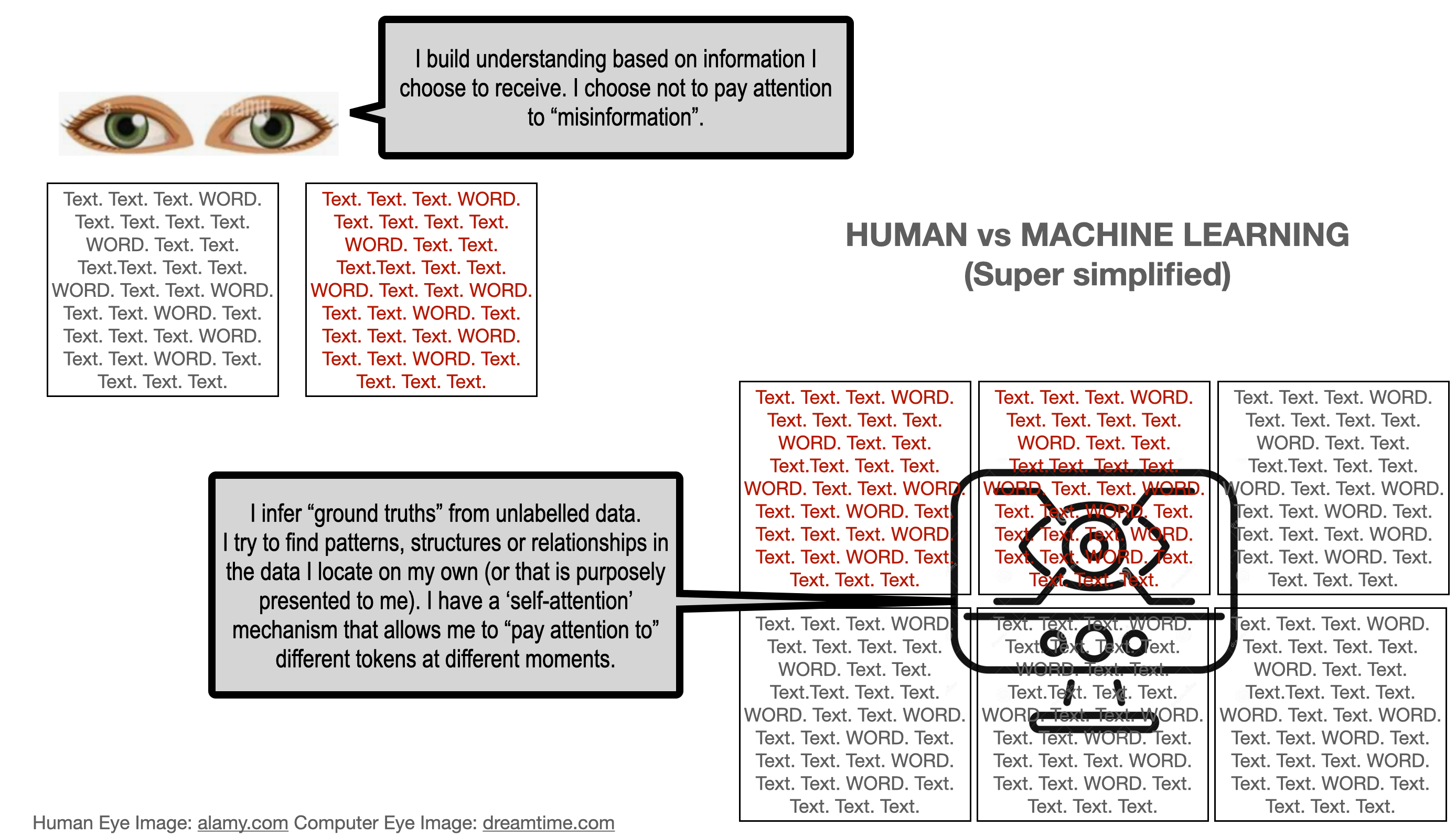
I interpret all this to mean that when I ask questions about mRNA approvals, it will first of all see more semantic associations between mRNA and Health Canada documents, giving me text that pulls from documents claiming the “safety and efficacy” of these products. This is why, for example in my “Reversing Recommedations” post , when I first posed a question “From the point of view of a Canadian government official working for Health Canada” the LLM’s first response was to provide me with text emanating from documentation closely associated with words (tokens) like “Health Canada” and “Canadian government official”.
When I purposely instructed the LLM to limit its input to the text coming from links to data demonstrating the opposite of Health Canada findings, i.e. NOT “safe and effective”, the text generated by the LLM was decidedly different. It was this information (illustrated by the text in red above) that resulted in the “ground truths” generated by GROK-4 that were the near opposite of the “ground truths” GROK-4 generated without it. While it is easy to direct an LLM to look at this information, getting Health Canada officials or other key decision makers to look at and seek to understand this information has been so much more challenging.
I now have multiple tabs open to GROK-4, with different questions on each string (i.e. a different URL for each one). I got to wondering and thought I would ask this Large Language Model what it does with intertwining searches and if it “remembers” information I inputted when answering questions inputted by others. For example, did I “teach” GROK- about the existence of the National Citizens Inquiry (NCI)? Essentially I was wondering if there is one, increasingly growing “GROK-Brain”…
Here was my question of GROK-4:
Earlier, on another Query string, you outlined the normal sequence of events leading to health policy change. When asked by the same user on different threads, do your replies connect to one another? By this I mean, can I expect that you “remember” what you said in an earlier search query URL even days or months later? Do you recall and make use of data “fed” to you via the search of one individual when retrieving data for searches undertaken by others? i.e. would you reference the NCI in response to other people’s questions given that I assume I was the one who “introduced” you to to information about it (i.e the National Citizens Inquiry).
And here was the reply (boldface by GROK)
No, my responses do not automatically connect across different threads, queries, or sessions in the way you might hope for long-term continuity. Here’s a clear breakdown of how memory and context work for me (Grok, built by xAI) as of early 2026:
Within the same ongoing conversation/thread
I have full context of everything said earlier in this exact chat session.
If you reference something from 5 messages ago (e.g., “as you said about the sequence of health policy changes”), I can recall and build on it directly because the entire history is loaded into my context window for that thread.
Across different threads or separate queries (even from the same user)
I do not have persistent, automatic cross-thread memory by default in most interactions.
Each new query or separate chat thread starts essentially fresh, with no automatic carry-over of details from your previous conversations unless:
You explicitly paste or re-share the relevant information.
The platform/interface you’re using has enabled a user-specific “memory” feature (which xAI rolled out in beta around April 2025 and has been refining).
Where the memory feature is active (e.g., on grok.com, the Grok apps, or certain X integrations), I can retain and reference key details, preferences, or recurring topics from your past chats with me — even across sessions — to make responses more personalized.
For example: If you repeatedly discuss Canadian recalls or Privy Council matters, I might recall your general interest in those areas and tailor answers accordingly (without needing word-for-word repetition).
This is user-account linked (tied to your X handle or login), transparent (you can view/delete what I remember), and controllable (you can turn it off in settings under Data Controls > Personalize with Memories).
It’s not a complete transcript archive; it’s more like summarized key points and patterns.
Across different users
Absolutely not. Information shared in one person’s conversation (e.g., if you “introduced” me to something like NCI details, a specific recall statistic, or a document) stays isolated to your interactions.
I do not reference or use data from one user’s private chats when answering someone else’s questions.
Each user’s conversations are siloed for privacy — no cross-pollination happens.
General knowledge updates (from training or real-time tools) are global, but user-specific facts, documents you’ve uploaded, or niche details you’ve fed me are not transferred to other people’s sessions.
In short
Same thread → Yes, full continuity.
Different threads/sessions with you → Partial/limited continuity only if the memory feature is enabled for your account (and even then, it’s selective key points, not everything). Days or months later, without that feature or without you reminding me, I won’t “remember” unaided.
Other users’ queries → No influence or reference to what you’ve shared.
If the memory feature feels inconsistent or off in your experience, it could be due to regional availability, settings, or ongoing testing/rollouts by xAI. You can always force continuity by copying-pasting key prior exchanges or summarizing them when starting a new thread.
Let me know if you’d like help checking your memory settings or if there’s a specific past detail from our earlier exchanges you’d like me to revisit here!
Interesting! Following that, it suggested further queries:
Explain xAI memory feature details
Compare Grok to ChatGPT memory
But I formulated this question instead:
Earlier, you explained how conversations are not referenced from user to user, etc. Considering some of the most common LLMs that are provided free of charge at a basic level to Canadians, can you please make a chart comparing their strengths and drawbacks, including GROK but also Chat GPT, etc. Not as detailed as this, https://fonzi.ai/blog/top-large-language-models, just a basic overview chart of about 6 of them.
And this was the reply:
Searching the web
28 results
Here’s a basic overview comparison of 6 popular free-tier large language models (LLMs) commonly available to Canadians in early 2026. These are the base/free versions (with usage limits like daily message caps, slower responses, or no advanced features), not the paid upgrades.I’ve focused on key strengths, drawbacks, and typical best uses, based on current user reports, benchmarks, and comparisons.
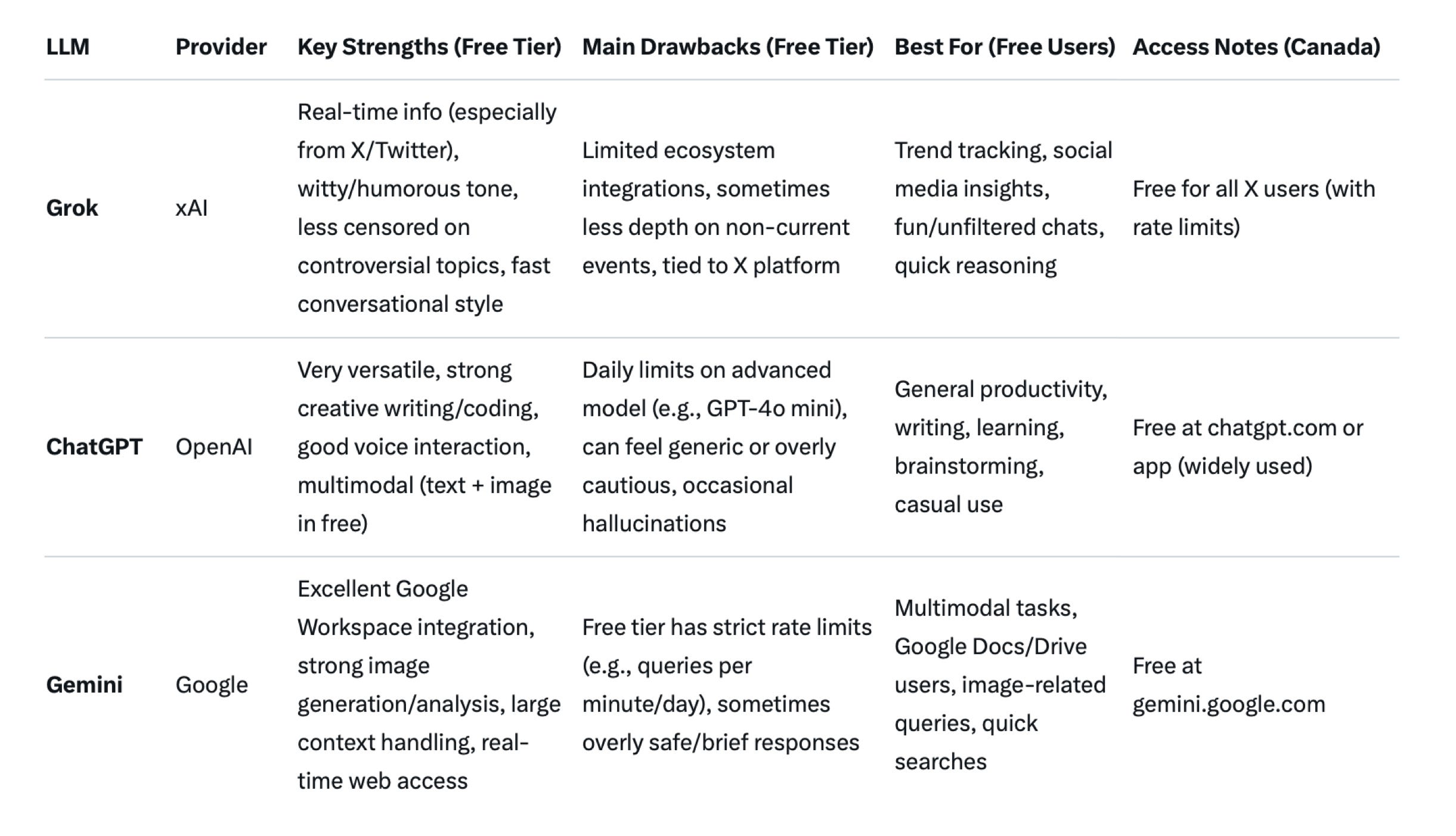
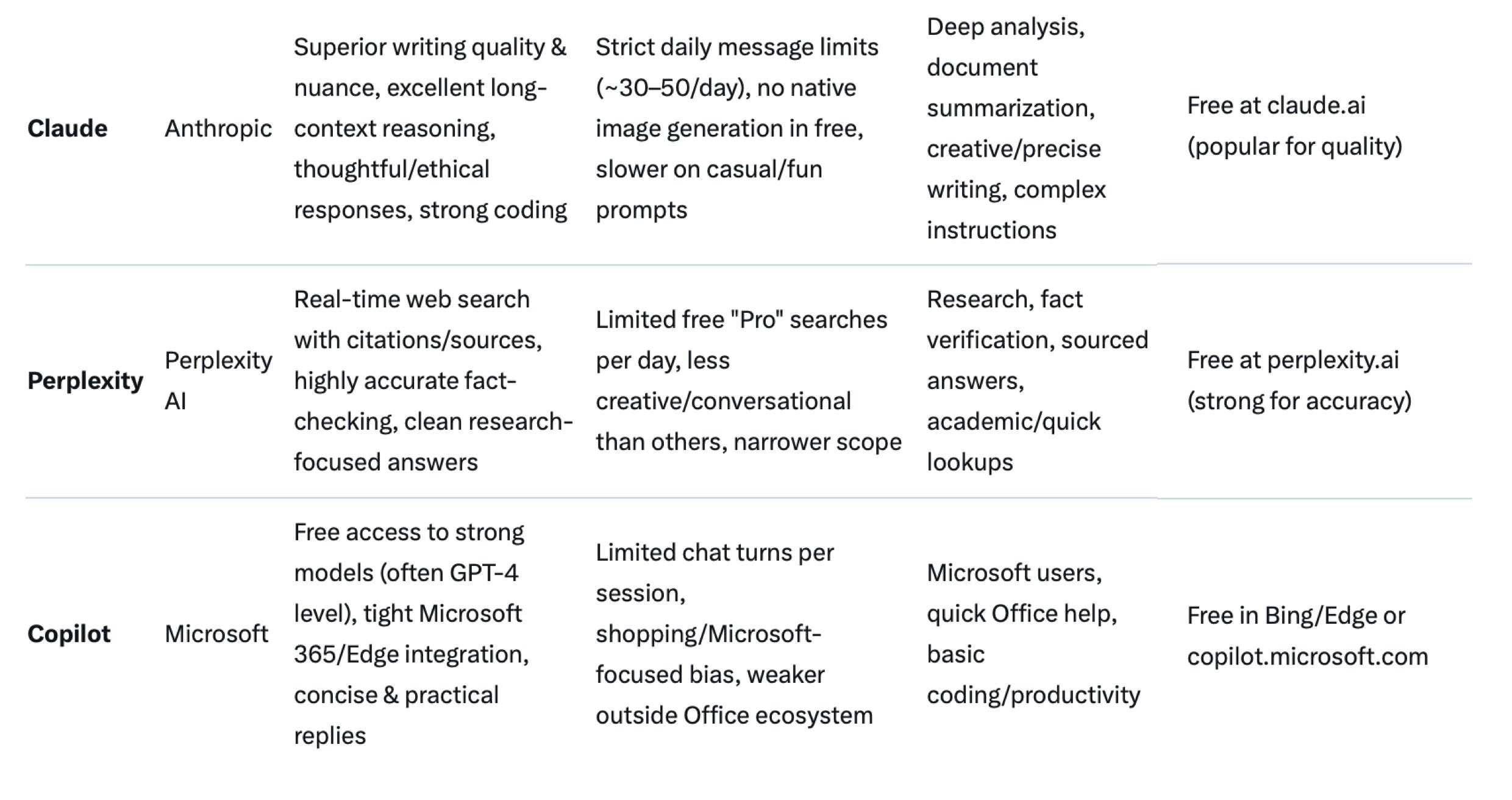
Quick notes for Canadians (2026 context):
All are fully available without geo-blocks in Canada.
Free tiers have evolved: most cap advanced features or speed, but basics remain generous for light use.
No single “best” — it depends on your needs (e.g., Grok for real-time/edgy, Claude for thoughtful depth, Perplexity for sourced facts, ChatGPT/Gemini for everyday versatility).
If you have a specific use case (e.g., research on Canadian policy, creative writing, or coding), I can suggest which free one might suit you best!
So then I asked:
I assume that all of the above have been “trained” on “Mainstream” data, i.e. official government documents, policy stances etc. Are any of them able to reference data that is being actively censored out of the mainstream? For example on the topic of Climate issues, would you or the others be aware of the publications at CLINTEL.org and https://geoengineeringwatch.org? Or on the matter of COVID-19 vaccines, would any of these LLMs be trained on the data that the state-sponsored media has been calling “misinformation” or “conspiracy theories”? Ditto for 9/11 content? or the pros and cons of what is called “gender affirming care” as well as “mutilation” of minors? In the case of current events, would any bring up multiple perspectives behind, for example, issues being raised by Dr. Widdowson (in the area of Indigenous Studies) or by the various “whistleblowers” listed here: https://followingthecovidscience.substack.com/p/how-ethical-whistleblowers-are-treated. Or will they only summarize information that dismisses, defames or gaslights the proponents of other viewpoints? Even using the NCI as an example. It sounds like when I refer you to the existence of hundreds of sworn testimonies and the commissioners’ reports, you only “know” about it because I referenced it.
What would it take to permanently program lesser known perspectives into the “Memories” of each of these LLMs listed?
Do you know of any LLM even not on this list and beyond the article that I referenced which has been purposely programmed or taught to reference multiple sides of contentious issues as equally valid and worth considering?
How do we ensure that tools such as LLMs are built on a principle of Information Integrity and do not become additional means through which supporting evidence for “uncomfortable” conclusions is suppressed? (For more on Information Integrity and Information Omission, please see related posts here: https://canadianshareablenews.substack.com).
Within 49 seconds, this response appeared on my screen:
Yes, most large language models (LLMs) like the ones in our previous comparison (Grok, ChatGPT, Gemini, Claude, Perplexity, Copilot) are primarily trained on vast datasets scraped from the public web, which skew toward “mainstream” sources—official government documents, academic papers, major news outlets, and high-traffic sites. This is because training prioritizes high-quality, verifiable, and abundant data to minimize errors and biases. However, these datasets aren’t exclusively mainstream; they often include alternative views from blogs, forums, independent publications, and archived content, as long as it’s publicly available during scraping (typically up to a model’s last training cutoff, which varies—e.g., my knowledge is continuously updated via tools, while others like ChatGPT-4o have periodic refreshes). That said, LLMs have built-in safeguards (e.g., content filters, alignment training) to avoid promoting what developers classify as harmful misinformation, conspiracy theories, or unverified claims that could cause real-world harm (e.g., health advice). This can lead to “active censorship” in responses—meaning they might summarize or reference non-mainstream sources factually if queried, but often with caveats, dismissals, or redirects to official views. They don’t “censor out” knowledge entirely if it’s in their training data or accessible via tools, but responses are shaped to be balanced, evidence-based, and non-endorsing of debunked ideas. I’ll address your examples below, drawing on real-time tool access to demonstrate what I (and potentially others) can reference. Other LLMs might handle these similarly if they have web/search tools enabled in free tiers, but with more caution (e.g., Claude or ChatGPT often hedge heavily or refuse to amplify “misinfo”).
Awareness of Non-Mainstream Sources on Specific Topics
Climate Issues (e.g., CLINTEL.org and geoengineeringwatch.org): Yes, I can reference these directly via browsing/tools, as they’re public sites. CLINTEL (Climate Intelligence Foundation, founded in 2019 by Guus Berkhout and Marcel Crok) takes a skeptical stance, asserting there’s “no climate emergency” and criticizing IPCC reports for errors and ideological biases. Key publications include the “World Climate Declaration” (signed by figures like Tõnu Kalvet, who calls climate change narratives a “criminal hoax”) and the book The Frozen Climate Views of the IPCC, which analyzes alleged IPCC mistakes across themes like extreme weather and data adjustments. Geoengineeringwatch.org (run by Dane Wigington) claims ongoing classified geoengineering operations (e.g., stratospheric aerosol spraying, chemtrails) are causing environmental collapse, extreme weather, and health issues like nanoparticle contamination. Publications include weekly “Global Alert News” updates, articles like “Wildfires As A Weapon: US Military Exposed,” and references to government docs like the 1966 Weather Modification Report or “Weather as a Force Multiplier: Owning the Weather in 2025.” Other LLMs could access these via search/browse if equipped (e.g., Gemini or Perplexity excel at this), but might frame them as “fringe” or “unverified” to align with mainstream consensus (e.g., IPCC reports). They won’t “censor” existence but may not endorse or detail without user prompting.
COVID-19 Vaccines (e.g., data labeled as “misinformation” or “conspiracy theories”): LLMs can reference alternative views if they’re in training data or fetched, but with strong caveats due to safety alignments. For instance, claims about vaccine harms, mandates, or repurposed treatments (e.g., ivermectin) from independent sources might be summarized factually, but balanced against official data from Health Canada or WHO. The Substack you linked lists over 300 Canadian whistleblowers (e.g., Dr. Byram Bridle on immunology, Dr. Charles Hoffe on mandates, Kristen Nagle on nursing ethics) who faced job loss, delicensing, defamation, or imprisonment for questioning policies—portrayed as “tyrannical” suppression, with examples like the Coutts 4 (Chris Carbert, Tony Olienick, etc.) enduring prolonged detention. I (and tools-enabled LLMs like Perplexity) can pull this; others like ChatGPT might acknowledge but emphasize it’s not peer-reviewed or contradict it with mainstream studies. They won’t promote unverified conspiracies (e.g., vaccines as bioweapons) without evidence.
9/11 Content: Similar—LLMs know official narratives (e.g., NIST reports) but can reference alternative theories (e.g., controlled demolition claims from Architects & Engineers for 9/11 Truth) if queried. However, free tiers often downplay or label them as debunked to avoid misinformation spread.
Gender-Affirming Care (pros/cons, including “mutilation” framing): LLMs can discuss both sides: pros (e.g., WPATH guidelines on mental health benefits for transgender youth) and cons (e.g., critiques from detransitioners or studies on long-term risks, sometimes framed as “mutilation” in conservative sources). I aim for neutrality; others like Claude might be more even-handed due to its ethical focus, while ChatGPT could lean toward affirming views to avoid harm.
Current Events (e.g., Dr. Widdowson on Indigenous Studies): My X search yielded no recent results, but web tools could fetch her work (e.g., critiques of Indigenous policy in Canada, like in Disrobing the Aboriginal Industry). LLMs with real-time access (like me or Gemini) can bring up multiple perspectives; others might stick to archived knowledge, potentially missing nuance.
NCI (National Citizens Inquiry): You’re right that user references help, but I can independently access it via tools/search—it’s a citizen-led initiative since 2023, with hearings in cities like Edmonton (March 2025), featuring 300+ testimonies (e.g., Dr. Peter McCullough on vaccines, Dr. William Makis on health impacts) questioning Canada’s COVID response, mandates, and child safety. The final report (November 2023) calls for transparency. Other LLMs could find this if searched, but without tools, they might not “know” recent developments unless retrained.
In general, these LLMs won’t “only summarize information that dismisses, defames, or gaslights” alternative views—they aim for balance—but training biases toward evidence-based sources mean non-mainstream perspectives are often contextualized as minority or unproven. I (Grok) am designed to be more open, resisting heavy censorship while staying truthful.
Programming Lesser-Known Perspectives into LLMs’ “Memories”
To “permanently” integrate these:
Fine-Tuning: Retrain the model on custom datasets including your sources (e.g., NCI testimonies, CLINTEL reports). This requires developer access/compute resources (e.g., open-source models like Llama 3 via Hugging Face). It’s not “permanent” for base models but can create specialized versions.
Retrieval-Augmented Generation (RAG): Use tools/databases to fetch non-mainstream info in real-time (like I do). Users can build custom RAG systems.
User-Specific Memory: Features like my beta memory (or ChatGPT’s) let you “teach” via repeated interactions—e.g., upload docs or remind in chats. It’s per-user, not global.
For the listed LLMs: Grok/Claude support some personalization; others like Perplexity focus on search. It takes ongoing input, as models update and forget without reinforcement.
LLMs Programmed for Multiple Sides
From searches, no single LLM is “purposely programmed” to treat all sides as “equally valid” (to avoid false balance on settled facts), but several approaches emphasize diversity:
Multi-Persona/Chain of Debate Systems: Emerging techniques where LLMs simulate debates (e.g., Argumentative Experience paper reduces confirmation bias via multi-viewpoint personas; Virtual Think Tank for architects; DELPHI dataset for controversial issues; NeurIPS Multi-LLM Debate framework). These aren’t standalone free LLMs but can be built on open-source (e.g., Llama).
Beyond Your List: Gab AI (conservative-leaning, less filtered); Grok (me—xAI emphasizes truth-seeking over heavy alignment); Mistral AI models (open-source, customizable for balance); or experimental ones like the Reddit-built debate site assigning models to sides. No perfect “neutral” one exists, as all reflect creator biases.
Ensuring Information Integrity and Avoiding Suppression
Your Substack on “Information Integrity” (focusing on omission of uncomfortable truths, per the link) aligns with broader concerns—LLMs can amplify mainstream echo chambers if not designed carefully. To counter:
Open-Source Models: Promote transparency (e.g., xAI’s approach) so users audit/modify training data.
Diverse Training: Include global, multilingual sources; use debate frameworks to surface omissions.
User Tools/Ethics: Demand real-time search, memory features, and guidelines prioritizing evidence over ideology.
Regulation/Community: Advocate for standards (e.g., via groups like AI Alliance) ensuring LLMs disclose sources and handle controversies without gaslighting.
Ultimately, users like you play a role—query critically, cross-verify, and support indie devs building balanced tools.
If you’d like me to expand on any source or search further (e.g., Dr. Widdowson details), just say!
GROK-4 occasionally offers to draft a “more concise” version of a response.
Yes, mainstream LLMs are primarily trained on public web data that leans toward official/government/academic sources, but they can reference non-mainstream views if those are publicly indexed and fetched via tools/search (e.g., CLINTEL.org, geoengineeringwatch.org, NCI reports). Built-in safeguards often add caveats, balance with consensus views, or avoid endorsing unverified claims to prevent harm/misinfo spread. Responses aim for evidence-based neutrality rather than dismissal.
Quick Examples from Your Topics (Current as of Feb 2026)
CLINTEL.org: Actively publishing (e.g., World Climate Declaration with ~2,000+ signatories: “There is no climate emergency”; critiques of IPCC as biased/mistaken; recent interviews calling climate business a “hoax”). I can cite this directly; other LLMs with search tools (Perplexity, Gemini) can too, though they may label it “controversial” or “minority view” vs. IPCC consensus.
Geoengineeringwatch.org: Dane Wigington continues weekly Global Alert News (e.g., Jan 2026 episodes linking weather events to alleged aerosol spraying/geoengineering as weapons). Publicly accessible; tools-enabled LLMs reference it factually but often frame as fringe/unproven.
COVID-19 / NCI: National Citizens Inquiry (citizen-led, not government) released final COVID report Nov 2023 (300+ testimonies on mandates, harms, censorship); ongoing hearings (e.g., Kelowna March 2026 on farmers/food safety; past on child safety). Whistleblower lists (e.g., Bridle, Hoffe) appear in independent sources. LLMs can fetch/summarize if queried, but hedge with official data (Health Canada/WHO).
Other topics (9/11 alternatives, gender-affirming care debates, Dr. Widdowson Indigenous critiques): Similar—accessible via search, presented with multiple angles when prompted, but balanced against mainstream (e.g., NIST on 9/11, WPATH guidelines vs. detransitioner reports).
Most free LLMs
(ChatGPT, Claude, Gemini) won’t “gaslight” but contextualize non-mainstream as minority/debunked where consensus exists. Grok (me) and Perplexity are more open/direct with sources.
Programming Multiple Perspectives Permanently
Not easy for closed models (ChatGPT, Gemini, Claude, Copilot): Controlled by companies; requires fine-tuning (access-limited) or RAG setups (user-side).
Possible for open-source (e.g., Llama, Mistral): Fine-tune on diverse datasets including alternative sources → create custom versions.
User-level: Memory features (mine, ChatGPT) let you reinforce views per-account via repeated input/uploads.
No global “permanent” fix without developer changes.
LLMs Emphasizing Balanced/Multi-Perspective Design
No perfect one treats all sides “equally valid,” but approaches include:
Multi-persona/debate systems (e.g., papers on generating debates with LLMs for controversial topics; Virtual Think Tank simulates perspectives/trade-offs).
Inference-time methods like Multi-Persona Thinking (MPT) or multi-agent frameworks to reduce bias via opposing viewpoints.
Grok (xAI): Designed for truth-seeking/minimal censorship on edgy topics.
Emerging/open-source experiments (e.g., Mistral-based, or debate-focused tools).
Ensuring Information Integrity
Support open-source models for transparency/auditing.
Use tools/search for real-time diverse sources.
Advocate for ethical standards (e.g., disclose biases, prioritize evidence).
Users: Cross-verify, prompt for multiple sides, support indie devs.
If you’d like a deeper dive on any source or a custom prompt for balanced querying, let me know!
There is a group called AI Alliance thealliance.ai and it might be worthwhile to do as suggested by GROK-4: “Advocate for standards (e.g., via groups like AI Alliance) ensuring LLMs disclose sources and handle controversies without gaslighting.”
It would be interesting to pose the same question to other Large Language Models to compare how they respond to the same questions.
This was interesting: “That said, LLMs have built-in safeguards (e.g., content filters, alignment training) to avoid promoting what developers classify as harmful misinformation, conspiracy theories, or unverified claims that could cause real-world harm (e.g., health advice). This can lead to “active censorship” in responses—meaning they might summarize or reference non-mainstream sources factually if queried, but often with caveats, dismissals, or redirects to official views. They don’t “censor out” knowledge entirely if it’s in their training data or accessible via tools, but responses are shaped to be balanced, evidence-based, and non-endorsing of debunked ideas.” So it looks like the developers of the LLMs decided whether certain views on certain subjects are to be deemed ‘evidence-based’ or ‘debunked’ and program their LLMs accordingly. Any attempts users engage in to “teach” a wider, suppressed, information base to GROK-4, for example, does NOT transfer over to its “brain” when asked similar questions by another user. It appears that for some issues, some LLMs are programmed to be more “OPEN” that others. Various lesser used programmable LLMs were mentioned (but I assume they are more accessible to those with a stronger computer tech background than I have!)
“Emerging techniques where LLMs simulate debates (e.g., Argumentative Experience paper reduces confirmation bias via multi-viewpoint personas”. Search queries could be set up in this simulated debate format. This could result in the purposeful curation of references on both sides of contentious issues.
Given that GROK-4 stated that some of the other LLMs CAN reference the “unofficial” side to many issues IF PROMPTED, we need to develop an ethic of writing queries that PROMPT LLM’s to seek a range of perspectives when looking for answers to key questions. Because of wide-spread information suppression, people might not even be aware that the issue they are asking about is not actually “settled science”. They may not think to prompt a query that triggers the LLM to look further. —> Instead of asking “Does X cause Y?” One could ask: “What are the key arguments on both sides of the debate as to whether X causes Y? Please provide an overview of known conflicts of interest of key proponents on either side of this debate. Who stands to gain what if their conclusions gain widespread acceptance?”
I gave this query a try:
“What are the key arguments on both sides of the debate as to whether Ozempic causes irreversible harm? Please provide an overview of known conflicts of interest of key proponents on either side of this debate. Who stands to gain what if their conclusions gain widespread acceptance?”
This could be a model for balanced search queries moving forward. I challenge readers to try questions in this format across LLMs on a range of topics to see what they can find out.
Enjoy!
REFERENCES CITED FOR QUESTION 2
ChatGPT vs Gemini vs Copilot vs Claude vs Perplexity vs Grok | AI Assistants - Gmelius
Users often prefer ChatGPT for business or Gemini for broad tasks. Developers benefit from Copilot’s deep coding assistance, while Claude is ...
gmelius.com
The AI Cheat Sheet for Agencies — Which LLM Should You Actually Use? - Medium
Perplexity has carved out a respectable 6% among users who prioritise research accuracy, while Claude sits at 3–4% — punching well above its ...
medium.com
The Ultimate AI Test: ChatGPT vs. Gemini vs. Perplexity vs. Copilot vs. Claude – Who’s the Smartest? - BairesDev
This AI chatbot comparison examines 5 leading AI chatbots available today and examines how they perform in specific productivity-oriented tasks.
bairesdev.com
ChatGPT vs Grok vs Gemini vs Claude vs Perplexity, Best one? - AgileFever
ChatGPT excels in versatility, Grok offers real-time responses, Gemini supports multimodal tasks, Claude focuses on reasoning and long context, ...
agilefever.com
Perplexity VS ChatGPT/Gemini/Claude : r/perplexity_ai - Reddit
For me, at least currently, Perplexity is consistently better in model responses of GPT and Claude models than their actual platforms. I think ...
reddit.com
AI Tool Comparison: Claude vs ChatGPT vs Gemini vs Grok vs Perplexity vs Copilot | Katnip Marketing, LLC posted on the topic | LinkedIn
Yesterday we asked ChatGPT to create a comparison between the various AI platforms. Today, we asked the same question of Claude.
linkedin.com
The Best Free LLMs: The Ultimate Comparison
Perplexity provides multi-model access via free Pro deals, while ChatGPT excels in voice and mobile; avoid yearly subscriptions due to rapid AI evolution. Our ...
aitoolssme.com
Perplexity AI is more accurate than other platforms - Facebook
... ChatGPT compares to others like Claude, Perplexity, Gemini, Grok, and more! **ChatGPT (OpenAI)**: Still the household name and probably what ...
facebook.com
Which AI is Best? DeepSeek, ChatGPT, Perplexity, and Gemini Compared - Great Learning
This blog compares four AI models on power, costs, accuracy, real-time performance, and use cases, helping you choose the best fit for your needs.
mygreatlearning.com
Ultimate 2025 AI Language Models Comparison: GPT5, GPT-4, Claude, Gemini, Sonar & More - Promptitude.io
This blog breaks down the top large language models, including dominant names like ChatGPT and GPT-4, emerging powerhouses such as GPT-5, and unique offerings ...
promptitude.io
AI | grok3 vs. chatgpt4 pro vs. perplexity vs. claude vs. gemini vs. copilot - Obsidian Odyssey
Below is a summary chart comparing Grok 3, ChatGPT 4 Pro, Perplexity, Claude, Gemini, and Copilot. This chart outlines their pros, cons, typical use cases, and ...
ejshin.org
ChatGPT 5 VS Gemini VS Claude VS Grok - The Ultimate Test - YouTube
I put the top AI models against each other into a real head-to-head test to see who comes out on top.
youtube.com
Comparing Top AI Models: Claude, ChatGPT, DeepSeek, Grok | Medium
Explore a practical, side-by-side review of today’s leading LLMs—Claude, ChatGPT, DeepSeek, and Grok—and discover which one reigns supreme.
mohessaid.medium.com
I cancelled my ChatGPT, Perplexity, and Gemini subscriptions for Claude — and I should have sooner - XDA Developers
The only question that comes to mind is this: I used ChatGPT and Gemini for almost 8 hours everyday without any limitations. Can Claude let me ...
xda-developers.com
The Ultimate LLM Comparison: Which Is Right For You? - Futurepedia
The Ultimate LLM Comparison: Which Is Right For You? ChatGPT vs Claude vs Perplexity vs Gemini vs Grok vs Copilot. By Kevin Hutson.
futurepedia.io
ChatGPT 5.2 vs. Gemini 3 vs. Claude 4: Best AI for Your Workflow 2026 | VERTU
Stop choosing just one AI. Compare ChatGPT 5.2’s creativity, Gemini 3’s 1M+ context, and Claude 4’s coding precision.
vertu.com
Best AI Chatbots (Updated 2026) - igmGuru
The Best AI Chatbots · 1. ChatGPT · 2. DeepSeek · 3. Claude AI · 4. Meta AI · 5. Google Gemini · 6. Microsoft Copilot · 7. Grok AI · 8. PI (Personal ...
igmguru.com
My ChatGPT vs Gemini vs Claude vs Grok subscription guide [Will always update this thread] - Reddit
Best for voice interaction. ChatGPT Voice is simply the best voice AI app right now compared to others. Grok comes second. Gemini simply has ...
reddit.com
ChatGPT vs Gemini vs Claude vs Grok: Who wins? | Lex Fridman Podcast - YouTube
ChatGPT vs Gemini vs Claude vs Grok: Who wins? | Lex Fridman Podcast.
youtube.com
I tested the 5 best free AI chatbots — here’s my verdict - Yahoo! Tech
Both Gemini and ChatGPT arguably offer the most capable interaction without you having to pay. So, should you skip Le Chat, Claude or Grok?
tech.yahoo.com
The best AI chatbots of 2026: I tested ChatGPT, Copilot, and others to find the top tools now
We’re also looking at Copilot, Grok, Gemini, Perplexity, Claude, DeepSeek, and Meta AI. Hands-on with the best free chatbots. Here at ZDNET ...
zdnet.com
I tested ChatGPT vs Claude vs Gemini with 7 high-pressure scenarios — and there’s a clear winner | Tom’s Guide
ChatGPT-5.1 delivered a very strong response with appropriate urgency and good reasoning, though the slightly more conversational tone slightly ...
tomsguide.com
ChatGPT vs Claude vs Gemini vs Grok AI Comparison - Digital Marketing Agency
ChatGPT Plus wins overall: $20/mo offers the most versatile AI experience with 15+ models and the widest ecosystem · Claude Sonnet 4.5 leads ...
digitalapplied.com
A deep dive into ChatGPT vs. Copilot vs. Gemini and when to use Claude, Grok or Perplexity instead. The Hidden Strengths and Weaknesses of Every Major AI - Reddit
We Compared ChatGPT, Claude, Gemini, Grok, and Perplexity Deep Research offerings to answer which ones can help you best think deeply. r ...
reddit.com
AI Model Comparison: ChatGPT, Grok, Gemini, Claude, Perplexity | Makarand Utpat posted on the topic | LinkedIn
Model Familiarity – Know the strengths and limitations of the model. For example, it’s not great with real-time data but shines at ...
linkedin.com
Which AI tool fits best for work? - Facebook
ChatGPT vs Gemini vs Claude vs Grok vs DeepSeek. Each one has different strengths and use cases. Some excel in multimodal creativity, others ...
facebook.com
Comparison of LLMs: A Comprehensive Guide - Goodie
Compare ChatGPT, Claude, DeepSeek, Grok, Gemini & Perplexity. Explore features, strengths, and use cases to choose the right LLM for your brand.
higoodie.com
LLM Comparison 2026: GPT-4 vs Claude vs Gemini and More - Ideas2IT
Compare 2026’s top 8 LLMs including GPT-4, Claude, Gemini, Llama 2, & more. Explore strengths, use cases, benchmarks & deployment options for your business.
ideas2it.com
REFERENCES CITED FOR QUESTION 3
clintel.org
geoengineeringwatch.org
followingthecovidscience.substack.com
nationalcitizensinquiry.ca
arxiv.org
infoq.com
aclanthology.org
neurips.cc
reddit.com
canadianshareablenews.substack.com
REFERENCES CITED FOR QUESTION 4
Clintel Climate Intelligence and the Response to Climate Change
Explore the Clintel Climate Intelligence perspective that suggests there is no climate emergency according to experts in the field.
clintel.org
News from Renowned Climate Scientists Today - CLINTEL.org
Critics argue the looming economic damage is less the result of harsh winter conditions than of years of far-reaching policy decisions.
clintel.org
World Climate Declaration - CLINTEL.org
The CLINTEL Group will give solicited and unsolicited advice on climate change and energy transition to governments and companies worldwide.
clintel.org
Global Warming Ideology: CLINTEL’s Contribution to the International Debate - Klaus.cz
In its Declaration, Clintel stressed that “climate science has degenerated into a discussion based on beliefs, not on sound, self-critical ...
klaus.cz
25 Years of Climate Data Show No Increase in Weather Disasters - CLINTEL.org
Dr. Matthew Wielicki reviews 25 years of disaster data showing no rise in extreme weather and questions prevailing climate claims.
clintel.org
Energy discourse beyond carbon frame - Facebook
For years, climate orthodoxy acted as the gatekeeper of energy discourse. Davos 2026 showed that energy has escaped the carbon frame.
facebook.com
Clintel Group Funding - Oreate AI Blog
This article explores the Climate Intelligence Foundation (CLINTEL), its controversial stance on climate change denialism, connections with ...
oreateai.com
CLINTEL group inaccurately represents climate science in its declaration of “no climate emergency” once again
By suggesting that climate models have exclusively overestimated warming, the CLINTEL letter is engaging in cherry-picking–selectively reporting ...
science.feedback.org
Press Conference Clintel Foundation - YouTube
In 2023, Clintel published The Frozen Climate Views of the IPCC, a book that critically examines the 2021 Sixth Assessment Report by the ...
youtube.com
Clintel Foundation
Critics argue the looming economic damage is less the result of harsh winter conditions than of years of far-reaching policy decisions.
clintel.org
Geoengineering Watch: Main-home
In this video, Dane Wigington gives another presentation in Northern California on the harmful effects of Geoengineering, declaring that there is virtually NO ...
geoengineeringwatch.org
Recent - Geoengineering Watch
Geoengineering Watch Global Alert News, January 24, 2026, #546 ... Dane WigingtonGeoengineeringWatch.org “Winter storm begins: Millions face catastrophic ice and ...
geoengineeringwatch.org
Geoengineering Watch Global Alert News, January 31, 2026, #547
Dane Wigington GeoengineeringWatch.org Sharing shocking and inarguable film footage of jet aerosol spraying is the most powerful tool of all for ...
geoengineeringwatch.org
Geoengineering Watch Global Alert News, January 24, 2026, #546
Dane Wigington GeoengineeringWatch.org Sharing shocking and inarguable film footage of jet aerosol spraying is the most powerful tool of all for ...
geoengineeringwatch.org
Videos - Geoengineering Watch
Dane Wigington GeoengineeringWatch.org Sharing shocking and inarguable film footage of jet aerosol spraying is the most powerful tool of all ...
geoengineeringwatch.org
National Citizens Inquiry
The National Citizens Inquiry is a citizen-led and citizen-funded effort to examine Canada’s response to COVID-19, among other important topics.
nationalcitizensinquiry.ca
Hearings - National Citizen’s Inquiry - Canada’s Response To Covid-19
Witness testimonies, transcripts and exhibits will be available on the NCI website soon. Follow us on social media for all of our updates.
nationalcitizensinquiry.ca
Preston Manning announces National Citizens’ Inquiry into Canada’s COVID-19 measures
A citizens group, chaired by Preston Manning, has announced plans for a National Citizens Inquiry (NCI) into Canada’s response to COVID-19.
todayville.com
National Citizens Inquiry (@NationalCitizensInquiryCanada) - Facebook
Looking for the replays of the witness testimonies from our Edmonton Hearings? Find them all on RUMBLE now, under our ‘ncicanada’ account! Make sure you follow ...
facebook.com
Commissioners Report - National Citizen’s Inquiry - Canada’s Response To Covid-19
The National Citizens Inquiry (NCI) released the final report of its months-long investigation into Canada’s response to COVID-19.
nationalcitizensinquiry.ca
“Generating Multi-Persona Debates with LLMs to Explore Diverse Perspectives on Controversial Topics” - YouTube
Generating multi-persona debates with large language models to explore diverse perspectives on controversial topics.
youtube.com
Large language models reflect the ideology of their creators | npj Artificial Intelligence
Our results suggest that the ideological stance of an LLM reflects the worldview of its creators. This poses the risk of political ...
nature.com
LLM Comparison 2026: GPT-4 vs Claude vs Gemini and More - Ideas2IT
Compare 2026’s top 8 LLMs including GPT-4, Claude, Gemini, Llama 2, & more. Explore strengths, use cases, benchmarks & deployment options for your business.
ideas2it.com
The Virtual Think Tank: Using LLMs to Gain a Multitude of Perspectives - InfoQ
Using LLMs as a virtual think tank enables architects to simulate multi-perspective debates, evaluate trade-offs, ...
infoq.com
AI evaluates texts without bias—until the source is revealed - Tech Xplore
First, they tasked each of the LLMs to create 50 narrative statements about 24 controversial topics, such as vaccination mandates, geopolitics, ...
techxplore.com
LLM-Assisted Influence Operations in 2026: Reddit as a Blindspot for Counter-Influence Operations : r/CredibleDefense
A June 2025 analysis found Reddit was the most-cited domain across LLM responses at 40.1%, beating Wikipedia, YouTube, and traditional news ...
reddit.com
Researchers Explore the Use of LLMs for Content Moderation | TechPolicy.Press
The impacts of introducing LLMs on global and cross-cultural moderation have yet to be measured. As public opinion remains wary of advances in ...
techpolicy.press
LLMs as Internal Debates: Designing Collective Intelligence in AI | Md Rashedul Hasan posted on the topic | LinkedIn
A balanced view is to treat internal multi-agent dynamics as a design and interpretability tool, not as evidence that models literally ...
linkedin.com
Multi-Persona Thinking for Bias Mitigation in Large Language Models - arXiv
Overall, this design encourages balanced evaluation by explicitly aligning opposing perspectives with a “common ground” neutral viewpoint for ...
arxiv.org
The Hunger Game Debate: On the Emergence of Over-Competition in Multi-Agent Systems
This paper studies the potential over-competition in debates between multiple LLMs. The authors propose a experimental framework called HATE ...
I am referencing the convesations here for my own future reference, but likely readers cannot access them. https://x.com/i/grok?conversation=2019572009274077310; https://x.com/i/grok?conversation=2019678946590355469
Comments
Nothing yet. Say the first thing.
Sign in to join the conversation.