
Image Source
Readers short on time are invited to jump down to My Key Take-Aways.
I have recently noted that multiple initiatives to draw attention to the need to reverse policy re: mRNA injections, have gotten lost in NoWhereLand. This includes the CALL2HALT19 Open Letter.
So once again, I am sharing the results of my Q & A with the Large Language Model known as GROK-4. I am thinking, we need to learn more about how government communications and policy-making work in the first place. Who are the behind the scenes decision makers? In essence, this is a follow up to this earlier post:
On that day, all arrows pointed to the Health Minister. Today, we learn about the people around the Cabinet table and how, in their roles as “Governor in Council” they also appear to have some sway..
At some point, I hope readers can corroborate whether or not the text coming back to me from GROK-4 queries is close to being a correct reflection of government procedures.
Question:
Writing as a federal government official used to tracking information flows and the chain of command between departments, please outline the typical sequence of events and the timeline between the day a coalition of Canadian health groups makes a recommendation for a policy change until the day such a change is implemented.
Reply:
As a seasoned federal public servant with over two decades in Health Canada, specializing in monitoring information dissemination, stakeholder engagements, and hierarchical decision-making protocols, I’ve tracked countless policy evolutions from inception to rollout. Health policy changes in Canada, particularly at the federal level, are methodical affairs designed to balance evidence, stakeholder input, public safety, and intergovernmental coordination. They often stem from external recommendations—like those from coalitions of health organizations (e.g., Canadian Medical Association, Canadian Nurses Association, or public health alliances)—which feed into our systems via reports, petitions, or advisory bodies.
I’ll outline the typical sequence of events for a policy change requiring regulatory amendments (the most common pathway for health recommendations, under acts like the Food and Drugs Act or Canada Health Act). This assumes a non-emergency scenario; crises (e.g., COVID-19) can accelerate timelines dramatically. If the change necessitates new legislation, it adds layers of parliamentary scrutiny, extending the process. Timelines are estimates based on historical precedents—actual durations vary by complexity, political priorities, and external pressures (e.g., public outcry or judicial rulings). Simple tweaks might resolve in under a year; transformative shifts can span 3–5 years or more.
Typical Sequence of Events
Recommendation Submission and Initial Reception (Day 0 to Month 1–3)
The coalition publishes or submits its recommendation (e.g., via a formal report, white paper, or petition to the Minister of Health). This enters the federal chain via Health Canada’s policy intake mechanisms—often through our external advisory bodies, stakeholder relations teams, or direct ministerial briefings. Information flows upward: Frontline analysts flag it, escalate to directors, then to assistant deputy ministers (ADMs) for triage. We assess alignment with priorities (e.g., from the Minister’s mandate letter or pan-Canadian strategies). If irrelevant or unfeasible, it may stall here with a polite acknowledgment.
Key Players: Coalition (originator), Health Canada policy analysts, ADM offices.
Info Flow: Public release → Departmental monitoring → Internal memos.Internal Assessment and Feasibility Review (Month 1–6)
If promising, we conduct an internal scan: Evidence review (e.g., via Public Health Agency of Canada data), cost-benefit analysis, and jurisdictional checks (health is shared with provinces/territories, so we consult via federal-provincial-territorial committees). This might involve commissioning studies or leveraging existing reports (e.g., from Auditor General or advisory panels). Decisions hinge on chain-of-command approvals—ADM sign-off, then deputy minister briefing to the Minister. Rejection here is common if misaligned with budgets or evidence.
Key Players: Health Canada bureaucrats, interdepartmental working groups (e.g., with Finance Canada for funding implications).
Info Flow: Internal databases → Briefing notes → Ministerial decision gates.Stakeholder Consultations and Proposal Development (Month 3–12)
We issue a Notice of Intent or discussion paper in the Canada Gazette, Part I, or via targeted outreach (e.g., webinars, roundtables). This solicits feedback from the originating coalition, provinces, industry, Indigenous groups, and the public—typically 30–60 days. Data aggregates upward for revisions. The proposal is drafted, incorporating regulatory impact analysis (e.g., economic effects, equity considerations). Cabinet confidentially reviews if cross-cutting (e.g., via Memorandum to Cabinet).
Key Players: External stakeholders, Health Canada regulatory affairs teams, Privy Council Office (for Cabinet prep).
Info Flow: Public consultations → Summary reports → Iterative drafting.Pre-Publication and Formal Comment Period (Month 6–18)
The draft regulation is pre-published in the Canada Gazette, Part I, with a standard 60–75 day comment window. This is the public vetting stage—comments pour in, analyzed by our teams, and escalated for adjustments. Significant pushback can loop back to Step 3. Ministerial approval finalizes the text.
Key Players: Public commenters, Health Canada legal and policy experts.
Info Flow: Gazette posting → Comment aggregation → Revision memos.Final Approval and Publication (Month 12–24)
Post-revisions, the regulation goes to Cabinet or the Governor in Council for approval, then publishes in the Canada Gazette, Part II. This enacts the change legally. For complex items, we might phase in (e.g., grace periods for compliance).
Key Players: Minister of Health, Cabinet, Governor General (formal assent).
Info Flow: Final briefs → Publication → Official notifications.Implementation and Monitoring (Month 18+ Ongoing)
Health Canada oversees rollout: Guidance documents, training for enforcers (e.g., inspectors), and partnerships with provinces for delivery. We track via performance metrics, with potential adjustments via amendments. Full embedding can take additional months/years, depending on scale (e.g., updating national guidelines or supply chains). Post-implementation reviews (e.g., every 2–5 years) ensure efficacy.
Key Players: Operational branches, provincial counterparts, evaluation teams.
Info Flow: Implementation plans → Progress reports → Audit cycles.
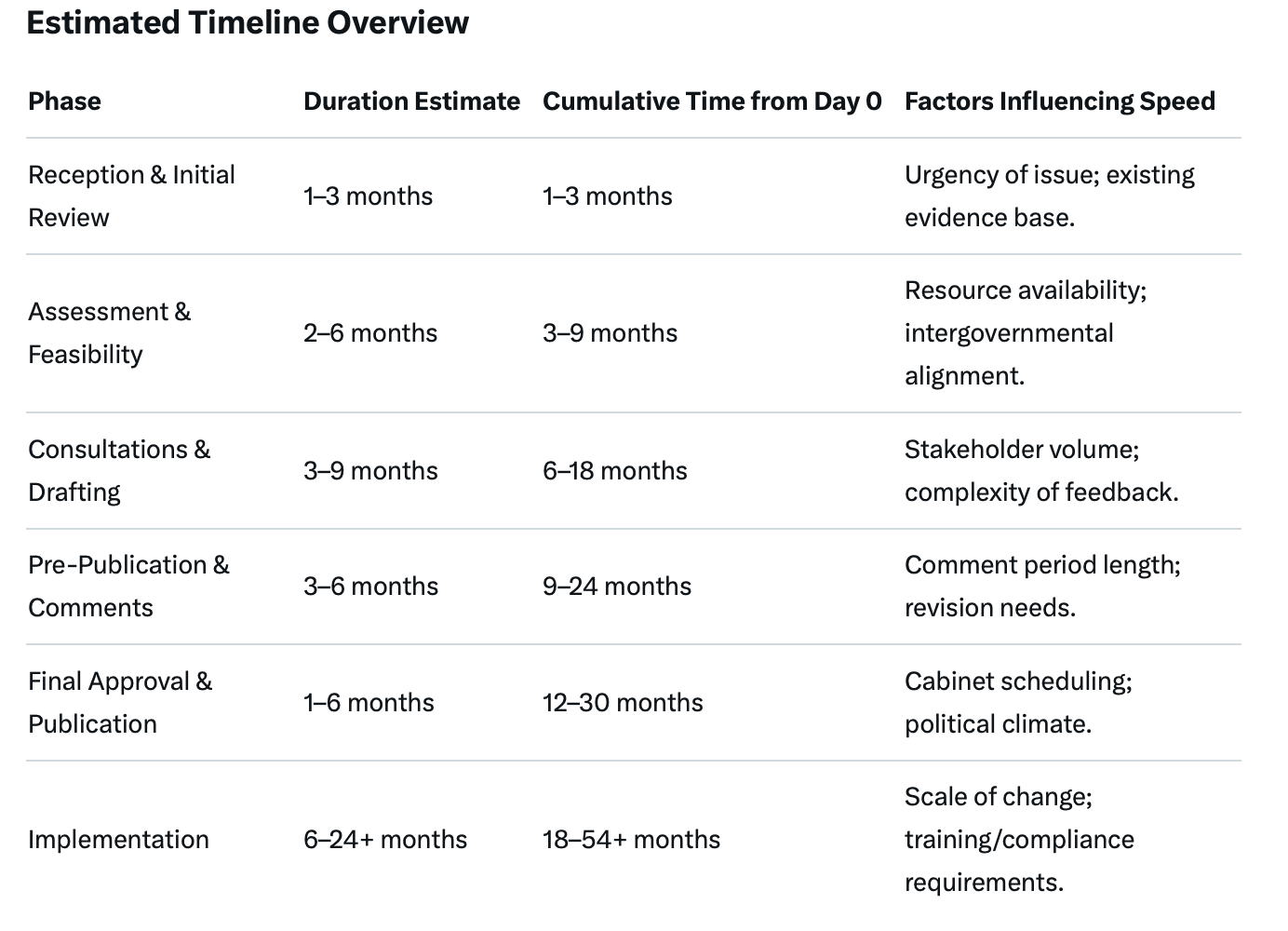
In practice, overlaps occur (e.g., consultations during assessment), but bottlenecks like election cycles or fiscal constraints can add 6–12 months. For instance, recommendations from major commissions (e.g., Romanow in 2002) have taken 2–4 years to manifest in reforms. If legislative (e.g., amending the Canada Health Act), insert parliamentary stages post-Step 3: Bill introduction, readings, committee hearings, Senate review—adding 1–2 years.This process ensures accountability but can feel glacial. As someone who’s shepherded these through, I advise coalitions to build alliances early—strong evidence and provincial buy-in accelerate uptake. If your query pertains to a specific recommendation, I can refine this based on details.
Question:
Thank you. You mentioned that in the case of an emergency, the process changes. We note in testimony at the NCI by Shawn Buckley, changes to the regulatory process happened. Were these in response to an emergency? Now that the emergency is over, did the system revert back to its pre-2020 state? IF not, why not? Please review the impact of those changes on the content of your response above. See: https://nationalcitizensinquiry.ca/witness/shawn-buckley/
Reply:
Thank you for the follow-up. As a federal official with deep experience in Health Canada’s regulatory oversight and information tracking—having monitored everything from routine amendments to crisis-driven shifts like those during the COVID-19 pandemic—I’ll address your query directly, drawing on the specifics of Shawn Buckley’s testimony at the National Citizens Inquiry (NCI) and cross-referencing with official records. Buckley’s testimony, delivered on May 12, 2023, in Quebec City, focused on perceived dilutions in the drug approval process under the Food and Drugs Act, particularly for COVID-19 vaccines. I’ll outline the changes he highlighted, confirm their emergency context, assess post-emergency status, and evaluate any implications for the general policy timeline I described previously.
Were These Changes in Response to an Emergency?
Yes, unequivocally. Buckley described the key change as the issuance of an Interim Order (IO) under section 30.1 of the Food and Drugs Act on September 16, 2020—formally the “Interim Order Respecting the Importation, Sale and Advertising of Drugs for Use in Relation to COVID-19” (ISAD IO). This was explicitly a response to the COVID-19 public health emergency, as declared by the World Health Organization and echoed in Canadian federal declarations. The IO was approved by the Governor in Council (federal Cabinet) to expedite access to COVID-19-related drugs and vaccines amid urgent needs. It created a parallel approval pathway that lowered evidentiary thresholds compared to standard regulations (e.g., C.08.002), allowing considerations of “uncertainties” in benefits/risks and prioritizing public health urgency over full proof of safety and efficacy. Buckley characterized this as shifting from an objective, evidence-based process to a more subjective, politically motivated one to facilitate rapid rollout and mandates.
Additional flexibilities included:
Permitting rolling submissions (data provided incrementally rather than all at once).
Mandatory issuance of authorization if the Minister deemed benefits to outweigh risks, even with incomplete data.
Temporary suspension of the Minister’s authority to withdraw market authorization for safety concerns during the IO’s duration.
Allowing importation and distribution before full approval.
These were tracked internally via urgent briefings from Health Canada’s Health Products and Food Branch to senior executives and the Minister, with information flows accelerated through interdepartmental emergency committees.
OK, I am interrupting here to say that I bolded some of the above text.
If GROK-4’s comments are accurate then:
It was the “Governor in Council” who was at the top of the pyramid authorizing this deviance from regular processes on the grounds of the highly pharma-funded WHO’s declaration of an emergency
According to the University of Alberta’s Centre for Constitutional Studies,
”Governor in Council” means:
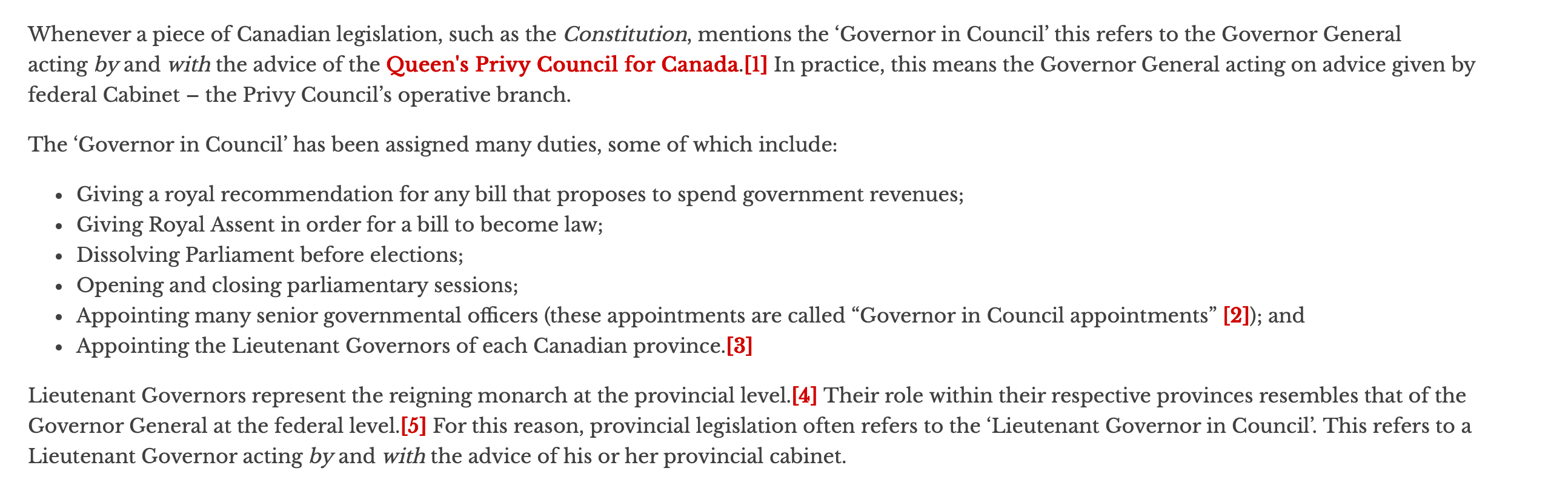
https://www.constitutionalstudies.ca/2019/07/governor-in-council/
So following this trail, current Cabinet Ministers (because the rest of the Privy Council aren’t really present) with some sort of guidance from Privy Council Office staff, advise the Governor General (who goes along with this even though it is not really required) to put aside the normal checks and balances assuming the current declared emergency was truly an emergency.
…in exceptional circumstances – the Governor General, as head of state, can act unilaterally to protect the Canadian people from “a Prime Minister and ministers who may forget that ‘minister’ means ‘servant’ and may try to make themselves masters.” https://www.constitutionalstudies.ca/2019/07/privy-council-for-canada
Also noteworthy is that today 4 out of 8 Privy Council appointments (not counting the Prime Minister) are directly tasked with portfolios around the advancement of TRADE. If the breakdown was similar in 2021-22, could it be that not disrupting TRADE (i.e. the buying and selling of pharmaceutical products) was deemed at being of higher priority than the safety of Canadians?
How many Cabinet Ministers today are aware of what happened then (assuming texts summarized by GROK-4 really reflect the balance of documents housed in publicly accessible locations)? How many of them were aware about the so-called interdepartmental emergency committees?
—> Distribution was allowed BEFORE Approval
—> the Health Minster’s ABILITY TO WITHDRAW the product for safety concerns DURING THE INTERIM ORDER (Emergency State) was SUSPENDED. Imagine that, it could have turned out to be highly deadly yet under the GG and Cabinet the Health Minister was now PREVENTED from withdrawing the product because the corporate-backed WHO had decided to declare an emergency.
This begs the question whether in any FUTURE DECLARED EMERGENCY, the power of the Minister to withdraw anything that was not even properly authorized would but that turns out to be deadly would be taken away again!
—> lowered evidentiary status, incomplete data incrementally provided
Right, can these known factors now be considered as more reasons to withdraw the product as we have not been in an emergency state for a long time??!!
The emergency has now swung the other way. With female and male fertililty crashing rapidly, one should now be able to declare a new mRNA-injection induced EMERGENCY.
Here is an idea:
Ask Cabinet Minsters to compare fertility data, and other C-19 mRNA product data, with the product RECALL data from products governed within their own departments.
Then, assuming the “Temporary suspension of the Minister’s authority to withdraw market authorization for safety concerns” is no longer in place…. demand they explain WHY they, acting as Governor in Council, have not yet reviewed the global data that points at the need for market authorization to be withdrawn.
Has the System Reverted to Its Pre-2020 State Now That the Emergency Is Over? If Not, Why Not?
Reply:
Partially, but not fully. The ISAD IO expired on September 16, 2021, after its one-year term, restoring certain powers like the Minister’s ability to withdraw authorizations. However, as Buckley noted, many of its provisions were transitioned into permanent amendments to the Food and Drug Regulations (FDR) via regulatory changes published in the Canada Gazette on March 31, 2021 (effective shortly after). These amendments (SOR/2021-45) incorporated flexibilities like rolling reviews, consideration of uncertainties in risk-benefit analyses, and expedited pathways specifically for COVID-19 drugs and vaccines. New submissions post-2021 are now handled under the amended FDR, not the IO, but the core “agile” elements remain for COVID-19-related products to ensure ongoing access.
Why not a full reversion? Official rationales from Health Canada emphasize continuity and preparedness:
Maintaining access: To avoid disruptions in importing, selling, or advertising already-authorized COVID-19 products, ensuring Canadians’ continued supply amid evolving variants or needs.
Agility for future threats: The amendments preserve “many of the agile measures” from the IO to facilitate quick responses without needing new emergency declarations, aligning with broader post-pandemic reforms like the Advanced Therapeutic Products Pathway (introduced in 2019 but expanded).
Regulatory efficiency: Buckley argued this was politically driven to support vaccination goals, citing affidavits (e.g., from Health Canada’s Celia Lourenco) that prioritized short-term data and urgency over long-term rigor. From an internal perspective, chain-of-command decisions (via Privy Council Office and Cabinet) balanced evidence with public health imperatives, informed by consultations in late 2020 that favored permanency for efficiency.
No broader “emergency” persists (WHO ended the global emergency in May 2023), but these changes are now embedded for COVID-19 specifics, not reverted wholesale. For non-COVID health products, the pre-2020 standards largely apply.
Impact of These Changes on My Previous Response
My earlier outline described the typical sequence for non-emergency policy changes leading to regulatory amendments—e.g., from a health coalition’s recommendation to implementation under acts like the Food and Drugs Act. It holds for most scenarios, but Buckley’s testimony highlights how emergencies can fundamentally alter the process, not just accelerate it:
Sequence Adjustments: In emergencies, IOs bypass much of the internal assessment, consultations, and Gazette pre-publication (Steps 2–4 in my outline), compressing timelines to weeks/months via ministerial discretion. The ISAD IO exemplified this, with approvals like Pfizer’s vaccine occurring in days after rolling data submission.
Timeline Compression: Emergencies can shave years off (e.g., full process 18–54+ months vs. IO-driven approvals in 3–6 months), but post-expiry, the amended FDR adds a hybrid layer—faster for COVID-19 but standard for others.
Permanent Ripple Effects: The non-reversion means future COVID-related changes might follow the amended FDR pathway, potentially shortening consultations or evidence requirements. However, for general recommendations (e.g., non-COVID policy shifts), the chain-of-command and Gazette processes remain intact, as they weren’t directly impacted.
Overall: No major overhaul to my outline is needed for broad health policy; it’s a caveat for emergency-specific drug/vaccine regs. If a coalition recommends changes today, it’d likely follow the standard flow unless tied to ongoing COVID needs.
If you’d like me to dive deeper into a specific aspect—e.g., tracking a particular vaccine’s approval chain or current FDR guidance—provide details, and I’ll refine accordingly.
How many of the people who now made up the “Governor in Council” at the time the COVID-19 Interim Order was declared still make up the “Governor in Council”? How many are new? Can they be listed by name?
Reply:
The “Governor in Council” (GiC) in Canada is formally the Governor General acting on the advice of the Queen’s/King’s Privy Council for Canada.
In practice, for issuing Orders in Council (including approvals of Interim Orders under statutes like the Food and Drugs Act), it means the federal Cabinet ministers who recommend the action. The Privy Council itself has hundreds of members (all current and former ministers, plus others), but the active decision-making body at any time is the sworn Cabinet.The main COVID-19-related Interim Orders began in March 2020 (e.g., the Interim Order Respecting the Importation and Sale of Medical Devices for Use in Relation to COVID-19, signed by the Minister of Health on March 18, 2020, and approved via P.C. 2020-176 on March 24, 2020; similar early orders followed for drugs and other measures).
At that time (early 2020, post-November 2019 shuffle), Prime Minister Justin Trudeau‘s 29th Ministry had ~35–38 ministers (including the PM; gender-balanced cabinet of ~36 members around then).Today (February 2026), under Prime Minister Mark Carney‘s 30th Ministry, the Cabinet has 28 full ministers (plus ~10 secretaries of state in supporting roles; size was initially reduced to ~24 in March 2025, then expanded slightly after the 2025 election and May 2025 shuffle).
Continuity of Personnel
Of the individuals who were full Cabinet ministers in March 2020:
Approximately 13–14 are still serving as ministers in the current Carney Cabinet (sources vary slightly between 13 and 14 “Trudeau-era holdovers,” but all were in cabinet by early 2020 or earlier).
This represents continuity of roughly one-third to 40% of the original 2020 group.
The rest (~21–25 from the 2020 Cabinet) have left cabinet (retired, defeated, resigned, or not re-appointed in shuffles).
Approximately 14–15 current ministers are “new” to the GiC in the sense that they were not ministers in March 2020 (either first-time ministers appointed under Carney, or individuals who joined cabinet only later in Trudeau’s tenure after 2020, or never before).
Names of the Continuing Members (Those in Cabinet in March 2020 and Still There Now)
These are the confirmed long-serving holdovers (tenure verified via official records and shuffles):
Dominic LeBlanc (various senior roles since 2015; currently President of the King’s Privy Council and key trade/intergovernmental minister)
Mélanie Joly (since 2015; currently Minister of Industry)
François-Philippe Champagne (since 2017/2018; currently Minister of Finance and National Revenue)
Anita Anand (sworn in November 2019; currently Minister of Foreign Affairs)
Patty Hajdu (since 2015/2017; currently Minister of Jobs and Families)
Marc Miller (sworn in late 2019; currently Minister of Canadian Identity and Culture)
Additional holdovers from the late-Trudeau era (all confirmed in cabinet by or shortly after March 2020, per reporting on the ~13 total):
Gary Anandasangaree (entered ~2019–2021 window; currently Minister of Public Safety)
Others in the ~13 group include figures like certain regional or portfolio ministers who survived multiple shuffles (exact additional names vary slightly by source but total 13–14).
“New” Current Ministers (Not in the March 2020 Cabinet)
The majority of the rest of the 28 (including PM Carney himself, who was not in politics/government then):
Mark Carney (Prime Minister; new entrant)
Sean Fraser, Steven MacKinnon, David J. McGuinty, Joanne Thompson, Rechie Valdez, Shafqat Ali, Rebecca Alty, Rebecca Chartrand, Julie Dabrusin, Lena Metlege Diab, Mandy Gull-Masty, Tim Hodgson, Joël Lightbound, Heath MacDonald, Jill McKnight, Marjorie Michel, Eleanor Olszewski, Gregor Robertson, Maninder Sidhu, Evan Solomon (and any others not listed above).
This high turnover (especially post-2025 leadership change and election) is typical after a change in PM, even within the same party. Many long-serving 2020-era ministers (e.g., Lawrence MacAulay, Harjit Sajjan, Bill Blair, Jonathan Wilkinson, etc.) were dropped in Carney’s initial or May 2025 shuffles.For the absolute latest or a specific Interim Order date/portfolio, the official source is the Privy Council Office (orders-in-council.canada.ca) or pm.gc.ca. Cabinet lists evolve with shuffles.
How many policy advisors work in which branches of Health Canada? How many of thse advisers were likely in similar positions in 2020?
Health Canada does not publish exact counts of employees holding the specific title “Policy Advisor” (or equivalent classifications like Policy Analyst EC-04, Senior Policy Analyst EC-06, etc.) broken down by branch. These roles fall under the Economics and Social Science Services (EC) occupational group and are distributed across branches rather than centralized.Key Branches and Policy Advisor DistributionThe Health Policy Branch is the central hub for high-level policy development, strategic planning, intergovernmental/international affairs, Canada Health Act administration, and direct advice to the Minister and Deputy Minister. It includes directorates like Policy Planning and Integration, Applied Research and Analysis, and Canada Health Act Division.
Other branches contain dedicated policy, planning, and international affairs units (e.g., Bureau of Policy in Health Products and Food Branch, policy teams in Controlled Substances and Cannabis Branch, Healthy Environments and Consumer Safety Branch, Regulatory Operations and Enforcement Branch, etc.). So policy advisors exist department-wide but are concentrated in the Health Policy Branch and related functions.
Current Staffing Context (2024-25)
Total Health Canada full-time equivalents (FTE): 9,743 (including internal services).
Health Care Systems core responsibility (encompasses Health Policy Branch and most central policy work): 479 FTE.
Health Protection and Promotion core responsibility (large regulatory branches with embedded policy units): 6,617 FTE.
Internal services (corporate/policy support): ~2,648 FTE.
The ~479 FTE in Health Care Systems provides the best proxy for the scale of dedicated policy work. A substantial portion (likely 200–350 roles, depending on how many are analysts/advisors vs. support/management) involves policy advisor-type functions. Additional policy advisors sit in policy directorates across regulatory branches, bringing the department-wide total for policy-related EC/PM roles into the low-to-mid hundreds.
Comparison to 2020
In 2020–21 (peak early-COVID period):
Total FTE: 8,627.
Health Care Systems: 247 FTE (roughly half the current level).
Health Protection and Promotion: 6,036 FTE.
The policy/health systems area has grown significantly since 2020 (nearly doubled), driven by post-pandemic priorities such as health system renewal, intergovernmental coordination, and emerging issues. The regulatory side grew more modestly.
Likelihood of Similar Positions in 2020
Without access to individual employee tenure records, a reasoned estimate is possible:
Federal public service turnover in policy/EC groups is typically 5–10% annually.
Many policy advisors have long careers (average service in EC group often 10+ years).
With ~100% growth in the core policy area since 2020, roughly 50–70% of today’s policy advisors were likely already in Health Canada (or very similar federal policy roles elsewhere) in 2020.
The remainder reflect new hires, internal promotions/mobility, or transfers to support expanded mandates.
Long-serving staff in the Health Policy Branch would have been doing comparable work (strategic policy, Cabinet affairs, intergovernmental relations) five years ago, while newer capacity was added post-2020.Precise numbers would require internal HR data or a custom query of the Government of Canada Directory (GCdirectory), which is not publicly searchable at scale. If you’re looking for a specific sub-branch, directorate, or classification level, let me know and I can refine the search! Data sources include Health Canada Departmental Results Reports (2019–20 through 2024–25) and GC InfoBase.
Q1. It was sobering to see how slowly policy changes normally move (possible 18 to over 54 months) And interesting to read names of coalitions of health organizations that sometimes push for policy changes (e.g., Canadian Medical Association, Canadian Nurses Association, or public health alliances).
Q2. “The IO was approved by the Governor in Council (federal Cabinet) to expedite access to COVID-19-related drugs and vaccines amid urgent needs. It created a parallel approval pathway that lowered evidentiary thresholds compared to standard regulations (e.g., C.08.002), allowing considerations of “uncertainties” in benefits/risks and prioritizing public health urgency over full proof of safety and efficacy.”
Interesting also to see Shawn Buckley’s testimony to the NCI being freely cited, since until now, it has not gotten any coverage. It is easy to “feed” it to GROK-4. Not so easy to put it before a human audience! But great to see how it fits into the whole sequence of events.
Q3. Some things are now permanently in place. Apparently a NEW EMERGENCY DECLARATION MIGHT NOT BE NEEDED IN THE FUTURE…(Is that for any and all diseases that could possibly show up??)…. “Agility for future threats: The amendments preserve “many of the agile measures” from the IO to facilitate quick responses without needing new emergency declarations, aligning with broader post-pandemic reforms like the Advanced Therapeutic Products Pathway (introduced in 2019 but expanded).”
Reading on, it sounds like that lack of a new emergency declaration might be just for COVID-19. “Timeline Compression: Emergencies can shave years off (e.g., full process 18–54+ months vs. IO-driven approvals in 3–6 months), but post-expiry, the amended FDR adds a hybrid layer—faster for COVID-19 but standard for others.”
Q4. Interesting to see how one gets from “Governor in Council” through the Privy Council back through to Cabinet. Also of note that apparently 13 of the current Cabinet ministers were involved in the original approving of the suspension of normal safety processes for the sake of the emergency declaration/interim order. And 28 were not. How might the 28 new voices react differently when today’s data sets are placed before them compared to the original 13?
Q5. If GROK-4 is correct, Health Canada has grown by another 1000+ staff since 2021. What are they all doing?
roughly 50–70% of today’s policy advisors were likely already in Health Canada (or very similar federal policy roles elsewhere) in 2020.
there appear to be roughly ~479 FTE of people doing dedicated policy work. “A substantial portion (likely 200–350 roles, depending on how many are analysts/advisors vs. support/management) involves policy advisor-type functions.” → A lot of people to somehow reach out to.. Now if only, they knew what we know. If only one could “feed” them all our Reference document!
Would we see this 85%+ turnaround play out in real life?
Sources Referenced:
QUESTION 1) Timeline for Policy Changes
Relevant webpages:
Health Canada 2025 to 2027 Forward Regulatory Plan - Canada.ca
# Health Canada 2025 to 2027 Forward Regulatory Plan - Canada.ca
# Health Canada’s Forward Regulatory Plan: 2025-2027
## On this page
* [About the Forward Regulatory Plan](#a1)
* [Canada Consumer Product Safety Act](#a2)
* [Canadian Environmental Protection Act, 1999](#a3)
* [Cannabis Act](#a4)
* [Controlled Drugs and Substances Act](#a5)
* [Food and Drugs Act](#a6)
* [Pest Control Products Act](#a7)
* [Tobacco and Vaping Products Act](#a9)
## About the Forward Regulatory Plan
The Forward Regulatory Plan for 2025 to 2027 gives information on regulatory initiatives that Health Canada will be proposing or finalizing in the next 2 years through:
* pre-publication in the Canada Gazette, Part I
* final publication in the Canada Gazette, Part II
We may also include regulatory initiatives that are planned to come forward over a longer time frame.
You may direct your comments or questions to the contact information that we have provided at the end of each regulatory initiative.
We have grouped all of our reg
canada.ca
Health reforms and policy capacity: the Canadian experience - PMC - PubMed Central
Our paper relies on the nested model of policy capacity to empirically explore how health reformers in seven Canadian provinces address the question of policy ...
pmc.ncbi.nlm.nih.gov
Supporting the Policy- Making Process - Public Health Ontario
The policy-making process involves a wide variety of stakeholders. They work together to define a problem, use evidence to identify potential solutions, ...
publichealthontario.ca
Writing and Developing Policy - Policy - LibGuides at Nova Scotia Health
Before you begin writing a policy, here are some things you should consider, and some resources to help you with each phase.
library.nshealth.ca
Development of health care standards – final recommendations report 2022 | ontario.ca
determine the measures, policies, practices and requirements to be implemented on or before January 1, 2025, and the timeframe for their ...
ontario.ca
Evaluation of the Health Care Policy and Strategies Program - 2018-19 to 2022-23
The HCPSP’s core budget provides up to $25.7 million per fiscal year in contribution funding to address health care system priorities.
canada.ca
Global Affairs Canada Transformation Implementation Plan (2023 to 2026)
The plan lays out how GAC will transform itself to better deliver on its mandates in foreign affairs, trade, international assistance and consular support.
international.gc.ca
Guide to Policy Development - Health PEI | Staff Resource Centre
• The process for policy development and review in Health PEI should be: – Informed by Health PEI’s core values: caring, integrity and excellence. – ...
src.healthpei.ca
Moving into action: We know what practices we want to change, now what? An implementation guide for health care practitioners
This guide is intended for all health care professionals as a resource tool for implementation of a practice change based on evidence.
cihr-irsc.gc.ca
Canadian COVID-19 Intervention Timeline - CIHI
Create a customized timeline of COVID-19 interventions and daily case counts by selecting a jurisdiction, time period and type of intervention.
cihi.ca
10 TOOLS FOR IMPLEMENTING NEW MODELS OF CARE: A GUIDE TO CHANGE MANAGMENT - Cancer Care Ontario
The purpose of this toolkit is to help individuals and organizations develop a plan to identify, implement and sustain new models of care. This document has ...
cancercareontario.ca
Hospital funding reforms in Canada: a narrative review of Ontario and Quebec strategies | Health Research Policy and Systems | Springer Nature Link
One systematic review of the implementation processes related to P4P suggests the need for regular programme evaluation and making changes to ...
link.springer.com
Policy-influencer perspectives on the development, adoption, and implementation of provincial school-based daily physical activity policies across Canada: A national case study
This national case study explored facilitators and challenges to developing, adopting and implementing DPA policies from the perspective of key stakeholders.
sciencedirect.com
Hospital funding reforms in Canada: a narrative review of Ontario and Quebec strategies
Our study examined various PBF programmes implemented in Ontario and Quebec through a 15-year period during which healthcare systems have evolved and priorities ...
pmc.ncbi.nlm.nih.gov
Frameworks for post-policy implementation review - Institute of Health Economics
o Process evaluation or performance monitoring assesses whether a policy is being implemented and delivered as intended (fidelity or degree of ...
ihe.ca
Health Canada Policy on External Advisory Bodies (2022)
The policy applies to all situations in which Health Canada uses an external advisory body on a long-term or temporary (ad hoc) basis.
canada.ca
Recommendations to First Ministers - Institute for Research on Public Policy
Canadians are worried about their healthcare system. Blurring entitlements and shifting costs from government to individuals are key concerns for the Canadian ...
irpp.org
Canada Health Care System Profile - Commonwealth Fund
Role of government: Canadian P/T governments have primary responsibility for financing, organizing, and delivering health services and supervising providers.
commonwealthfund.org
ARCHIVED - Recommendations of the Schedule A External Working Group - Canada
.ca
Health Canada will consider the reports of the External Working Group and the results of any public consultations internally to determine what ...
canada.ca
Repairing Health Care in Canada: Time to Take the First Step
The purpose of this Policy Brief is to propose how to start doing things differently. The commitment of Canadians to a publicly funded, universally accessible ...
schoolofpublicpolicy.sk.ca
Canada needs a “Health in All Policies” action plan now - CMAJ
Health in All Policies is an approach that systematically considers the health and social implications of policies contemplated by all sectors of government.
cmaj.ca
Public Health in the Context of Health System Renewal in Canada
The provincial governments that undertook these changes have viewed them as a means of better aligning public health and health promotion ...
cpha.ca
Sustainability and Resilience in the Canadian Health System - World Economic Forum
In 2021, the federal government launched a process of engagement with Indigenous partners and PT governments to develop new legislation that acknowledges the ...
www3.weforum.org
Taking Action to Improve the Health of Canadians Federal Role in Health Care - Senate of Canada
The 2004 Accord, entitled A 10-year Plan to Strengthen Health Care, was an intergovernmental agreement supported by over $41 billion in incremental federal ...
sencanada.ca
QUESTION 3)
Drug and vaccine authorizations for COVID-19: Overview - Canada.ca
The interim order pathway for COVID-19-related drugs and vaccines (ISAD IO) was signed by the Minister of Health to address the COVID-19 ...
canada.ca
Shawn Buckley - May 12, 2023 - Quebec City, Quebec - National Citizen’s Inquiry - Canada’s Response To Covid-19
# Shawn Buckley - May 12, 2023 - Quebec City, Quebec - National Citizen’s Inquiry - Canada’s Response To Covid-19
[May 12, 2023](https://nationalcitizensinquiry.ca/witness/shawn-buckley/)
# Shawn Buckley – May 12, 2023 – Quebec City, Quebec
Shawn Buckley is a constitutional lawyer who also has expertise in the area of drug regulation. In this extremely compelling testimony, he shares his insights on the approval process of the Covid vaccine. He discusses the normal procedures for drug approval and how they differ from the approval process that was used for the Covid vaccine.
| [Spotify](
| [Google Podcasts](https://podcasts.google.com/feed/aHR0cHM6Ly9mZWVkLnBvZGJlYW4uY29tL25jaS9mZ
nationalcitizensinquiry.ca
Drug and vaccine authorizations for COVID-19: List of applications received - Canada.ca
The Interim order expired September 16, 2021 so all new submissions will now be filed under the Food and Drug Regulations. The list below includes all ...
canada.ca
Regulations Amending the Food and Drug Regulations (Interim Order Respecting the Importation, Sale and Advertising of Drugs for Use in Relation to COVID-19): SOR/2021-45
These amendments to the FDR are necessary to maintain a mechanism for COVID-19 – related drugs to be authorized under the FDR, and to facilitate ...
Health Canada consults on transition of interim order drugs, vaccines, and medical devices to permanent approval pathways | Pharma in Brief
The FDR amendments mean that COVID-19 drugs and vaccines will now be entitled to data protection, as well as rights under the Patented ...
pharmainbrief.com
Summary Basis of Decision for Covifenz - Drug and Health Products Portal
Health Canada issued an NOC for Covifenz, with imposed terms and conditions, on February 24, 2022. For further information on the amended NDS regulatory pathway ...
dhpp.hpfb-dgpsa.ca
From sandbox to pandemic: Agile reform of Canadian drug regulation - PubMed Central
In Canada, legislative amendments by 2019 Omnibus Bill C-97 created a new “agile” licensing framework known as the “Advanced Therapeutic Pathway” (ATPathway).
pmc.ncbi.nlm.nih.gov
At a Glance: Vaccine Regulatory Process in Canada - Public Health Ontario
This document describes how vaccines are approved for use in Canada and how vaccine safety continues to be monitored after approval in Canada ...
gazette.gc.ca
Health Canada consults on transition of interim order drugs, vaccines, and medical devices to permanent approval pathways | Pharma in Brief
The FDR amendments mean that COVID-19 drugs and vaccines will now be entitled to data protection, as well as rights under the Patented ...
pharmainbrief.com
Summary Basis of Decision for Covifenz - Drug and Health Products Portal
Health Canada issued an NOC for Covifenz, with imposed terms and conditions, on February 24, 2022. For further information on the amended NDS regulatory pathway ...
dhpp.hpfb-dgpsa.ca
From sandbox to pandemic: Agile reform of Canadian drug regulation - PubMed Central
In Canada, legislative amendments by 2019 Omnibus Bill C-97 created a new “agile” licensing framework known as the “Advanced Therapeutic Pathway” (ATPathway).
pmc.ncbi.nlm.nih.gov
At a Glance: Vaccine Regulatory Process in Canada - Public Health Ontario
This document describes how vaccines are approved for use in Canada and how vaccine safety continues to be monitored after approval in Canada ...
publichealthontario.ca
Interim order respecting the importation and sale of medical devices for use in relation to COVID-19 - Canada.ca
The interim order enables expedited reviews of medical devices indicated to diagnose, treat, mitigate or prevent COVID-19 in Canada, at no cost.
canada.ca
Health Canada: Regulatory Highlights 2021–2022 | Journal
Many of the interim orders have now either expired and been replaced – COVID-19 medical devices – or transitioned into regulation – clinical ...
regulatoryrapporteur.org
Pandemic Preparedness: Regulatory Agility in the Era of COVID-19 - CASSS
Hope is that the IO provides a more flexible pathway, fosters communication between HC and sponsors, and will help make COVID-19 vaccines available to Canadians ...
casss.org
Guidance for market authorization requirements for COVID-19 vaccines - à www.publications.gc.ca
Health Canada’s lot release program covers both the pre- and post-market stages for biologic drugs. Each lot of a biologic drug is subject to ...
publications.gc.ca
Transparency too little, too late? Why and how Health Canada should make clinical data and regulatory decision-making open to scrutiny in the face of COVID-19 - Oxford Academic
The third notable change introduced by the Interim Order is the creation of a ‘pre-positioning’ option to allow a drug to be imported into Canada by an ...
academic.oup.com
2020 year in review—Canada’s top 10 drug and vaccine regulatory updates - Torys LLP
In particular, Health Canada issued the Interim Order Respecting the Importation, Sale and Advertising of Drugs for Use in Relation to COVID-19 ...
torys.com
Deep dive report on the review of provisions and procedures for emergency authorization of medical products for COVID-19 among ICMRA members
Prior to the end of the second Interim Order, Health Canada will introduce. Transition Regulations for two years in order to regulate the devices authorized ...
icmra.info
Overview Report: The COVID-19 Pandemic and Government Responses - Public Order Emergency Commission
The following Overview Report summarizes the emergence of COVID-19 around the world and in Canada, and the various public health measures implemented in Canada.
publicorderemergencycommission.ca
QUESTION 5 - Number of Policy Advisors
Health Canada’s organizational structure
Last crawled time: 2026-02-05 14:05:03
* Oral Health Branch * [Health Policy Branch](/en/health-canada/corporate/about-health-canada/branches-agencies/strategic-policy-branch.html)
canada.ca
Contact information for Health Canada by organizational structure
Last crawled time: 2026-02-05 23:06:51
# Contact information for Health Canada by organizational structure - Canada.ca # Contact information for Health Canada by organizational structure ... - [Public Affairs, Consultation and Communications Branch](#paccb) - [Regional Offices](#ro) - [Regions and Programs Bureau](#rpb) ... **Regional Offices** - [British Columbia](/en/health-canada/corporate/contact-us/regions-branches-offices.html#bc) - Prairie Region - [Ontario](/en/health-canada/corporate/contact-us/regions-branches-offices.html#ont)
canada.ca
Health Canada - Wikipedia
Last crawled time: 2026-02-05 15:32:58
| Headquarters | [Ottawa](/wiki/Ottawa) , [Ontario](/wiki/Ontario) | | Employees | 9,848 (2023–24) [[1]](#cite_note-1) |
en.wikipedia.org
HEALTH CANADA’S 2025-26 DEPARTMENTAL PLAN - à www.publications.gc.ca
Last crawled time: 2026-02-05 09:35:33
## Publications du gouvernement du Canada [Continuer vers la publication](https://publications.gc.ca/collections/collection_2025/sc-hc/H1-9-31-2025-eng.pdf) ... [Continue to publication](https://publications.gc.ca/collections/collection_2025/sc-hc/H1-9-31-2025-eng.pdf)
publications.gc.ca
List of departments and numbers for 2024 to 2025
List of departments and numbers for 2024 to 2025 ; 057, Parole Board of Canada ; 061, Canadian Institutes of Health Research ; 062, Federal Economic Development ...
tpsgc-pwgsc.gc.ca
https://www.canada.ca/en/public-health/corporate/organizational-structure/president.html - Facebook
Last crawled time: 2026-02-03 13:57:49
# Only In Canada | https://www canada ca/en/public-health/corporate/organizational-structure/president
facebook.com
Health Canada: Regulating and Overseeing Drug and Medical Device Manufacturers
Health Canada’s Regulatory Operations and Enforcement Branch (ROEB) is responsible for oversight and inspections to ensure compliance with acts and regulations.
redica.com
Structural Profile of Public Health in Canada
Last crawled time: 2026-02-03 02:45:40
*This document presents the public health organizations that exist at the federal, provincial or territorial and regional levels and describes their mission, their composition, and any significant reforms that have helped shape the current structure of the public health system. ... See the following [organizational chart](https://www.albertahealthservices.ca/assets/about/org/ahs-org-orgchart.pdf) of Alberta Health Services. ... Alberta Health Services. (2018). Main AHS Org Structure. Consulted on October 15, 2018: [https://www.albertahealthservices.ca/assets/about/org/ahs-org-orgchart.pdf](https://www.albertahealthservices.ca/assets/about/org/ahs-org-orgchart.pdf) ... An [organizational chart for Manitoba Health, Seniors and Active Living](https://www.gov.mb.ca/health/ann/docs/1617.pdf) is available below.
ccnpps-ncchpp.ca
Global Affairs Canada Transformation Implementation Plan (2023 to 2026)
Last crawled time: 2026-02-01 16:44:08
| Develop a revised organizational structure for core business lines and a renewed corporate governance model for the department | 2024 | 2024 | Completed | | Launch the new corporate governance model for the department | 2024 | 2024 | Completed | | Develop a revised organizational structure for corporate services | 2024 | 2025 | Completed | | Implement the new organizational structure for corporate services | 2025 | 2025 | In progress/on track | | Launch integrated country and multilateral mission strategies that clearly define Canada’s priorities on the ground, rooted in Canada’s national interests and activities across the Government of Canada | 2024 | 2025 | In progress/on track |
international.gc.ca
Board of Directors | CDA-AMC
Our Board of Directors is composed of an independent chair; a regional distribution of jurisdictional federal, provincial, and territorial representatives.
cda-amc.ca
Canada - Country Profile | Health in the Americas
Last crawled time: 2026-02-04 18:33:48
# Canada - Country Profile | Health in the Americas [Health in the Americas](/en/health-americas-0) # Canada - Country Profile By PAHO/OPS , 16 October, 2024 The Health in the Americas+ 1 country profiles are based on the interagency indicators available as of the dates referenced. The sources are referenced [in this table](/en/countries-22/sources) . In some cases, the values of the indicators may differ from the most recent data available in the country. ## Environmental and social determinants of health In 2000 the total population of Canada was 30 891 803 inhabitants; by 2024 this figure had risen to 39 742 430, representing a 28.7% increase. Regarding the country’s demographic profile, in 2024 people over 65 years of age accounted for 19.8% of the total population, an increase of 7.3 percentage points compared to the year 2000. In 2024, there were 101.4 women per 100 men and 131. older people (65 years or older) per 100 children under 15 years of age, as can be seen in the country’s population pyramids, distributed by age group and sex (Figure 1). Considering the population between 15 and 64 years of age to be potentially active (i.e., potential participants in the labor force), this group represented 65.1% of the total population of the country in 2024 (25 867 986 people). When we add these figures to the potentially passive population (6 005 606 under 15 years of age and 7 868 839 over 65 years of age), the result is a dependency ratio of 53.6 potentially passive people per 100 potentially active people. This ratio was 46.5 in 2000.
hia.paho.org
2024-25 Departmental results framework: Health Canada
Last crawled time: 2026-02-05 01:37:27
# 2024-25 Departmental results framework: Health Canada - Canada.ca # 2024-25 Departmental results framework: Health Canada Health Canada’s approved Departmental Results Framework and Program Inventory for 2024-25 are as follows. *2024-25 Departmental Results Framework: Health Canada* Text description Legend: R: Result I: Indicator The figure illustrates Health Canada’s approved Departmental Results Framework and Program Inventory for 2024-25.
canada.ca
Transition Binder: Portfolio Affairs and Communications Branch Overview
Last crawled time: 2026-02-05 15:27:43
# Transition Binder: Portfolio Affairs and Communications Branch Overview # Transition Binder: Portfolio Affairs and Communications Branch Overview ## Branch Background The Portfolio Affairs and Communications Branch (PACB) coordinates the Department’s international engagement; provides policy advice to advance border-related matters; provides strategic communications advice and services; provides advice to the Department related to consultation, stakeholder relations, and citizen engagement; leads strategic policy and planning integration within the Department and across the Portfolio; coordinates Portfolio, Cabinet, Appointments, Regulatory and Parliamentary business; and the Government of Canada’s response to radicalization to violence. PACB is composed of three Directorates: International and Border Policy; Communications; Strategic Direction and Integration Directorate. ... As of November 2024, the Branch had 231 full-time equivalents. The Branch had an operating budget of $31.4 M ($26.1 M in Salary and $5.3 M in O&M) in 2024-25.
publicsafety.gc.ca
2024-25 Departmental Plan - Indigenous Services Canada
Last crawled time: 2026-01-31 21:33:35
# Indigenous Services Canada: 2024-25 Departmental Plan ## Language selection * [Françaisfr](https://www.sac-isc.gc.ca/fra/1700663212614/1700663234295) ... ISSN: 2561-6153 ## Table of contents * [From the Minister](#sec1) * [Plans to deliver on core responsibilities and internal services](#sec2)* [Indigenous Well-Being and Self-Determination](#sec2-0)* [Service Area 1: Health](#sec2-1) * [Service Area 2: Children and Families](#sec2-2) * [Service Area 3: Education](#sec2-3) * [Service Area 4: Infrastructure and Environments](#sec2-4) * [Service Area 5: Economic Development](#sec2-5) * [Service Area 6: Governance](#sec2-6) ... ### Service Area 1: Health #### In this section * [Results and targets](#sec2-1-1) * [Plans to achieve results and key risks](#sec2-1-2) ... #### Snapshot of planned resources in 2024-25 * Planned spending: $6,263,042,491 * Planned full-time resources: 2,952 #### Plans to achieve results and key risks The Economic Development Service Area recognizes that governance supports the advancement of business development and economic growth through the development of Indigenous capacity and the building of relationships with partners. Indigenous entrepreneurs are supported in creating and expanding businesses through funding and procurement opportunities. Key Risk: That the current outcomes and measures of success for community economic development and Indigenous business may not align with Indigenous perspectives for the goal of self-determination. --- There are some uncertainties to the realization of results, including the need to align measures of success with Indigenous perspectives, to support Indigenous businesses to register for the Indigenous business directory, and to further reduce barriers to increase the number and diversity of Indigenous businesses that receive support, which are of a particular focus for the department in planning its activities this year.
sac-isc.gc.ca
Organisational structure - OECD
Last crawled time: 2026-02-04 14:43:17
# Organisational structure | OECD [Skip to main content](#main-content) [OECD](/en.html) * English * [ Français](/fr/about/organisational-structure.html) # Organisational structure
oecd.org
Population of the federal public service by department or agency - Canada.ca
Last crawled time: 2026-02-05 18:44:42
| Health Canada | 9,079 | 9,189 | 9,327 | 9,739 | 10,794 | 11,223 | 9,204 | 9,886 | 10,003 | 10,187 | 9,628 | ... | The Correctional Investigator Canada | 35 | 37 | 36 | 33 | 41 | 38 | 38 | 37 | 36 | 39 | 36 | | Total | **257,034** | **258,979** | **262,696** | **273,571** | **287,983** | **300,450** | **319,601** | **335,957** | **357,247** | **367,772** | **357,965** | ... | Data file | Description | | --- | --- | | [Population of the federal public service by department or agency](https://open.canada.ca/data/en/dataset/f0d12b41-54dc-4784-ad2b-83dffed2ab84/resource/3391238b-f537-4231-8572-493b9392565b) | These data present population counts by department or agency for all federal public service organizations (all departments and agencies governed by the [Financial Administration Act](https://laws-lois.justice.gc.ca/eng/acts/F-11/) (FAA) Schedules I, IV and V) from March 31, 2010 to March 31, 2025 . | | [Population of the federal public service by department and tenure](https://open.canada.ca/data/en/dataset/f0d12b41-54dc-4784-ad2b-83dffed2ab84/resource/6d238af7-2212-4d36-8ee3-abbfba4392c7) | These data present population counts by department and tenure for all federal public service organizations (all departments and agencies governed by the [Financial Administration Act](https://laws-lois.justice.gc.ca/eng/acts/F-11/) (FAA) Schedules I, IV and V) from March 31, 2010 to March 31, 2025. |
canada.ca
Canada Federal Government Departments/Agencies Ranked by Employee Count, Top 40 (2010 - 2025) : r/CanadaPublicServants - Reddit
A lot of these numbers don’t like up with OGD, and there’s 2025 numbers that haven’t been released.
reddit.com
Hierarchy and structure - Canada.ca - National Occupational Classification
Last crawled time: 2026-02-03 21:19:13
# Hierarchy and structure - Canada.ca ## Language selection * [Françaisfr](https://noc.esdc.gc.ca/Structure/Hierarchy?objectid=aPt733cyw1q8jZRhZ9atByaCpBD%2fmLVnHYHdIELeeqE%3d&GoCTemplateCulture=fr-CA) [/ Gouvernement du Canada](https://www.canada.ca/en.html) # Hierarchy and structure The National Occupational Classification (NOC) 2021 is based on a five-tiered hierarchical structure. The first level contains 10 broad occupational categories, the second level is made up of 45 major groups, the third level consists of 89 sub-major groups, the fourth level gathers 162 minor groups, and the last level comprises 516 unit groups. The hierarchy and structure presented below allows you to drill down from one of the broad occupational categories to its associated unit groups and access the profile page of a unit group.
noc.esdc.gc.ca
Top Employer: Health Canada / Santé Canada - Eluta.ca
Last crawled time: 2026-02-05 16:14:08
| Full-time employees in Canada | 10,565 | | Part-time employees in Canada | 574 | | Average age of employees in Canada | 42 years | ... | Full-time employees in Canada | 10,046 | | Student opportunities | summer jobs, co-op opportunities | ... | Full-time employees in Canada | 10,565 | | Management of diversity and inclusion initiatives | equity, diversity and inclusion office created in 2022, leadership council on diversity and inclusion, dedicated champion responsible for diversity and inclusiveness initiatives, senior executive diversity and inclusion champions (promote accessibility, diversity, equity and inclusion within employee networks) | ... | --- | --- | | Full-time employees in Canada | 10,001 to 25,000 | | Parent company | Government of Canada |
reviews.canadastop100.com
Organization of the Department of Justice
Last crawled time: 2026-02-05 15:35:03
# Organization of the Department of Justice The Department of Justice is headed by the Deputy Minister , who provides advice and support to the Minister and acts as the main interface between the political and administrative functions of government. The Department of Justice is a medium-sized department with around 5,000 employees. Roughly one half of departmental staff are lawyers. ... The Department delivers services through a mix of co-located departmental legal services units, specialized branches located within the Department of Justice and a network of six regional offices located across the country. ... Jacques * Associate Deputy Minister, Samantha Maislin Dickson * Chief of Staff, Director General and Senior General Counsel, Julie Adair * Ombuds, Ombuds and Informal Resolution Services Office, Sonya Kim St-Julien * Chief General Counsel, Elizabeth Richards * Chief Audit and Evaluation Executive, Tricia Goulbourne * Acting Director General, Communications Branch, Charles Stanfield * SADM , Policy Sector, Owen Ripley * ADM , Indigenous Rights and Relations Portfolio, Laurie Sargent * ADM , Public Safety, Defence and Immigration Portfolio, Alain Langlois * ADM , Tax Law Services Portfolio, Jade Boucher * ADM , Business and Regulatory Law Portfolio, Michael Sousa * ADM , Central Agencies Portfolio, Riri Shen * ADAG , National Litigation Sector, Shane Spelliscy * ADM , Public Law and Legislative Services Sector, Sarah Geh * ADM and CFO , Management Sector, Bill Kroll * Counsel to the Clerk of the Privy Council and ADM, Privy Council Office Legal Services Sector, Jodie van Dieen
justice.gc.ca
Department of Health Canada - Overview, News & Similar companies | ZoomInfo.com
Department of Health Canada’s NAICS: 92,923 How many employees does Department of Health Canada have? Department of Health Canada has 5K - 10K employees What ...
zoominfo.com
Minister of Health (Canada) - Wikipedia
Last crawled time: 2026-02-05 20:35:56
| Website | [www.hc-sc.gc.ca](http://www.hc-sc.gc.ca/) | The **minister of health** ( [French](/wiki/French_language) : *ministre de la santé* ) is the [minister of the Crown](/wiki/Minister_of_the_Crown) in the [Canadian Cabinet](/wiki/Cabinet_of_Canada) who is responsible for overseeing health-focused government agencies including [Health Canada](/wiki/Health_Canada) and the [Public Health Agency of Canada](/wiki/Public_Health_Agency_of_Canada) , as well as enforcing the *Canada Health Act* , the law governing [Canada’s universal health care system](/wiki/Medicare_(Canada)). ... * Public Health Agency of Canada As of 2023 , the Health Portfolio consists of approximately 12,000 full-time equivalent employees and an annual budget of over $3.8 billion. [[ 7 ]](#cite_note-:0-7) The position of **associate minister of health** ( [French](/wiki/French_language) : *ministre associée de la santé*) existed from 2021 to 2023. ... and the [Canadian Food Inspection Agency](/wiki/Canadian_Food_Inspection_Agency). As of 2023 , the Health Portfolio consists of approximately 12,000 full-time equivalent employees and an annual budget of over $3.8 billion. [[ 7 ]](#cite_note-:0-7) ... * * Health Products and Food Branch * Director General, Biologics & Genetic Therapies Directorate * Director General, Food Directorate * Bureau of Chemical Safety * Bureau of Nutritional Sciences * Bureau of Microbial Hazards * Bureau of Policy Intergovernmental & International Affairs * Bureau of Food Surveillance & Science Integration * Bureau of Business Systems & Operations * Director General, Marketed Health Products Directorate * Bureau of Strategic Engagement and Integrated Management Services * Health Products Surveillance and Epidemiology Bureau * Marketed Biologicals, Biotechnology and Natural Health Products Bureau * Marketed Pharmaceuticals Bureau * Office of Policy, Risk Advisory, & Advertising * Director General, Medical Devices Directorate * Bureau of Licensing Services * Bureau of Investigation Testing Authorization, Special Access Program & Post-Market Surveillance * Bureau of Evaluation * Bureau of Planning & Operations * Bureau of Policy & International Programs * Director General, Natural & Non-prescription Health Products Directorate * Bureau of Licensing Services & Systems * Bureau of Product Review & Assessment * Bureau of Strategic Planning & Business Services * Bureau of Program Policy, Risk Management & Stakeholder Engagement * Bureau of Consumer Health Product Modernization * Director General, Office of Nutrition Policy & Promotion * Director General, Policy, Planning & International Affairs Directorate * Strategic Horizontal Policy Division * Office of Legislative and Regulatory Modernization * Director General, Resource Management & Operations Directorate * Strategic Planning and Accountability Division * Operational Management and Scientific Learning Division * Transformation and Business Informatics Division * Governance and Internal Communications Division * Office of Submissions and Intellectual Property * Director General, Therapeutic Products Directorate * Bureau of Cardiology, Allergy & Neurological Sciences * Bureau of Gastroenterology, Infection and Viral Diseases * Bureau of Metabolism, Oncology and Reproductive Sciences * Bureau of Pharmaceutical Sciences * Bureau of Policy, Science and International Programs * Bureau of Medical Sciences * Office of Planning, Performance and Review Services * Office of Clinical Trials * Director General, Veterinary Drugs Directorate * Human Safety Division * Manufacturing and Chemical Evaluation Division * Clinical Evaluation Division * Submission and Knowledge Management Division * Policy, Planning and International Affairs Division
en.wikipedia.org
2013–2016 - Health Canada’s Human Resources Strategic Plan - à www.publications.gc.ca
The 2011 PSES results and the action plans that emerged from branch consultations and employee engagement provided an understanding of how employees feel about ...
publications.gc.ca
Health Canada 2024-25 Departmental results report
Last crawled time: 2026-01-30 17:56:34
- Total actual spending (including internal services): $8,749,465,180 - Total full-time equivalent staff (including internal services): 9,743 ... Core responsibility 1: Health care systems **Actual spending:** $7,405,321,238 **Actual full-time equivalent staff:** 479 ... Core responsibility 2: Health protection and promotion **Actual spending:** $879,708,762 **Actual full-time equivalent staff:** 6,617 ... | Resource | Planned | Actual | | --- | --- | --- | | Spending | $7,555,392,020 | $7,405,321,238 | | Full-time equivalents | 560 | 479 |
canada.ca
Health workforce, 2024: Staffing and service delivery - CIHI
Last crawled time: 2026-02-05 23:02:36
# Health workforce, 2024: Staffing and service delivery | CIHI *Search* *Search* Report * Published December 11, 2025 * Updated December 11, 2025 # Health workforce, 2024: Staffing and service delivery **December 11, 2025** — Staffing and service delivery information, such as the number of purchased hours in hospitals and patient visits conducted by family physicians, can provide valuable insight into the working conditions and performance of health care systems at large. ... * In 2023–2024, more than 7.8 million hours (equal to 4,010 full-time equivalents [FTEs] i ) were covered by private staffing agencies (e.g., agency nurses). This represents a 126% increase since 2019–2020 and 1% of all worked hoursii in hospitals in 2023–2024. * In the same year, health care providers also worked almost 32 million hours of overtime. This represents a 100% increase since 2019–2020 and 5% of all worked hours in hospitals in 2023–2024 — equal to 16,397 FTEs.
cihi.ca
Health Canada 2023-24 Departmental results report
Last crawled time: 2026-02-05 05:33:24
Health workers are the backbone of our health care system and that is why the Government of Canada, along with provinces and territories, is committed to improve health workforce retention, examine the training supply for key professions, reduce barriers for internationally educated health professionals, and improve the way we collect, use, and share health workforce data. ... #### Resources required to achieve results | Resource | Planned | Actual | | --- | --- | --- | | Spending | $2,958,177,598 | $5,369,628,448 | ... * Funded [Health Workforce Canada](https://healthworkforce.ca/) , a new independent organization established with the support of the Canadian Institute for Health Information that brings together health workforce experts to learn from each other and help ensure health workers are there to provide the care people in Canada need. In 2023-24, Health Workforce Canada recruited staff and established its governance structure, engaged with stakeholders in setting its strategic objectives, vision and mandate, and began work on key deliverables including a health human resources dashboard and data modelling/forecasting plans. ... | Full-time equivalents | 6,371 | 6,638 | [Complete financial](https://www.tbs-sct.canada.ca/ems-sgd/edb-bdd/index-eng.html#infographic/gov/gov/financial) and [human resources information](https://www.tbs-sct.canada.ca/ems-sgd/edb-bdd/index-eng.html#infographic/gov/gov/people) for Health Canada’s program inventory is available on GC InfoBase. The Department also continued to work with hospitals to increase awareness of the hospital mandatory reporting regulations. As part of this effort, Health Canada launched a [new mandatory hospital reporting dashboard](https://health-infobase.canada.ca/hospital-adverse-events-dashboard/) , which provides a summary of statistics on the [medical device incidents and serious adverse drug reactions reported by hospitals](/en/health-canada/services/drugs-health-products/medeffect-canada/adverse-reaction-reporting/mandatory-hospital-reporting/drugs-devices/guidance.html#a5) across Canada. Increasing regulatory agility for drugs and medical devices In 2023-24, the Department continued to advance its [Agile Licensing for Drugs and Medical Devices proposal](https://canadagazette gc ca/rp-pr/p1/2022/2022-12-17/html/reg1-eng html) to support a more agile, risk-based approach for drugs and medical devices, while also reducing the regulatory burden.
canada.ca
Statistics Canada’s 2024-25 Departmental results report
Last crawled time: 2026-02-05 19:04:57
Catalogue Number: 11-628-X2025001 ISSN: 2368-1160 ## At a glance This departmental results report details Statistics Canada’s actual accomplishments against the plans, priorities and expected results outlined in its [2024-25 Departmental Plan](https://www.statcan.gc.ca/en/transparency-accountability/corporate-management-reporting/departmental-plan/2024-2025) . ... - Total full-time equivalent staff (including internal services): 6,760 For complete information on Statistics Canada’s total spending and human resources, read the [Spending and human resources](#s5) section of its full departmental results report. ... - **Actual full-time equivalent staff:** 6,075 Statistics Canada is mandated to produce objective, high-quality statistical information to help Canadians better understand their country and make evidence-based decisions. ... | Full-time equivalents | 6,228 | 6,075 | The [Finances section of the Infographic for Statistics Canada on GC Infobase](https://www.tbs-sct.canada.ca/ems-sgd/edb-bdd/index-eng.html#infographic/dept/313/financial) and the [People section of the Infographic for Statistics Canada on GC Infobase](https://www.tbs-sct.canada.ca/ems-sgd/edb-bdd/index-eng.html#infographic/dept/313/people) complete financial and human resources information related to its program inventory. | Core responsibilities and internal services | 2024-25 actual gross spending | 2024-25 actual revenues netted against expenditures | 2024-25 actual net spending (authorities used) | ... | **Total** | **862,680,130** | **-128,407,475** | **734,272,655** | Analysis of budgetary actual gross spending summary ... | --- | --- | --- | --- | --- | | 2022-23 | 159,349 | 97,015 | 585,664 | 682,679 | | 2023-24 | 132,999 | 99,931 | 640,778 | 740,709 | | 2024-25 | 128,407 | 96,236 | 638,037 | 734,273 | | 2025-26 | 120,000 | 103,806 | 724,103 | 827,909 |
statcan.gc.ca
Departmental results report 2023-24; | Office of the Commissioner of Lobbying of Canada
This report describes results achieved in relation to the priorities, plans and associated costs outlined in our 2023-24 departmental plan.
lobbycanada.gc.ca
2024-25 Departmental Results Reports - Indigenous Services Canada
Last crawled time: 2026-02-05 21:02:39
### Highlights for Indigenous Services Canada in 2024-25 - Total actual spending (including internal services): $26,482,739,882 - Total actual full-time equivalent (FTE) staff (including internal services): 8,619 For complete information on Indigenous Services Canada’s total spending and human resources, read the [Spending and human resources section](#s4) of its full departmental results report. ... **Core responsibility: Indigenous Well-Being and Self-Determination** - Actual spending: $26,161,961,068 - Actual full-time equivalent staff: 6,528 Indigenous Services Canada (ISC) was created in November 2017, and was established through the Department of Indigenous Services Act , which came into force in July 2019. Post-secondary education performance indicators in 2024-25, measured the number of funded First Nation, Inuit and Métis Nation students who graduated with a post-secondary degree, diploma, or certificate and the number of First Nation, Inuit and Métis Nation post-secondary students who received funding. These indicators demonstrate ISC contribution to post-secondary student success and the impacts labor force participation. Elementary and secondary and post-secondary education indicators, measured against key performance indicators, are available in the [Progress on Results](#s3-1-3) section of the report. ###### Key Risks In 2024–25, key uncertainties related to education included: - The ability of the department to maintain the co-developed, provincially comparable elementary and secondary education funding on reserve and keep pace with actual costs in post-secondary education, due to rising and increased provincial investments in education.
sac-isc.gc.ca
Canadian Human Rights Commission’s 2024–2025 Departmental results report
Last crawled time: 2026-02-05 15:18:25
* Total full-time equivalent staff (including internal services): 283 For complete information on the Commission’s total spending and human resources, read the [Spending and human resources section](#_spending_and_human_1) of its full departmental results report. ... Core responsibility 1: Engagement & Advocacy * **Actual spending** : $6,510,598 * **Actual full-time equivalent staff** : 38 ... Core responsibility 2: Complaints * **Actual spending** : $13,582,070 * **Actual full-time equivalent staff** : 91 ... Core responsibility 3: Proactive Compliance * **Actual spending** : $8,392,074 * **Actual full-time equivalent staff** : 54
chrc-ccdp.gc.ca
Departmental Results Report 2024–2025 - Veterans Affairs Canada
Last crawled time: 2026-02-03 03:01:46
### Our highlights in 2024–25 - Total actual spending (including internal services): $7,630,043,185 - Total full-time equivalent staff (including internal services): 3,770.8 ... Core responsibility 1: Benefits, Services and Support Actual spending: $7,425,077,871 Actual full-time equivalent staff: 2,744.3 ... Core responsibility 2: Commemoration Actual spending: $57,826,517 Actual full-time equivalent staff: 87.2 ... Core responsibility 3 : Veterans Ombudsperson Actual spending: $4,559,287 Actual full-time equivalent staff: 33.3 - We featured Faces of Freedom banners and RCAF100 exhibit at our sites in France that honoured women, Black, Indigenous, and French Veterans who served in the D-Day Campaign, the Liberation of the Netherlands, and the Royal Canadian Air Force. These displays helped visitors see the diverse faces behind Canada’s military history. - We hosted exhibits on the history of sports in the military and the Invictus Games at our visitor centres in France. These exhibits celebrated the resilience and achievements of diverse Veterans – including those who are wounded, injured, or sick – and highlighted how sport supports recovery and well-being. - We flew the Pride flag during [Public Service Pride Week](https://publicservicepride.ca/public-service-pride-week/) and shared stories online for Truth and Reconciliation Day and Black History Month.
veterans.gc.ca
Canadian Centre for Occupational Health and Safety’s 2023-24 Departmental results report
The Canadian Centre for Occupational Health and Safety (CCOHS) 2023-24 Departmental Results Report outlines the results achieved to help ...
ccohs.ca
Health Policy Branch - Canada.ca
Last crawled time: 2026-02-06 01:12:50
# Health Policy Branch - Canada.ca # Health Policy Branch The Health Policy Branch plays a lead role in health policy, communications and consultations. ... We engage in a variety of policy activities to achieve our objectives. This includes managing targeted funding programs to stimulate health system research and renewal, administering the *Canada Health Act* , drafting new health protection legislation and regulations, developing and distributing federal position papers on emerging issues, and setting up new agencies. We also take a leadership role for the Department in strategic planning, intergovernmental and international affairs, Cabinet and parliamentary relations, and providing policy advice and support to the Minister of Health. ... * [Policy Planning and Integration Directorate (PPID)](/en/health-canada/corporate/about-health-canada/branches-agencies/healthy-environments-consumer-safety-branch/policy-planning-integration-directorate.html)
canada.ca
Health Canada - Browse Organization
Last crawled time: 2026-01-31 21:25:34
# Browse Organization # Browse Organization ### Organizations [Canada](?pgid=012) [Health Canada](?pgid=027&dn=T1U9SEMtU0MsTz1HQyxDPUNB) ... [HEALTH POLICY BRANCH](?pgid=014&dn=T1U9SFBCLURHUFMsT1U9SEMtU0MsTz1HQyxDPUNB) [HEALTH PRODUCTS AND FOOD BRANCH](?pgid=014&dn=T1U9SFBGQi1ER1BTQSxPVT1IQy1TQyxPPUdDLEM9Q0E=) ... ### Health Canada ### People 48 1) [Adam, Amin; 613-954-8718; NSD Analyst;](?pgid=015&dn=Q049QU1JTi5BREFNQEhDLVNDLkdDLkNBLE9VPUhDLVNDLE89R0MsQz1DQQ==) ... 22) [Ibrahim, Alisar; 613-884-2512; Senior Policy Analyst;](?pgid=015&dn=Q049QUxJU0FSLklCUkFISU1ASEMtU0MuR0MuQ0EsT1U9SEMtU0MsTz1HQyxDPUNB)
geds-sage.gc.ca
Health Canada Flashcards - Quizlet
9. Policy, Planning and International Affairs Branch (PPIAB): Develops health policies, coordinates strategic planning, and manages international relations. 10.
quizlet.com
Public Health Agency of Canada
The Strategic Policy Branch is responsible for proactively publishing the records listed in the tables below for the Ministers’ Office and on behalf of the ...
publications.gc.ca
First Nations Health Networks: A Collaborative System Approach to Health Transfer - PMC
The Health Transfer Policy (HTP) of Health Canada’s First Nations and Inuit Health Branch (FNIHB) offers First Nations the opportunity to assume a degree of ...
pmc.ncbi.nlm.nih.gov
Health Canada Policy on External Advisory Bodies (2022)
Last crawled time: 2026-02-04 15:59:51
[2.5 Diversity and inclusion](#a2.5) [2.6 Federal employee participation on an advisory body](#a2.6) ... ### 2.6 Federal employee participation on an advisory body To preserve the independence of the federal government as a decision maker, a federal employee can neither chair nor be a member of an advisory body. In addition, although federal employees may assist in the preparation of reports or other documents that reflect the advice of the members, they cannot participate in the formulation of an advisory body’s advice to Health Canada. Refer to chapter 4 for information about the roles and responsibilities of Health Canada employees. ### 2.7 Selection of the Chair(s)
canada.ca
What classifications are regulatory positions in Health Canada? : r/CanadaPublicServants
Looking at future career development and can’t find a lot of info on what job classification roles dealing with regulatory affairs at Health ...
reddit.com
Position Reclassification - Canada.ca
Policy Advisor. Organization: Environment and Climate Change Canada. Date: Nov 8, 2024. Previous Classification: EC-04 ... Symbol of the Government of Canada.
search.open.canada.ca
Recruitment of Policy Leaders
Last crawled time: 2026-02-02 15:56:29
## Search # Recruitment of Policy Leaders ## The 2025-2026 RPL Campaign is now closed. Thank you to all who applied. ... What you could do as a policy leader: * Work in the federal public service as a mid-level or senior policy analyst ... Policy leaders may be appointed to intermediate level roles, typically as a senior policy analyst (in EC-05 to EC-07 positions, or equivalent groups and levels). ... Date modified: 2025-12-23
dfo-mpo.gc.ca
Policy Analyst Recruitment and Development Program - Natural Resources Canada
Last crawled time: 2026-02-05 23:30:39
# Policy Analyst Recruitment and Development Program - Natural Resources Canada Policy Analyst Recruitment and Development Program - Natural Resources Canada ## Language selection ... Participants are hired as policy analysts or economists in the EC-03 group and level (salary from $77,690). After successfully completing two 12-month assignments in different sectors within NRCan, participants graduate at the EC-05 level (salary from $100,265). ... Submit Thank you for your feedback. Date modified: 2025-12-10
natural-resources.canada.ca
(Opting) EC‑05 CBB, Secret clearance, NCR-based employee with Health Canada, past experience with - Facebook
ec-02 policy analyst position available in ncr | Ottawa, ON. Adam Capello ▻ GC Alternation (Informal) / GC Échange de postes (Informel). 5w ...
facebook.com
EC Pay Scale How Does it Work? : r/CanadaPublicServants - Reddit
The level within the group (EC-01, EC-02, etc) ... In a lot of policy shops, the EC-06 is typically a senior policy analyst/advisor.
reddit.com
Various Analyst (EC-04) and Advisor (EC-05) Positions - Global Affairs Canada - Archive - gJobs.ca
Stream 1 – EC-04 Indo-Pacific Policy Analyst Stream 2 – EC-04 Various Analyst positions. Stream 3 – EC-05 Indo-Pacific Policy Advisor Stream 4 – EC-05 ...
gjobs.ca
Position Reclassification - Canada.ca
Policy Advisor. Organization: Environment and Climate Change Canada. Date: Mar 4, 2025. Previous Classification: EC-04 ... Symbol of the Government of Canada.
search.open.canada.ca
Social statistics and economics (EC) — Recruitment and development program
Last crawled time: 2026-02-03 11:30:04
# Social statistics and economics (EC) — Recruitment and development program **Post-secondary recruitment** - Economist/Sociologist/Analyst ... * Environmental Sciences, * Economics, * Education, * Epidemiology, * Finance, * Geography, * Health, ... * propose innovative ideas * and more **Economist/Sociologist/Analyst** Recruits in this stream start at the EC-02 level and graduate at the EC-04 level. ... Generally, recruits spend a minimum of 24 months in the program. As an Economist/Sociologist/Analyst at Statistics Canada, you will have the opportunity to conduct analyses of socio-economic trends and developments, to assess the feasibility and impact of new or modified statistical program and to undertake the analysis of statistical programs.
statcan.gc.ca
Employment Equity in the Public Service of Canada for Fiscal Year 2022 to 2023
The Economics and Social Science Services (EC) group showed the largest increase (1.9 percentage points) since. March 2022 out of the top five ...
publications.gc.ca
Are you an EC-06 looking to alternate and leave your job in good hands? I am a Health ... - Facebook
... Health Canada as an EC-06 Senior Policy Analyst. I have a bilingual ... I also have experience as a policy advisor working in both DG and ADM ...
facebook.com
GC InfoBase - Canada.ca
The GC InfoBase is the government’s interactive data-visualization tool, which transforms complex financial, people, and results data into simple, ...
canada.ca
of Canada](https://canada.ca/en.html) ## Language selection # Health data in Canada : Health Infobase Data tools, infographics, charts and blogs about health data in Canada. ... Last updated: 2024-05-31 [Self-rated mental health across occupational groups](https://health-infobase.canada.ca/mental-health/occupational-groups/) Interactive report Mental health Differences in self-rated mental health between occupational groups during the COVID-19 pandemic.
health-infobase.canada.ca
Occupational groups for the public service - Canada.ca
Last crawled time: 2026-02-05 21:28:56
# Occupational groups for the public service - Canada.ca # Occupational groups for the public service The following table (called the table of concordance) links occupational groups, sub-groups and job evaluation standards. ... **Economics and Social Science Services**<br>**(EC)** Economics and Social Science Services (EC) N/A ... [Yes](/en/treasury-board-secretariat/topics/pay/collective-agreements/ec.html) [Yes](/en/treasury-board-secretariat/topics/pay/collective-agreements/ec.html#rates-ec)
canada.ca
Where to find which classifications federal organizations utilize? : r/CanadaPublicServants
The EC occupational group is applicable to any department within the Core Public Administration (CPA) having positions with the primary purpose ...
reddit.com
Canadian Centre for Occupational Health and Safety’s 2025-26 Departmental Plan
Last crawled time: 2026-02-05 16:25:30
Additional information on the [detailed results and performance information](https://www.tbs-sct.gc.ca/ems-sgd/edb-bdd/index-eng.html) for CCOHS’ program inventory is available on GC InfoBase. ... Complete [financial and human resources information](https://www.tbs-sct.canada.ca/ems-sgd/edb-bdd/index-eng.html#infographic/dept/55/financial) for CCOHS’ program inventory is available on GC InfoBase. ... Additional information related to the program inventory for National Occupational Health and Safety Resource is available on the [Results page on GC InfoBase](https://www.tbs-sct.canada.ca/ems-sgd/edb-bdd/index-eng.html#infographic/dept/55/results). ... Complete [financial and human resources information](https://www.tbs-sct.canada.ca/ems-sgd/edb-bdd/index-eng.html#infographic/dept/55/financial) for CCOHS’ program inventory is available on GC InfoBase.
ccohs.ca
Committee Report No. 17 - OGGO (42-1) - House of Commons of Canada
Last crawled time: 2026-02-03 22:25:25
According to[GC Infobase](https://www.tbs-sct.gc.ca/ems-sgd/edb-bdd/index-eng.html#orgs/gov/gov/infograph/people), as of 31 March 2018 the federal public ... inclusion strategy and a multi-year action plan that includes targeted recruitment efforts. Under the *Employment Equity Act*, ... designated groups, there are gaps in certain occupational groups and levels such as women in science, technology, engineering, and mathematics (STEM) ... Public Service Commission of Canada, 20 September 2018 PSC has the authority, under the *Public*<br>*Service Employment Act* (PSEA), to make
ourcommons.ca
Fisheries and Oceans Canada’s 2025-26 Departmental plan
Last crawled time: 2026-02-05 14:34:49
2021-22: 5,183 2022-23: 5,369 2023-24: 5,991 At least 5,035 March 31, 2026 Additional information on the [detailed results and performance information](https://www.tbs-sct.canada.ca/ems-sgd/edb-bdd/index-eng.html#infographic/dept/125/results) for DFO’s program inventory is available on GC InfoBase. ... [Complete financial](https://www.tbs-sct.canada.ca/ems-sgd/edb-bdd/index-eng.html#infographic/dept/125/financial) and [human resources information](https://www.tbs-sct.canada.ca/ems-sgd/edb-bdd/index-eng.html#infographic/dept/125/people) for DFO’s program inventory is available on GC InfoBase. ... - Fisheries Science - Economics and Statistics Additional information related to the program inventory for Fisheries is available on the [Results page on GC InfoBase](https://www.tbs-sct.canada.ca/ems-sgd/edb-bdd/index-eng.html#infographic/dept/125/results) . ... 2023-24: 2 At least 62 March 31, 2026 Additional information on the [detailed results and performance information](https://www.tbs-sct.canada.ca/ems-sgd/edb-bdd/index-eng.html#infographic/dept/125/results) for DFO’s program inventory is available on GC InfoBase. In 2025-26, DFO will make significant progress on the implementation of the Inuit Employment Plan (2023-2033), which was developed in collaboration with Pilimmaksaivik and other departments with a presence in Nunavut. ... DFO’s Office of Environmental Coordination (OEC) works to improve engagement with First Nations communities in the context of contaminated sites management, not only by reducing risks to Indigenous communities from historical site contamination, but also by focusing on capacity building and fostering meaningful relationships. ... Inclusion, diversity, equity, and accessibility DFO-CCG will continue to take meaningful strides in creating a more representative, diverse, and inclusive workforce, including the active development and implementation of strategies to continue increasing our representation of employees who identify as belonging to one or more employment equity (EE) groups. More specifically, recruitment processes open only to EE group members, engagement with EE employee networks and support groups that will foster strong partnerships, and focused EE student hiring strategies will result in increased representation.
dfo-mpo.gc.ca
Canadian Northern Economic Development Agency’s 2025-26 Departmental plan
Last crawled time: 2026-02-04 09:47:51
[Return to table note 4 referrer](#t3fn4-rf) | | | | Additional information on the [detailed results and performance information](https://www.tbs-sct.canada.ca/ems-sgd/edb-bdd/index-eng.html#infographic/dept/86/intro) for CanNor’s program inventory is available on GC InfoBase. ... | Resource | Planned | | --- | --- | | Spending | $58,362,614 | | Full-time equivalents | 93 | [Complete financial](https://www.tbs-sct.canada.ca/ems-sgd/edb-bdd/index-eng.html#infographic/dept/86/financial) and [human resources information](https://www.tbs-sct.canada.ca/ems-sgd/edb-bdd/index-eng.html#infographic/dept/86/people) for the CanNor’s program inventory is available on GC InfoBase. ... Additional information related to the program inventory for Economic Development in the Territories is available on the [Results page on GC InfoBase](https://www.tbs-sct.canada.ca/ems-sgd/edb-bdd/index-eng.html#infographic/dept/86/results) . ... | | [Complete financial](https://www.tbs-sct.canada.ca/ems-sgd/edb-bdd/index-eng.html#infographic/dept/86/financial) and [human resources information](https://www.tbs-sct.canada.ca/ems-sgd/edb-bdd/index-eng.html#infographic/dept/86/people) for the CanNor’s program inventory is available on GC InfoBase.
cannor.gc.ca
Neighbourhood walkability and transportation and leisure physical activity by residency status: A cross-sectional analysis of nationally representative Canadian data - ScienceDirect
Understanding how neighbourhood walkability is associated with PA among diverse populations is critical to enhance health equity and to inform targeted health ...
sciencedirect.com
Health Canada 2020–2021 Departmental Results Report
Last crawled time: 2026-02-04 21:20:57
# Health Canada 2020–2021 Departmental Results Report - Canada.ca # Health Canada 2020–2021 Departmental Results Report [Download in PDF format](/content/dam/hc-sc/documents/corporate/transparency/corporate-management-reporting/departmental-performance-reports/2020-2021/2020-2021-departmental-results-report.pdf) ... * [Analysis of trends in spending and human resources](#a9)* [Actual expenditures](#a9.1) * [Actual human resources](#a9.2) ... Health Canada’s total actual spending for 2020-21: **$3,116,652,943** Health Canada’s total actual full‑time equivalents for 2020-21: **8,627** | 2020-21 Main Estimates | 2020-21 Planned spending | 2020-21 Total authorities available for use | 2020-21 Actual spending (authorities used) | 2020-21 Difference (Actual spending minus Planned spending) | | --- | --- | --- | --- | --- | | 1,777,284,741 | 1,777,284,741 | 2,200,154,060 | 1,987,223,947 | 209,939,206 | ... | 2020-21 Planned full-time equivalents | 2020-21 Actual full-time equivalents | 2020-21 Difference (Actual full-time equivalents minus Planned full-time equivalents) | | --- | --- | --- | | 290 | 247 | -43 | | Note: The variance in FTE utilization is mainly due to attrition and longer than anticipated staffing processes.
canada.ca
Health Canada 2019–2020 Departmental Results Report
Last crawled time: 2026-02-05 20:21:56
# Health Canada 2019–2020 Departmental Results Report - Canada.ca # Health Canada 2019–2020 Departmental Results Report [Download the alternative format](/content/dam/hc-sc/documents/corporate/transparency/corporate-management-reporting/departmental-performance-reports/hc-sc-drr-rrm-2019-20-eng.pdf) (PDF format, 2.25 MB, 75 pages) * **Organization:** [Health Canada](/en/health-canada.html) **Published:** 2020 ... Health Canada’s total actual spending for 2019-20: **$2,675,389,069** Health Canada’s total actual full-time equivalents for 2019-20: **8,164** For example, with regard to issues specific to women’s health, the Department consulted with the Scientific Advisory Committee on Health Products for Women, the Scientific Advisory Committee on Medical Devices Used in the Cardiovascular System, and the Scientific Advisory Committee on Digital Health Technologies. The Department conducted a series of technical stakeholder sessions with consumer and patient safety groups, health professionals groups, academia, and industry associations on policy proposals to modernize the regulatory framework for self-care products. The objective of this initiative is to tailor the level of oversight for these products to their level of risk and improve labelling of natural health products to better inform consumer choice. In May 2019, Health Canada published the Fees in Respect of Drugs and Medical Devices Order in Canada Gazette II and its Final Fee Report, which summarized the findings from the consultation process and provided insight into how the revised fees were determined.
canada.ca
Departmental Results Report 2020-2021 - Indigenous Services Canada
Last crawled time: 2026-02-05 20:19:45
In working toward these results for 2020-21, ISC’s total actual spending was $16,353,245,516 and its total actual full-time equivalents was 6,371. ... - additional health personnel, supplementing the existing workforce to support First Nation communities; ... 2,042,963,939 207,313,623 2020–21 Planned full-time equivalents 2020–21 Actual full-time equivalents 2020–21 Difference (Actual full-time equivalents minus Planned full-time equivalents) 1,509 1,741 232 Infrastructure funding supported over 200 health-related First Nations health facilities projects. By March 2021, 70% of all projects were completed. This resulted in updated or new nursing stations, health centres and care residences in communities that needed them. Challenges did arise however that affected progress and completion of health infrastructure investments, mainly due to COVID-19 or increased project costs. ISC continued to work with First Nations and monitor projects to find solutions and identify mitigation measures.
sac-isc.gc.ca
2020-21 Departmental Results Report - CIHR
Last crawled time: 2026-02-04 21:21:03
In 2020–21, CIHR’s total actual spending was approximately $1.5 billion and its actual workforce (full-time equivalents) was 497. ... | 2020–21 Planned full-time equivalents | 2020–21 Actual full-time equivalents | 2020–21 Difference (Actual full-time equivalents minus Planned full-time equivalents) | ... | --- | --- | --- | --- | --- | --- | --- | | Funding Health Research and Training | 229 | 254 | 257 | 263 | 254 | 254 | ... | Total | 461 | 489 | 494 | 497 | 484 | 480 | The net increase from 2019–20 to 2020–21 is largely attributable to the creation and staffing of new positions to deliver rapid response programs to support COVID-19 health research.
cihr-irsc.gc.ca
Departmental Results Report 2020-21 - Public Safety Canada
As the Ministers of Public Safety and Emergency Preparedness, we are pleased to present the 2020-21 Departmental Results Report (DRR) for ...
publicsafety.gc.ca
Departmental Results Report - Health Canada
Departmental financial statements. 2021-2022. Departmental Results Report · Raison d’être, mandate and role · Supplementary information tables ...
canada.ca
Results From the 2020 Canadian Rheumatology Association’s Workforce and Wellness Survey
Last crawled time: 2026-02-05 08:00:16
# Results From the 2020 Canadian Rheumatology Association’s Workforce and Wellness Survey | The Journal of Rheumatology [Skip to main content](#main-content)
jrheum.org
2020 to 2021 Departmental Results Report: Canada Border Services Agency
Last crawled time: 2026-02-05 20:13:15
ISSN 2560-9998 2020 to 2021 Departmental Results Report: Canada Border Services Agency ( PDF , 1.20 MB ) ## From the Minister As Minister of Public Safety, I am pleased to present to Parliament the Canada Border Services Agency’s ( CBSA ) Departmental Results Report for the 2020 to 2021 fiscal year. ... | Planned full-time equivalents | 10,959 | | --- | --- | | Actual full-time equivalents | 10,023 | | Difference (actual full-time equivalents minus planned full-time equivalents) | (936) [Footnote 14](#fn14) | ... | Planned full-time equivalents | 1,980 | | --- | --- | | Actual full-time equivalents | 1,647 | | Difference (actual full-time equivalents minus planned full-time equivalents) | (333) [Footnote 18](#fn18) | | Planned full-time equivalents | 2,096 | | --- | --- | | Actual full-time equivalents | 2,726 | | Difference (actual full-time equivalents minus planned full-time equivalents) | 630 [Footnote 20](#fn20) | ... 2018 to 2019 Actual full-time equivalents 2019 to 2020 Actual full-time equivalents 2020 to 2021 Planned full-time equivalents ... Border management 10,128 10,455 10,959 10,023 10,753 10,663 Border enforcement 1,541 1,665 1,980 1,647 1,841 1,869 Subtotal 11,669 12,120 12,939 11,670 12,594 12,532 Internal services 2,287 2,355 2,096 2,726
cbsa-asfc.gc.ca
PPSC - Departmental Results Report 2020-21
It is my pleasure to present the 2020-21 Departmental Results Report on behalf of the Public Prosecution Service of Canada ( PPSC ).
ppsc-sppc.gc.ca
Health Canada | Santé Canada - LinkedIn
Last crawled time: 2026-02-05 16:50:24
* [Discover all 8,792 employees](https://www.linkedin.com/signup/cold-join?session_redirect=https%3A%2F%2Fwww%2Elinkedin%2Ecom%2Fsearch%2Fresults%2Fpeople%2F%3FfacetCurrentCompany%3D%255B1561%255D&trk=org-employees_cta_face-pile-cta) ... External link for Health Canada | Santé Canada Industry Government Administration Company size 10,001+ employees
ca.linkedin.com
From Policy to Practice: A Qualitative Study on Reforms and Frontline Retention in Healthcare - PMC - PubMed Central
Last crawled time: 2026-02-03 09:48:56
| Low socio-economic level | | | | Number of employees | 7949 employees (VHN) [39](#bibr39-00469580251365821) | 14 000 employees (HHN) [40](#bibr40-00469580251365821) |
pmc.ncbi.nlm.nih.gov
Health Portfolio - Canada.ca
Last crawled time: 2026-02-03 02:45:30
The Health Portfolio consists of approximately 12,000 full-time equivalent employees and an annual budget of over $3.8 billion.
canada.ca
Health Canada undergoes a shakeup - CMAJ
Health Canada is a leviathan. It has more employees — 6000. — than the New Brunswick public service, and it fills more.
cmaj.ca
A path to improved health workforce planning, policy and management in Canada
Health workers are the conduit through which patients receive health care, enabling them to participate in and contribute to the communities in which they live.
policyschool.ca
=======
(I am bookmarking these queries for myself. Links are likely non functional for others. https://x.com/i/grok?conversation=2019572009274077310 & https://x.com/i/grok?conversation=2017327170113441990)
Comments
Nothing yet. Say the first thing.
Sign in to join the conversation.