
Today, with hindsight, most people agree that Swedish immigration policy has failed for a long time. Political parties are now trying to show decisiveness. Proposals and arguments that once led to people being branded “Nazis,” “racists,” or “right-wing extremists” are now returning as fully legitimate parts of the debate.
That leads to an uncomfortable question. If what was once dismissed is now accepted, what does that say about how people were treated back then?
What should we have done differently?
The question is directed at you who stood on the other side. You who excluded, cast suspicion, and led the mobs. You who today largely say the same things, yet still cling to the labels you placed on those who said them first. You who still exclude and suspect us who stood at the forefront back then.
-
I start from myself, but I speak indirectly for thousands of boys and girls—today men and women. Most have long since moved on. They are likely part of the Sweden Democrats’ middle-aged voter base. They probably rarely think about that time, when they were outcasts, labeled, and banished. Because it really was that bad.
I think about it often. More and more now. We have been right about much, but we are still not welcome. That makes me ask: how did I become who I became? “The Nazi.” “The racist.” “The extremist.” I have seen myself that way. I have carried those words, openly and consciously. For a long time.
I am barely a teenager when it begins. Swedish history fascinates me. In the Swedish civil defense pamphlet “If War Comes”, I learned that Sweden must be defended. That we must never give up. In school I am taught that democracy is wonderful because we get to have a say. That we have freedoms, but also responsibilities. One should show respect. One should be generous. I feel pride. I love my country. I carry a sense of patriotism.
I see graffiti. BSS – Bevara Sverige svenskt (Keep Sweden Swedish). I don’t understand everything, but something sticks. Over time, a concern grows. When I’m 13, maybe 14 and start seventh grade, it becomes real. A handful of immigrants create unrest at school. Conflicts arise. I don’t back down.
The Sweden Democrats send letters to parents describing what has happened. The school responds. They place the blame on us. I go to the director of studies, Lisa, put the letter on the table, and ask how they can write that when they know what happened. She has no answer.
I stand my ground. When I express concern about immigration and try to argue against it, I am called a “Nazi” by a teacher. Another says I stand for “racism.” Experts are brought in to combat what they call racism. A Jewish survivor calls me evil. At one point I am allowed to speak in the classroom, but the teacher tears me down in front of the others. It is humiliating.
Afterward, researcher and teacher Christer Mattsson has himself described such methods: targeting young people, pressuring them, marking them out. I recognize it.
At the same time, I am told that we must adapt to those who have come to the school in Kallhäll. To the same group that one afternoon surrounds me and beats me. Because I am considered a “racist.”
Here we need to pause.
I ask the question that must be asked:
What should I have done?
I don’t know what you expected. But I understood early on that your democracy, your freedom of speech, and your values did not include me. So I did the only thing left. I took on what you had already placed on me. I became what you called me. “Nazi.” “Racist.” “Extremist.” Not in secret, but openly.
And at that very moment, you moved your positions forward.
The Sweden Democrats were labeled Nazis. They were not to be engaged, only shut out. People lost their jobs. Mass media exposed ordinary people. The police kept an eye on us. Authorities launched initiatives. Civil society mobilized. Documentaries followed one after another, and the image was the same. We were the enemy.
No one listened to us. No one asked us. No one tried to understand why so many young people chose that path. When Ultima Thule sold 90,000 copies of För fäderneslandet (For the Fatherland), it was met with boycotts. We were excluded from military service. Students were sent home for wearing Swedish symbols. People talked about us, rarely with us.
More and more of us went all the way. We wore the symbols you called hateful. We played the role. We became what you had already decided we were. The spiral went downward, fast and hard. Hate bred hate. Violence met violence.
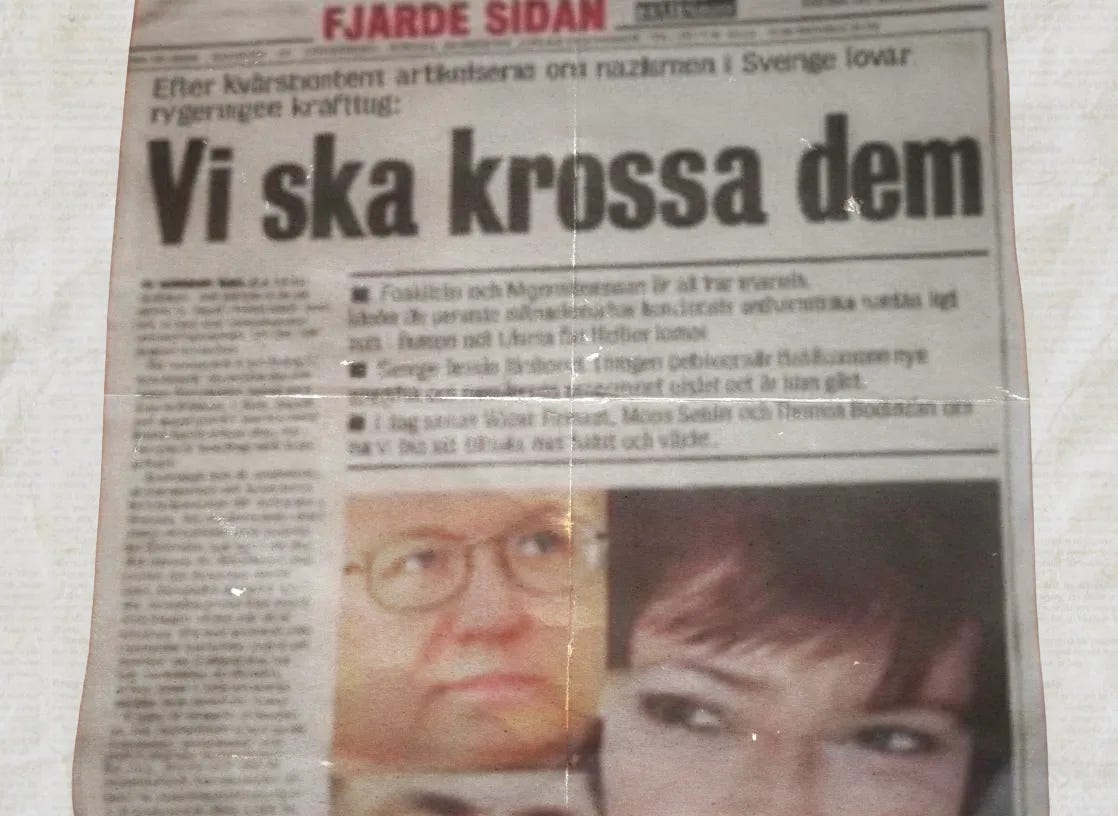
When Göran Persson, Mona Sahlin, and Thomas Bodström in the autumn of 2000 wrote1 that “we will crush them,” the direction was already set. Two months later, Daniel Wretström was murdered2. Hate had already taken root. But now it was open season to attack us.
Here we need to pause.
What should we have done?
I am waiting for the answer.
-
Let me be self-critical. I have no problem with that. Our movement did not make things easier for itself. We lost ourselves somewhere along the way. When I enter it, it is 20-year-old skinheads who are my role models. Later I am drawn to more explicitly revolutionary environments in Sweden. And we do become destructive.
I go further than many others. The symbols are to be tattooed into the skin. I stay. I become one of those pushing things forward. I believe in what I say, write, and shout. From the time I am an adult, I am prepared to take responsibility for everything—for the ideas I put forward, for driving my own radicalization further. It knows no limits. I see the state, society, and the establishment as enemies. I will not compromise. Everything is directed at the opponent. Harder. More uncompromising. More violent.
During the most extreme years, I also understand the reaction. The police monitor. Authorities act. Laws are tightened. People become afraid. And that is not unfounded. We are perceived as dangerous because in many cases we are. I take responsibility for that.
At the same time, I see something else. For me, and for many like me, the development was inevitable. When you are not allowed to speak, when you are excluded and humiliated, two paths remain: to retreat or to strike back. Many retreated. I did not.
And for those of us who went all the way, there was no way back.
At the same time, people from the most extreme left could—and still can—move into the center of society. Birgitta Dahl is one example from politics. Showan Shattak from more recent times. In media there is Robert Aschberg and Mathias Wåg. In academia I can mention Tobias Hübinette. They have not had to reckon with anything. They have not been pressured to explain themselves. On the contrary, some of them still stand with one foot in the extreme.3
And to this day violence remains an accepted element on the left.
It has been 36 years since I was twelve and wanted to “keep Sweden Swedish.” At fourteen I argued with teachers and said that Sweden would become what is now reality. I was labeled a “Nazi” and a “racist.” More than fifteen years ago, I left the Swedish Resistance Movement and the ideology behind it.
At that time, I wrote that I wanted to find a Swedish nationalism for the 21st century. That “keep Sweden Swedish” was too late to pursue in the form it once took. I have not seen myself as a National Socialist for fifteen years. At the same time, I have not spent energy correcting those who continue to place the same labels on me.
I listen in amazement as my thoughts and positions are now voiced in public. But not by me, because I am still labeled, still a pariah.
Time has caught up. The concept of anti-Swedish hostility is used openly. The consequences of mass immigration are visible. Even repatriation is discussed. And population replacement. More people understand that being Swedish is more than a citizenship. Parallel structures are growing. Islam is gaining more space. The defense needed strengthening, and the threat from Russia became real. When I helped organize Swedish volunteers to Ukraine during Maidan, the media described them as “white jihadists.”
Politicians and columnists who once fueled the campaign against us have changed their positions. But they still do not let us in—the ones who stood firm when it cost something. The label remains. “Nazis.” “Racists.” “Extremists.”
My question remains.
What should we have done under those circumstances?
Stayed silent?
Been respectable?
Gotten involved—where?
Done as you perhaps did? Gone with the flow. Woken up late. And if we had—whose backs would you then have stood on when it became safe to say what was said thirty, forty, fifty years ago? What we paid the price for?
And who among you today is willing to speak with us?
Is there anyone willing—brave enough—to come to terms with this history?
Göran Persson, Mona Sahlin, and Thomas Bodström were leading Swedish Social Democratic politicians around the year 2000. Persson served as Prime Minister (1996–2006), Sahlin was a senior cabinet minister and later party leader, and Bodström was Minister for Justice (2000–2006). All three were prominent figures in shaping Sweden’s political response to extremism during that period.
Daniel Wretström was a 16-year-old Swedish youth who was killed in 2000 after being assaulted by a group of young men of immigrant background in Salem, outside Stockholm. His death later became a rallying point for parts of the Swedish far-right, particularly in the annual “Salem marches,” and was widely debated in Swedish media and politics.
Birgitta Dahl is a former Swedish Social Democratic politician who, in her youth, was associated with Maoist circles during the radical left movements of the 1960s and 1970s, and later served as Speaker of Parliament. Showan Shattak is a Swedish activist linked to violent anti-fascist movements. Robert Aschberg is a prominent Swedish media figure who in his youth was involved in far-left activism, including participation in revolutionary groups. Mathias Wåg is a journalist and researcher associated with Antifa both in Sweden and internationl. Tobias Hübinette is a Swedish academic and writer who has written extensively on race and identity and has a past in violent radical left activism. Several of these individuals have been connected to movements where violent methods have been part of the broader political context, while later becoming integrated into mainstream Swedish society.
No posts
Comments
Nothing yet. Say the first thing.
Sign in to join the conversation.