
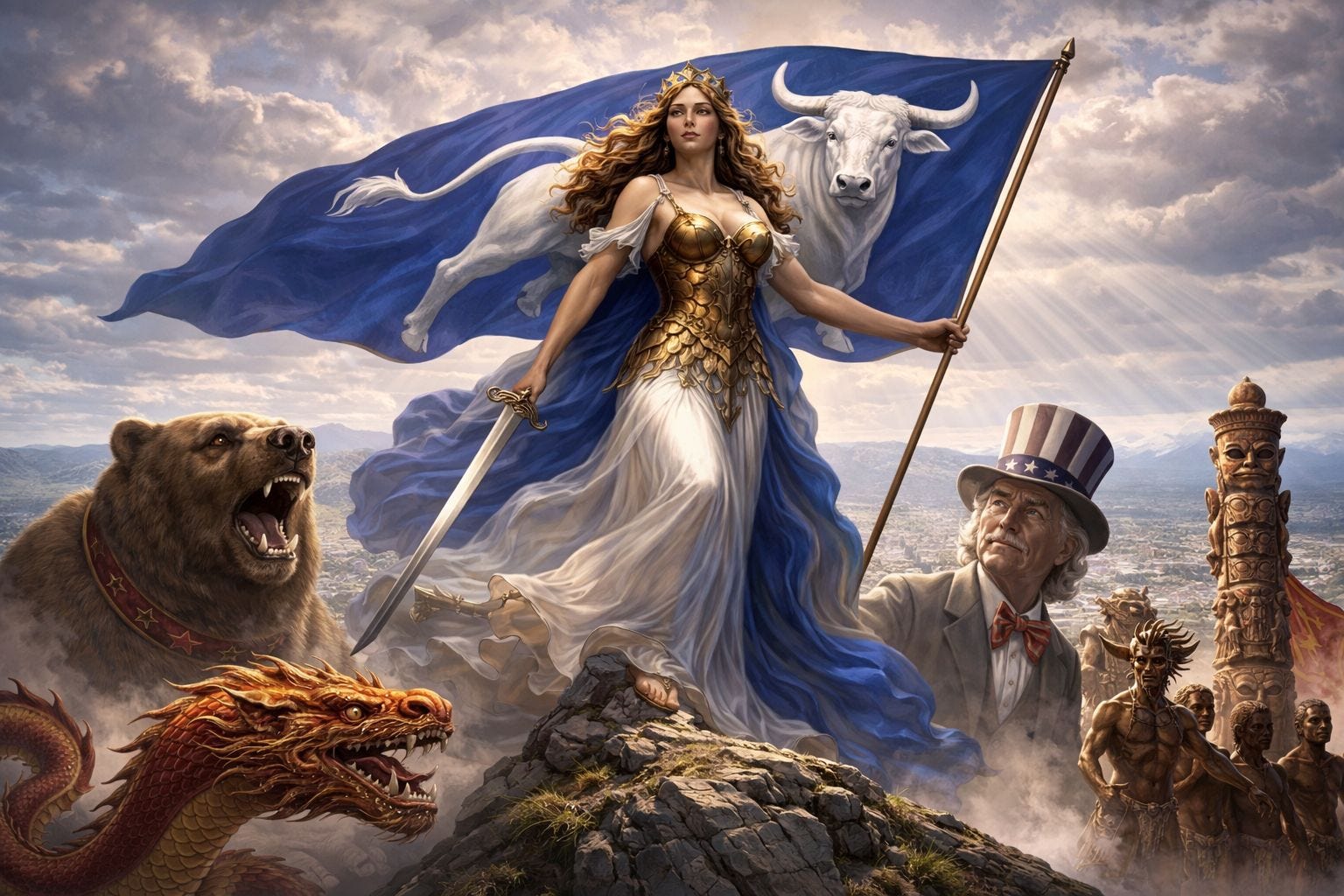
Europe faces a choice that has been postponed for far too long. This is not about a technical path or choosing between different political programs. The question is whether Europe should continue to be a project—or once again become a civilization.
For decades, the continent has been able to avoid that very question. As long as the United States has carried the ultimate security burden, Europe has had the space to define itself as something administered, regulated, and fundamentally demilitarized. Politics has been reduced to procedures, compromises, and a certain comfort in which the most difficult questions never truly had to be asked.
That time is now coming to an end.
It is not even necessary for a U.S. withdrawal from NATO to actually take place—something Donald Trump has repeatedly said will happen. It is enough that the intention exists, that uncertainty is present. That alone fundamentally changes Europe’s conditions.
Suddenly, it is no longer possible to postpone the decisive question: what is Europe when it can no longer lean on someone else?
The answer does not lie in trying to force a unified state into existence. That path is not only unrealistic but also misguided. Europe is not a single nation. It is a civilization—and civilizations do not function by erasing their internal differences, but by organizing them.
From that insight, a more mature Europe can begin to take shape. We are not seeking a single center, but several natural ones that cooperate. Such a Europe rests on different pillars—each with its own function, focus, and responsibility.
The first pillar is the Nordic-Baltic one. Sweden, Finland, Norway, Iceland, Denmark (including Greenland), and the Baltic states together form a coherent strategic space.
Here lies control of the Baltic Sea, proximity to the Arctic, and access to the North Atlantic. There is also a high level of technological development, strong societies, and an unusually clear understanding of what is at stake.
This is Europe’s northern shield.
If the region is bound together politically and militarily, it ceases to be peripheral. Instead, it emerges as one of Europe’s most cohesive and capable areas—united by both geography and experience.
The second pillar is Central Europe, with Germany, Poland, and their immediate surroundings.
Here lies Europe’s industrial and logistical center of gravity. Production capacity, transport networks, and population mass are concentrated in this area. This is where Europe’s material power is gathered.
This is Europe’s body.
The relationship between Germany and Poland carries historical tensions, but in practice is bound together by a shared geopolitical reality. They share the same space, the same dependence on stability, and the same need to hold Europe’s center together. Friction exists—but no reasonable path leads to conflict.
The third pillar is France.
France holds a unique position in Europe. It possesses nuclear weapons, an unbroken military tradition, and a habit of thinking in terms of power, reach, and strategic action beyond its own continent.
This is Europe’s will.
France is not merely one state among others, but the actor that most clearly still understands what it means to formulate and defend interests in a world where such things are decisive.
Italy is not a peripheral state. It is an axis. Historically, power in Europe has never stopped at the Alps or at the northern shores of the Mediterranean. The Roman Empire was not a European project in the modern sense, but a Mediterranean empire that connected southern Europe and North Africa into a shared strategic space.
If Europe is to once again become a real actor, it must also relearn how to think in these terms. The sea is not a boundary. It is a route. The Mediterranean does not separate Europe from Africa—it connects them. This means that Europe’s natural extension does not end at the coastline but continues across the water. It includes, in one way or another, North Africa as a strategic neighborhood.
This is not about nostalgic imperial dreams, but about realism.
Control over migration flows, energy routes, and security zones requires presence, influence, and the ability to set conditions on the other side of the sea. A Europe that limits its thinking to its own shoreline will not be able to maintain that control. Here, Italy, Spain and France converge as the core southern actors, spanning both the central and western Mediterranean and giving Europe strategic depth across the entire basin.
Thus emerges the fourth pillar. It links Southern Europe with North Africa—not as a cultural extension of Europe, but as an area where Europe must be present in order to remain itself. This is Europe’s southern dimension.
This is not a Europe that competes with itself. It is a Europe that distributes responsibility.
A northern shield.
A central body.
A western will.
A southern reach.
It is a Europe that does not see its different countries as rivals, but as functions that uphold an entire civilization.
For this to become reality, something long absent is required: an acceptance of hierarchy.
Not all countries are equally important in all matters. Not all regions carry the same responsibility in every situation. The Nordic and Baltic countries bear greater responsibility in matters concerning the Baltic Sea and Russia. France in matters concerning nuclear weapons and the Mediterranean. Germany in matters concerning industry and logistics. And so on. This is not unfair. It is necessary. It is also reasonable if we raise our perspective to the civilizational level.
A shift is also required—from rules to interests. Europe has long tried to replace power with norms. That does not hold in the long run. Cooperation does not arise from goodwill alone, but from clear interests that meet and balance one another.
A question arises: where does the United Kingdom fit into this picture? The answer is not that it lacks importance—on the contrary. The United Kingdom remains one of Europe’s strongest military and strategic actors. But its position is different.
For a long time, the United Kingdom has chosen to stand with one foot outside the European project. Brexit made it formal, but the direction existed long before. Its strategic center of gravity has consistently been across the Atlantic, in its close relationship with the United States. This is not a temporary choice, but a pattern.
Today, the United Kingdom largely acts as part of an Anglosphere rather than as an integrated part of a European whole. It cooperates with Europe when interests align—not as a central pillar of a shared structure.
This means that, in this model, the United Kingdom does not constitute a pillar of its own. It does not lack capacity, but its strategic orientation points in a different direction. That does not mean the United Kingdom stands outside Europe’s future. But it does mean that Europe’s future cannot be built with the United Kingdom as its foundation.
A Europe that knows what it is also knows what it wants. The transformation does not occur the day the United States leaves or NATO changes. It happens when Europe stops asking what others will do—and begins to define its own direction.
Such a Europe will not be perfect. It will not be free of conflict in every periphery or in every individual issue. But it will become something that has long been missing: self-sustaining.
And that is where everything begins.

No posts
Comments
Nothing yet. Say the first thing.
Sign in to join the conversation.