
This is a newsletter of Faces of Digital Health - a podcast that explores the diversity of healthcare systems and healthcare innovation worldwide. Interviews with policymakers, entrepreneurs, and clinicians provide the listeners with insights into market specifics, go-to-market strategies, barriers to success, characteristics of different healthcare systems, challenges of healthcare systems, and access to healthcare. Find out more on the website, tune in on Spotify or iTunes.
There is no shortage of challenges with healthcare AI:
Out of 38 OECD - OCDE countries, only 7 have a formal AI strategy. Furthermore, only 11% have workforce upskilling programs, and 9 conduct Health Technology Assessments (HTA) on AI, with 8 in the process of updating their Health Technology Assessment (HTA) frameworks to evaluate AI’s clinical relevance, cost-effectiveness, transparency, and long-term safety, according to the 2026 Scaling AI in Health OECD Report.
No internationally comparable indicators exist for AI deployment in health systems.
Off-the-record, we hear that not just patients, but clinicians sometimes add identifiable personal information in general large language models,
Policymakers are struggling to create regulation at the pace of innovation, which has accelerated significantly with AI: in the healthtech space, the risk-benefit discourse is benefit-skewed.
Healthcare providers feel frustrated by patients using AI, asking more questions or taking insights it gives them as the sole truth.
At the same time, which is what I am exploring through the Agentic Patient series, patients don’t necessarily trust AI, but are definitely excited by it, because it can fill the gaps between visits, care coordination and more.
In 2025 The European Patients’ Forum ran a European survey on patient attitudes toward AI in healthcare, translated into multiple languages, with nearly 1,000 responses. The headline finding is that patient enthusiasm is high: 98% responded positively about AI’s potential.
The dominant concern is bias and the possibility that AI-driven decisions could be wrong.
Patients want direct communication from healthcare professionals about AI’s role in their care, and where appropriate, AI-specific consent forms.
While I disagree, that doctors should be the primary point of information about AI for patients, it is true that patients are most likely to talk about AI in the consultation room, leading to an actionable takeaway for AI deployers and health systems: the patient trust problem is solved less by communication campaigns and more by getting clinicians equipped to talk about AI specifically, in patient-appropriate language.
Another aspect not discussed enough, is the impact AI has on youth. As a mother of a young child, I an increasingly finding myself thinking how most adults seem largely unaware that technology is shaping the youngest generations in ways that are fundamentally different from how it has shaped adults.
At HIMSS Europe, Tara Steele, Director, Safe AI for Children Alliance and Marc D. Ritter, CEO of AWE Wellness, emphasized that children are vulnerable to AI systems and AI companions, and can form emotional attachments to them very quickly.
US social psychologist Jonathan Haidt, started a movement that calls for changes in how children use technology and experience childhood. As he explores in his book The Anxious Generation, the rapid shift from a play-based childhood to a phone-based childhood has contributed significantly to rising rates of anxiety, depression, and other mental health challenges among young people.
However, it seem like we are not paying enough attention to this, especially when it comes to policy.
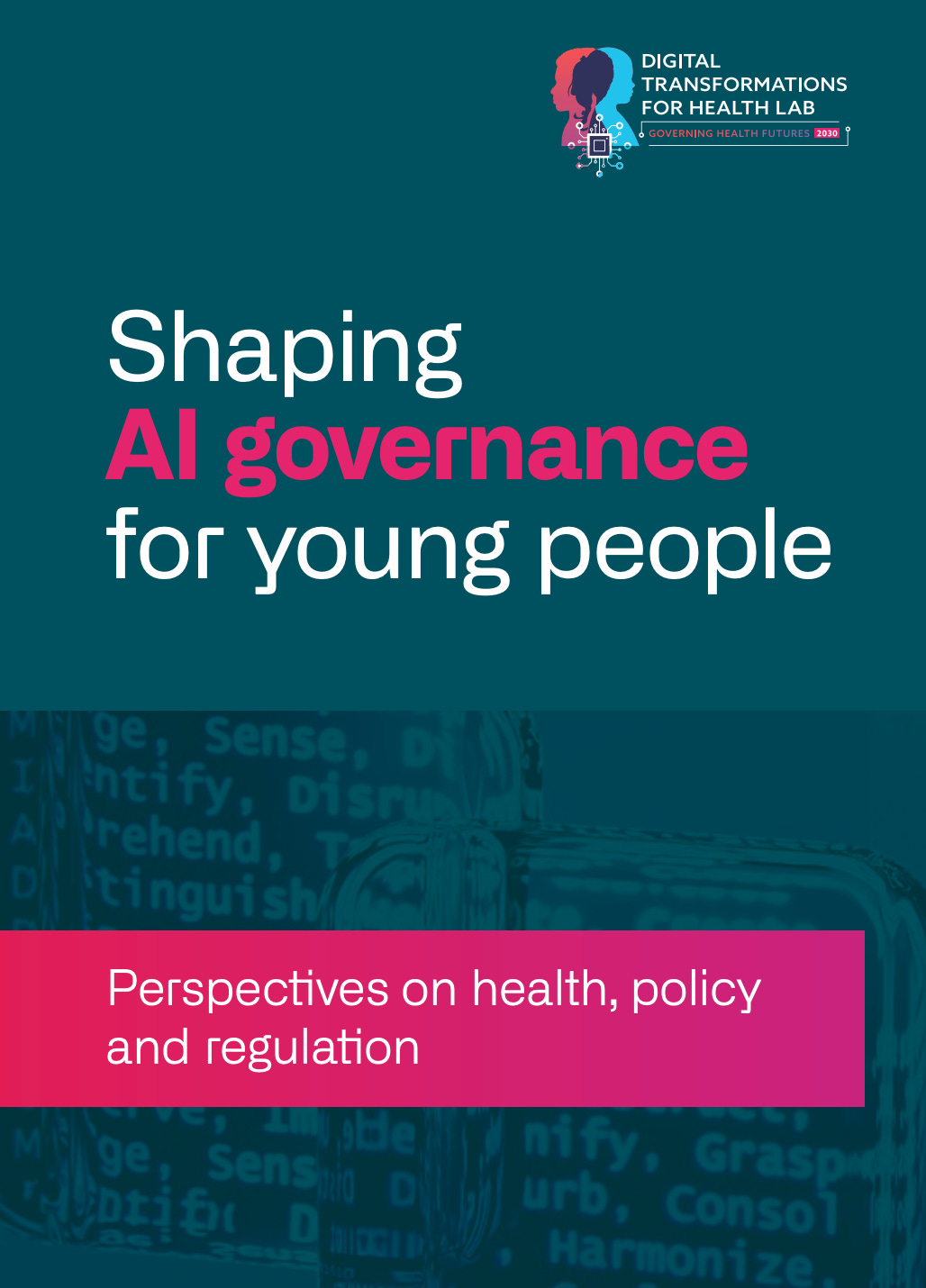
Digital Transformations for Health Lab has been tracking for over a decade how national digital health strategies treat young people. The pattern is stubbornly consistent, says Aferdita Bytyqi, Executive Director and Founding Partner of DTH Lab. Ten years ago, youth health and wellbeing was largely absent from national digital health strategies; today, looking at AI governance frameworks, she sees the same omission reproduced. When young people appear at all, it is through the lens of skills, education, or innovation — a future workforce to be trained — rather than as current users whose health and development are already being shaped by these systems (Read more in the report Shaping AI Governance for Young People).
Aferdita’s most direct argument why this needs to change is numerical: in many lower- and middle-income countries, 50–60% of the population is under 35. Designing AI frameworks without them is not a moral question; it is a sample-size problem.
HealthAI - The Global Agency for Responsible AI in health recently published a paper on translating the EU AI Act in action. Five recommendations include:
Countries need to optimize AI supervision - Countries have horizontal AI supervision (under an AI authority) and vertical AI supervision (within the health sector). We should explore joint mock exercises across governmental institutions to stress-test the coordination before real deployments expose the gaps.
EU should address regulatory barriers and cross-nation reimbursement Health technology assessment and reimbursement pathways are still configured for a different category of product. Until that is fixed, AI scales for whoever can afford the regulatory entry cost — which is not most builders.
We need clarity on the interplay between EHDS, MDR and EU AI Act The AI Act, MDR, and European Health Data Space all touch AI in health, but the different director generals within the Commission need to be coordinating internally, and lessons learned at member-state level need to flow back into framework design.
Let's formalize knowledge exchange instead of duplicate efforts
To scale we need multi-stakeholder engagement beyond borders - civil society and patient organizations need to be active actors in the legislative and deployment process — not tokens at the consultation stage.
AI is here to stay. As with any innovation, unwanted side effects occur, and it takes time to mitigate them. As Ilona Kickbuch mentioned at the Responsible Scale of AI in Health conference in Madrid, referring to the tobacco/lead/social-media analogy, “accountability historically arrives via litigation rather than foresight.”
Warnings are lining up. Society for Digital Mental Health cautions that general AI models are optimized for conversational fluency and engagement, not designed for clinical accuracy or patient safety. We need more purpose-built mental health AI developed using domain-specific clinical data, built with clinical expertise and safety-oriented design, clear boundaries around appropriate use, crisis detection and escalation protocols.
Personally, I am hopeful that the lessons learned from the harmful impacts of algorithms and social media will help us respond faster and more effectively to the challenges posed by AI, for a broader predominantly positive impact.
Recorded live at health.tech in Basel, this panel unpacks the convergence reshaping clinical software: ambient AI scribes, agentic AI in healthcare, on-device LLMs, and the regulatory drag (MDR, EU AI Act, EHDS) that is widening the gap between what clinicians actually use and what hospitals are allowed to buy.
Host Tjaša Zajc is joined byJhonatan Bringas — CEO & Founder, Lapsi Health (Kaiku: FDA-cleared AI stethoscope, ambient scribe and clinical assistant in one device), Blaž Triglav — CEO, Mediately (drug information platform, 1M+ HCPs across Europe), Amanda Herbrand — Clinical data modelling consultant, formerly University Hospital Basel.
The conversation covers:
Why EHR data fragmentation is the precondition AI hasn’t solved
Shadow AI: why clinicians trust ChatGPT more than enterprise tools (and the agency hypothesis behind it)
The asymmetry that will break European medtech: applicants using AI to build, regulators forbidden from using AI to assess
On-device AI, ambient computing, AGI in clinical workflows — and the de-skilling risk no one wants to discuss
No posts
Comments
Nothing yet. Say the first thing.
Sign in to join the conversation.