
I come from a long line of patriotic Virginians, who will not let you forget how many of the Founding Fathers hailed from their state. My mom’s side has a tradition of reading the Declaration of Independence on the 4th of July.
I host an annual BBQ that begins with this reading and it’s clear that many of my guests are uncomfortable with the idea. The disproportionately left wing and highly educated people (right now, same group because of education polarization) that I hang out with are very unpatriotic.
But my experience is that they leave surprised at how short, accessible, and relevant it still is.
One reason that I think I differ from them is that I try to take a much broader, global view of America and compare it to the appropriate peers. And when I do so, I come away feeling pretty good!
Before I get to that, some data. It doesn’t seem like the anti-patriotism among my cohort isn’t getting better:
Some of these lowest numbers came from Democrats while they were in power! They were higher even when Trump was in power the first time! What’s going on here?
This all bums me out because it’s not how it’s always been. Progressives have usually appealed to a broader sense of optimism and passion for America. Think of James Baldwin’s famous quote: “I love America more than any other country in the world and, exactly for this reason, I insist on the right to criticize her perpetually.”
When Langston Hughes criticized his country he wrote “Let America Be America Again,” not “America Has Always Sucked, So Let’s Scrap It.”
Being anti-patriotic is a bad brand and it’s uninspiring. It makes progressive culture alienating to normal people. It makes it alienating to me. I wrote a bit more here about Richard Rorty and his vision of a positive, patriotic left.
But “you should be patriotic because it’s instrumentally useful and it’s good politics” is probably not going to be enough for highly educated people. So let’s try to think about it a bit more rationally.
A lot of the negativity about America comes from making unrealistic comparisons that are apples to oranges.
People love to compare the whole United States with a small European nation like Denmark, or to some idyllic European city they visit like Paris or Berlin. But that’s ridiculous!
It’s probably more accurate to compare the entirety of Europe with America. The EU has around 440 million people in it, the US has around 330 million people in it. Much more reasonable comparison than trying to compare the US and Denmark, which has around 6 million people living in it.
The question is: what is America’s appropriate reference class? What group does it belong in? What are the realistic expectations that follow?
Zooming out, two groupings feel salient to me:
Large, populous, multiethnic democracies
Countries in the Western Hemisphere
Let’s start with the first category. I went and pulled a list of all the countries in the world with populations over 100,000 people. Less than 10% meet this description and the only European country on the list is Russia:
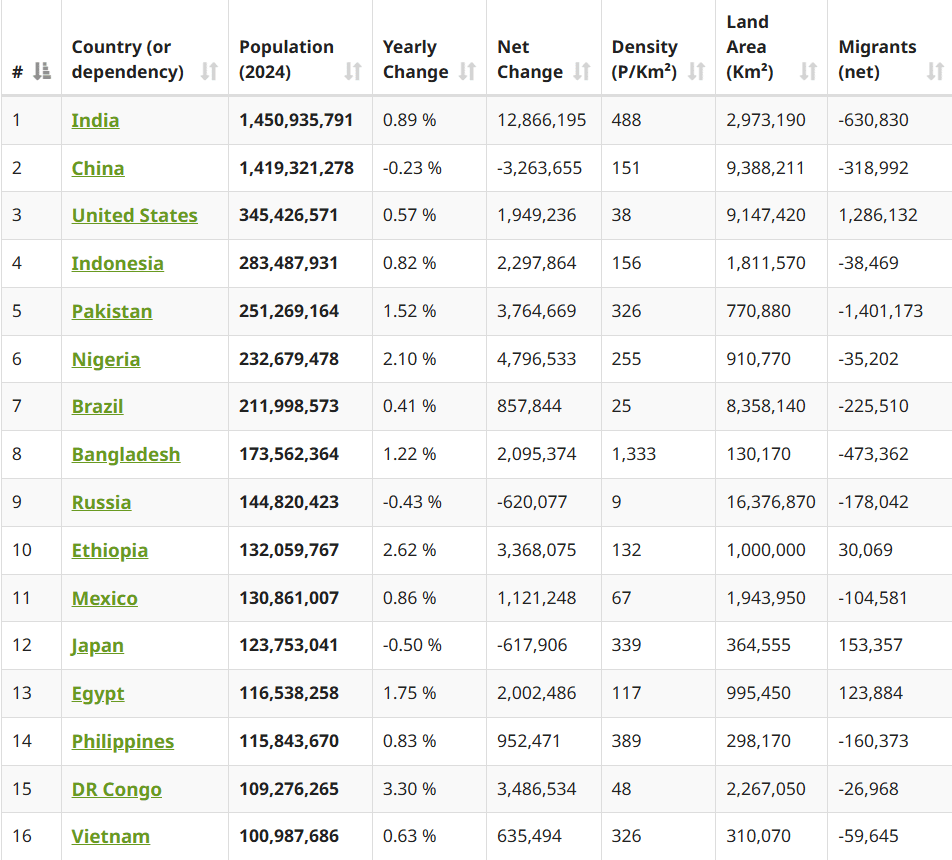
My takeaway from this list is: being a large and populous country is hard! Being a democracy is even harder! Being a diverse, multiethnic country is hard! Being all three? Woof.
Who even meets all three of those criteria? Not a lot. Strongest contenders are India, Indonesia, and Brazil. Maybe Bangladesh?
Pakistan, Nigeria, and Mexico come close, but struggle to actually govern all of their own territory. Many here are not democracies and/or work to actively suppress diversity, such as the Uyghurs in China.
India has almost five times our population. In some ways, it’s the reverse of the US-Denmark problem – the state of Uttar Pradesh alone has 241M people in it. Perhaps the US should be compared to clusters of Indian states or regions, rather than the whole country. This is, in fact, how investors talk about India, as being essentially three countries in one.
To return to the question of our peers. I’ll settle on Indonesia, Brazil, and Mexico as our best comparison points there.
The last two gives us a nice segue into America’s other best reference class: the Americas.
Latin America, which makes up most of the Americas, is also the region with the most inequality in the world. Violence, one of the United States’ big issues relative to Europe, looks a lot more normal in the context of “New World violence.” A recent article by Lisa Miller, “Lethal Violence and the Americas: Beyond the U.S.-European Comparisons on Crime and Punishment,” makes the same argument in an academic context.
Both relevant facts when discussing the United States.
Personally, I think a lot becomes clear the second you look at the list of the 16 most populous countries. But let’s actually be data-driven here and compare across some issues: democratic stability, violence, inequality, and prosperity. I’ll also throw Russia and Germany in there for reference, as those are the two most populous European countries, one in the EU and one not.
Claude helped me pull the numbers into this nice table:
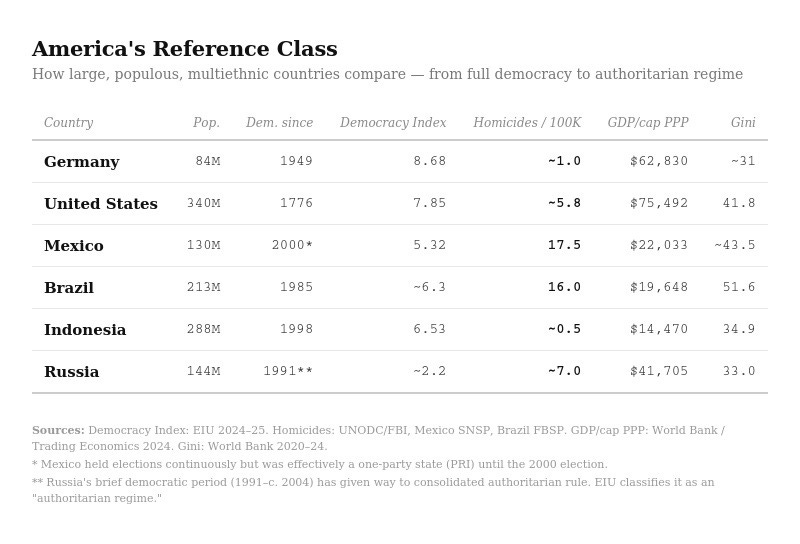
A few things stand out. One, the US has a lot of people, with a population of Brazil and Mexico put together. Or Russia plus two Germanys.
It is much more violent than Germany and Indonesia, but much less violent than Mexico and Brazil. I was surprised that Russia was more violent than the US, as lower violent crime is sometimes a benefit of authoritarian regimes (something I observed firsthand in Cuba in 2018).
The US does indeed have high inequality, on par with Mexico. But it’s also much much richer than anyone else on the list, besides Germany.1
The US has an unparalleled run of 250 years of democracy and looks solid on its Democracy Index. But democratic backsliding is real and not limited to the US. Indonesia’s democracy is less than 30 years old and, while I’m no expert, it seems like they are already dealing with rising authoritarianism and that 2024 Democracy Index rating would likely be lower today.
Brazil had its own January 6 moment on January 8, 2023. As I’ve written here, our politics is coming to more closely resemble that of Latin America: strongmen, misinformation, polarization, massive pendulum swings election-to-election.
This is unquestionably bad, but also probably still places America as “very democratic” in the grand scheme of history and the world writ large, which still features many authoritarian regimes. Frankly, it also feels like America is reverting to the mean and increasingly resembling its own chaotic 19th century.
As many European nations have shown, Germany included, democratic backsliding is also not an irreversible one-way trend. Perhaps, as Robert Putnam suggested in his book, we’re due for an Upswing.
It’s not crazy to look at America in comparison to other rich countries like Germany. But it’s not the whole picture, and I hope this sober comparison opens up some new ways of considering the American experiment.
My goal is to avoid American exceptionalism, which I think cuts both ways here in the patriotism conversation. That phrase, “American exceptionalism,” is usually brought up in response to patriotic cheerleaders. America’s harshest critics are exceptionalists, too, just in the opposite direction.
Being a large country, a populous country, a diverse country, and a democratic country are four separate challenges. Combining the four has almost no precedent around the world.
A lot of what seems most troubling about America makes a lot more sense when you accept that it is wrestling with the same problems that plague its peer countries, be they American nations or large, diverse democracies.
Here’s to another 250 years of muddling through!
No posts
Comments
Nothing yet. Say the first thing.
Sign in to join the conversation.