
Regular readers know that I’ve been grappling a lot with current efforts to reform America’s political institutions. To borrow a framing from Francis Fukuyama, we spend too much time debating the size and quantity of government, not enough on the quality of government.
The one time in American history when we made major strides on the quality of government is the Progressive Era, the period after the Gilded Age when we built the modern national government. One of the most illuminating books that I’ve read about the era is Stephen Skowronek’s Building A New American State, which I wrote about here and here.
Skowronek is one of our foremost scholars on the ways that America has continually reinvented its political institutions to meet the challenges of the day. His latest book, The Adaptability Paradox, takes stock of the present moment and it’s quite dark.
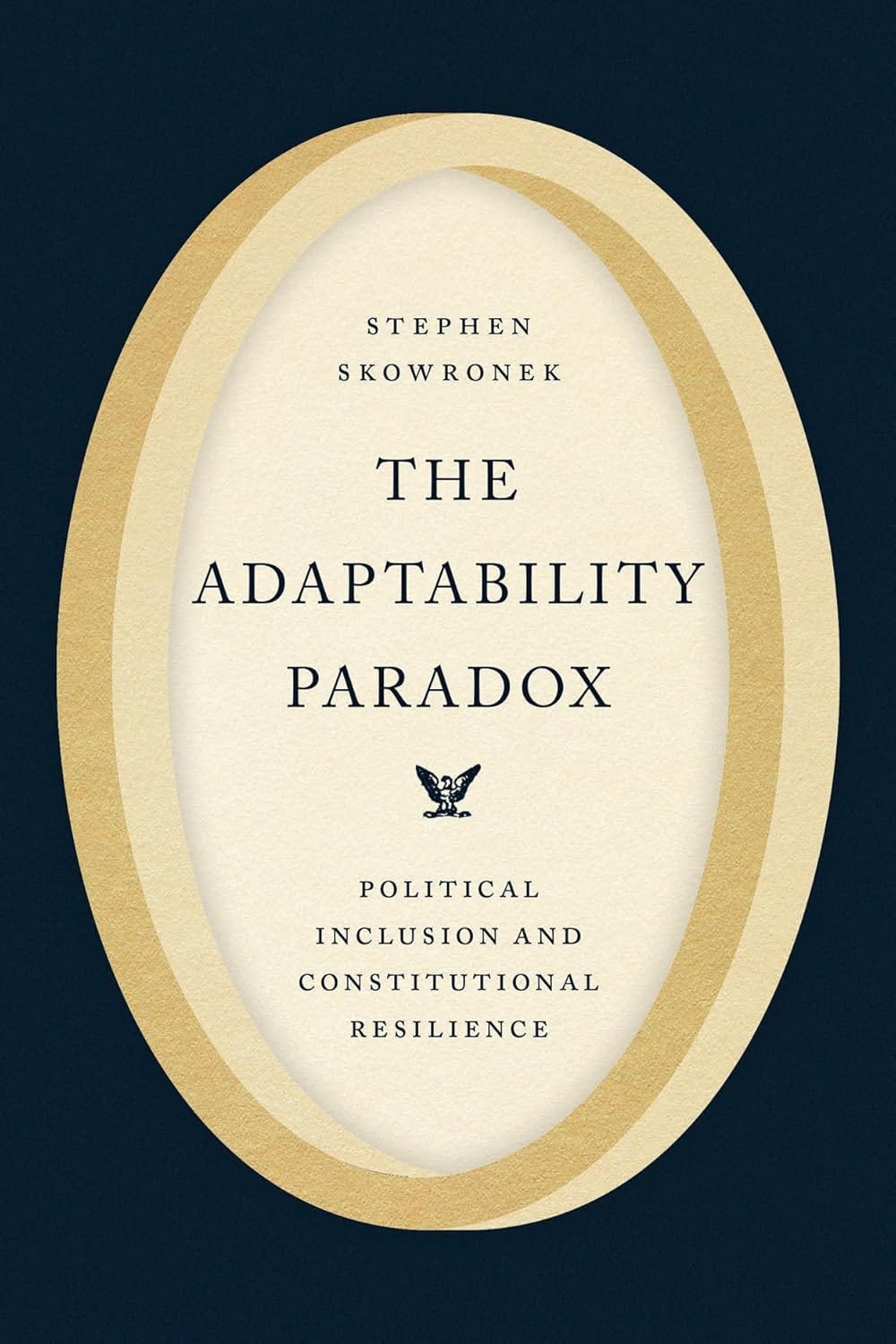
The book argues that these previous reinventions and adaptations always depended on social exclusion to arrive at common ground. Since the Rights Revolution of the 1960s and 70s, we’ve actually created a fully inclusive democracy, but it may have eroded the common ground needed to adapt our institutions to address contemporary challenges.
Professor Skowronek was gracious enough to make some time to answer my questions about these two books and about contemporary reform efforts.
As a last bit of housekeeping, I thoroughly enjoyed Jack Balkin’s recent symposium he hosted about the book on his blog, which we both reference a few times during the interview.
Ben: I’m struck, given the topic of your most recent book, that your first one, Building a New American State, also ends with a suggestion that we might need to move beyond our Constitution. It’s the very last paragraph of the book.1 And so I’m curious — obviously The Adaptability Paradox lands on a sharper version of that kind of question. What were the light-bulb moments for you between that initial suggestion and the work that you’re writing now?
Skowronek: I’m sorry, what happened to change my mind? I don’t think I’ve changed my mind. There’s sort of an exhaustion that runs through all of my writing, even about the presidency. On the one hand an attention to this remarkable history of renewal and a capacity to regenerate American government. I think that’s true in Building a New American State. It’s true in The Politics Presidents Make, and it’s true in The Adaptability Paradox.
But there’s a sense in which I’m looking to the past not only for clues as to how we were able to regenerate politics in the past, but as to whether there’s anything different about this particular moment that might lead us to think that that regenerative capacity is not what it once was.
Ben: Thinking about that capacity in your work on the Progressive Era — you sort of divide it in two. There’s this Patchwork era of reform where the problems exist, there’s social pressure to address them from the bottom up, but the political system, especially at the federal level, is not well suited to address them. And then there’s this era of Reform where a bunch of stuff happens and this pent-up demand is addressed.
I came away thinking that we’re in a Patchwork era today, where partisan competition is too tight to let inter-branch reform take over. Your diagnosis in your more recent book is almost a little deeper. It sort of suggests that even if Republicans or Democrats ran the table for 20 years, we wouldn’t see a pivot toward inter-branch conflict.
So I guess I’ve been stuck on that one-party-rule idea as one of the things that got us out of it in the Progressive Era. And I’m curious, how important do you think that one-party-rule concept is? And how much do you think applies today?
Skowronek: Well, I agree with you. The clearest analog to politics in the last 20 years is politics in the late 19th century, when there was no dominant party. The parties rotated in and out of national power every two years. There was a lot of pent-up demand for reform. So I agree that this is a moment like that.
When I said that, I didn’t think that a solution is for one of the parties to run the table and take control of the government. I was thinking about American politics since 2008, right? So we had supposedly the Obama breakthrough, right? And that lasted about two years. And then in 2016, we had a Trump breakthrough, and that lasted about two years. And then in 2024 we had another Trump breakthrough. You might say we even had a Biden breakthrough in 2020 that lasted probably less than two years.
And now, I just don’t see that the solution is for one of these parties to take control. That’s not the solution. The solution has to be in building some kind of larger consensus about what the purposes of the government are, which I think we’ve completely lost.
Ben: In your second response to the Balkinization symposium you mention Civic Constitutionalism. Is that what you mean?
Skowronek: Well, of the ideas that are out there, that strikes me as the closest to something — people who are thinking that it’s got to be more than just a partisan victory. There’s got to be some groundwork. I mean, you could call it social capital, or you could even call it what the Progressives had. The last time we had a movement for good government — but in order to have a movement for good government, you have to know what the government’s supposed to be doing, right?
And how do you generate a common sense of that? I think that is really where you have to begin now, because right now it is just a matter of one party taking control and screwing the other party.
Ben: As somebody who has seen nonprofit funding in that civic-dialogue and reconstruction kind of space, I’ll admit it’s hard sometimes to tell what’s a nice academic seminar idea and what’s something that’s really got some teeth. I’m curious if there’s any work that you’re seeing out there in that cultural, deeper vein you’re talking about, that inspires you or that you think is promising.
Skowronek: Well, I wish I could say that I did. I mean, it may be that I’m just not looking hard enough, just not aware of all that’s going on out there. But I haven’t seen much. I certainly haven’t seen that dialogue penetrate into the public sphere.
Ben: Let me sort of go back and think about something from Adaptability Paradox, which is — you talk a lot about how some of these political reorderings come when a new social class emerges with new skills.
So you talk about that some with Van Buren, you talk about that some with the universities. I’ve been thinking a lot about the “rise of the professions” in the Progressive Era. In a way, there’s a similar thing going on with your narrative about the Federalist Society and originalism and the way they worked the legal world.
And it seems like, the Rights Revolution did not do that. There was some collective ambivalence about the state, which tracks with some of the stuff I’ve read from Marc Dunkelman and others.
I’m curious — again, we’re talking about sort of reform efforts today — there is sort of an emerging centrist community of people that I think, in the best-case scenario, would be seen as “Neo-Progressives.” How do you read this current moment in the policy world? What skill sets do you think are needed for them to be successful?
Skowronek: Yeah. Well, I’m glad you picked up on that, because this is a piece of the book that few people have picked up on, which is that these major reorderings have come from new social classes: the rise of the entrepreneurial class in the 1830s, the rise of a professional class in the turn of the 20th century, which built the administrative state.
I think — and I looked, I mean, the last chapter of that book looks around and says, well, do we have any analogues to that? And I look at the so-called new class that arose during the 1960s and 70s, and I look at the legal-conservative movement.
What distinguishes those from the earlier reconstructive common carriers of a new governmental vision is that they’re from the same class — they’re just factions of university-trained professionals that are fighting. They have the same basic skills. They come from the same basic institutions, the same basic training.
So what I see is a kind of fragmentation of the professional class, a polarization of the professional class that mirrors the polarization of the political class.
Ironically, I think if you’re looking for a new class, a new social movement that has a different vision of governance, I think it is probably the revanchist Trumpers who are taking aim at the professional class. They’re quite uncomfortable with the Federalist Society as well, and they certainly have no use for the new class. And that’s pretty scary to me because they don’t have much stake in constitutional government at all.
So that’s the scariest thing to me — that the broadside critique of the administrative state is coming from those who don’t have a stake in re-envisioning constitutional government.
Ben: There’s a populist movement, and that was also something that arose during the Progressive Era too — although there wasn’t an existing administrative state to attack yet.
Skowronek: Right. The Progressives absorbed the Populists.
Ben: Yeah, exactly. What do you think about the most recent generation of Silicon Valley wealth as an emerging class with sort of a different way of addressing problems and stuff like that? How do you think they fit into your description of the professional classes?
Skowronek: Interesting. Well, they seem to have made a pact with the populists as a kind of anti-government movement. To reference the previous historical eras, which may or may not be a guide, these earlier classes threw up elites who thought a lot about the Constitution.
They thought a lot about how they could make this Constitution work in a new period for new purposes. And I don’t see that in Silicon Valley. I don’t think they have much use for government. They don’t have a governmental vision.
So in that sense, that makes them potential allies to today’s populists. But as I said, I can’t tell you that I’m an expert on what Silicon Valley thinking is these days.
Ben: It strikes me that there’s some interesting discourse amongst some of those people, especially with a lot of new wealth being created by AI companies, about assuming more of a civic mantle.
[Note for readers: Alex Karp of Palantir is one of the main people pushing for this publicly. I’d direct readers to both Tanner Greer’s sympathetic but insightful takedown of Karp’s book from the Right, as well as another recent response from Niskanen Center’s Geoff Kabaservice. I take the recent viral piece by Nan Ransohoff about the upcoming “Third Wave of American Philanthropy” (from AI wealth) to be grappling with similar questions.]
It just strikes me that when you think about emerging social classes that have some sort of shared values — that it will be significant what happens there, one way or another.
Skowronek: What is their thinking about their civic consciousness?
Ben: I think there’s a number of people who are focused on state capacity from a technological perspective. The model that fits into my head, honestly, is that I think that information technology has broken our institutions in a similar way that the telegraph and the railroad did in the Progressive Era. There’s a similar speed-condensing of space and time that has happened that our institutions are not very well set up for.
So there’s a growing community of technologists who take the government’s role seriously and are trying to equip the government to be more responsive or have better tools for public engagement.
[Hat tip to this recent Patrick McKenzie interview with Luke Farrell, who talks about the US Digital Service. Here’s another recent Substack I’ve enjoyed talking about bridging the gap between technologists and policymakers.]
Audrey Tang’s work in Taiwan is a global case study that people cite. There’s Glen Weyl, who I think works at Microsoft currently, who’s working with Tang and exploring interesting participatory tools to give people more of a voice in government process but in less of a veto-heavy way than we tend to do with community participation today.
So there are people who think that way. But I think your impression is shared by many people and it’s revealing. This idea that tech elites have not always been seriously concerned with questions of governance in the past. I mean, with some exceptions — Bill Gates is ultimately a part of that as well, and the Gates Foundation is deeply concerned with institutions.
Skowronek: Look, what did the entrepreneurs in these previous reorderings or adaptations of constitutional government in the United States come up with? They invented new institutions. They invented institutions that could mediate conflicts in a new way, and institutions that were seen in some way to embody a public interest. And I just don’t see that.
If we’re going to gut the bureaucracy and hollow out the parties, what are the mediating institutions that are going to express a kind of common ground? And I don’t mean this in the sense that everybody’s going to agree. It’s that competition and contestation have to have some modicum of agreement on what the purposes are.
I think the most troubling thing in The Adaptability Paradox is that that agreement on what the common purposes are, previously, in earlier eras, was premised consistently on an agreement on who would be left out. And that leads to the question of, can we reconstitute constitutional government in the United States on the premise of full inclusion? Because that’s the one thing that was missing in all the previous reconstitutions.
Ben: Well, let me ask you a question that I think ties into that question of what the common ground is, but also something you were talking about earlier — about the movement for good government.
You mentioned in your Balkinization symposium response, you said: “Our commitment to a new state for a new democracy has yet to be coupled to a potent social movement.” And I am struck, when I read about the Progressives, what a deeply Christian and moral movement it was.
Ben: For example, I studied Joseph Folk, who was St. Louis prosecutor and then governor of Missouri. They called him “Holy Joe” because he had a broad politics of anti-vice and pro-morality, and he just saw corruption as the worst vice, basically.
I think that our current lack of a common shared moral language is related to your adaptability-paradox idea — but I’m curious, do you see a synthesis coming there? Do you see a moral language that can unite some of these emerging reform efforts?
I see rumblings of it with some of the AI backlash and the backlash to social media; some of the focus on protecting kids is similar to what was happening in the Progressive Era. I’m curious what you see happening now, and are there any lines or dots that could get connected?
Skowronek: Yeah, I wish I could be more helpful on this kind of stuff. I wrote the book because I wanted to point to what elites in previous eras saw and how they articulated it, to show that that doesn’t seem to be happening today, or we’re long overdue.
And the one thing that we haven’t done is to articulate a kind of common aspiration, a common set of goals. In fact, what I see is the dominant trend that continues to deepen — one wonders how deep it can go — which is drifting apart in basic conceptions of what America is all about.
Look, The Adaptability Paradox, it’s a disturbing book. If I had a solution, I would have written a more hopeful book. I didn’t write it because I don’t want people to think about what it might be, but I don’t know what it is, and I don’t see it out there — as Richard Nixon would say, bring us together.
I’m sorry I can’t be more responsive to this.
Ben: No, it’s okay. I think that is its own answer. I’m trying to figure out some of these answers too, so that’s why I’m asking.
Ben: So I have a wonkier question. The United States has, for lots of periods in its history, been a “Nation of Courts and Parties.: Parties are hollowed out right now. But there’s some interesting stuff happening with the courts.
I am trying to grapple with the Roberts Court’s role from this institutional lens. So I see something like trying to limit universal injunctions, and that immediately gets funneled into partisan framing, right? That’s like how the news functions.
But is the Roberts Court trying to put pressure back on Congress in a way that is actually constructive from an institutional lens, and not be a pressure-release valve for things Congress is abdicating responsibility for, which you can argue they’ve been doing in one form or another all the way back to the Progressive Era? Or am I being too generous?
Skowronek: Certainly that’s what the Roberts Court thinks it’s doing, or at least tells itself it’s doing — that it’s Congress’s faithful agent, and all Congress has to do is get its act together and state its purposes and the Court will govern accordingly.
But the Court’s not going to do it if they can’t figure out what Congress wants. Josh Chafetz calls this congressional gaslighting. It’s like there’s no effort on the Court to recognize how Congress operates and how Congress does try to make its purposes clear. And when Congress does use new and inventive tools, the court strikes it down as a violation of the separation of powers.
This fetishism for the separation of powers puts Congress in a box. Congress is the one branch that cannot abide a strict separation of powers. It depends on the other branches for some kind of cooperative and sympathetic interaction.
So in the 1970s, the last great era of Congressional creativity about government, they relied on the legislative veto. The Court said, “It’s unconstitutional, I can’t do this.” All right…
Think about the Consumer Financial Protection Bureau They came up with a kind of ingenious structure for that. One thing Congress can do is kind of construct agencies in new and inventive ways. And the Court says “you can’t do that, you’re in this box, can’t do that.”
And they’re about to strike down independent agencies. They’re about to strike down all the instruments that Congress uses to make clear how it wants to govern.
So it seems to me that the Court talks a good game — “Oh, we’re the faithful agents of Congress. All we need to know is exactly what their purposes are, and we’ll rule accordingly.” And then when Congress tries to organize a government as it sees fit, the Court says “you can’t do that.”
It’s a catch-22. You do need a sympathetic court, but I don’t think this is a sympathetic court.
Ben: I am always struck that history helps me remember that no problem is brand new. We’ve seen a lot of similar situations before.
There was a lot I learned from your book and others about Teddy Roosevelt. I think he was a sort of pathbreaking, norm-breaking figure that helps me read some of what’s happening today in a new light.
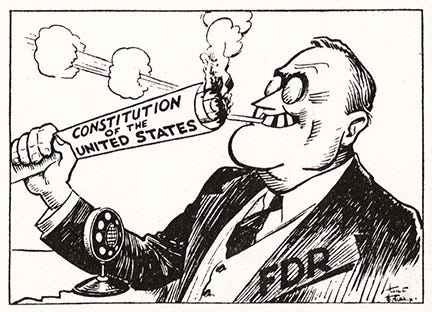
In your symposium response, you bring up FDR as… an aggressive pursuer of presidentialism, to put it diplomatically.
I’ve also personally been thinking a lot about Richard Nixon lately as a forebearer of our modern culture wars and a similar war on the administrative state.
I’m curious — you have so much deep knowledge about American history — is there anyone else outside of those figures that comes to mind for you when you try to process what’s happening today or the last 20 years?
Skowronek: Nixon is a good one. Most of our contemporary issues with governance relate back to what happened in the 1970s. And what happened in the 1970s is largely about how the government’s going to respond to the rights revolution and the inclusion of women and minorities,.
The inability to find a solution to that problem — and the sort of the progressively deepening problems that emerged from the 1970s, in terms of how we’re going to organize the government to accommodate this new democracy. This is where I think the problem is anchored.
Of course, everybody wants to point to Andrew Jackson, right? You point to Andrew. We used to say in Trump’s first term, right, he had pictures of Andrew Jackson all over the White House, that he was taking his cues from Jackson. I think it’s gone much farther than that now. It’s much deeper than that now.
There’s a kind of disregard for constitutional government that would make Jackson blush.
Ben: One of my big takeaways from your book is that Van Buren is an incredibly consequential figure that is not discussed enough. Is he America’s most overlooked influential political figure?
Skowronek: I mean, in my circles he’s not overlooked. But perhaps in popular lore.
I mean, his conception of a two-party system, and how a two-party system could hold the nation together and suppress the slavery issue — I think that’s one of the big architectural moments since the Constitution of reconfiguring institutional relationships: the invention of a competitive party system.
But, you know, Richard Hofstadter understood that in the 1950s. So I don’t know that it’s overlooked.
Since the Constitution there have been two moments of extraordinary institutional creativity. One is the Jackson era, which gave us party government, and the other is the Progressive Era, which gave us the administrative state.
I’m conspicuously passing over Civil War Reconstruction, because while that gave us three incredibly potent Constitutional amendments, it didn’t reorganize the government to give them effect.
So those are the two great moments. And we’re long overdue for another moment. I don’t see it, but maybe we’re in the midst of it. Maybe Trumpism is it. I don’t know. That would be very depressing.
Ben: Let me push you on that. Let’s say you’re Stephen Skowronek III, writing in the year 2126 about the great period of institutional renewal of the 2020s or the 2030s. What do you think — what’s a plausible way that goes? Be as optimistic or pessimistic as you want.
Skowronek: Well, I don’t know — but the easy answer would be, and the answer that I always hear and I think has some merit, is a kind of — I think Rogers Smith raised this in his response to The Adaptability Paradox in that symposium, where he talked about federation — not federalism so much as federation — as a way of allowing different communities to thrive perhaps without a central government imposing one particular view. Smith then extends this idea of federation to the world. He talks about world federation, kind of a Wilsonian idea.
Ben: It’s interesting how much I’m hearing about versions of federalism from both right and left, whereas I feel like it’s typically a right-coded concept. But I’ve heard it more from some national folks I know, doing work in DC on the left-wing side too, of just saying “we’ve got to have some proof points at the state level and make some of this stuff work to scale it up.”
Skowronek: I’m of two minds about that. So the Court’s abortion decision, overruling national-sanctioned abortion, throwing it back to the states. I think that that was effective in taking it off the national agenda. It’s not much of an issue right now.
But the downside of that is that there are some states where women don’t have the right and some states where women do. So I’m not sure that that’s — the problem with federalism, perhaps, as opposed to federation — the problem with federalism is that it accepts unequal rights. People have different rights in different places. And if you’re a democrat, a small-D, genuine democrat, that’s a hard pill to swallow.
“The magnitude of the governing problems at hand, the press of time, and popular outrage aimed at bureaucratic bungling may ultimately work to complete the Progressives break with the past. The search for control and direction may yet persuade us to move beyond our unwieldy Constitution. It hardly need be said that this path toward a regeneration of American government requires the utmost caution, lest in disgust with bureaucracy we stumble upon a sense of the state far more threatening than any we have yet known.”
No posts
Comments
Nothing yet. Say the first thing.
Sign in to join the conversation.