
As readers of this blog will know, I’ve become obsessed with state capacity, the government’s ability to execute on its goals. As demonstrated by recent books like Abundance (my review here) and Why Nothing Works (two posts here and here), there has been a big drop in state capacity in the United States since the 1970s.
As Francis Fukuyama says, we spend a lot of time in politics arguing about what the government should do and how big it should be. But if you look at successful countries around the world, they often differ in politics but align in having an effective government.
So the real question is: how do we improve the quality of government, whatever its size?
I’ve been reading about the Progressive Era to try to answer that question. That period, which runs roughly from 1890-1920, was a period of intense social and political reform that reinvented our political institutions and boosted state capacity.
I’m particularly interested in the politics: how do you actually knit together a political coalition and message effectively around these issues, which can often be kind of wonky (e.g., procurement reform), to get them passed?
One lesson crystallized across all the books I read: reform needs business.
Given the state of interest group politics today, I think that is even more true now than it was back then. The left-wing allergy to business is a huge barrier standing in the way of progress.
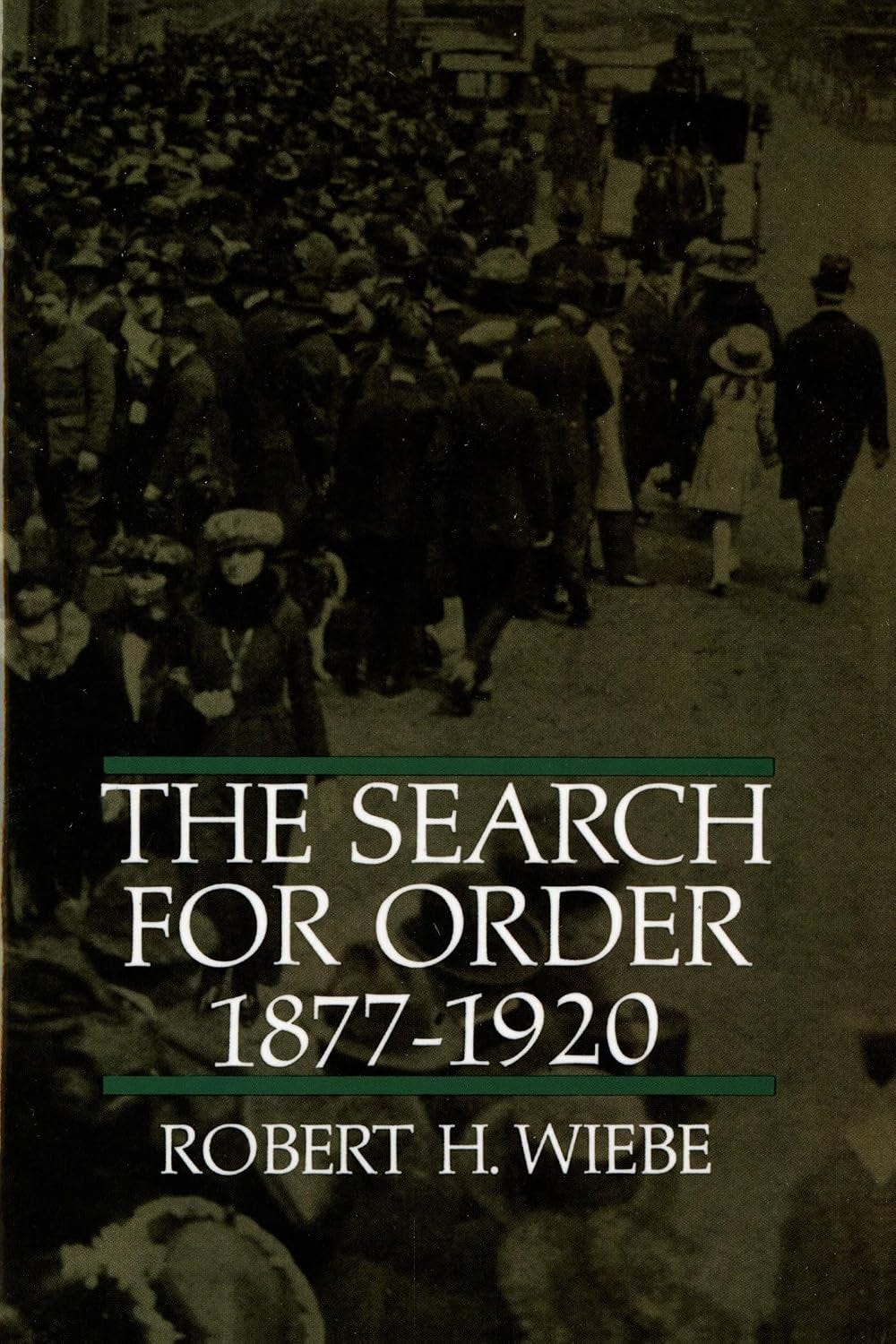
It wasn’t always this way. Robert Wiebe’s The Search for Order describes how the late 1800s saw a rapid expansion and differentiation of business associational life — trade groups, industry councils, professional organizations. Generally, these were structured as federated membership organizations. Meaning that there were nested chapters (national, state, local) and dues-paying members.
Jon Teaford, in The Unheralded Triumph (which I wrote about here), zooms in on municipal governments, which were at the forefront of governmental innovation in this period.
Business played a huge role in two ways. For one, there was a civic-minded business elite that helped advance reforms and often occupied the Mayor’s office. (This group has, unfortunately, hollowed out significantly. See this post from Aaron Renn.)
But normal businesses were often pushing for reforms that were in their own interest. Fire insurance companies had a strong vested interest in improving fire safety and used their advocacy muscle to do so.
To pick a messier example, large meatpackers were actually quite friendly to food safety regulations, because it made it harder for their smaller competitors to keep up with the necessary compliance. Regulation tends to benefit big incumbents, so in an era where new laws and regulations were needed, big business was not inherently an enemy of Progressives.
Businesses have on-the-ground knowledge of how various government processes work that is valuable for reform. Real estate developers understand permitting, for example. We might call it “lived experience.”
From a structural perspective, what’s more important is that there is a direct line of accountability between the fire insurance association’s lobbyist and her members.
This matters because, as Theda Skocpol has documented, the federated membership model has hollowed out in most of American civic life. Immigration advocacy groups are not actually composed of a bunch of immigrants who pay dues and influence strategy. They’re funded by rich donors and foundations and staffed by activists who don’t always share the views of the people they claim to represent. This has led to all sorts of distortions in American policymaking, particularly in the Democratic Party.
That decline in what scholars call “associational life” is broad and extends beyond politics. Robert Putnam’s Bowling Alone is the famous book here.
But relative to that broader decline, business associations are an area where membership-based associations still operate pretty well. As a result, I think they’re particularly needed in the Democratic Party today to balance out the foundation-funded “associations without members.”
A labor organizer friend is fond of telling workers who are skeptical of joining a union: “whether or not you choose to organize, your boss is organized.” He’s right.
Relatedly, business associations bring their own resources to support the reform movement. If the Democratic Party is actually so concerned about billionaire influence in politics, they should welcome groups like a Realtors Association that can be independent and aren’t beholden to Big Money donors.
Put succinctly, they’re more democratic than most Democratic interest groups.
Finally, a lot has been written about how Democrats need to have a “bigger tent” party. The national brand is seen as elitist, judgmental, and aloof with respect to the average voter. What better way to reinforce that image than to spurn influence from the businesses that employ 70% of Americans!
All of this seems like a no-brainer when you lay it out. And the smartest political actors know this. So why does the aversion to business among left-wing reformers persist?
Even leftist labor people that I know are happy to cultivate small business owners when there’s a real electoral issue on the table. But those same people are quick to complain about “capital” in Marxist terms as soon as someone allies with a business group they don’t like.
We should reject that kind of totalizing structural thinking. Sometimes big business will be your ally, like the food safety example above. Or take my recent writing about the early days of the US environmental movement, when big business was more on the side of regulation than small landowners:
Other times, small business will be your ally. For example, I’m a big fan of efforts to push for Clinical Trial Abundance, getting more effective, cutting-edge drugs and therapeutics to patients faster. On the whole, big pharma is much less interested in reforms at the FDA than small biotech companies are, because they know all the unwritten rules and how to navigate the process. It’s just like the food safety rules: regulation benefits big incumbents. But in this case we want less regulation (or at least clearer rules).
Basically, we need to just be chill about business and welcome them into the reform push whenever their interests align with the public good.
This will be a cultural struggle for Democrats, who love to police their membership with projects like the Revolving Door Project (which is, ironically, an association without members funded by rich people and foundations).
Railing against oligarchs, big business, and corporate power has become even more essential to a large faction within the Democratic Party. This has its populist spokespeople, like Graham Platner, as well as its elitist intellectuals, who are largely in the Neo-Brandeisian anti-monopoly crowd associated with Elizabeth Warren and Lina Khan.
As a talking point to get people fired up, it’s fine. Us vs. them politics has its time and place. But it’s more problematic for making actual good policy, as both Noah Smith and Jonathan Chait have recently argued.
This allergy to business connections leads to the government staffing itself poorly. Jerusalem Demsas spoke in a recent podcast about how she “heard from someone who was in Treasury on background tell me about how they had trouble during the SVB (Silicon Valley Bank) crisis to finding someone [internally] who could walk them through what was literally going to happen as this crisis was unfolding because they didn’t have people who were working in, you know, banking in the administration in those offices.” That’s bad!
To draw on my own experience, I worked on a case where a business association was pushing for a state-level housing reform. This policy would have massive benefits for racial equity (with disproportionate benefits flowing to small and under-resourced municipalities), housing supply and cost, and economic growth and business (making it easier to build and sell homes). In short, a win-win for progressives and for business.
But it was incredibly hard for me to sell colleagues on the fact that business people might be doing something good, despite all the clear evidence. Ultimately, I got the grant through, but only after my colleagues forced them to write a mea culpa for wrongs committed by their trade ~80 years ago.
The Democratic Party’s allergy to business doesn’t seem to be getting better, unfortunately. The anti-corporate faction only seems to be getting stronger in blue states. But for anyone pragmatic, the direction should be clear: work with whoever wants to advance your shared goals. And relying exclusively on groups who take money from rich people and foundations does not get you out of the conundrum of working with vested interests.
You can definitely err too far in relying on business, which can calcify into regulatory capture and corruption. But the opposite — a reform movement that refuses to work with business on principle — is a reform movement that can’t get anything done.
This is part of a series on lessons from the Progressive Era. Previous entries: The Diminishing Returns Problem, Does Reform Require One-Party Rule?, and We’re in the Patchwork Era.
No posts
Comments
Nothing yet. Say the first thing.
Sign in to join the conversation.