
I remember when Abundance came out I was talking to a friend with lots of political campaign experience. His review: “great book, everything in it is right, but they’re gonna need better branding. Abundance has too many syllables.”
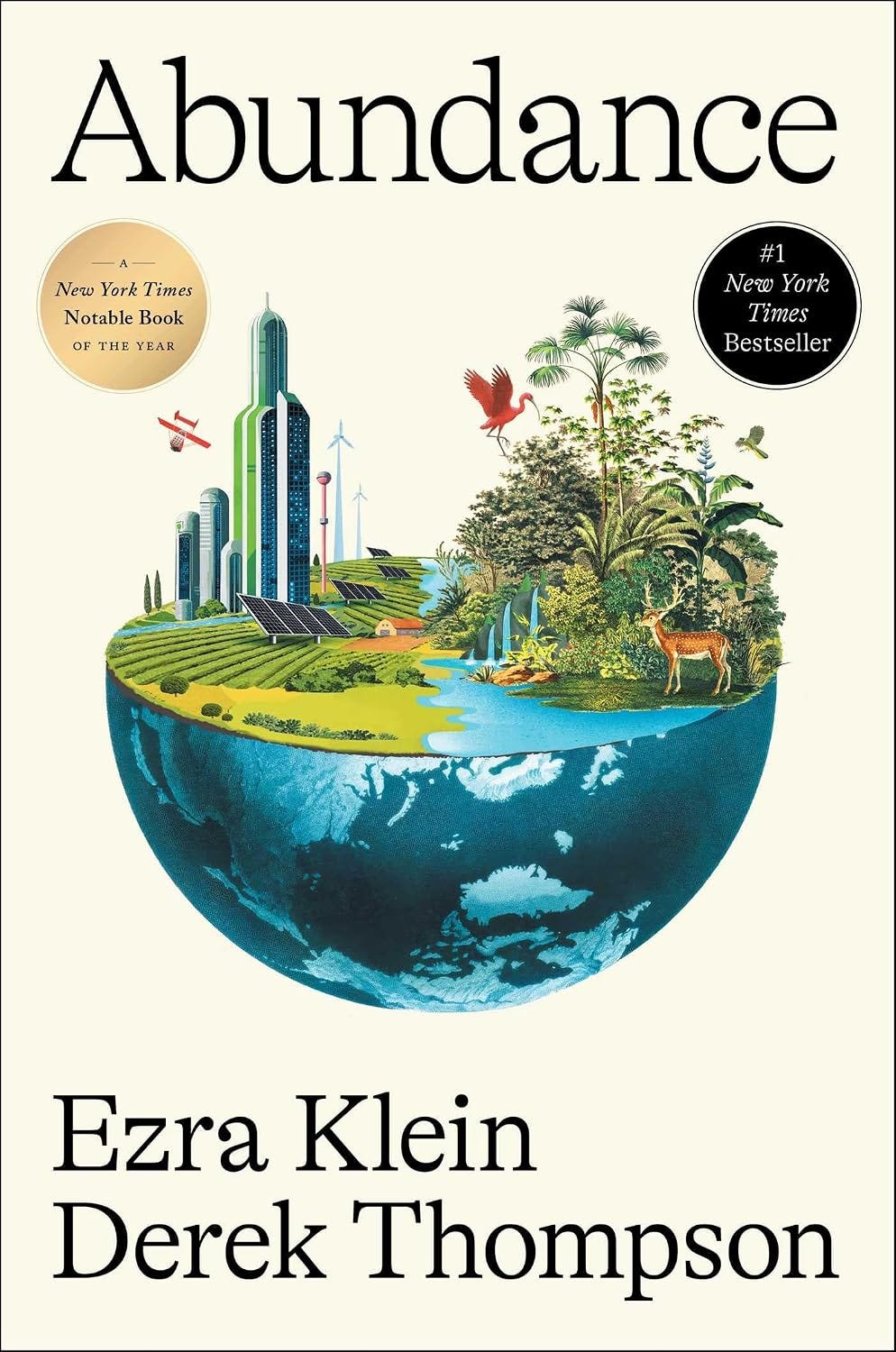
Sad, but likely true for connecting with the general public. The book has certainly been influential at the elite persuasion level, driving lots of conversation and even favorable responses from unlikely factionalists like Bernie Sanders and Zohran Mamdani.
Yet a May 2026 NYT poll found that only 9% of Democratic voters had heard of the “abundance movement. Maybe too many syllables is right!
The constellation of thinkers focused on abundance and state capacity are heirs to a long run of government reformers. Successful reform movements and coalitions typically have some sort of unifying idea or brand that both ties together a variety of issues and resonates with the public.
As readers of this blog know, I think the Progressive Era (~1890-1920) is important to mine for lessons, as it featured the most successful reform movement in American history. In that era, Progressives overhauled and modernized the US national government. In the process, they took over both political parties. Since that’s basically the best case scenario for this moment of Abundance-minded reformers, it seems worth asking: what ideas and framings successfully united the Progressives? What might work today? Which worked for elite persuasion and which worked for mass mobilization?
To cut to the chase, successful reform movements run on moral energy and we’ve lost the nerve to talk about public morality unless it’s about children.
Part of what inspired this post was a surprisingly resonant passage from Robert Wiebe’s The Search for Order: 1877-1920, one of the seminal books on the period.
For context, “bureaucratic thought” doesn’t have the negative connotation it might have today. It’s more talking about the idea that we should empower experts in the government, housed in the Executive Branch, to solve complex problems (including paving roads, building bridges, cleaning the water supply):
Exponents of bureaucratic thought felt obligated to find a more emotionally satisfying bond among all citizens. They required a mundane common denominator that in its own way would draw a diverse nation together as neatly as natural law had. Deeply impressed by America’s economic productivity, a number of them sought the answer within a context of abundance. Their fascination with the processes of an urban economy led them naturally to the distribution of goods and from there to the consumer. Here, announced such men as Walter Weyl and Walter Lippmann, was a primary function for the citizens of a bountiful society, a singularly American source of consciousness that in turn would underwrite its common action. But they seemed at a loss to know how they might use the discovery. It generated little excitement and even fewer applications.
Essentially, focusing on material abundance and treating the American public as a bunch of consumers made some sense. But it didn’t have the juice for organizing a larger political movement. Perhaps a lesson for today. Either way, Abundance mentioned!
I was also struck by parallels with another great movement of the Progressive Era, the environmental movement.
As Samuel Hays wrote in his landmark Conservation and the Gospel of Efficiency (which I wrote about here), the famous conservation movement was highly motivated by economic efficiency. This is particularly true for elite actors like Teddy Roosevelt and his influential Forest Service Chief, Gifford Pinchot.
Efficiency is quite similar to Abundance. A substantial portion of the public was motivated by romantic preservation of nature (think John Muir), which is the narrative that people prefer to tell about the early environmental movement. But make no mistake, Roosevelt was primarily concerned with the rational use of resources to further economic growth.
Once conservation got momentum, everyone was ready to hop on board and the term quickly became diluted. Here’s Hays:
The term “conservation” proved to be highly elastic. After the summer of 1908 its meaning expanded to include almost every movement of the day, and a wide variety of reformers flocked into conservation organizations. Roosevelt initiated the process by popularizing the conservation of human health. …
This was only a beginning. At the first session of the National Conservation Congress in August 1909 delegates delivered speeches on the conservation of peace and friendship among nations, the conservation of the morals of youth, the conservation of children’s lives through the elimination of child labor, the conservation of civic beauty, the elimination of waste in education and war, the conservation of manhood, and the conservation of the Anglo-Saxon race!
A good reminder of the malleability of slogans that bears repeating today.
So yes, ideas of economic abundance and growth were operative at the elite level in the Progressive Era, as they are today. But what about the unifying threads and concepts that actually knit together the mass movement? I found two.
Anyone who learned three bullet points about the Progressive Movement in high school history class will know that it was in large part a backlash to Gilded Age corruption. I didn’t realize how much this was part of a broader moral, Christian crusade against vice. It makes sense; after all, the Temperance Movement was gaining steam around this time.
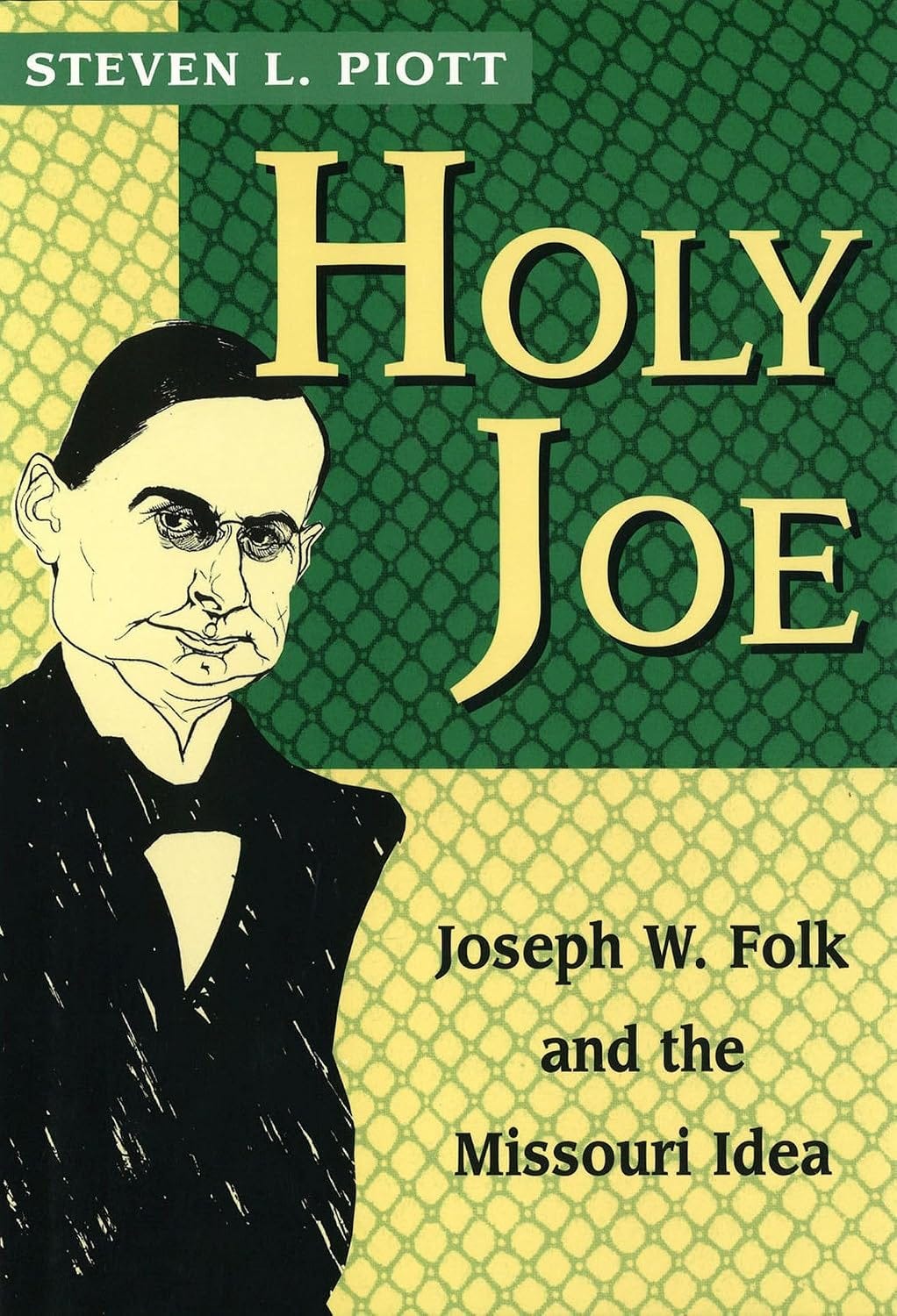
City-prosecutor-turned-reform-governor Joseph Folk developed a national profile by pioneering what was called the “Missouri Idea.” He was anti-gambling, anti-drinking, and framed political corruption as the worst vice of all. He was nicknamed “Holy Joe”:
[Folk] championed the law as the weapon with which to check political commercialism and restrain powerful corporations. And by enforcing the law, Folk reasserted the primacy of traditional, moral values over those that bribe-givers and bribe-takers embodied…. Folk firmly believed that government rested upon the law, and that bribery was the most dangerous crime because it struck at the foundation of all law.
As a candidate for governor in 1904, Folk gave vitality to the ideal that public office is a public trust by popularizing the doctrine that became known as the “Missouri Idea”-- the idea “that citizenship in a free country implies a civic obligation to enforce the performance of every public trust; that bribery is treason, and the givers and takers of bribes are the traitors of peace; that laws are made to be enforced, not to be ignored; that officials should no more embezzle the public power entrusted to them than public money in their custody.”
(from Steven L. Piott’s biography Holy Joe)
This quote emphasizes an angle that has some overlap with economic populism, though note that the corruption here was much more extreme and direct (in terms of bribes) than we see today. He came to prominence busting up The Big Cinch, St. Louis’s cabal of businesses and machine politics, which was as blatantly corrupt as anywhere in the country.
He was equally serious about the other forms of vice and never dropped his campaigning for restrictions on alcohol. Ultimately, opposition from immigrants like the Germans in St. Louis (whose livelihood depended on alcohol, from saloon keepers all the way to Anheuser-Busch) sank his career.
But only after he passed a massive haul of reformist legislation and became a national figure who contemplated a run for President. I mean, look at this list of Missouri state accomplishments from 1905-1907:
They made great strides in opposing special interests (antibribery and antilobby laws), and in encouraging greater democratic participation in the political process (state primary, senatorial preference primary, initiative, referendum, and recall). They expanded the power and scope of government in the public interest through social legislation (compulsory school attendance, child labor, maximum hour, fellow servant, and consumer protection laws), and economic regulation (of railroads, public service corporations, and monopolies). Folk, by his leadership, added texture, impetus, and a moral tone to progressivism.
In some ways, he was a victim of his own success. Once all of his popular reforms were passed, all that was left was more traditional anti-vice politics, which was less popular.
The other most common and successful issue framing that came up in my history: protecting children, the ultimate symbol of future progress. Here’s Wiebe again:
If humanitarian progressivism had a central theme, it was the child. He united the campaigns for health, education, and a richer city environment, and he dominated much of the interest in labor legislation. Female wage earners—mothers in absentia—received far closer attention than male, movements for industrial safety and workmen’s compensation invariably raised the specter of the unprotected young, and child labor laws drew the progressives’ unanimous support. The most popular versions of legal and penal reform also emphasized the needs of youth. Something more than sympathy for the helpless, or even the powerful influence of women in this portion of progressivism, explained that intense preoccupation. The child was the carrier of tomorrow’s hope whose innocence and freedom made him singularly receptive to education in rational, humane behavior. Protect him, nurture him, and in his manhood he would create that bright new world of the progressives’ vision.
I haven’t had a chance to read it yet, but Theda Skocpol’s landmark Protecting Soldiers and Mothers also makes a similar argument, that protecting children (via their mothers) was the core idea underpinning the original American welfare state.
Some of my takeaways:
First, elite persuasion can actually get you pretty far. Economic efficiency didn’t light the fire of a grassroots conservation movement or stick in the national imagination a la John Muir. But we did get the US Forest Service, which was one of the most competent US civil service agencies for decades.
Second, these terms get diluted really quickly. Once there’s a successful issue frame, everyone wants to glom their idea on to it. This eventually dilutes the framing, driving the search for novel ideas. You can see this with the Conservation Congress example above. The same may already be happening with “abundance,” see this article by Steven Teles outlining the diverse political actors trying to claim the term.
Third, we’ve really lost some moral muscle in our public life, but I doubt that’s a permanent shift. I once asked an organizer friend why he always has his rallies opened and MC’d by a pastor. “They’re the only ones who speak about morality in public anymore,” he said.
That certainly wasn’t the case in 1904. Piott again from Holy Joe:
As one historian has noted: “Christian [moral] progressivism makes us uncomfortable. The reformers’ indignation, moralism, and righteous rhetoric offends the tastes and grates on the ears of many modern people.” It is easy today to dismiss moral reformers like Folk as naive, innocent, smugly self-assured, or narrowly intolerant. Christianity today has become the rallying cry of illiberalism as much as liberalism. But in dismissing the moralistic rhetoric of the progressives as unimportant and in characterizing their emphasis on improved public behavior as irrelevant to the “real” goals of progressives (usually defined as modernization, order, or efficiency), critics have minimalized the moral dimension of progressivism and marginalized progressive reformers like Joe Folk.
Now, there are obstacles to reclaiming this moral language. Norm-breaking can be hard to reverse, and we’ve basically broken every scandal-type norm in the Trump Era.
Plus, there’s a deeper loss of moral common ground in an increasingly diverse society. We have a truly broad-based, inclusive democracy for the first time in US (maybe world?) history, and it makes shared values and solutions hard. Historian Stephen Skowronek explored this in his recent book The Adaptability Paradox, I interviewed him here:
More important than diversity is probably secularization. Is there any normative morality today that has the strength and reach of past Christianity? Probably not. As a Jewish person, that’s not all bad, but it does make this kind of broad-based political framing more difficult.
If I had to make my best guess, successful reform efforts of the future will hinge on protecting children.
With some exceptions, there seems to be a pretty laissez faire attitude today about regulating the actions of adults. When places legalized sports gambling and marijuana, we basically just let it rip. Even in a red state like Missouri, there was little interest in closing loopholes like all the unlicensed convenience stores selling delta-8 THC, a synthetic marijuana product.
That makes some sense for the Right, which of course has its libertarian streak. In a horseshoe theory sense, there’s also an anarchist (versus socialist) orientation to the contemporary American Left. Particularly in the post-mass-incarceration aversion to any use of law enforcement.
But I suspect there is a backlash brewing to a number of the trends of the day. Social media, sports gambling, a breakdown of road safety, extremely potent and publicly-consumed marijuana.
While a broad libertarian morality holds sway with adults, we do still have some muscle to exert control and talk about morality with respect to children. Regardless of what you think about the issue, note that the Right has recently chosen to pick policy fights primarily about the trans issues that concern minors.
Or think about how Jonathan Haidt’s crusade against smartphones has been focused on teens, even when I’d assume that we could make many similar arguments about their harms to adults. Nonetheless, we’ve seen an embrace of school phone bans across the country.

Finally, the biggest breakthrough legal challenge to AI labs, which spurred political posturing from figures like Ron DeSantis, was not anything about job disruption to adults. It was about a kid using ChatGPT to help him commit suicide.
Once again our national anxieties about a new technology find their expression by worrying about children. The impulse to protect children and nurture them as a symbol of the future seems to have persisted, despite the withering away of both our statist and moral muscles.
While keeping kids from gambling and building safer roads may seem quite disparate, I think that both require re-asserting some state capacity that’s currently lacking. It’s not a coincidence that a government that is so burdened by process that it costs $1.7M to build a public park toilet also has a hard time getting delta-8 out of gas stations.
As Dean Ball noted with children’s AI usage, there will be many challenges regulating “AI child safety.” As we try to restrict their access, they’ll use less-regulated, open-source models hosted offshore. Kids always find a way around rules, and I’ll note that similar issues apply to sports gambling. The modern Internet poses real challenges for exerting social control, even when we’d want to.
But let’s leave the implementation challenges (usually my favorite topic) to another day. Moral language is what really animates reform efforts. And smart reformers should, like Joseph Folk, couple their project to it.
As Robert Wiebe said, the Progressive Era was a “search for order” in an increasingly complex and interconnected modern world. I believe that we’ll see a similar desire today. Perhaps it is only by thinking of the youth and the promise of tomorrow that we can re-gain the backbone to re-order our society.
No posts
Comments
Nothing yet. Say the first thing.
Sign in to join the conversation.