
It’s 6:54 p.m. and Thad Shermichael is visibly peeved. In six minutes, his book signing at Dub’s Fly Shop in Asheville, North Carolina, is set to begin, but the only person in the store other than the author is the owner.
On the table 58-year-old Shermichael sits behind are stacks of his latest work, The Complete Guide To Spey Casting Synthetic Shrimp And Worm Patterns For Non-Tidal Brackish Water Flounder. It’s the follow-up to his 2022 release, The Ultimate Guide To Foam Surface Patterns For Perch In Remote Glacial Lakes. I already know nobody is showing up to this signing, and if 20 people in the world have read one of Shermichael’s books cover-to-cover I’d be shocked.
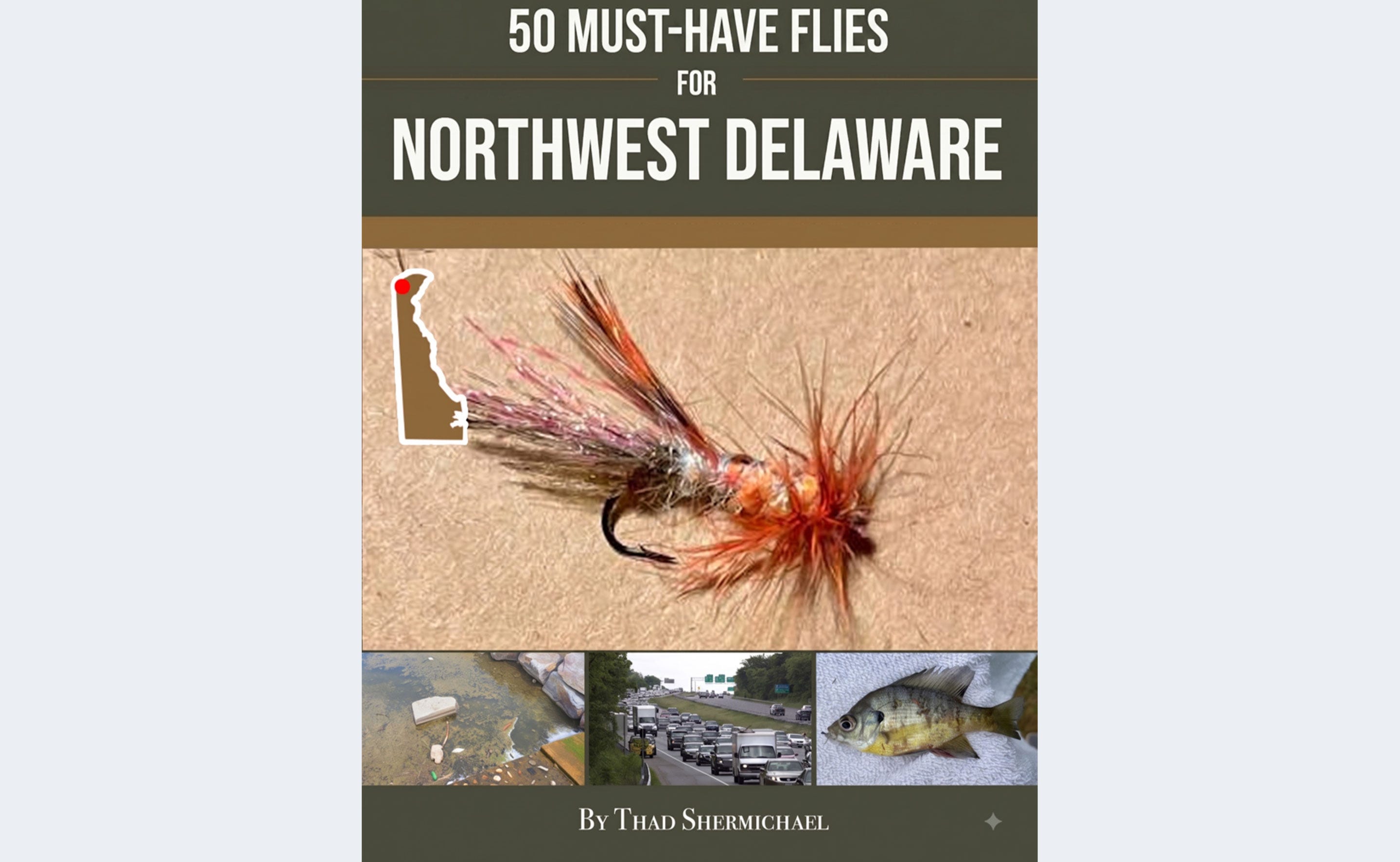
Even his first title, 2018’s 50 Must-Have Flies For Northwest Delaware, was a complete flop. Why, then, do people like Shermichael keep writing these books and, more importantly, why do publishers keep accepting the manuscripts?
What made me decide to investigate was the never-ending stream of unsolicited fly-fishing books mailed to my office. Every week I could count on at least one bubble mailer featuring a press release about an author I’ve never heard of and a crisp copy of a book with a title like My Fly Life: A Year Of Whiskey, Open Roads, And Rainbow Warriors; The Absolute Beginner’s Guide To Flyfishing With German Short-Haired Pointers; or 41 Places To Fly Fish Before You Get Alzheimer’s. The truth I uncovered about fly-fishing books in the modern era proves that while print might not be dead, if you read between the lines, you’ll find it’s desperately gasping for air (and attention!) like the grass carp in your municipal sludge pond.
The first thing I learn from Dan Harrison is there are two primary reasons anyone writes a fly-fishing book nowadays. The first is ownership. They believe simply by writing about a technique or body of water, they are automatically the leading authority on it, and it doesn’t matter if they’ve been at it 30 years or three. The second is a belief among the modern fly crowd that their experiences are deep, metaphorical and novel when most of the time they are not.
Harrison, 62, is the head honcho at Tipple & Thread Books based in New York City, one of the three biggest publishers of fishing titles in the country. He fully admits that when his father, Tom Harrison, started the business in the late 1970s, they were incredibly selective about authors and titles, but not anymore.
“You can’t make money on fly-fishing books now,” he says. “You can’t bank on any new title selling year-over-year like a classic Gierach book or one of Lefty’s how-to books. Back in the day, you had pioneers of the sport, but now everyone is an expert or storyteller. I can’t get by with one book a year from the few good, well-known writers left on the roster. Now I have to lean into volume and, yeah, I’ll kind of take anything. You tell me it’s like Bourdain meets fly fishing and you’re in.”
People are so eager to see their name on a fly-fishing book they’ll agree to a very low advance. They won’t see any royalties until net sales have risen above that advance, which rarely happens. Fortunately for Harrison, hardly any newer authors are in it for the money.
“Maybe I owe the guy a couple hundred bucks before the book goes out of print,” he says. “At best, I’m making a few grand myself, which isn’t much, but when you publish 80 or more new titles in a year it sort of works out. Frankly, I sometimes make more money selling authors cases of their own books at a discount. Of course, that comes out of their royalties, too.”
He motions to a set of proofs on his cluttered desk and holds up the stack of pages to show me the cover. It features an AI image of a road leading off into a mountainous desert. The title is Viva Trutta: Zapatos, Burritos, And The Pursuit Of The Elusive Gila Trout by Connor Flynn.
“Here’s another first-time author. And guess what? Absolutely nobody will give a damn about this story except him,” Harrison tells me. “I think a monkey has a better handle on grammar. But he’ll hype it to death on social media, maybe get on a podcast nobody listens to and forever be able to say, ‘I wrote a book.’ That’s all he really wants.”
Of all the new books I got to peruse in the Tipple & Thread offices, none gave me greater pause than The Definitive Guide To Flyfishing For Blitzing Striped Bass. I was so taken aback by the idea of 216 pages dedicated to fish that will hit almost any fly you throw while they’re foaming at the surface, I tracked down author Dean Kimball at his home in Cranston, Rhode Island. A real estate agent by trade, Kimball has been guiding on the side for two years. The book, he hopes, will boost his name recognition and allow him to be on the water full-time.
“I’d been thinking about writing a book for a while,” the 30-year-old tells me. “I was torn between sharing my knowledge to help others catch more fish, or just penning funny and meaningful stories from my two years of part-time guiding. Ultimately, I decided sharing fishing tips would help me gain more clients, particularly rich old guys. Rich old guys love fishing with guides who have written books.”
When I ask Kimball what he does when the local stripers aren’t blitzing, he shrugs.
“I don’t know. Fling Clousers around the bridge pilings and hope a schoolie grabs one,” he says. “I can’t lie, I kinda struggle when the birds aren’t diving on bass frothing up top. I live for the blitz, and I think my passion for catching blitzing stripers is really captured in the chapter titled The Most Coolest Blitzes I Ever Fished In.”
For Thad Shermichael, the book signing at Dub’s Fly Shop was a bust. He sold exactly one copy to a woman who came in for a gift card and likely felt too guilty to walk away bookless after Shermichael chatted her up. He, of course, blamed the shop for failing to promote the event properly, carrying on about how much better the turn out will be at Ye Olde Bookery in Martha’s Vineyard next week.
I asked Dub’s owner, 29-year-old Travis Wertz, if he was disappointed in the event.
“I mean, I feel kinda bad for the dude, but he reached out to us,” he said. “I thought I put something on the Gram about it, but I don’t really remember. He was kind of full of himself anyway, so whatever.”
When I returned home, I put my signed copy of The Complete Guide To Spey Casting Synthetic Shrimp And Worm Patterns For Non-Tidal Brackish Water Flounder on the IKEA Tonstad book shelf I’d recently purchased after filling my old IKEA Ekenabben book shelf with all the free fly-fishing titles sent to me in just the last two months.
As I reclined in my IKEA Huvudspelare desk chair and took in all the volumes I’ve never even opened, I realized they represented thousands of hours of work and contained countless tidbits of fly-fishing insight and information, very few of which I couldn’t find on YouTube in 15 seconds if really wanted or needed to know them.
Comments
Nothing yet. Say the first thing.
Sign in to join the conversation.