
I am going to keep this simple for the sake of the argument: learning can be a regular, enriching, and accessible daily practice.
Why should you dedicate any time to expanding your vocabulary? To better learn how to say what you truly mean. Allow yourself access to language that can better articulate your thoughts and eliminate vagueness. Speak with precision.
Learning new words and their meanings helps you understand yourself more intimately. Discovering definitions that hone in on the tiny details, bringing clarity to your thoughts and feelings, is the goal.
I love every nook and cranny of the 1948 dramatization on Building Your Vocabulary, mainly for its simplicity. To keep on theme, I have simplified my notes on the subject:
1: The more words you know and understand, the better you can communicate.
2: You do not have to sit and read/memorize a dictionary; learning new words will come naturally in your daily activities.
2A: You can discover new vocabulary by attentively listening to others in natural conversation (not only will this make you a better LISTENER, but you will uncover words embedded with context).
2B: You can also discover words by reading. Read. We must all be reading. And do so actively. This means engaging with the text and notating, in any manner you prefer, any words that are unfamiliar to you.
3: Recording newly discovered vocabulary is as simple as keeping a mini notebook in your jacket pocket. (Or for the digital age: a notes app)
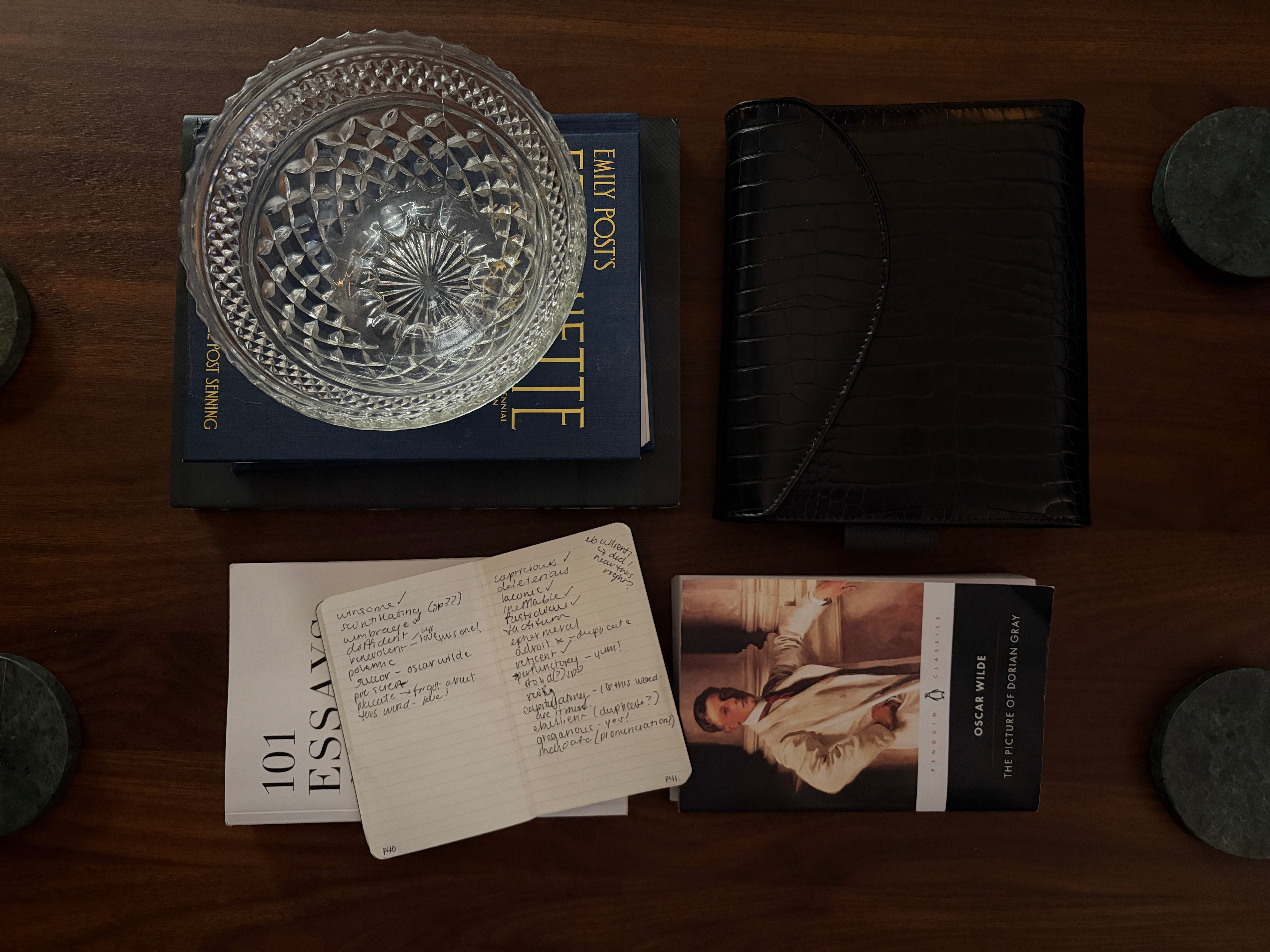
4: Practical application of a word helps solidify the retention of its definition. Learn a new word: write it in your next email, say it out loud in a sentence to your roommate, try it on in a conversation at dinner, or tweet it. Whatever the vehicle, put it into practice.
Similar to Mr. Willis’ son, I too have a Vocabulary Notebook - Notion Edition.
When I read, I always have a pen in my hand.
“Books are not precious things. It should look like you read the book. Im going to take great pleasure in writing in it, folding pages, spilling food on it. Books are meant to be read. That’s how you pay respect to an author. By really engaging with the text, by making it a part of your life, by bringing it with you. Some of the best meals I’ve had have occurred over a book, and the stains will prove it.”
I scribble a simple circle over any word that is unfamiliar to me, or that intrigues me. A quick circle ensures that I do not disrupt my reading pattern by taking too many steps to annotate.
When I finish a book, I transfer my marginalia to my knowledge vault. You may be familiar with this process as I have detailed in the following article(s):
How to Remember What You Read
·
Feb 2

You finish a book. You loved it. You highlighted passages and took notes in the margins. Two weeks later, someone asks what it was about, and you freeze. You remember liking it. You remember the general idea. But you struggle to convey a comprehensive summary. The arguments the author made? The connections you were so excited about while reading? Gone. Or at least, buried so deep in your brain that they might as well be.
How to Take Notes
·
Jan 30
Whether we like it or not, we are forced to navigate the constant stream of information that defines modern life. Whether you enjoy podcasts during your commute, quick article reads in between meetings, professional development courses, or enlightening and inspiring films and creative arts,
A critical part of my end-of-reading routine, is to add any new vocabulary I’ve plucked from the pages and enter it into my vocabulary database.
This is a workspace I have crafted using Notion to store and record my growing lexicon. A place I can materialize what I’ve learned as part of the retention process, as well as have a vault of words I can return to for study or use in any new purpose. Beyond housing expanded vocabulary in my primary language, this database serves as a cohesive language learning tool in my lifelong pursuit of becoming multilingual.
All neat and tidy under one roof - just the way I like it!
I have reworked my language & vocabulary database to share as a template to use in your own workspace.
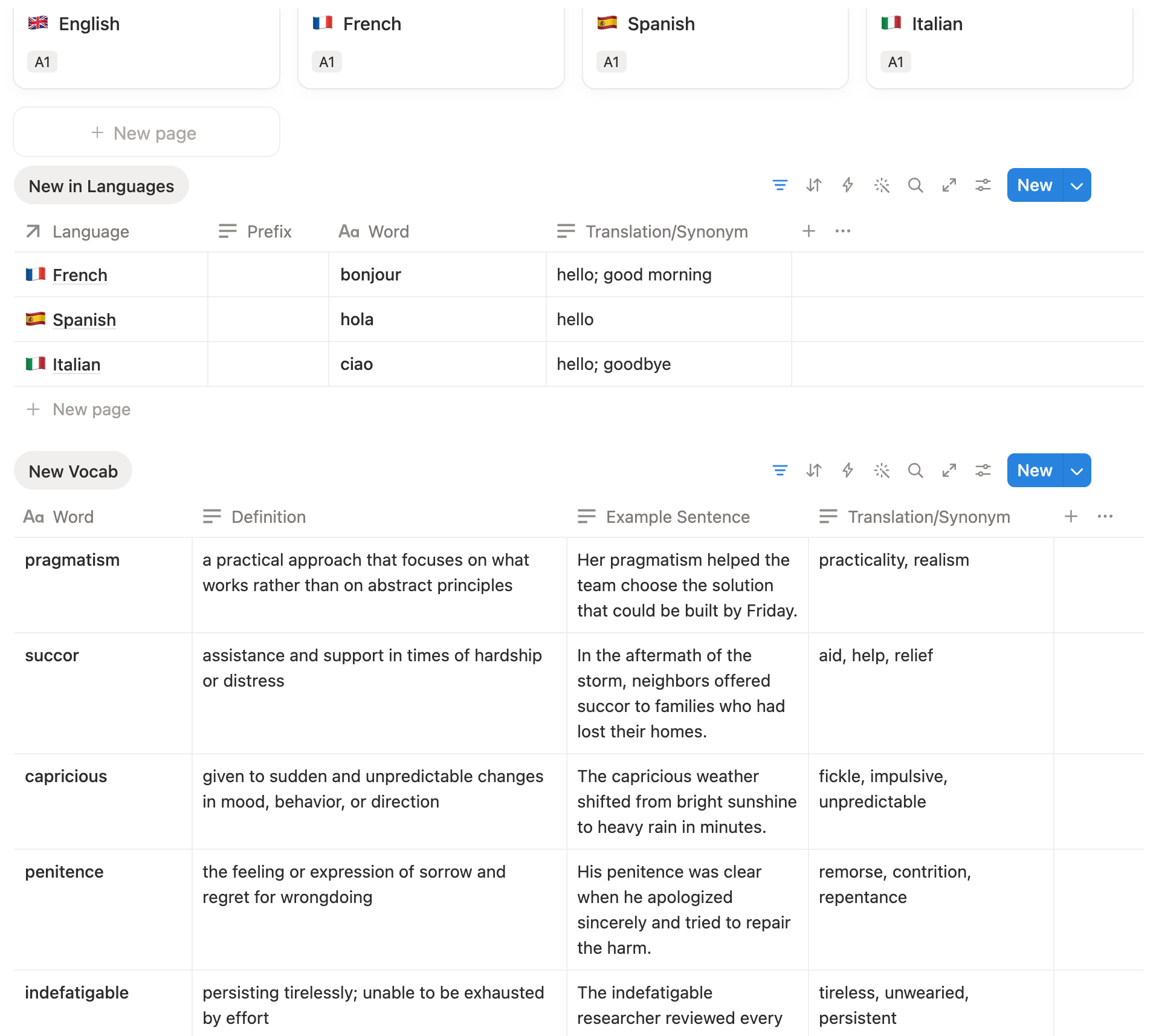
Follow the instructions below to download the Notion template to edit, customize, and use!
Happy Learning.
Much love,
Flossy Fay.
Comments
Nothing yet. Say the first thing.
Sign in to join the conversation.