
I spent the fall of last year fascinated with the concept of Gestalt, mentioning it 279 times in my school papers. I knew it would make a fascinating Flight Patterns post, but the topic is so complex I wasn’t sure where to start.
Origin, Historical Context, and Ideological Background
Why Gestalt Is Significant
Drawbacks, Controversy, and the Need for Caution
A Theology of Gestalt
The year is 1912. The world is optimistic about its scientific and technological advancements, yet war looms on the horizon.
Max Wertheimer1 is a German psychologist who is fascinated with word associations, patients unable to speak, and the thinking of non-Western people groups. This is the year he will write an analysis on phi phenomenon, a theory about how motion is visually perceived.
His paper is recognized as the beginning of the Gestalt school of thought. The professors to pioneered Gestalt were trying to figure out the ways that humans perceive the outside world (through vision and other senses,) encode it into thoughts and memories, then express it with words and language.
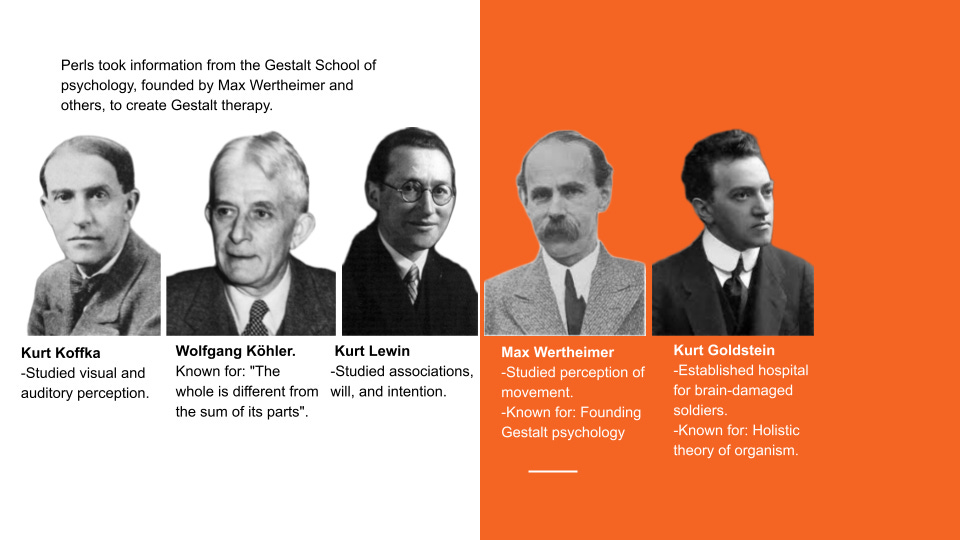
Kurt Goldstein2 established The Institute for Research into the Consequences of the Brain, a hospital for brain damaged WWI veterans in Frankfort. He identified that physical damage to different areas of the brain affected specific cognitive functions, such as speech and language comprehension. This vastly changed how we understand brain function. Goldstein is known for developing the holistic theory of organism which looked at the way parts of a living thing worked better together than each of them separately.
Goldstein’s colleague, Wolfgang Köhler, coined the saying “the whole is greater than the sum of its parts,” describing the work of Wertheimer, Goldstein, and others. Köhler, a trained psychologist and physicist, was responsible for expanding the Gestalt school of thought from the purely psychological arena to wider applications, such as biology and electricity.
Gestalt, according to Köhler, began in the field of visual perceptions and contextual conclusions drawn by optical input. It branched out to language and music. He said that a musical piece played at a different pitch is still recognized as the original musical piece, even though the notes, or component parts, are different. He also pointed out that if a person looks at a sentence, the meaning is different than looking at each word individually.
Ultimately, for the point of this discussion, Gestalt is 1) how humans use context to perceive things and 2) how humans are fundamentally greater than the sum of their parts.
The key players in the development of the Gestalt school of thought knew each other. Many had the same professors, some taught each other. Several worked in Goldstein’s Institute. Köhler participated in Wertheimer’s groundbreaking 1912 study. One couple was married. They were predominantly Jewish Germans, or at least German or Jewish. Most either attended or taught at Frankfurt University (chartered in 1914.)
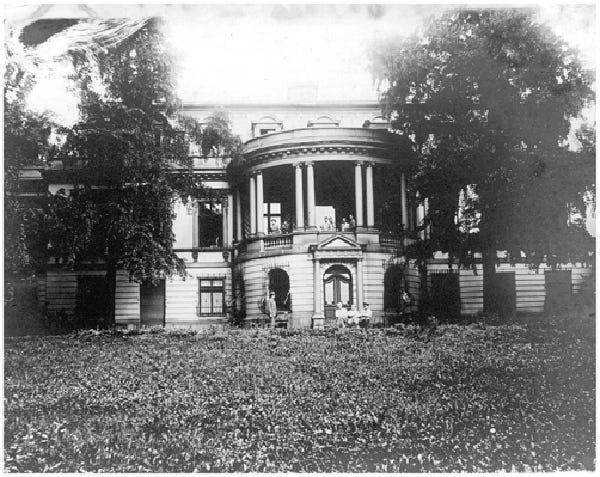
Gestalt was not the only idea to be nurtured by the academic environment of Frankfurt University. In 1923, Frankfurt University partnered with the Institüt für Sozialforschung (Institute for Social Research,) a Marxist institute with Communist influence, that hoped for a drastic cultural revolution of religion, art, traditions, and family structures.3
In 1933, the University of Frankfort was taken over by members of the National Socialist party, who appointed Ernst Kriek the new rector. Kriek was an elementary school teacher with no university education and a hotly contested honorary doctorate. Kriek called the Frankfort professors “a veritable burden, which can only serve to pollute the people who come in contact with it.” (Zneimer 148.) During the National Social Party takeover of Frankfort, many of the Gestalt professors (German Jews) left the country and immigrated to America, including Wertheimer, Goldstein, Kohler, and Koffka.
Today the National Socialist Party is simply known as the Nazis.

Much of Gestalt’s development took place in the Weimar Republic during the first half of the 20th century.
The mainstream philosophical thought was mechanistic, reflecting the rapid industrialization of Germany and technological advances of the time. One reason the opposing idea of holism espoused by Gestalt increased in popularity is because people were growing disillusioned with the problems they saw in the modern culture of the Roaring Thirties, namely, “a reductionist approach to human nature, an individualist society, and the loss of an aesthetic and religious worldview.” (Ludwig 40)
People were growing tired of reductionism and new empirical evidence not aligning with traditionally assumed paradigms. It has been said that prominent worldviews tend to swing back and forth in reaction to each other. Gestalt’s organic and holistic concepts were in part a reaction to existing worldviews that glorified technology and mechanics.
One of the reasons it took me an entire year to write this post is because I knew I have a bias in favor of Gestalt, when in fact, it is not a perfect worldview.
While I believe there is great benefit to having a holistic understanding of how humans tend to operate, no amount of psychology will fix every problem or work perfectly for every person.
The biggest and most subtle issue with Gestalt is its humanist roots. What’s the problem with humanism? Humanism is like a video camera that only ever shows one perspective: that of the individual. The focus is on the self, and how the self perceives things. Imagine a movie that’s only a close up of the main actor’s face the entire 2 hours. There’s a reason films use different shots and angles to tell a story. Humanism’s limit is the focus it puts on humans, who are limited, instead of God, who has no limits. Just like a few close-ups make a good movie, there is definitely room for examining ourselves like Gestalt asks for. Someone using Gestalt as a psychological tool will heighten their awareness of inner conflict, emotions, and behavior. But this can easily go too far— too much navel-gazing can catch us in a cage of our own making. I definitely fell into this trap while researching Gestalt, simply because I really loved the concept.
We can’t fix ourselves. Even if I know everything there is about myself, it wouldn’t do me any good. It’s really knowledge of God that makes me any kind of a better person. I was blessed to be part of an amazing study on the attributes of God at the same time as my deep dive into Gestalt and the two harmonized very well together.
A second issue is the way some people practice Gestalt, especially in therapy settings. Gestalt therapy itself is a fascinating subject, but people have very different ideas on how it should be practiced. The limits of Gestalt as a therapy lie within its insistent focus on the present moment. This could hinder someone’s ability to learn from the lessons of the past or wisely prepare for the future. Gestalt can also be very confrontational or overwhelming. It’s not necessarily a good thing for people who are dealing with trauma or serious/urgent mental health needs.
Some people are simply not ready for self reflection, while others can get too absorbed in it they don’t have time for anybody else.
Additionally, Gestalt is often taught alongside Eastern philosophies such as Zen. As always, it’s important to be discerning about different worldviews.
That being said, I believe Gestalt itself is neither good nor bad; it is a tool that can be wielded in God-honoring ways.
“Be still, and know that I am God.
I will be exalted among the nations,
I will be exalted in the earth!”
–Psalm 46:10
Gestalt allows us to see how God makes things work together. I am always amazed when I consider the intricate details of His creation, whether that’s the precise workings of neurotransmitters in the brain or the billions and billions of stars that make up countless galaxies.
Gestalt focuses on healthy people. Where a lot of other types of psychology can dwell inordinately on humankind’s problems, Gestalt allows a fuller perspective of the sin nature and the redeemed nature that wrestle within us.
"Do not be anxious about anything, but in every situation, by prayer and petition, with thanksgiving, present your requests to God. And the peace of God, which transcends all understanding, will guard your hearts and your minds in Christ Jesus."
–Philippians 4:6-7
Gestalt meshes well with a Christian worldview. We can see this in Matthew 6:34 where Yeshua tells His audience not to worry about tomorrow, that God will give them enough to deal with the present moment. We can also see Gestalt’s focus on small things echoed in Matthew 25:20-21 where the servant is rewarded for being faithful over a little. In the application of Gestalt Therapy, it is the little things that have the most impact. It is the same way in the Kingdom of Heaven.
For everything there is a season, and a time for every matter under heaven
–Ecclesiastes 3:1
A Christian Gestalt perspective can help open our eyes to God’s will and His timing, when we understand that —without God’s help—our perspective IS limited, and we will naturally only think of ourselves.
Gestalt is a unique worldview for the modern age because it pushes back against ideas that humans are like machines; instead, it promotes the dignity and worth of the human life and experiences.
To wrap this post up: I personally love Gestalt because it’s a breath of fresh air in the middle of a bunch of screwy modern era thought. It lines up really well with my favorite concepts of small things, being holistically healthy, living in the moment, and loving the human experience with all of its quirks. While this post may be a little odder than most, I believe it is important to know about the subtle but pervasive influence of this movement: in the face of political, military, and social turmoil, Gestalt is a balanced perspective that holds that a person is more than the sum of their parts.
Max was the ultimate interdisciplinary student. He studied law, logic, philosophy, psychophysics, psychology, and experimental psychology in his years at Charles University (1989-1902) and the Friedrich-Wilhelm University of Berlin (1902-1904.) He completed his doctorate at the University of Wurzburg in 1904. From 1929-1933 he served as a professor at Frankfort University (chartered in 1914) before immigrating to the United States, due to Hitler’s rise to power.
While Kurt did not consider himself a part of the Gestalt movement, he contributed greatly to it and collaborated with several of the founders.
There does not seem to be overlap between the members or ideas of the Gestalt school of thought with the cultural Marxist Institute for Social Research.
Comments
Nothing yet. Say the first thing.
Sign in to join the conversation.