
The 2026 Legislative Session(s) are in the books, and it’s been another riveting year for affordable housing policy people. We had our 60 day Regular Session from January to March, a two-week Special Session in May to deal with the state’s Budget, and another two-day Special Session in June to send a big-time homestead property tax proposal to the November ballot.
In the post-Live Local era, housing affordability continues to command serious attention in Tallahassee, with growing legislative interest in supply-side solutions and funding initiatives.
On Tuesday, June 16 from 11am - 12pm, myself and the rest of FHC’s Policy Team are hosting a one-hour webinar to go in-depth on all that passed this Session that affects affordable housing policy. You can register for that here. I’m always down to chat about what these changes could mean for local governments, builders, and advocates and help out however I can.
On the funding front, the news is largely positive. Thanks to the work of the Sadowski Coalition and Sadowski Affiliates, Florida’s Sadowski Housing Trust Fund programs are fully funded for the sixth consecutive year with $165.7 million for the State Housing Initiatives Partnership (SHIP) program and $70.8 million for the State Apartment Incentive Loan (SAIL) program. After two decades of trust fund sweeps between 2001 and 2021, six consecutive years of full funding is a durable shift in how these programs are treated and we applaud the Legislature for sustaining that commitment.
The Legislature also appropriated $50 million for the Hometown Heroes Housing Program and funded the Affordable Housing Catalyst Program, which helps local governments and nonprofits effectively administer housing initiatives.
But with that good news is some bad. The Legislature did not fund the Innovative SAIL program (also called the “Live Local SAIL Program”), the affordable rental housing program created under the 2023 Live Local Act to supplement traditional SAIL. Having received $150 million annually for its first three years, the program had already generated more than 7,000 affordable rental homes in the pipeline statewide, making the funding lapse all the more consequential. Because the Innovative SAIL program was not funded, there was a dip in overall core affordable housing program funding.
In total, $458 million will be appropriated to affordable housing programs in the upcoming state fiscal year, roughly half of current-year funding.
House Bill 1389 has three main components: amendments to the Live Local Act, expansion of Florida’s Yes-in-God’s-Backyard (YIGBY) laws, and updates to the Florida Fair Housing Act.
HB 1389 refines the Live Local Act’s land use mandate, which allows multifamily and mixed-use affordable housing in commercial, industrial, and mixed-use areas. The bill:
Expanded eligibility to land owned by counties, cities, school districts, and qualifying religious institutions
Prohibits localities from restricting eligible height via setbacks/stepbacks, or requiring setback/setbacks that are more restrictive than the minimum permitted in the proposed development
Clarifies that farm operations are not considered commercial or industrial uses for eligibility
Exempts open space districts, areas of critical state concern, and conservation easements
The bill also tightened the criteria for when a taxing authority can opt-out of the 80-120% AMI Multifamily Middle Market (MMM) Property Tax Exemption. Previously, a jurisdiction could opt out if the most recently published annual report from the Shimberg Center for Housing Studies showed a surplus of affordable units for households earning up to 120% AMI. Now, a surplus must be demonstrated for three consecutive years before opting out.
Additionally, properties with a building permit issued on or after July 1, 2026, within four years before an opt-out ordinance takes effect may still apply for and receive the exemption — a provision that should address underwriting concerns lenders have raised around the opt-out.
HB 1389 extends the Live Local Act’s land use mandate to include qualifying land owned by religious institutions, making local government approval of multifamily and mixed-use affordable housing mandatory on eligible faith-based parcels beginning July 1, 2026. For a full deep dive, check out an earlier post of mine. To qualify, land must:
Have a house of worship that has been active for at least 10 years
Exceed 3 acres
Maintain the house of worship active after construction of the housing
Set aside at least 40% of the homes as affordable rentals to households up to 120% AMI
This new state mandate builds on SB 1730 (2025), which gave local governments the option to approve affordable housing on eligible faith-based land. Florida now has two YIGBY laws, one mandatory, one optional for local governments, covering different parcels with different qualifying criteria.
The critical distinction between the two laws: The state mandate does not apply to parcels 3 acres or smaller, contiguous parcels to a house of worship, or land where the house of worship has been active fewer than 10 years. The local option covers all of those cases. Where the mandate doesn’t reach, advocates will need to ensure their local governments pursue the optional route.
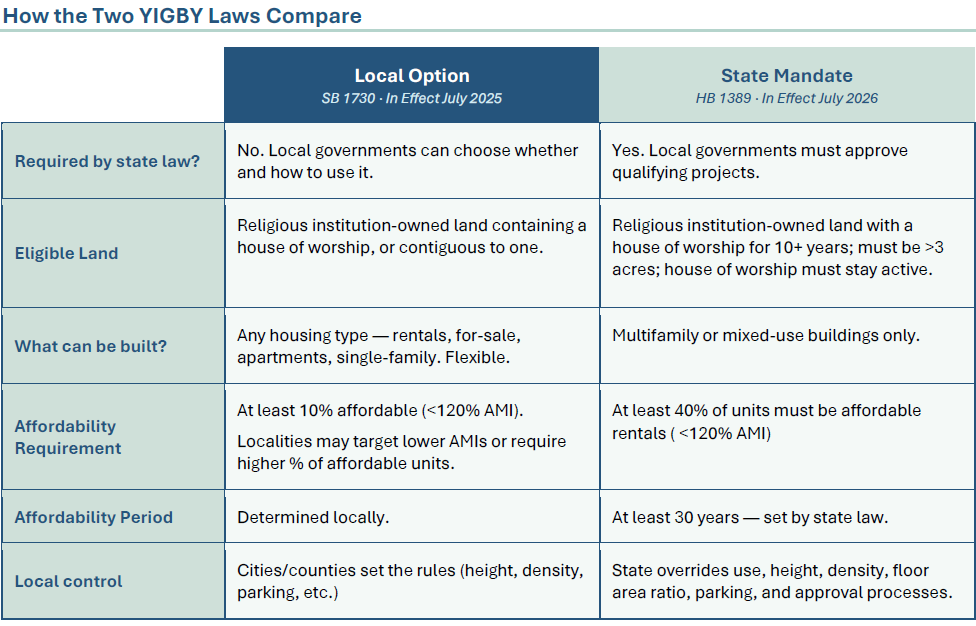
Preliminary data analysis by our team estimates the optional YIGBY tool applies to roughly five times more land than the new state mandate meaning local advocacy remains essential to unlocking as much faith-based land for affordable housing as possible.
HB 1389 makes two key clarifications to the Florida Fair Housing Act:
1. Sovereign Immunity Waiver. The bill clarifies that sovereign immunity is waived when a governmental entity violates the Florida Fair Housing Act, responding to a recent court ruling that questioned whether the statute clearly waived immunity.
2. Prohibited discrimination against affordable housing. The bill also clarifies that local governments may not discriminate against affordable housing in land use decisions. Since 2000, Florida law has prohibited discrimination based on a project’s source of financing (such as Low Income Housing Tax Credits). HB 1389 reinforces that affordable housing developments must be treated the same as market-rate housing in land use decisions.
SB 594 amends the SHIP statute to repeal the 20% cap on using a locality’s annual SHIP allocation on manufactured housing. This means a SHIP jurisdiction could use as much of its SHIP funds as it wants to support the purchase, repair, or construction of manufactured housing. This gives localities more flexibility and can be especially helpful in rural areas and places with higher demand for factory-built housing options.
The bill also requires each SHIP jurisdiction to include two new strategies in its Local Housing Assistance Plan (LHAP) that address the needs of mobile home owners: 1) A strategy that addresses the needs of persons who are deprived of affordable housing due to closure of a mobile home park; and 2) A strategy for providing program funds to mobile home owners, which must include lot rental assistance.
Starting July 1 2026, local governments will be required to allow modular and manufactured homes, by right, in any zoning district where single-family detached homes are allowed. Local governments retain authority to apply uniform architectural, design, and compatibility standards, but may not treat factory-built homes more restrictively than site-built homes. Any conflicting local regulations are void and unenforceable. Localities will now need to review and amend their zoning codes, if needed, to come into compliance by 2027.
SB 1434 requires administrative approval in Miami-Dade, Palm Beach, and Broward counties for housing on qualifying “environmentally impacted land” (e.g. Brownfields).
SB 1602 creates a new pilot program to address veteran homelessness in Broward, Escambia, Hillsborough, and Santa Rosa counties. This program has not yet been funded but the bill creates the framework.
HB 927 governs qualified contractors conducting pre-application reviews of plans, permits, and plats.
SB 824 requires school districts to submit an annual inventory of unimproved real property to the Florida Department of Education. While there is no direct affordable housing component to this new inventory, the inventory itself will be helpful for local advocacy efforts on using school district land for affordable homes.
SB 1134 prohibits cities and counties from taking certain actions related to diversity, equity, and inclusion.
SB 686 regulates housing built in agricultural enclaves.
HB 797 makes a number of changes to Florida’s Nonprofit Corporation Act.
Two bills to highlight that didn’t make the cut in 2026 but will be back in 2027 are the Florida Starter Homes Act (SB 948/HB 1143) and the bill requiring local governments to legalize accessory dwelling units in all single-family areas (SB 48/HB 313).
The Starter Homes Act, which would have allowed residential lots to be as small as 1,200 square feet when connected to water and sewer, allowed these lots to have up to a quadplex on them, and allowed administrative lot splits, is one I expect to gain more momentum in the 2027 Session. It got a hearing in both chambers this session and more supporters along the way.
The ADU bill died for the second straight year and will likely be back for a third. The Senate passed its version early in the Session but the House and Senate still can’t agree on whether to let localities prohibit ADUs from being rented for less than one month. The Senate’s bill would’ve allowed localities to ban ADUs as short-term rentals while the House version did not. Unless this gets resolved, the ADU bill may suffer the same fate each year. As we wrote in an earlier piece, the limited data we have shows ADUs are rarely used as vacation rentals. So either way, I don’t think a short-term rental prohibition should be the reason the bill dies either way.
As I wrote about last week, voters have a big decision to make in November that could lead to a complete overhaul for how local governments work in Florida. The House and Senate passed House Joint Resolution 1-F on June 2 which, if approved by the voters in November, would reduce property taxes for homestead property owners by increasing the non-school homestead exemption from $25,000 to $250,000 over two years and greatly impact local government revenue in Florida.
While the Florida Housing Coalition will not take a public position for or against the amendment, we will work to provide data and analysis that help the public understand the potential effects on Florida’s affordable housing programs.
In November, Florida voters will decide a Governor’s race, all 120 House seats, and 20 Senate seats on the ballot. This is an incredible opportunity to elevate affordable housing as a campaign issue, advocate for the full funding of the Sadowski Housing Trust Funds, and advocate for state and local housing policy.
We will work for the remainder of the year to ensure that housing affordability is front and center in the election cycle through op-eds, one-pagers, advocacy toolkits, candidate questionnaires, and more – anything we can do to ensure that the Florida Legislature enters the 2027 Legislative Session with affordable housing top of mind and fully funds SHIP and SAIL for the seventh consecutive year. We will also continue advancing state-level policy beyond appropriations to support affordable housing production and preservation.
If you have questions about how these policies may affect your work, feel free to reach out anytime at glazer@flhousing.org.
Comments
Nothing yet. Say the first thing.
Sign in to join the conversation.