
On May 14, the St. Petersburg City Council approved the long-anticipated SunRunner BRT (Bus Rapid Transit) Overlay, which applies to a portion of the SunRunner BRT route as shown below.
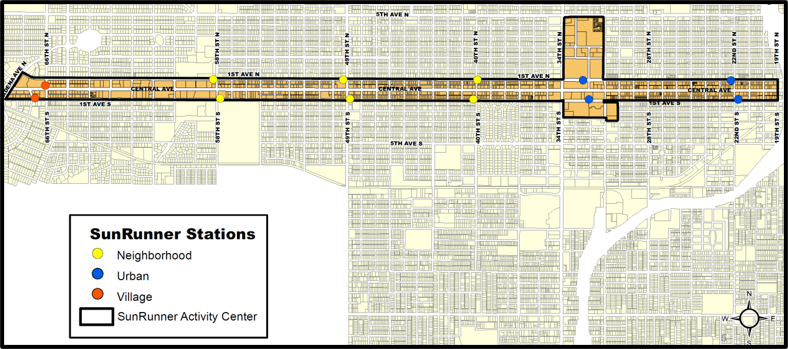
The ordinance is intended to encourage a wider mix of uses, denser development, and transit-oriented development standards beyond what the existing zoning allows (Ordinance No. 633-H). The overlay will affect both residential and commercial properties along the Central Avenue corridor, allowing taller buildings, denser development, and more connected, walkable neighborhoods. Because the overlay is optional, builders can still choose to stick with the zoning rules already in place for a given property, which vary significantly along the 10-mile corridor.
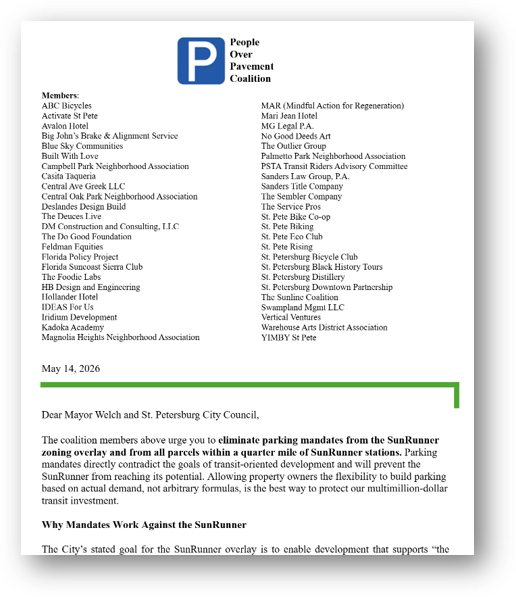
Alongside the big jump in allowed density, one of the boldest moves St. Pete made with this vote was eliminating parking mandates, rules that force developers to build a set number of parking spaces regardless of actual demand, across the Overlay and from all parcels within ¼ mile of a SunRunner station. Eliminating minimum parking requirements near transit lowers development costs and frees up more land for more homes. By executing on this planning best practice, St. Petersburg is once again leading the state on affordable housing policy.
How this happened: This major housing win was made possible by the tremendous advocates on the ground in St. Petersburg. Max McCann of Activate St. Pete and the People Over Pavement Coalition were instrumental to the elimination of parking mandates along the corridor. The Coalition brings together a refreshingly diverse set of groups: local restaurants and businesses, pro-housing policy groups, neighborhood associations, and even an auto mechanic shop. They succeeded by meeting with key city staff and council members, showing up to the meetings that mattered, and (as the coalition’s name suggests) building their entire campaign around the idea of putting people over pavement.
“This campaign showed that passionate advocacy can make a real difference in your community, even on technical and politically charged issues like zoning reform and parking policy." Max McCann, Activate St. Pete
Increases maximum density, intensity, and building height for future residential and commercial development within the SunRunner BRT’s three distinct station area types: Urban, Neighborhood, and Village. Maximum density rises to 150 units per acre in Urban Station Areas, while intensity—measured by Floor Area Ratio (FAR), or the total building area allowed relative to parcel size—increases to 5.0 FAR in the same downtown areas. Maximum building heights increase to 86 feet along the corridor and up to 150 feet for the portion of the overlay extending from 5th Ave N to 3rd Ave S.


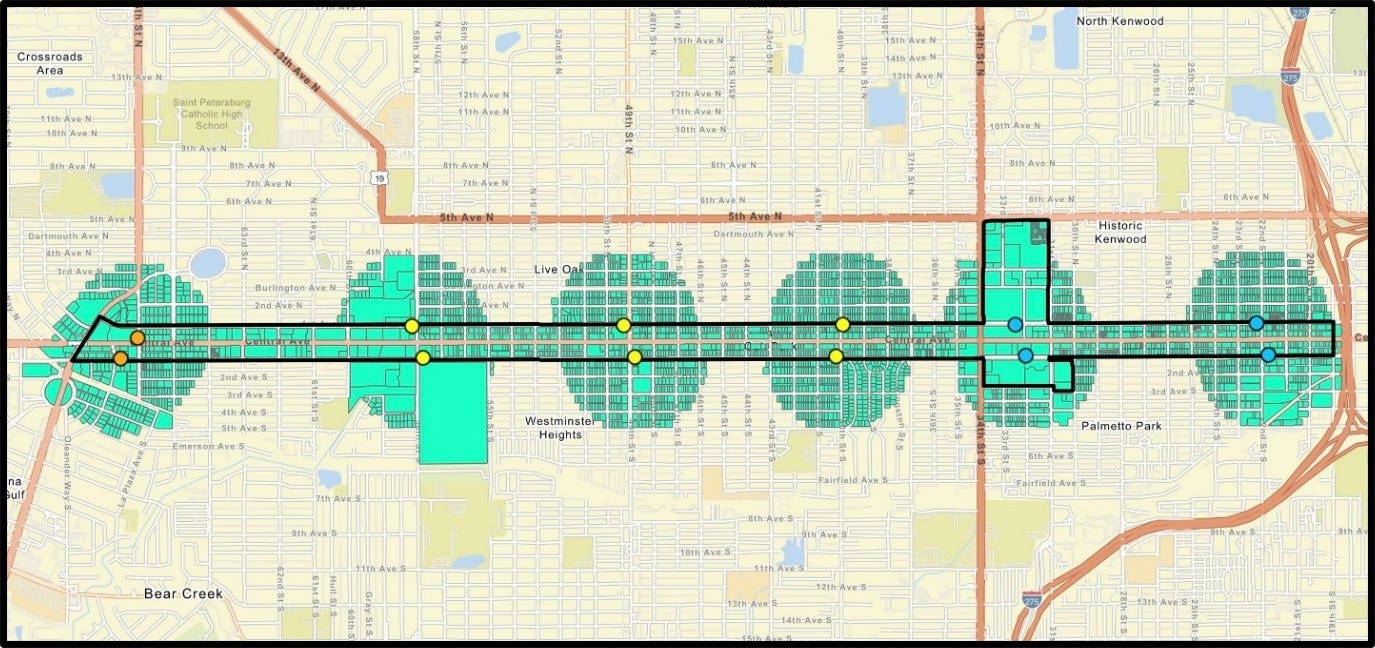
Eliminates minimum parking requirements for any property within the overlay and within ¼ mile of any SunRunner station. This is a major shift in the City’s parking policy, effectively meaning that builders are no longer required to provide a set number of parking spaces for qualifying projects. With structured parking costing developers as much as $50,000 per space, this change could significantly reduce total development costs and lead to more homes in affected projects.
Map of areas along the SunRunner route with no minimum parking requirements—in green:
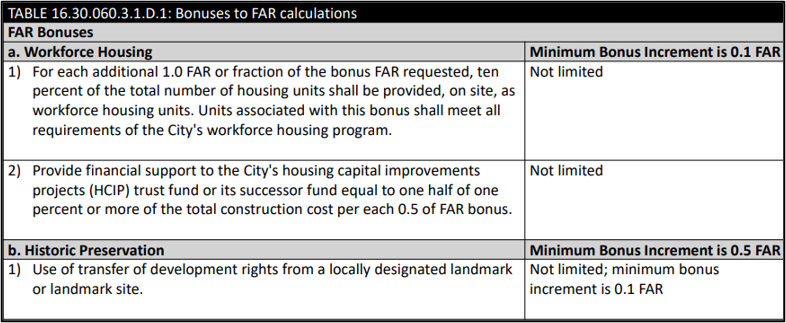
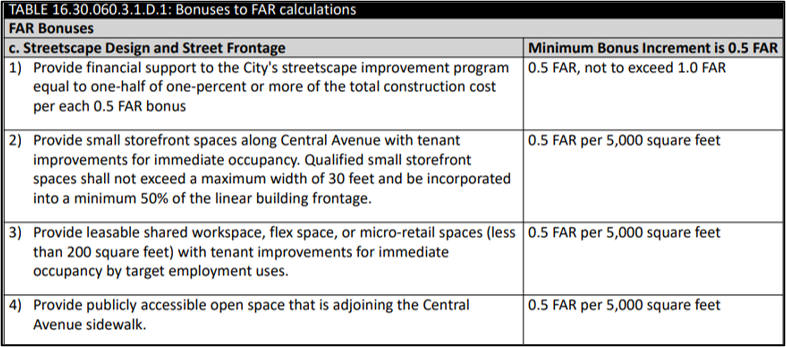
Provides density bonuses to developers that commit to workforce housing, historic preservation, and streetscape design and street frontage improvements for a specific project. FAR bonuses may be granted in several ways, including contributions to the City’s Housing Capital Improvements Projects (HCIP) trust fund to support workforce housing, the use of transfer of development rights from a locally designated landmark or landmark site, or support for streetscaping and retail frontage. The latter includes several options: directly funding the City’s Streetscape Improvement Program; providing small storefront retail space on site; creating leasable shared workspace, flex space, or micro-retail space on site; or creating publicly accessible open space adjacent to and adjoining the Central Avenue sidewalk. A breakdown of the FAR bonuses for all three categories is listed below. (Source: SunRunner BRT Overlay Presentation, City Council 2nd Hearing)
In 2021, the City’s StPete2050 Vision Plan projected demand for 31,000 to 47,000 new homes over the next 30 years, plus an increase of 3.6 to 5.9 million square feet of new retail and office space over the same period. A 2022 Kimley-Horn study estimated that 30 to 40% of those new homes, and between 60 and 80% of new retail and office space could come from upzoned parcels along the SunRunner TOD corridor. (Upzoning means reforming land-use rules to allow more housing per parcel.) It’s not yet clear whether those projections line up exactly with the final dimensions of the overlay adopted last month, but the added density, height, and intensity along the corridor clearly open up significant room for future residential and commercial growth.
Large-scale upzoning of this kind has also been shown to boost housing supply. Some of the strongest recent examples come from New York City and Philadelphia, where new housing was far more likely to appear in upzoned areas than in comparable non-upzoned areas. A 2025 study found that the most heavily upzoned parcels in New York City saw an 8% increase in total housing units within seven years of the land-use reforms. While New York City is approximately 30 times larger than St. Pete by population, similar increases in housing supply are plausible here because both examples of upzoning center on transit-oriented development in walkable, mixed-use areas with access to frequent, reliable, and fast public transportation.
The overlay could also dramatically increase St. Pete residents’ access to reliable transit through the SunRunner Bus Rapid Transit system. In Florida, only 1.1% of housing is within a half-mile of frequent bus or rail transit, and in the Tampa-St. Pete MSA, only 0.6% of all housing is within ¼ mile of frequent bus or rail transit. Because the SunRunner TOD Overlay runs from the centerline of 1st Avenue North to the centerline of 1st Avenue South, which is the area right around the SunRunner stops, it could significantly increase the share of housing located within walking distance of reliable, frequent transit.
From a national perspective, “areas near transit have lower housing costs, are more racially or ethnically diverse, and have lower average incomes than neighborhoods farther from transit in the same urban area” (Urban Institute, 2026). And while the median home value for property near frequent bus or rail transit in the Tampa-St. Pete MSA is $454k, the median household income in those same areas is just $87,000—slightly below the 100% Area Median Income for a two-person household in St. Pete ($91,700). This suggests that upzoning around frequent bus transit can increase or stabilize home values without necessarily pricing out moderate-income residents.
St. Pete’s new SunRunner TOD Overlay is no cure-all for the City’s chronic housing shortage, affordability crisis, or lack of reliable public transit. But it is a meaningful step forward in boosting housing supply—which could lead to more affordable units—and in creating a more connected, mixed-use urban core with greater access to frequent and fast public transportation.
Other local governments with transit corridors should follow St. Pete's lead: repeal parking minimums, raise density limits, and clear the zoning barriers that keep more homes from being built near transit.
Comments
Nothing yet. Say the first thing.
Sign in to join the conversation.