
Today’s musing is a series of quotes on the connected topic of equality.
The Little Thing: Public education
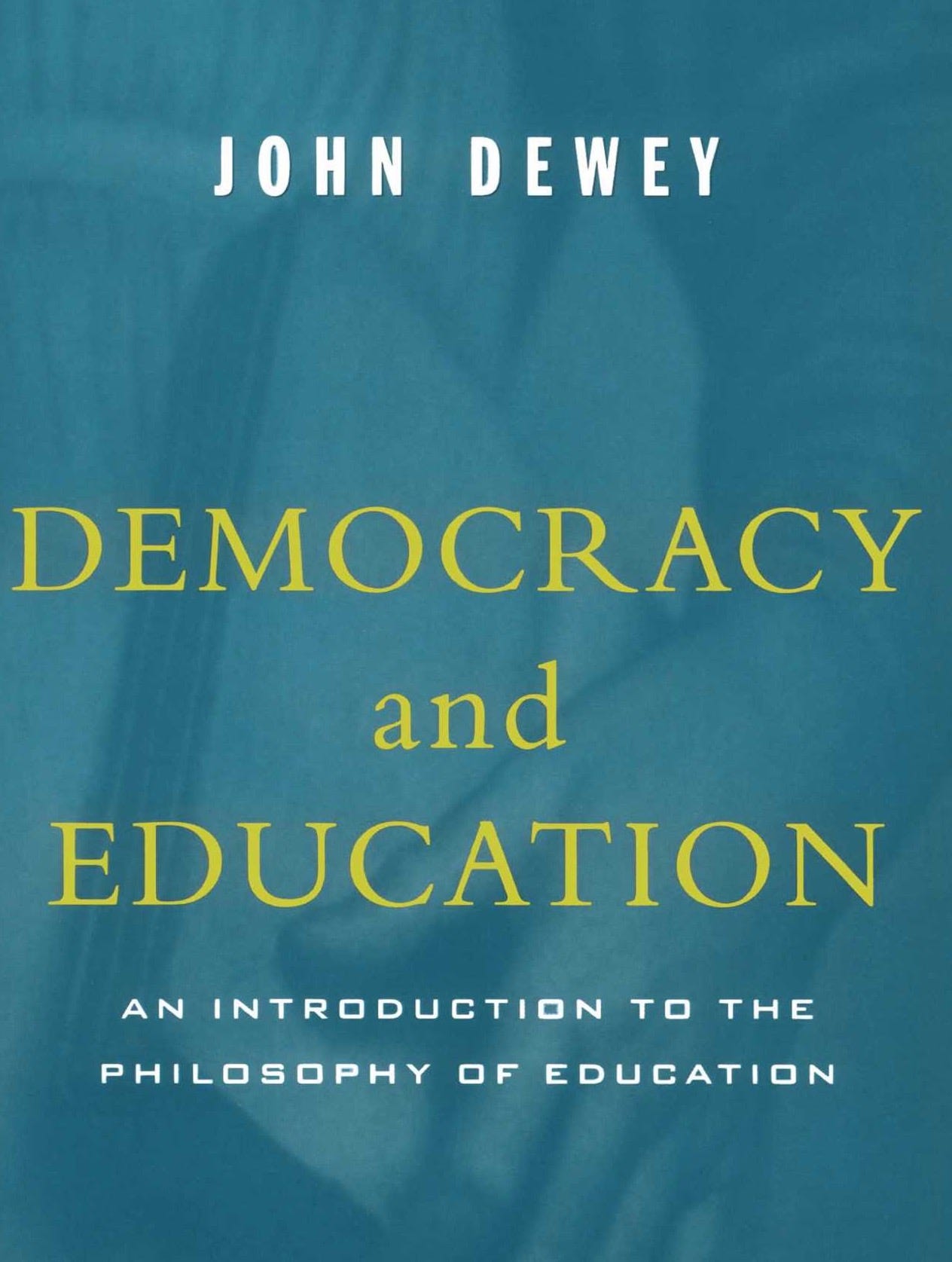
According to American philosopher John Dewey, education is a pillar of a democratic society. To paraphrase Dewey: Without education, no democracy. This applies to any democratic society, Canada included.
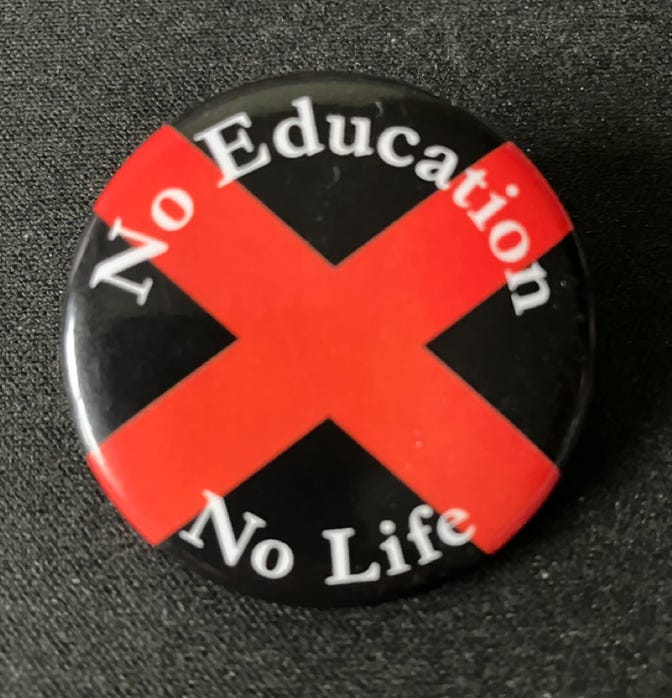
Or, in the words of the Baltimore City Algebra Project: “No Education. No Life.”
More on the Algebra Project later, but first, according to Dewey:
Society exists through a process of transmission quite as much as biological life. This transmission occurs by means of communication of habits of doing, thinking, and feeling from the older to the younger. Without this communication of ideals, hopes, expectations, standards, opinions, from those members of society who are passing out of the group life to those who coming into it, social life could not survive.1
Dewey’s point: Education is necessary for a society to carry on. This necessary outcome is attained through the transmission of knowledge — from one generation to another. Simply put, education transmits useful information across generations, making the continuation of society possible. No education, no life.
But there’s more to it than the mere transmission of data from one generation to the next. The qualities, or characteristics, of education (from inputs to processes to outcomes) matter more than what’s covered by the curriculum, as the curriculum is just one piece of an overall puzzle. Knowledge, gained through experience, of how to be a citizen in a democracy must be at the heart of democratic education.
Students must be vested in their society, because otherwise there is no point in participation, no point for education, no point to society.
Citizenship in a democracy requires knowing how to read, knowing the value of rules, having a sense of belonging to a society (this can be small: classroom, school, neighbourhood, etc.), knowing about, and being entitled to, certain rights, valuing one’s responsibilities to their society, expecting accountability for your actions (and those of others), and seeing a connection between voice, vote, and outcome.
Students must be vested in their society, because otherwise there is no point in participation, no point in education, no point in society. At school, this requires that students be vested in the society of their classroom and school, contextualized within their greater society. School must include you. School must make sense to you. And school must matter to you. Otherwise, the lesson learned, through education, is that society does not matter, does not make sense, and has no place for you.
According to Dewey, education is not merely telling students things to know or do. Educational processes, the experiences of education, lead to the transmission of the knowledge that’s necessary for the society. In Dewey’s view, three ideas lie at the heart these processes. First is the idea of society. Second is the idea of life, especially in terms of the life of a society. And third is the idea of transmission, or of learning, which is attaining knowledge for the purpose of more growth, or expanded capacity.
Dewey defines society in terms of the “democratic ideal,” which is a society based on two foundations: First, widespread common interests. Second, the shared social means by which to respond, as a society, to changes faced by (within and without) that society.
In terms of society, Dewey defines society in several ways. First, he recognizes that there is an “ideal”2 meaning of the word, as in a community with a common interest, which is, for that community, something good; the common good. In this sense, society is a set of relationships stemming from another set of common interests. These interests make cooperation possible (through necessity).
Second, society is any community (or group) of people who have something in common, even if they lack shared values or interests. This includes societies that are governed by a despot or by enslavers, whose interests do not align with the governed or enslaved. But, in such an instance, social life is inhibited because, according to Dewey, it lacks an “extensive number of common interests,” thereby limiting the “free play back and forth between members of the social group”3. A lesser society.
And third, Dewey defines society in terms of the “democratic ideal,”4 which is a society based on two foundations: First, widespread common interests. Second, the shared social means by which to respond, as a society, to changes faced by (within and without) that society. Social mobility, pluralism, and equality of (at least) opportunity are essential components for such an ideal.
How a democratic society transmits knowledge, through education, must reflect democratic and pluralistic aims. In this, education is life, both life of the society, as a whole (a pluralistic democracy), and the life of the members within it (the citizens). Dewey calls the conditions for supporting the democratic ideal of society a “varied intercourse,”5 which functions between groups of citizens and provides the basis for a society readjusting to reality together.
Equality of opportunity and the means for social mobility are the throughputs of these processes. The interplay of these throughputs, between processes within the society and the outcomes of that society, provides an infinite loop in support of democracy.
Equality of opportunity and the means for social mobility are the throughputs of these processes. The interplay of these throughputs, processes within society and outcomes from society, provides an infinite loop in support of democracy. Feed equal opportunity and social mobility into society and get back a democratic society, which then, in turn, feeds equal opportunity and social mobility back into it. Repeat and repeat. Education is a both a means of this loop and an outcome of it, as education makes equal opportunity and social mobility possible, which in turn makes democratic education possible. Repeat and repeat.
Education is the loop, and the conditions for democracy are both its inputs and outcomes, with equal opportunity and social mobility satisfying these necessary conditions. They are not optional and are not merely “in the interest of” those who stand to benefit from the opportunities and mobility. There can be no democratic society without these throughputs, which Dewey called “varied intercourse,” the means by which democracy survives, made possible through education.
The details of transmission therefore must be embedded into democratic education, which must also embody the aim of sustaining democratic society. Education, in a democracy, must therefore be democratic and students must experience democracy in education.
The specifics of the “how” (the qualities) of education matter. The kind of society you are aiming to transmit (pass down) from one generation to another depends not solely on transmission, but also on what is what is transmitted. The details of transmission therefore are embedded into a democratic education, embodying the aim of sustaining democratic society. Students must therefore experience democracy in education.
For example, I worked with the Algebra Project in Baltimore City, when I was a community organizer in Baltimore in the early 2000s. Through this organization, inner city high school students and teachers worked together to demand access to quality public education for all. The project’s aim was to teach democratic engagement around the value of education itself. Through engagement, centred around the economic human right to an education, participants not only learned about democracy, but they also enacted it. Transmission in its fullest meaning.
Opportunity, education, and mobility are requirements for democracy, and it is education that maintains this part of the system.
The Algebra Project’s mantra (“No Education. No Life.”) is emblematic of the notion of education as not only key to the life of a society but also to the members within it. Dewey’s philosophy of education goes beyond the truism that complex and rich societies need skilled and knowledgeable people to run it, because complex and wealthy are not analogous to democratic. Opportunity, education, and mobility are requirements for democracy, and it is education that maintains this part of the system.
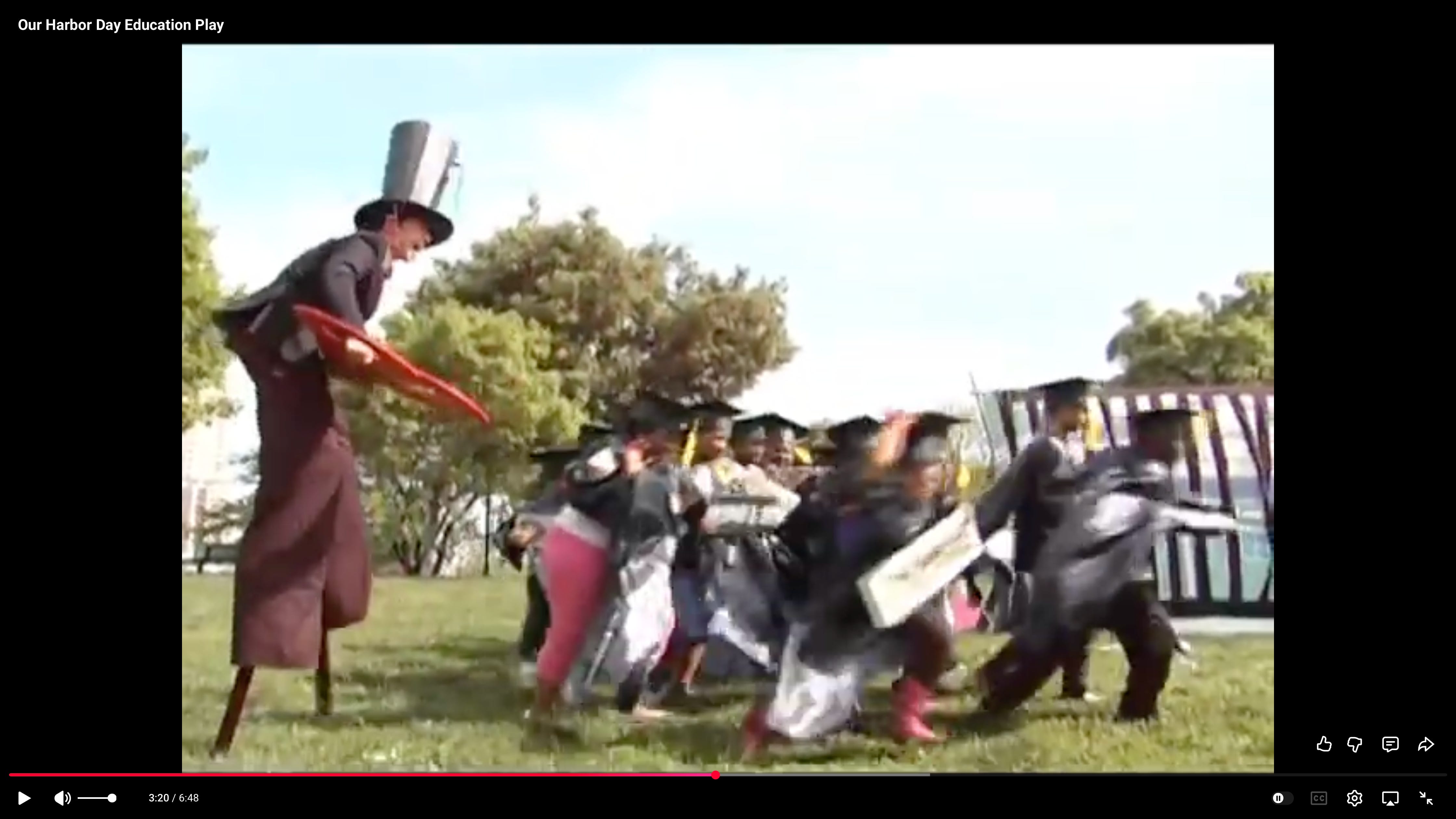
The screen shot above is from a video6 of Algebra Project student-leaders taking part in “Our Harbor Day,” which, according to the event’s poster, was a “cast of hundreds in a community-wide participation play to retell the people’s history of human rights and social justice struggles”7. The day was organized by the United Workers, an economic human rights organization that I worked with for several years, since its founding by homeless day labourers in the early 2000s.
The day of street theatre started in three neighbourhood locations spread throughout the city. At each location, a community group performed a scene related to their community’s economic rights. One organization of day labourers and retail workers in the downtown core focused on workers’ rights, another group focused on environmental stewardship, and the third, Algebra Project, focused on the right to an education. Students told the “pipeline to prison” story, that centred on the governor taking funds from schools in order to build a massive new juvenile jail.
Their play started with students graduating, on their way to becoming nurses, teachers, police officers, doctors, etc. Next scene: The governor’s budget cuts take money from the city’s schools to pay for a new prison for youth. Graduation photos are turned into mug shots; opportunities are limited, education is displaced. At the scene’s end, the chains of poverty are broken, affirming the power of education and democracy.
Students, and their audience, then packed up to march to City Hall and finish the play by going back in time to hear Harriet Tubman urge the community to “keep going” with the struggle to end poverty.
There is hope in recognizing education as life. Learning to read, that is hope. Speaking your voice, that is hope. Being part of a society, that is hope. This matters most when there is nothing but hope. Without hope, why carry on? But with hope, you stand together, you fight for your rights, you expand human dignity, you increase human power, and you build educational systems that keep hope alive.
Telling the story of hope in past times, such as the hope embodied by Harriet Tubman in her armed struggle against slavery, and the hope embodied in the history of enslaved Americans who resisted slavery for centuries, and the hope told by the students of the Algebra Project, is how we sustain democracy. This is education for life, for the life of our society.
Imagine the hope required of enslaved Americans, before emancipation, to teach each other how to read and write, to transmit the knowledge of a promise that through education and literacy freedom will, one day, be at hand. This is the hope of shared freedom, of universal dignity, and of human rights. It is the hope that freedom, dignity, and rights can be re-captured back — through acts of literacy, reading as resistance, and education.
The hope that education provides is that a society, based in pluralism, democracy, and equality, “shall not perish from the earth.”
Liberation from institutional slavery in North America happened through widening literacy, moral leadership, expanded education, and the determination, and power, of a democratic state in overcoming its own fatal constitutional contradiction, by all means necessary. A republic based in liberty, equality, and freedom cannot endure slavery within it — democracy and institutional slavery cannot coexist.
The contradiction of enslavement versus democracy almost ended American society. Constitutional reconciliation came only after a civil war. While slavery is no longer grafted onto the supreme law of the land, the country’s advocates for inequality, those who oppose racial justice, remain committed to their struggle against human rights for all. If given the chance, they’d bring back a society of inequality, division, and singularism. They are fighting for this chance in our streets today, but the hope that education provides is that a society, based in pluralism, democracy, and equality, “shall not perish from the earth”8.
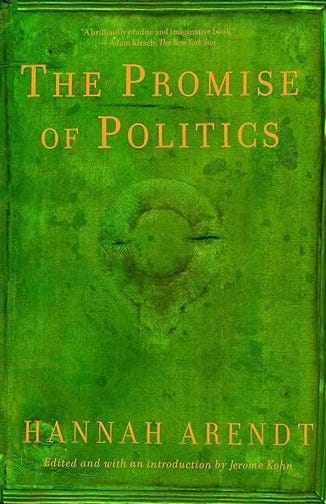
Hannah Arendt’s “Promise of Politics,”9 published after her death and based on several of her unpublished manuscripts, is about politics and philosophy. Arendt did not want to be considered a philosopher10, opting instead for active thinker. Applied thinking, in the context of the here and now, was her focus. Not thinking to think; but thinking to act, that was her mantra.
Arendt’s thinking about totalitarianism, both fascist and communist, informs how we understand the 20th century in terms of its horrific wars and terrible tragedies. She placed the millions of countless little actions, carried out by ordinary people like you and me, in moral terms — terms that we should think about in the context of our actions today. Our era starts on the ugliest of terms. Governments, led by the likes of Adolf Hitler, Joseph Stalin, and Mao Zedong, killed millions of people in their pursuit of pure ideology and personal power. Millions more suffered, as well as countless others who simply endured.
These terrible men all headed regimes that were death machines; systems of power aimed at controlling life and destroying humanity. They ruined the lives of the ordinary millions. As mentioned in the first Fleas and rats post, Margaret Thatcher once famously asked “who is society?” Her answer was that “there is no such thing! There are individual men and women and there are families and no government can do anything except through people”11.
As it was not Thatcher, alone, who broke the miners’ unions and who broke social democratic Britain, so too it was not Hitler, Stalin, or Mao, alone, who did all of their killing. They each needed their masses to do this work for them. The followers, or workers, of fascist and communist regimes, driven by ruthless and indifferent leaders of administrative (death-machine) regimes, were also not alone in making possible the pursuit of reckless power for a system or ideology. They were led by tyrants. In truth, many of these workers are not to blame, as the system of death that they took part in was run on their involuntary support and it was kill or be killed (sometimes immediate, sometimes distant). That said, there were also many functionaries who knew better and who willingly took part in the killings.
We also know that fascism and communism are not alone in constructing death-machine systems. Capitalism and liberalism have blood on their hands, too. Imperial exploitation by the British Empire and slave-republics like America provide stark reminders of how complicit so many human hierarchies are in producing bad outcomes for humanity. The foundations of modern liberal society include chattel slavery, a system which parallels the horrors of the Holocaust. How we navigate these realities, according to Arendt, is determined by how well we think. She challenged us to think of the here and now, of our places in the reality of today, and in what we each decide to do when faced with seemingly impossible choices between life and death for our society.
Some ideologies produce only destruction, as that is their sole aim, while others muddle along, weaving together both the good and the bad of emergent properties manifesting between our actions and the resulting outcomes.
Some ideologies produce only destruction, as that is their sole aim, while others muddle along, weaving together both the good and the bad of emergent properties manifesting between our actions and the resulting outcomes. But as far as outcomes are concerned, intentions do not matter. Outcomes simply “are” (or “are not”). At the end of any social process is an outcome that is determined by the actions put into the process, outcomes that we must live with, regardless of our intentions and regardless of what we wanted them to be.
In her book “On Violence,” Arendt writes that, “bureaucracy is the form of government in which everybody is deprived of political freedom, of the power to act; for the rule by Nobody is not no-rule, and where all are equally powerless, we have a tyranny without a tyrant”12. In “The Promise of Politics” Arendt expands on this idea, writing:
Bureaucracy is a form of government from which the personal element of rulership has disappeared, and it is also true that such a government may rule in the interest of no class. But this no-man-rule, the fact that in an authentic bureaucracy nobody occupies the empty chair of the ruler, does not mean that the conditions of rule have disappeared. This nobody rules very effectively when looked upon from the side of the ruled, and what is worse, has one important trait in common with the tyrant.
Tyrannical power is defined by tradition as arbitrary power and this originally signified a rule for which no account need be given, a rule that owes no one any responsibility. The same is true for the bureaucratic rule by nobody, thought for an altogether different reason. There are many people in a bureaucracy who may demand an account, but there is nobody to give it, because ‘nobody’ cannot be held responsible.13
Last week, I wrote of the world-wide rallies to protest against President Trump’s modern-day tyranny. These rallies are named “no king” to evoke the American War of Independence, a war of a revolution that embraces the self-evident truth of human equality and the belief that all humans are created equal. So, who is our biggest tyrant now?
Is it Donald J. Trump? Or is it No-body, the administrative state? Could it be both?
We are seeing this question play out on the streets of America, with two sides both fighting against their own worst tyrant. For one side, the president is the tyrant, head of an increasingly lawless state that’s armed with a federalized force of public Klansmen. For the other side, the state was already lawless, run by its invisible bureaucracy and accountable to Nobody. Neither side offers an alternative. It’s either rule by autocrat or rule by bureaucrat.
Is public education, a pillar of our democracy, no longer run at the level required for this democratic society to survive?
Public schools, and the democracy they are meant to help sustain, are in danger. The power of “rule by Nobody” threatens to take hold of our public school system. De-professionalism (discussed in last week’s post) is already taking its toll on public education. With de-professionalism goes teaching, standards, and education. Again, I ask: Is it too late?
We must ask ourselves: Is public education, a pillar of our democracy, no longer run at the level required for this democratic society to survive? Have we lost our ability to put responsible adults in charge of exercising the professional judgement that is required to care for, and properly educate, the next generation?
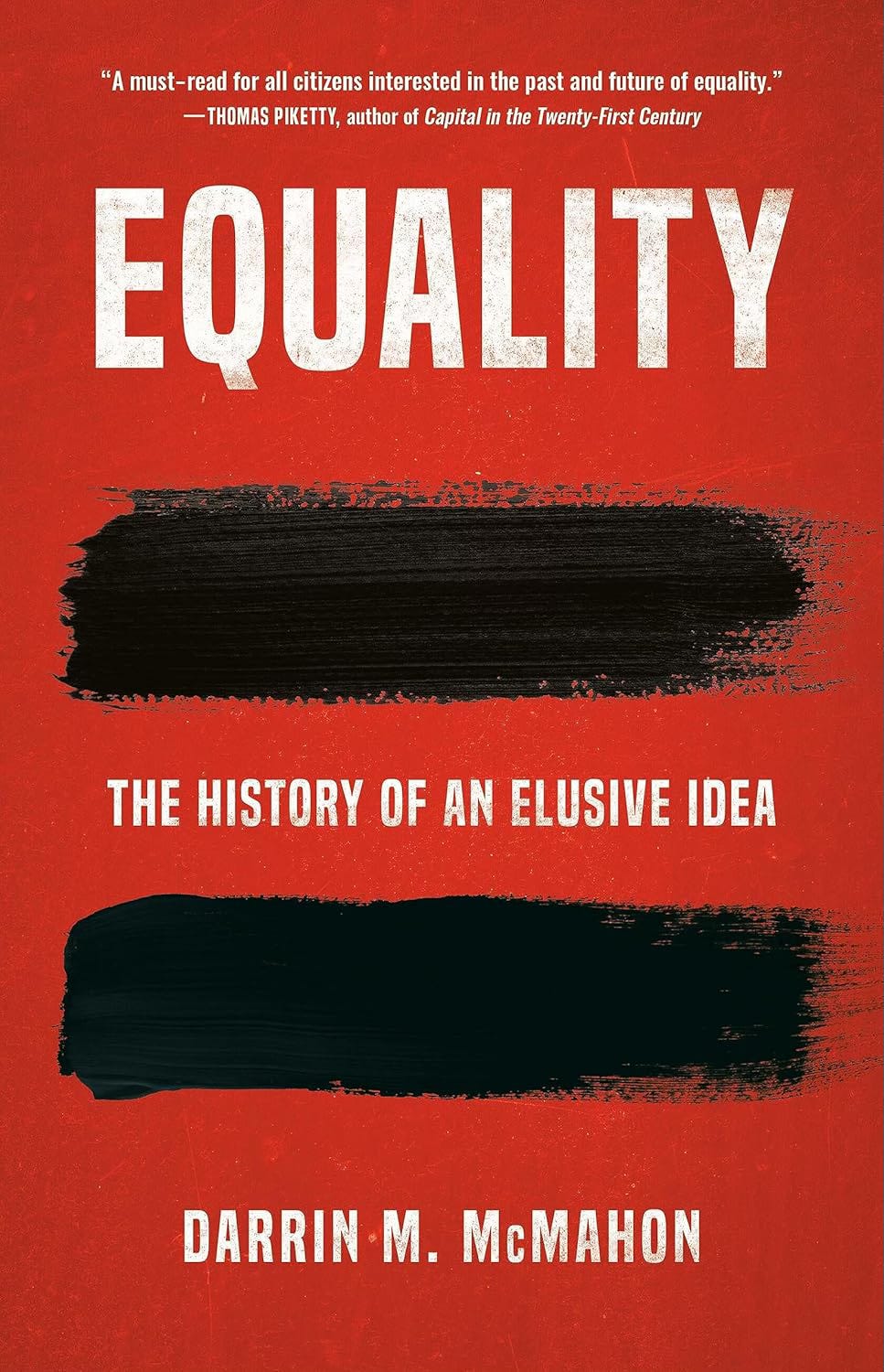
Today’s musing ends with a warning, of sorts, from Darrin McMahon’s book on the history of the idea of equality:
[In the 2010’s] equality’s horizon was receding from public view, to be replaced by what British sociologist Mike Savage has aptly called the new “inequality paradigm,” which focuses attention on inequalities of every kind. From the glaring disparities in wealth and income between rich and poor, north and south, present or past, to the disparate effects of climate change or pandemics, to the ongoing impacts of colonialism and slavery, to vastly different outcomes in education, life chances, and health owing to ethnicity, gender, or place of birth, the subject is as expansive as the inequalities that divide the people of the world.14
The warning is this: The opponents to the pursuit of equality, as a paramount aim for the government, use the failings in achieving the aim to challenge the entire idea of equality. Their logic is this: Equality remains an elusive aim. And that is reason enough to stop its advancement as a political goal. They continue: Because the proponents of equality offer little more than a hope and a dream, it’s better to focus on other goals instead.
In place of hope, these opponents of equality tell us give up instead.
In place of hope, these opponents of equality tell us to give up instead. Because we have not achieved the aims of equality in opportunity, equality in living standards, equality in life spans, and equality in social power and mobility, then let’s give up and stop working for increased opportunity, improved living standards, greater life spans, and more power and mobility. Absolute equality is not possible, so let’s not even try.
For some, the reason to oppose the aspiration of equality is because they have always disagreed with the idea of it. They believe that not everyone is born of equal worth, not everyone has equal dignity, and not everyone deserves equal rights. For these opponents, their position is clear. They simply do not agree that equality is a worthwhile goal. But for its other opponents, the reason to oppose equality is because time is against the fight to achieve it. There simply is too much need to be met, so fighting for equality isn’t worth the time or effort.
To those who say that absolute equality won’t happen: They are likely right. Differences and hierarchies will always exist and it’s impossible to have a free world with absolute equality in outcomes.
To those who say that absolute equality won’t happen: They are likely right. Differences and hierarchies will always exist in human society. It’s impossible to have a free world and absolute equality (in outcomes). But, in practice, it’s not impossible for legal systems to exercise equality of law. It’s not impossible for health care to be paid for on a universal basis (in system where nobody pays for their own health care directly). Disability and social security payments can be provided for on a universal basis, as can workplace protections, collective agreements, and health and safety regulations. Possible also: Free and universal education for all. Approximate equality, moving ever closer to fully attained equality, is possible.
Dewey’s “ideal society” is one of shared interests that includes mobility within the hierarchies that exist within any social system of tens of millions of people. Education that transmits the knowledge, on an equally open basis for all children and youth in the society, makes it possible for such a system to continue. While imperfect, the Canadian democracy in which we live improves our lives across metrics of health, life span, security, safety, and happiness. Any changes to the system should produce at least equal, if not better, results. And in the meantime, we must carefully protect and continually sustain the education system on which transmission of the knowledge needed to continue this system into the future depends.
Democracy and Education: An Introduction to the Philosophy of Education, by John Dewey, The Free Press, Simon and Shuster, 1916, 1944, page 3
Democracy and Education: An Introduction to the Philosophy of Education, by John Dewey, The Free Press, Simon and Shuster, 1916, 1944, page 82
Democracy and Education: An Introduction to the Philosophy of Education, by John Dewey, The Free Press, Simon and Shuster, 1916, 1944, page 84
Democracy and Education: An Introduction to the Philosophy of Education, by John Dewey, The Free Press, Simon and Shuster, 1916, 1944, page 86
Democracy and Education: An Introduction to the Philosophy of Education, by John Dewey, The Free Press, Simon and Shuster, 1916, 1944, page 87
United Workers Association
The Promise of Politics, by Hannah Arendt, Schocken Books, 2005
On Violence, by Hannah Arendt, Harvest/HBJ, 1969, 1970, page 81
The Promise of Politics, by Hannah Arendt, Schocken Books, 2005, pages 77-78
Equality: The History of an Elusive Idea, by By Darrin M. McMahon, Basic Books, 2023, page 406
No posts
Comments
Nothing yet. Say the first thing.
Sign in to join the conversation.