
Today’s musing is a series of quotes on the connected topic of tyranny.
The Little Thing: Working together
The aptly named “No Kings” rallies (“since 1776”) were held throughout the United States on Saturday. Millions rallied, around the world, for American democracy1.
These rallies smartly use “kings” as their rallying cry, evoking the tyranny of King George III for key messaging (instead of a more modern association, such as “authoritarianism”). Kings and tyrants work because what’s happening in the United States is happening there, not someplace else.
Bruce Springsteen, in his recent song “Streets of Minneapolis,” evokes something similar to this. His lyrics are distinctly American, with the federal ICE agents described as “thugs,” up against the “citizens [who] stood for justice,” in “the dawn’s early light,” after ICE agents killed U.S. citizens Alex Pretti and Renee Good. Springsteen describes the masked agents of Operation Metro Surge this way:
Trump’s federal thugs beat up on his face and his chest
Then we heard the gunshots and Alex Pretti lay in the snow dead
Their claim was self-defense, sir, just don’t believe your eyes
It’s our blood and bones and these whistles and phones against Miller and Noem’s dirty lies2
The American Revolution remains, even now, at the heart of American identity and its revolutionary ideals provide the basis for the structure and rules of American government. The U.S. system is a product of a revolution, one which rejected a monarch, and the tyranny that he represented, by embracing the self-evident truth of human equality (albeit in deeply contradictory ways).
President Trump is an American president. He is not a Russian tzar, nor a German führer, nor an Iranian supreme leader, nor a Venezuelan president.
This messaging matters because America is America, not someplace else. President Trump is an American president. He is not a Russian tzar, nor a German führer, nor an Iranian supreme leader, nor a Venezuelan president. And it is therefore up to Americans to determine what happens next, in the time and place of here and now.
It is Americans who will determine what happens with ICE and the upcoming midterm elections. It is they who will decide whether or not January 6th will be repeated (which, according to a CBC headline, was a “near-death experience” for American democracy)3. And it is Americans who will determine if masked federal agents will be allowed to assault them and their civil liberties4.
These issues are also at stake: Will American residents be sent to torture camps abroad56, will the U.S. expand mass surveillance7 and mass detention8, and will the country continue to wage wars of aggression around the globe9?
To face all this, America must deal with Civil War resentment, Jim Crow revivalism, and Klan rebirtherism, a trifecta of historic forces bubbling up, once again, to the forefront of the nation’s internal grievances. But more than moving away from the past, the struggle today is over America’s future.
It is a fight between the (old) New Deal and today’s robber barons. Is wealth to be spread out or concentrated? It is also a fight over the 13th and 14th amendments, placing equal rights, under the law, within a constitutional mandate including all who reside in America under its promised protection. For the (old) New Deal, this is looking like a fight to the death. Same for the struggle for equality and racial justice, which closely dovetails with the fight for economic security and working class prosperity for all.
The rising tide of neighbourly love and can-do spiritism is quickly colliding with the technological breakdown of politics and economics in real time, including the technologies of isolation, fever politics, fentanyl, and automation
The rising tide of neighbourly love and can-do spiritism is quickly colliding with the technological breakdown of politics and economics in real time, including the technologies of isolation, fever politics, fentanyl, and automation. We are on a crash course to somewhere, even though we have no idea where it’s headed. The fabric of liberal societies globally is being torn apart, thread-by-thread, in these heated battles over the future of our world.
We are living through America 2026. To understand what’s happening now, we must remain as grounded in the present as possible, as we avoid simplistic political metaphors that won’t help us understand the context of the United States today (and the world today). Travelling to another time and place of the past won’t help us understand our struggles today.
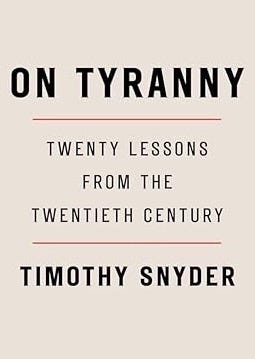
Timothy Snyder hits this nail on the head in his short book “On Tyranny”10. In it, he lists twenty things that we should do to prevent the end of liberal democracy in the United States (and other liberal democracies around the world). The lessons come from the past. What we do now is what determines our future.
Two, of his twenty strategies, stand out:
Remember professional ethics.
Defend institutions.
Strategy One: Remember Professional Ethics
My masters thesis (in educational leadership) is about the importance of professional ethics11. In it, I list the legal, institutional, and administrative framework for professionalism in the practice of public education in British Columbia
While I am not going to dig into the strategy of maintaining professional ethics in this post, there is one thing that surprises me looking back, six years ago, to when I wrote the paper for my masters degree. In just over half a decade’s time, most of the self-regulatory bodies and regulatory frameworks that had been in place, and that I referenced in the thesis, are now gone. Gutted.
This makes the paper, which was on how these institutional frameworks made teaching with integrity possible, now out of date. The point of the paper was that teaching with integrity is possible because of those professional frameworks. Teachers working within the frameworks could ensure that their practice upheld student dignity and fulfilled educational mandates.
While different frameworks are in place, these are not professional bodies, as they are not independent of the same government agency that now employs, certifies, and regulates the occupation of public school teacher in the province. Checks and balances: Gone. Independent professional bodies: Gone.
All this means that teaching is no longer recognized, in British Columbia, as the self-regulated profession that it once was12. Where does that leave us teachers, in terms of our professional ethics? When the government takes away the bodies that once governed those ethics (through professional self-regulation), accountability, transparency, and professional knowledge are too easily pushed aside.
Is it too late?
Strategy Two: Defend Institutions
Snyder also writes about the importance of defending institutions:
Defend institutions. It is institutions that help us to preserve decency. They need our help as well. Do not speak of “our institutions” unless you make them yours by acting on their behalf. Institutions do not protect themselves. They fall one after the other unless each is defended from the beginning. So choose an institution you care about—a court, a newspaper, a law, a labor union—and take its side.13
This has been a call to action, for me personally, since I first read the book. That said, I find that, just as with ruptured professionalism, we are already in troubling time when it comes to public institutions. For example, important institutions have already fallen into the authoritarian traps of internal-censorship, anti-pluralism, and illiberalism. Additionally, rules and processes are increasingly undermined by institutional leaders who don’t see value in the institution itself, but rather only in what the institution can do for them.
So, which of “my institutions” do I focus on defending? The local teachers’ union? The provincial teachers’ union? The provincial public school system? My congregation? My church? The once social democratic political party? City Council? The Labour Council? Or do I focus on the more mundane, such as my city’s public library or its public water system? These institutions, all of which I am a supporter of, face challenging times. They are all struggling to hold it together.
Again, is it too late?
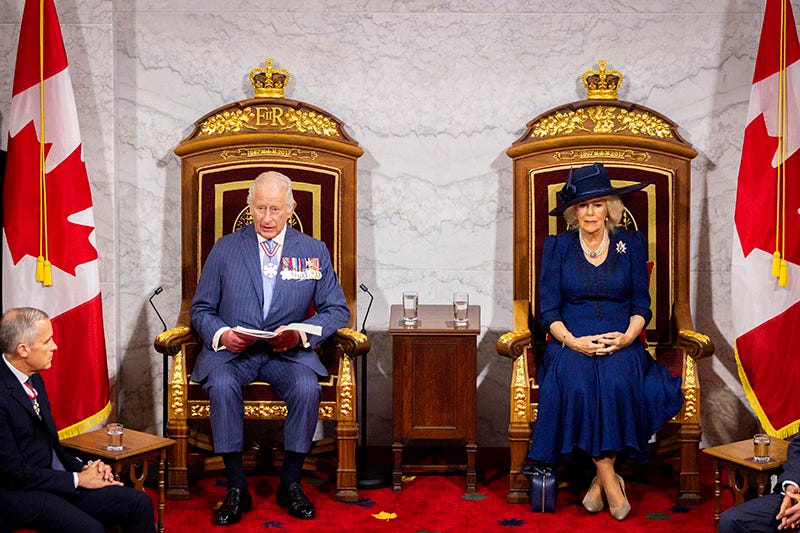
Prime Minster Mark Carney’s speech14 on the rupture of the international order still has me thinking. But it’s not a quote from the speech that I want to share first. Rather, it’s a quote from Snyder that stands out — mostly in its similarity to the Prime Minister’s speech:
When the dissident thinker Václav Havel wrote “The Power of the Powerless” three decades later, in 1978, he was explaining the continuity of an oppressive regime in whose goals and ideology few people still believed. He offered a parable of a greengrocer who places a sign reading “Workers of the world, unite!” in his shop window. It is not that the man actually endorses the content of this quotation from The Communist Manifesto. He places the sign in his window so that he can withdraw into daily life without trouble from the authorities. When everyone else follows the same logic, the public sphere is covered with signs of loyalty, and resistance becomes unthinkable.15
Here’s what Prime Minister Carney wrote in his speech:
In 1978, the Czech dissident Václav Havel, later president, wrote an essay called The Power of the Powerless. In it, he asked a simple question: how did the communist system sustain itself? His answer began with a greengrocer. Every morning, this shopkeeper places a sign in his window: “Workers of the world, unite!” He does not believe it. No one believes it. But he places the sign anyway – to avoid trouble, to signal compliance, to get along. And because every shopkeeper on every street does the same, the system persists.16
This makes me curious. Did Prime Minister Carney not only read “On Tyranny” but did he also want to telegraph this to Canada and the world in the Davos speech?
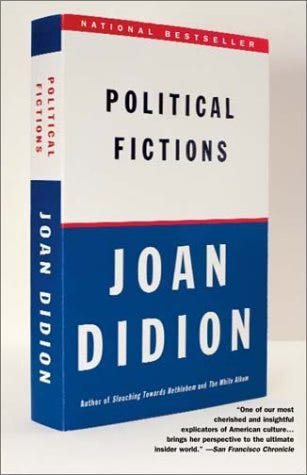
Finally, a quote from Joan Didion from her 2001 book, which looks back at American politics of the 1980s and 1990s. The rupture did not start today. And part of the rupture stems from the identity politics first perfected by rightwing Republican strategists in the 1980s forward. We call these "culture wars” for the right and “identity politics” for the left, but the two terms are two sides of one coin.
The impact of both culture wars and identity politics has been to wreak havoc for both ends of the political spectrum. While the origin of these politics may have more to do with information technology and marketing science than with political ideology, the impact is, today, political and economic.
The two sides of this coin are, at first, appealing because they speak to the core of who we are as humans. Culture wars appeal to our sense of morality and ask us work together for a just society. Identity politics also appeal to our sense of what is right and wrong, asking us to include everyone and to respect universal dignity. Politics based on these instincts ask us to aspire to be better as a society.
These tactics narrow the focus (and pit one side against another) by building support through division. The invitation is warped by these processes and it all becomes a bit of a bait and switch — start with an appeal to our better angels and then divide us against each other. Supporters who care about right and wrong (from one set of values or another) are mobilized, and then pitted against each other. This unites subsections of society by dividing them against other subsections of society, a cynical form of politics that creates an ever-growing snowball of resentment, isolation, and division.
We pay a heavy price for these tactics. In the passage below, Didion describes a Republican political event held right after the impeachment vote for President Bill Clinton. The chapter is “Vichy Washington,” which provides the frame for the significance of the impeachment and those gathered to celebrate their “win”.
In retrospect, the story (in the chapter) and the title (of the chapter) particularly resonant with where we are now. Was the impeachment of President Clinton the start of the flood — a flood caused by the double-sided coin of culture and identity at the heart of political mobilization?
Did this mark the beginning of the end of the political era that was in place prior to today’s era? And if so, are the Republicans of that era the founders of these times, setting in motion what is so clearly unfolding today? Did Republican strategies invent identity politics?
Didion writes:
This evening could have seemed, for those who still misunderstood the Reagan mandate to been based on what we now call “social” issues, the last redoubt. Familiar themes were sounded, favorite notes struck. … Mentions of “Maxine Waters” were cues for derision. “Barney Frank” was a laugh line. The loneliness of the shared position was assumed, and proudly stressed.17
Is this when it became too late?
“Streets of Minneapolis” by Bruce Springsteen, produced by Ron Aniello Bruce Springsteen, distributed by Columbia Records [Lyrics from https://springsteenlyrics.com]
On Tyranny: Twenty Lessons from the Twentieth Century, by Timothy Snyder, 2017, Crown (Random House) 2017
While many collective agreements in British Columbia continue to recognize, on a district-by-district basis, teachers as professionals who are expected (and recognized) to practice professional autonomy, the legal framework of professionalism has been gutted. Professional, meaning collective, ethics require frameworks that are grounded in the public interest, democratic institutions, and an independent profession. That system is no longer in place, meaning that independent self-regulation of teaching in B.C. is no longer the case.
On Tyranny: Twenty Lessons from the Twentieth Century, by Timothy Snyder, 2017, Crown (Random House) [22]
On Tyranny: Twenty Lessons from the Twentieth Century, by Timothy Snyder, 2017, Crown (Random House) [36]
Political Fictions by Joan Didion, 2001, First Vintage (Random House) [251]
No posts
Comments
Nothing yet. Say the first thing.
Sign in to join the conversation.