
If you find this content useful, share it with a friend, become a paid subscriber, or gift a subscription. Paid subscriptions give you full access to all interviews & articles and help my Substack climb the rankings to reach more readers.
In case you want to listen to the interview on Spotify or Apple Podcasts:
Spotify: https://open.spotify.com/episode/5CUdKZeh76AXiFHLC246as
Apple Podcasts: https://podcasts.apple.com/us/podcast/united-states-of-silicon-the-only-trustworthy/id1863496846?i=1000777147194
Ever heard about Pax Silica? Probably not. But it’s up there together with Pax Romana and Pax Britannica. At least that’s the claim and the intent of those who launched the Pax Silica initiative in December of 2025.
Eras are usually declared after the fact. The Pax Romana was declared more than a thousand years after it happened. Not so Pax Silica: it’s an announcement of an era that is in the process of being created right now - or at least that’s the hope of Pax Silica’s architects.
Eras used to be named after geographic locations. Not Pax Silica. It’s named for the material that functions as a semiconductor and enables AI control systems.
In our interview, Courtenay Turner argues that this Silicon Peace era is creating global control systems that turn human beings into data “nodes” within a programmable “security economy.” The traditional concept of autonomous citizens with individual rights is disappearing; humans will have no meaningful say in the AI governed world of Pax Silica.
“People are not part of this equation because people have become nodes. We're just nodes for that infrastructure.”
Turner is the host of The Courtenay Turner Podcast. She and Patrick Wood co-authored the recently released The Final Betrayal: How Technocracy Destroyed America, a book about the rise of technocratic control systems. You can find her substack here.
Why so openly and grandly declare the United States as the hegemon over global AI supply chains? Perhaps to put a stake in the ground and signal America’s intention to reward those countries that go along and accept America as the AI hegemon - and to entice, cajole, warn or punish those that resist going along (like China).
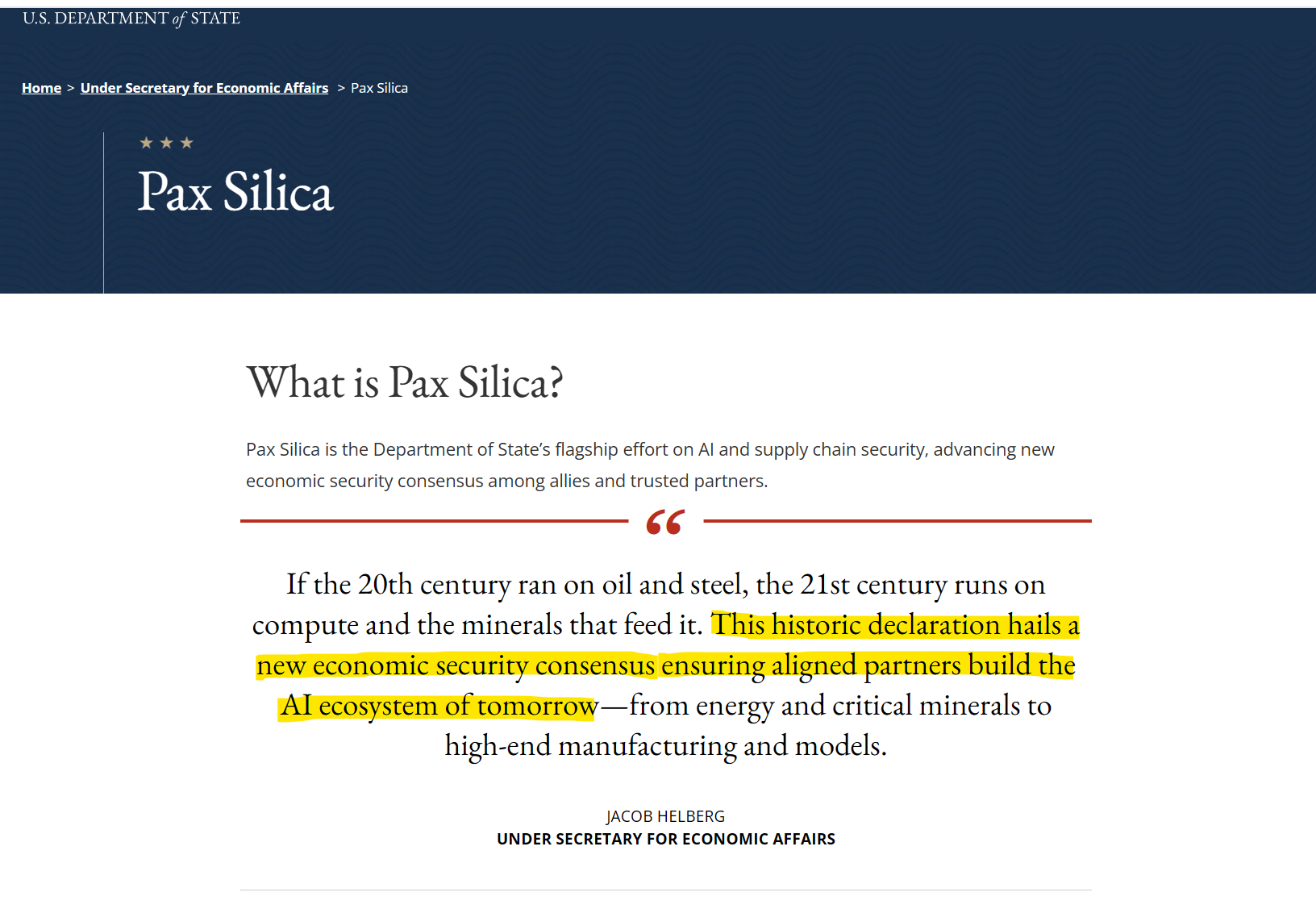
The quote above is from Jacob Helberg. He’s a French and American technology policy insider and the current Under Secretary of State for Economic Affairs. Helberg apparently played a crucial role in the conception and writing of the Pax Silica declaration.
In the quote, he makes it clear that the United States is dead serious about pursuing and reaching global AI supremacy: it’s a “historic declaration,” Helberg writes, that “hails a new economic security consensus” for those that fall in line. “Aligned partners” will “build the AI ecosystem of tomorrow.”
And what ensures that this AI ecosystem is being built correctly?
The “new economic security consensus” ensures aligned partners build this AI system. But what is this economic security consensus? Is it the consensus that economic security can only be achieved under the AI hegemony of the United States?
Who are the aligned partners? And what happens to the non-aligned? Are the unaligned also potential partners? That would be first and foremost China. Can it be aligned? Can it be enticed, cajoled, persuaded or forced to align?
It’s interesting: “National security” is mentioned just once in the two page Pax Silica declaration. “Economic security” is mentioned six times.
“Mutual economic security” depends on a reliable supply chain, the declaration says. But what does a reliable supply chain depend on? It depends on the use of trustworthy AI systems. And such trustworthy system, we already know from the declaration, can only be AI systems developed within America’s AI hegemony.
Therefore, without American hegemony there won’t be economic security nor prosperity:
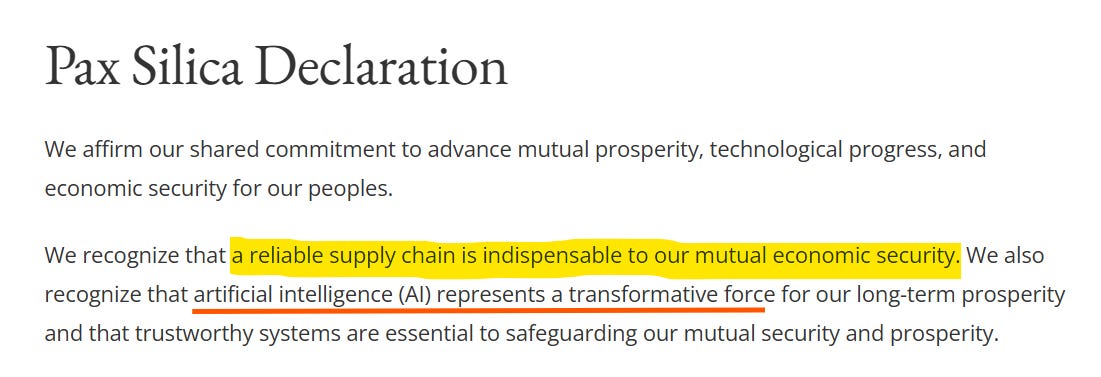
AI development, the declaration continues, is happening faster and faster. The apprentice is turning into the master: AI now increasingly “reorganizes the world economy and reshapes global supply chains.”
The declaration continues:
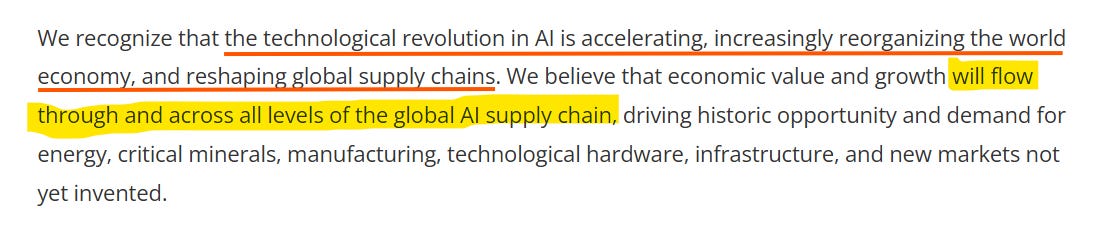
Without global AI driven supply chains under the hegemony of the United States, there will be no “historic opportunity,” no value, no growth, no new markets and no demand for energy, critical minerals, manufacturing, technological hardware and infrastructure. That’s the narrative of Pax Silica.
But where will the United States get its much need rare earth minerals from if not from China? It’s crucial then to turn China into a trusted partner - or not? No wonder, Trump keeps telling Xi what a great friend he considers him to be.
Once China is aligned, it’s pretty much the whole world aligned against “their peoples” who have no voice in any of this.
Further down in the declaration it says:

The new economic security paradigm relies on “forging new connections with reliable partners and suppliers committed to fair market practices.” Those who are not aligned with America are not reliable partners and not trustworthy (like China).
How often did Trump tell Xi Jinping during his recent China visit that he is his very good friend and that he really means it? And how many of the richest and most powerful tech CEOs did he schlepp to Beijing and present to Xi Jinping during this recent visit as an enticing offering?
If unaligned and untrustworthy partner China decides to align with Trump’s Pax Silica vision, China will also turn into a trustworthy partner to whom “the full stack of technological advancements that are shaping the AI economy” will open up.
It’s China’s choice - as well as the choice of other unaligned countries: accept America as the world’s AI hegemon and enjoy the riches and prosperity that “trusted” AI systems will bring. Or don’t and remain locked out.
Here is the list of the aligned, trustworthy partner states that signed the Pax Silica Declaration:
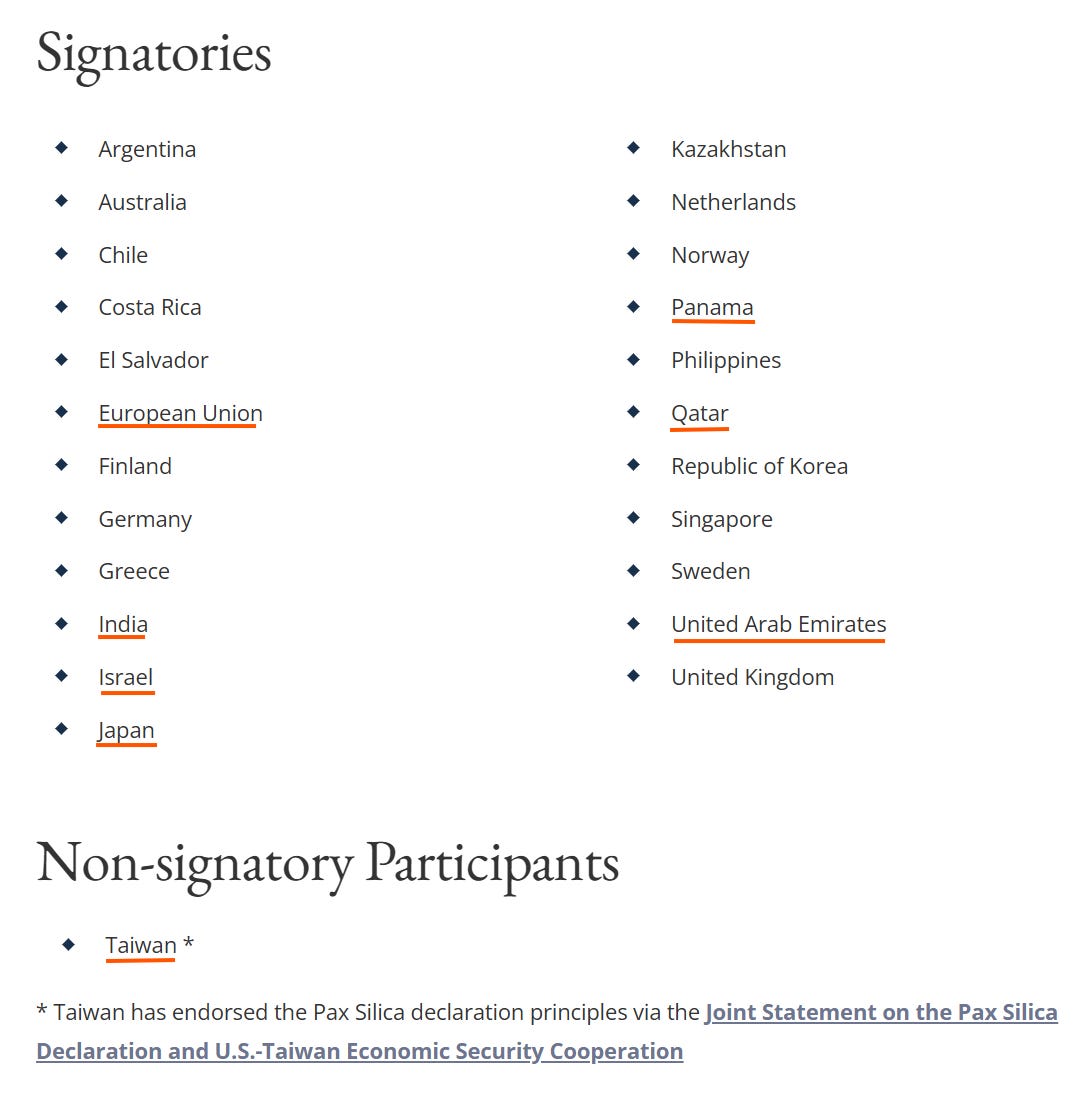
Between the lines, the Pax Silica Declaration makes clear that the aligned partners are the trustworthy ones only because they submit to America’s claim as the global AI hegemon. Which means the aligned become nodes in AI’s global supply chains, subjected to the relentless dictates of algorithmic controls set by the United States.
Trust, Turner points out, no longer has anything to do with earned human rapport. It’s earned by submission to America controlled AI systems.
Helberg is likely the main architect of the Pax Silica Declaration and probably drafted it himself with the help of his staff. Who is he? Well, he certainly has had an interesting career so far.
He’s apparently French as well as American, a young guy, in his mid thirties or so, and he has been gliding through the rotating door many times already. Have a look at his LinkedIn profile:
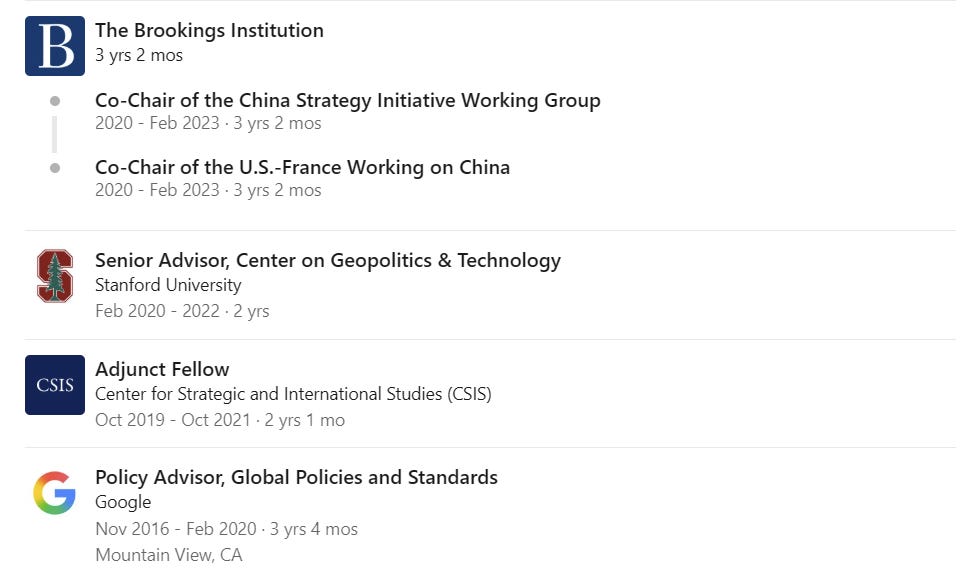
He pivots from a big tech corporation (Google) to influential DC think tanks (with close connections to intelligence agencies), academia and government.
You see a focus on China emerging in the early 2020s when Helberg was simultaneously the Co-Chair of the US-France Working Group on China and the Co-Chair of the China Strategy Initiative Working Group at the Brookings Institution:
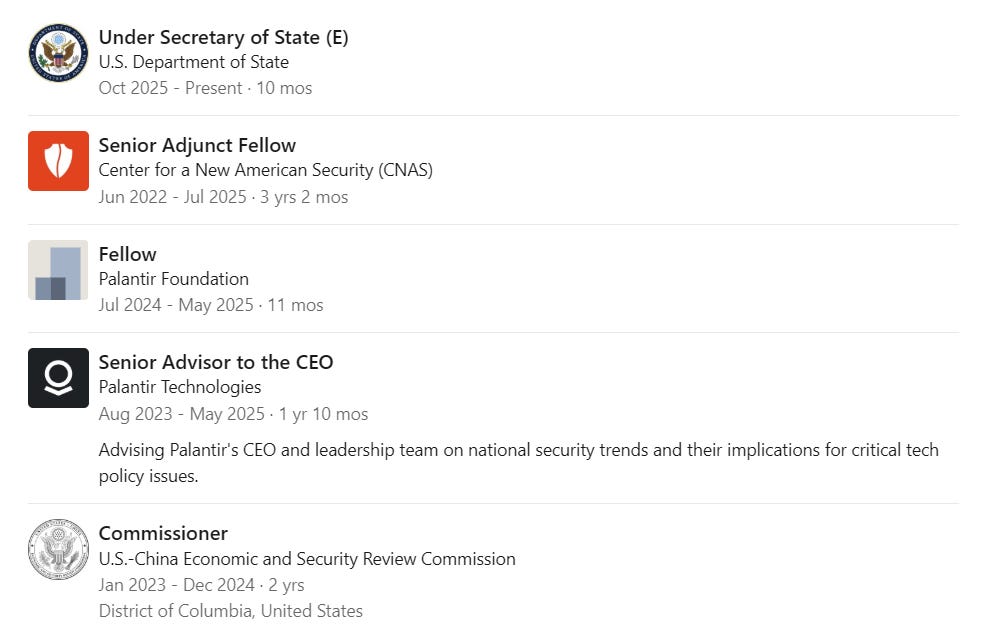
From Brookings he switched to a Government position as Commissioner of the US-China Economic and Security Review Commission.
Then he became Senior Advisor to the co-founder and CEO of Palantir, Alex Carp. From Palantir he glided back to another government position and a much more visible and influential one: Under Secretary of State for Economic Affairs.
Turner argues that the thousands of hyperscale data centers, which have already been built in America over the last years or are in the process of planning and construction, are built not for current AI needs but to power the global control system that the United States needs to exercise its claimed worldwide AI supremacy.
Data centers are regarded as a critical part of economic security. And economic security folds into national security. Trump’s Emergency Order from last year declaring data centers as part of America’s national security infrastructure proofs the point.
Sadly, 250 years on, the America government is in the business of aligning not just other countries but its own people too to reach the point where they can be trusted. And that’s best done by controlling them.
00:05 Introduction to Pax Silica and the Power Structure
14:00 What Is Pax Silica and Why Was It Launched
21:18 Wearables, Biometric Data, and the Selling of Personal Data
24:03 Catherine Austin Fitts’ Two-Lock vs. Three-Lock Transaction System
29:03 Why Data Centers Are the System’s Linchpin
34:30 The Push for a Global AGI Constitution
39:30 Data Centers as National Security Infrastructure and Protest Risk
42:32 The “Anti-Tech Extremist” Designation and Environmental Concerns
47:30 Reading the Official Pax Silica Declaration on State.gov
49:58 Comparing Pax Silica to Trump’s Three-Pillar AI Stack
55:22 Profile of Jacob Helberg and His Career Path
1:02:28 Humans as Nodes: Sovereign Property vs. Private Property
1:15:18 The Declaration’s Vision for Economic Partnership
1:28:03 Trusted Information Networks and the Meaning of “Trust”
1:29:26 Building a New “Economic Security Order”
Comments
Nothing yet. Say the first thing.
Sign in to join the conversation.