
If you find this content useful, please share it with a friend, become a paid subscriber, or gift a subscription. Paid subscriptions give you full access to all interviews & articles and help my Substack climb the rankings to reach more readers.
Festus is a small town thirty-five miles south to St. Louis, Missouri.
About a year ago and unbeknownst to Festus’ 14,000 residents, the town’s city council started secretly meeting with real estate developer CRG to discuss building a massive 360-acre hyperscale data center in a wooded area in Festus.
The North American real estate firm CRG is the real estate development arm of the construction company Clayco. Bob Clark is Clayco’s founder.
Lori Merriman, who lives in Festus, became a leading force in the town’s fight against the data center.
She told me that it took three to four months before citizens in Festus got wind of what was happening behind the scenes. Once they did, they turned up in force to the next council meeting where the mayor and councilmen told them not to worry and that the whole scenario with the data center was completely hypothetical.
Just two days later, the city council voted unanimously to approve the rezoning of a large woodland area to allow for the construction of a hyperscale data center called “Festus Campus.”
The fight was on. Battles have been waging since November 2025 and they will continue for an unforeseeable time.
Festus’ mayor repeatedly dismissed data center opponents as a “vocal minority” - no matter how overwhelming the evidence that it was in fact a vast vocal majority.
Merriman said: “I’m gonna keep referring to the FOIA documents because that’s where we found out what was really going on behind everybody’s backs and the truth about what they were doing. They called the people of Festus that were opposed to the data center ‘sideshow of uneducated people, dumb hicks.’”
In March of 2026, the city council approved the building of the data center against massive opposition of the town’s residents.
One month later, in April 2026, all three incumbent councilmen that were up for election were thrown out of office. In a next step, Festus’ citizens collected the required signatures for a recall election of the mayor and the remaining councilmen. The county clerk approved the required signatures and gave the green light for the recall election.
Meanwhile, Merriman, on the advice of environmental lawyer Stephen Jeffery, formed an LLC to raise money to sue the city council and mayor for approving the building of the data center.
And now it gets really interesting: the city council refused to hold the recall election. Instead, it sued the county clerk of Jefferson County for approving the recall election while at the same time Festus residents started another lawsuit suing the city council for refusing to hold the recall election. Three lawsuits in total so far.
Who’s going to win this war? That is completely unclear. Will it be the citizens of Festus who overwhelmingly reject the data center, or will it be the city council backed by Missouri’s Governor Mike Kehoe?
Through FOIA requests, Festus citizens found out that Missouri’s Governor Mike Kehoe had voiced his willingness to “nudge” city council members to make sure they’d vote in favor of the rezoning and in favor of approving the data center.
Such backing of the town’s city council’s plans to get the Festus data center built, by the way, doesn’t stop with Governor Kehoe. It goes, Merriman suggests, all the way up:
“It goes all the way to the governor, and, I believe, it goes all the way to Trump.”
Listen to the interview with Lori: there are lots of great lessons to be learnt from her and her co-warriors about how to fight hyperscale data center wars.
Here is a quick crash course on data centers as context and backdrop to what is happening in Festus, Missouri, and in so many other American towns.
America is, by far, the country with the largest number of data centers in the entire world.
The U.S. has about a third of all data centers worldwide. And it accounts for 54% of total global hyperscale capacity. It currently has around 5,500 data centers and around 1,500 in different stages of planning and construction.
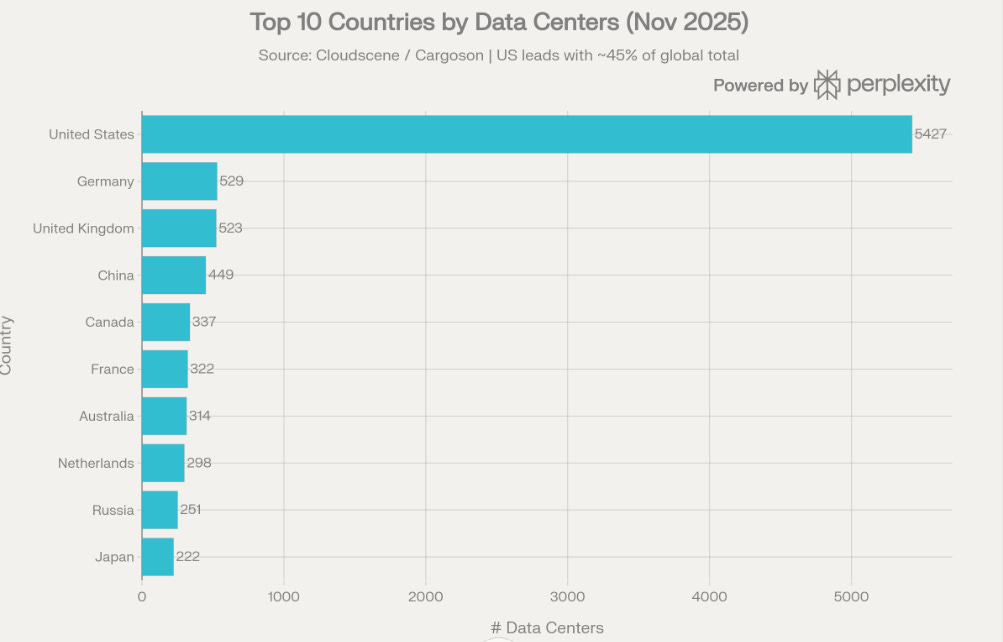
The rest of the world’s countries have much smaller numbers of data centers compared with America: Germany and the UK are the countries with the second largest numbers of data centers in the world with around 500, less than one tenth than America’s. These countries do, of course, have only between one fourth to one third of its population.
China follows with something like 450 or so data centers; the population is vastly greater than that of the United States. Something like 1.4 billion people.
Russia has around 250 data centers; the population is not quite 150 million people.
Nobody seems to know how many data centers India has; estimates vary from 150 to 300. Population similar to China: around 1.4 billion people.
Not only does America have a humungous number of data centers already, more than 1,500 new data centers are currently in various stages of development.
What are they for? Why does the US need so many more data centers than other countries?
They’re not needed for the way we use AI now because, well, we’re already doing that. Are they going to be mass surveillance centers fed by enormous masses of our personal data, from countless flock cameras to our biometric information to financial transaction information?
What’s the definition of a hyperscale data center? It must have at least 5,000 servers and 10,000 square feet of floor space. And that would in fact be a minuscule hyperscale data center. The hyperscale centers currently planned and built occupy hundreds of acres with power demands of 100-500 megawatts and even more - like the one being planned in Festus.
Which means that such gigantic hyperscale data centers easily need as much energy as a mid-sized American city. But, in contrast to the city, only about 50 people or so are needed to run it.
Also good to know is this: America’s data centers currently use about 4.5% of all energy, with projections to reach 10–15% of energy use by 2028.
How much water do the centers need to cool the servers? Water needs depend on the cooling method being used and some methods require more water than others. Meta’s Missouri data center which is already operating needs around 9 million gallons of water per day. There are larger data centers than that one and they need up to 13 million gallons per day.
A mid-sized American city of 50,000 people uses something like 5 million gallons of water per day. By the way, even a mid-sized data center, not a hyperscale one, consumes as much water as a small town.
So where do the data centers get the huge amount of water from that they need? Well, that’s a very good question with troubling answers: municipal water supplies, but that’s of course not nearly enough, then rivers, local aquifers even.
Well, massive scale of course.
Then extreme scalability which means you can very quickly add compute (computing power), storage and networking facility without constructing additional buildings.
They are built for continuous uptime to support cloud services, AI and big data.
They also have huge numbers of diesel generators, by the way, in case of electricity blackouts. And those generators are noisy!
What are the costs of building these data centers? The global construction pipeline is estimated at $2.3 trillion in late 2025. In America, almost $50 billion was spent on data center construction in 2025 — a 32% year-over-year increase.
The U.S. data center construction market is projected to nearly double from ~$48 billion in 2024 to over $112 billion by 2030.
Who is building them, or rather, for whom are they built and who will eventually operate them? It’s the tech giants like Amazon Web Services, Microsoft Azure, Google Cloud, Meta, Apple, OpenAI and Oracle.
In Lori’s state, Missouri, there’s already a bunch of gigantic hyperscale data centers built and others are in planning or under construction. Thirteen are planned, the one in Festus among them.
It’s interesting to have a closer look at Missouri: it had something like 50 data centers in the 2020s, today it has 91 operating data centers, almost twice the number from like 5 years ago. Major operators are Google, Meta, but also MasterCard, and Citi.
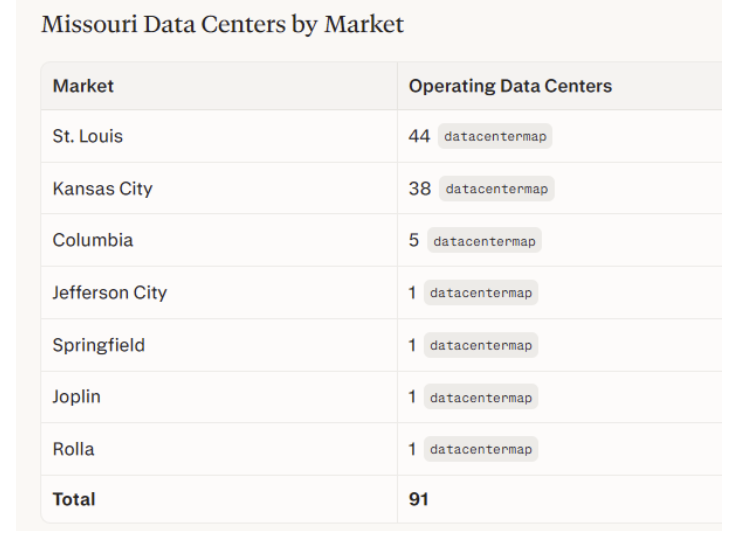
Then there are 13 additional planned projects across Missouri - and these are gigantic projects. They would, if all built, increase Missouri’s data power capacity by a factor of 27. Almost all of it driven by AI compute demand.
These additional 13 monster data centers, Festus’ data center among them, will add something like 2,300 MW of additional capacity, compared to only 84 MW currently operational.
Here are some examples of such monster data centers:
Google’s Project Mica (Kansas City area) — 500 acres, $10B, already under construction
Google’s Project Spade — 934 acres, proposed/confirmed January 2026
AWS’s (Amazon Web Services) Project Green — 1,000 acres, up to 21 buildings
CRG’s Festus campus — 360+ acres, $6 billion: Festus campus, that sounds so festive, doesn’t it? But there is nothing festive about it - although I guess your mayor and most of your former city councilmen would beg to differ, right?
Most of these new massive data centers are being built in rural areas.
And they are increasingly built in the mid west, no longer in the coastal regions. Here is an interesting map that shows how data center hubs are moving from the west and east coast to the interior of the country
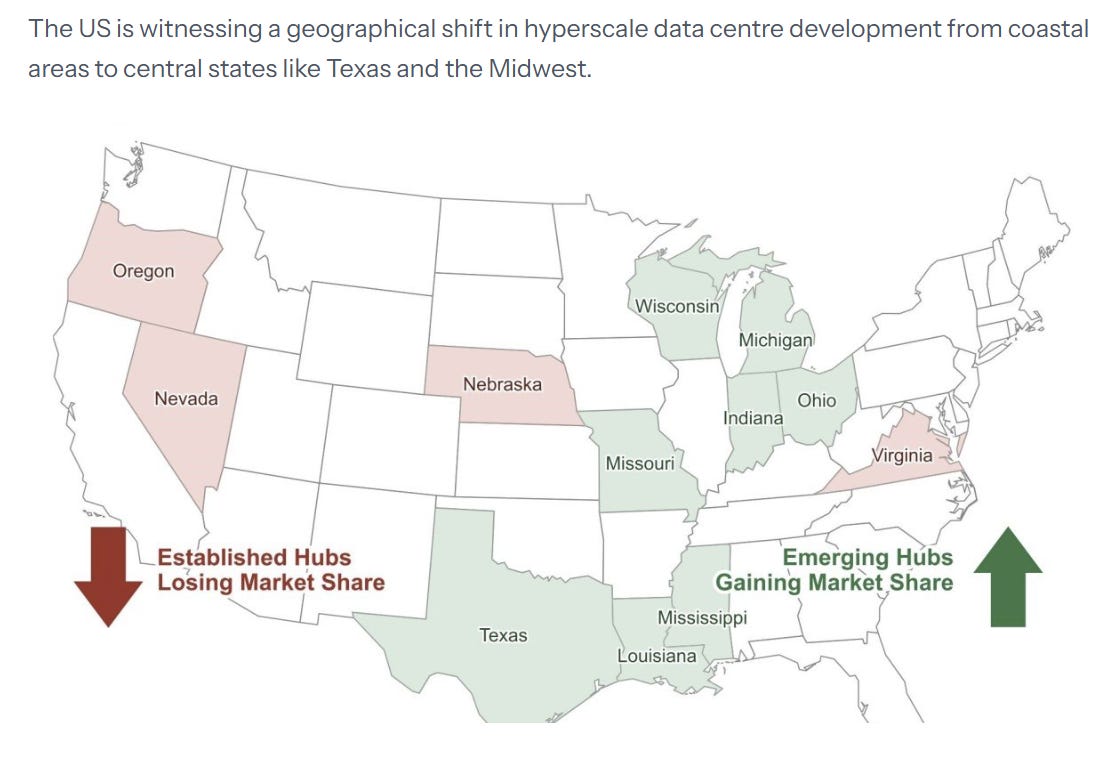
From: Digitalisation World, Shift in US hyperscale data centres towards central regions
0:00 Introduction to Festus and the Data Center Threat
0:18 Data Center Crash Course: US Statistics and Global Rankings
9:11 Missouri’s Data Center Boom and Major Operators
13:37 Life in Festus Before the Data Center Craze
14:54 November 2025: The Meeting Where It All Began
21:46 City Council Composition and the Vacant Seat
22:19 Secret Meetings to Dodge Sunshine Law Quorums
25:10 The 6-2 Vote to Approve the Contract
27:16 Local Newspapers and Buried Public Notices
31:26 FOIA Documents Reveal “Dumb Hicks” Insults
33:07 Public Backlash Against the Mayor’s Conduct
35:47 Governor Kehoe’s Offer to “Nudge” Council Members
38:03 Political Fallout and Ties to State Politics
39:21 Union Members Bussed in to Support the Project
40:37 The Search for an Attorney
41:28 Stephen Jeffery and Wake Up Jeffco LLC
42:34 Why Everyone Was Afraid to Form the LLC
45:02 Fast-Tracked Approval of Data Center in the School Gymnasium
45:37 April 2026: Incumbents Voted Out
47:00 Discovery Battles and Delay Tactics
49:33 Fundraising Totals and Ongoing Legal Costs
50:16 Untangling the Three Lawsuits
54:41 Organizing the Recall Signature Campaign
55:12 National Media Attention and Uncertain Future
55:37 Bob Clark, Clayco, and the Closed-Door Meeting
1:00:00 The Recall Rejected: Reasons Deemed “Not Sufficient”
1:01:11 Suing the County Clerk Over Election Certification
1:03:53 More Delays, More Legal Costs for Citizens
1:16:49 The Recall Signature Requirements Explained
Comments
Nothing yet. Say the first thing.
Sign in to join the conversation.