
Lower back pain is one of the most common reasons people stop exercising, avoid lifting, or struggle with daily tasks.
The first instinct is to treat the painful area — stretching, massage, strengthening. Those approaches can help. But they often skip an important question.
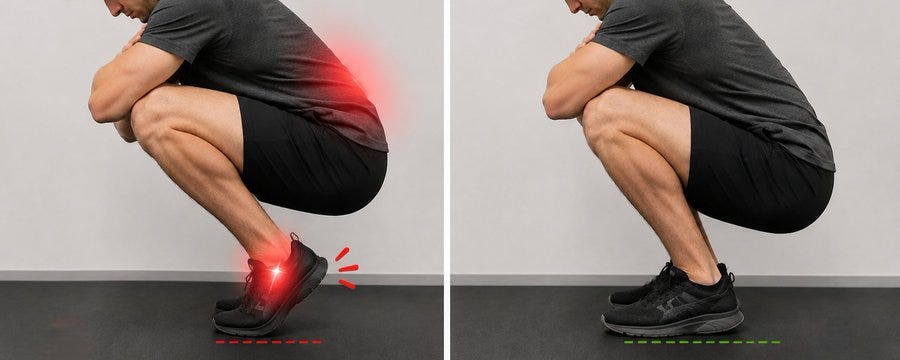
What if the lower back is compensating for poor movement somewhere else?
One of the most overlooked areas is the ankle.
The body moves as one system
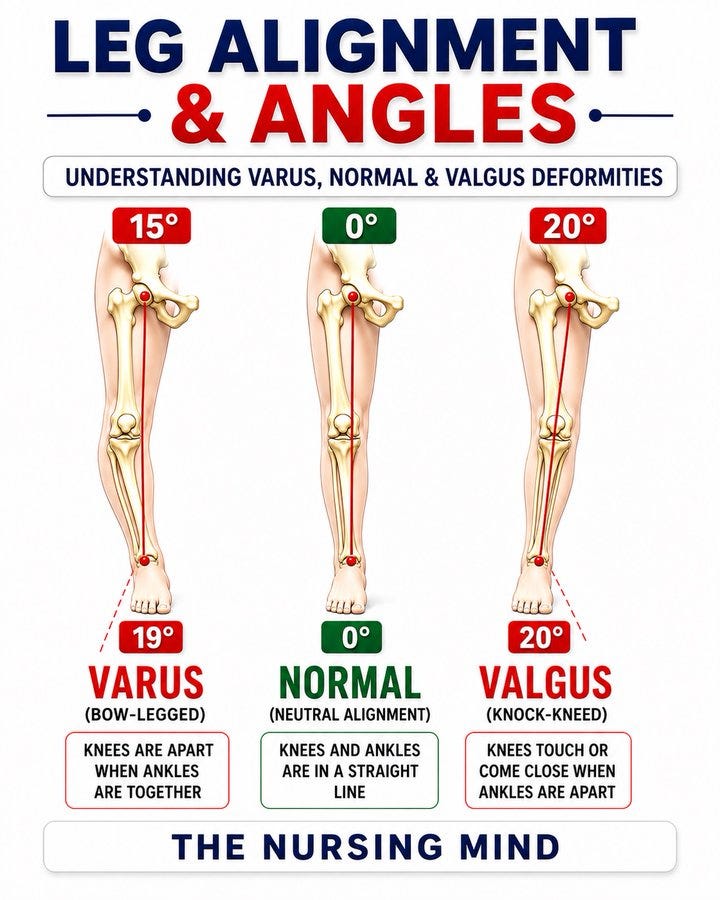
Every movement — walking, squatting, picking something up — is a coordinated chain involving the feet, ankles, knees, hips, pelvis, and spine.
When one joint loses mobility, another moves more than it was designed to. Researchers call this compensation. Over months or years, these small adjustments place extra stress on the structures doing the extra work.
There is growing evidence that ankle dysfunction and lower back pain are directly connected through this kinematic chain — even though the ankle and spine seem like distant regions of the body.
Why ankle mobility matters
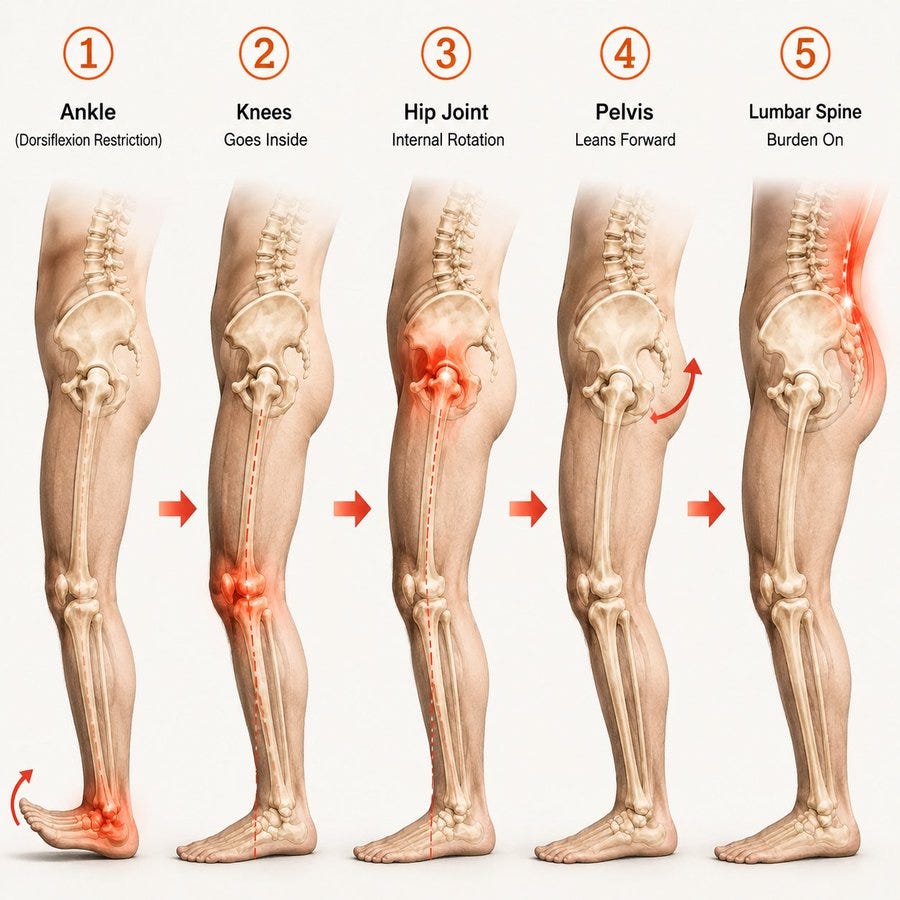
A healthy ankle allows the shin to move forward over the foot during weight-bearing. This movement — dorsiflexion — is required for lunging, running, squatting, getting out of a chair, climbing stairs, and picking things up from the floor.
When this motion is restricted, the body finds another path.
A 2025 study confirmed that limited ankle dorsiflexion is directly associated with greater anterior pelvic tilt, increased hip and lumbar spine flexion, and greater forward trunk lean during squatting — all of which increase spinal loading.
[Source: Effect of Limited Ankle Dorsiflexion on Lower Limbs and Trunk Kinematics During Squatting. Journal of Sport Rehabilitation. 2025. doi: 10.1123/jsr.2024-0291]
These compensations — heels rising, knees caving inward, excessive forward lean, feet turning out, lower back arching — are not automatically harmful. Repeating them hundreds of times a day is.
The hidden cost of poor ankle mobility
Research on individuals with limited ankle dorsiflexion found they demonstrated significantly altered knee kinematics during squatting compared to those with normal range — including greater knee valgus and reduced knee flexion displacement.
[Source: Altered knee and ankle kinematics during squatting in those with limited weight-bearing-lunge ankle dorsiflexion range of motion. PubMed. PMID: 25144599]
A separate study confirmed that restricting ankle dorsiflexion during a double-leg squat produced increased knee valgus and medial knee displacement — changes similar to those seen in people with patellofemoral pain.
[Source: Effect of limiting ankle-dorsiflexion range of motion on lower extremity kinematics and muscle-activation patterns during a squat. PubMed. PMID: 22100617 ]
Many people spend hours stretching their hamstrings or lower back without realising the real restriction starts closer to the ground.
A quick self-assessment
The weight-bearing lunge test is a reliable, validated clinical tool for measuring ankle dorsiflexion range in a weight-bearing position. Research has confirmed inter-rater reliability of ICC = 0.98–0.99 and intra-rater reliability of ICC = 0.65–0.99.
[Source: Reliability of the weight-bearing lunge test: systematic review. Physio-Pedia / Powden et al. Manual Therapy.]
Try it now.
Stand facing a wall. Place one foot approximately 10cm away. Keep the entire foot flat on the floor. Slowly drive your knee toward the wall.
A good result: the knee reaches the wall without the heel lifting.
If the heel rises before the knee touches, your ankle dorsiflexion may be restricted. Compare both sides. A noticeable difference may explain why certain movements feel uneven.
A simple exercise that takes under two minutes
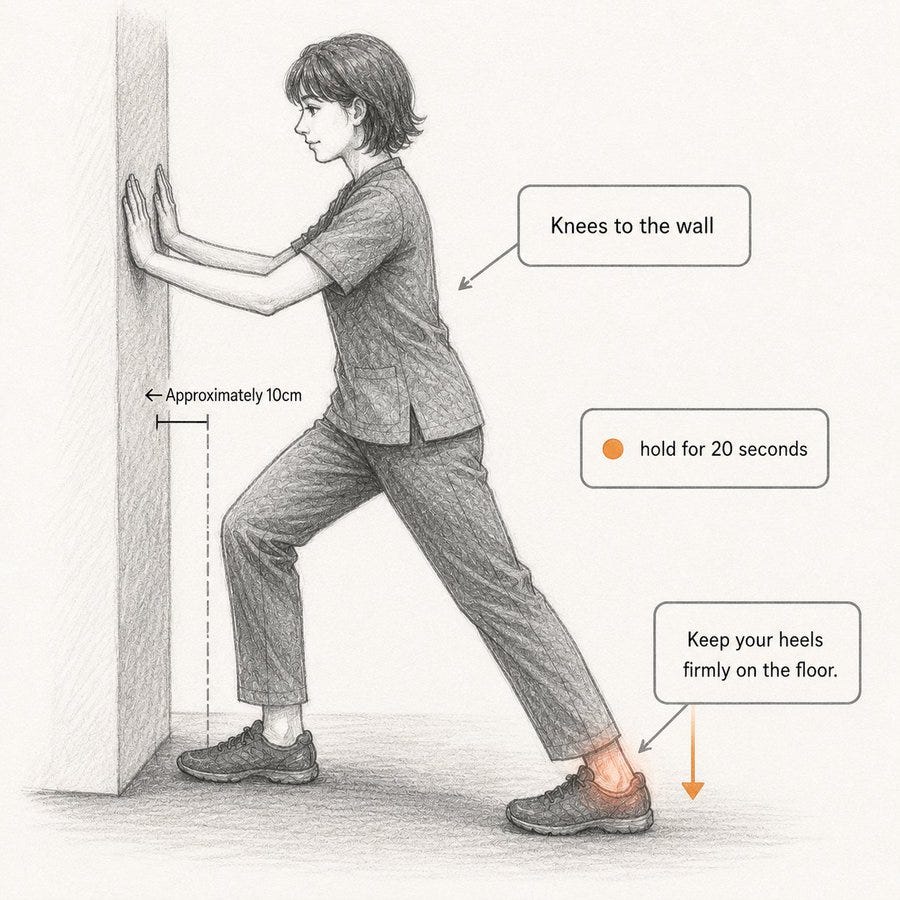
Stand facing a wall. Keep your heel planted. Slowly drive your knee toward the wall. Stop just before the heel wants to lift. Hold 20–30 seconds. Repeat 3–5 times each side.
As mobility improves, move the foot farther from the wall while maintaining full heel contact.
Research on ankle dorsiflexion range of motion found a significant positive correlation between weight-bearing dorsiflexion and lower-limb kinetic chain function — confirming that improving ankle range directly affects the stability and efficiency of the entire chain above it.
[Source: Correlation of ankle dorsiflexion range of motion with lower-limb kinetic chain function and hop test performance. PeerJ. 2023. doi: 10.7717/peerj.14877 ✅]
Slow and controlled movement is more effective than forcing a larger stretch.
Don’t ignore the rest of the chain
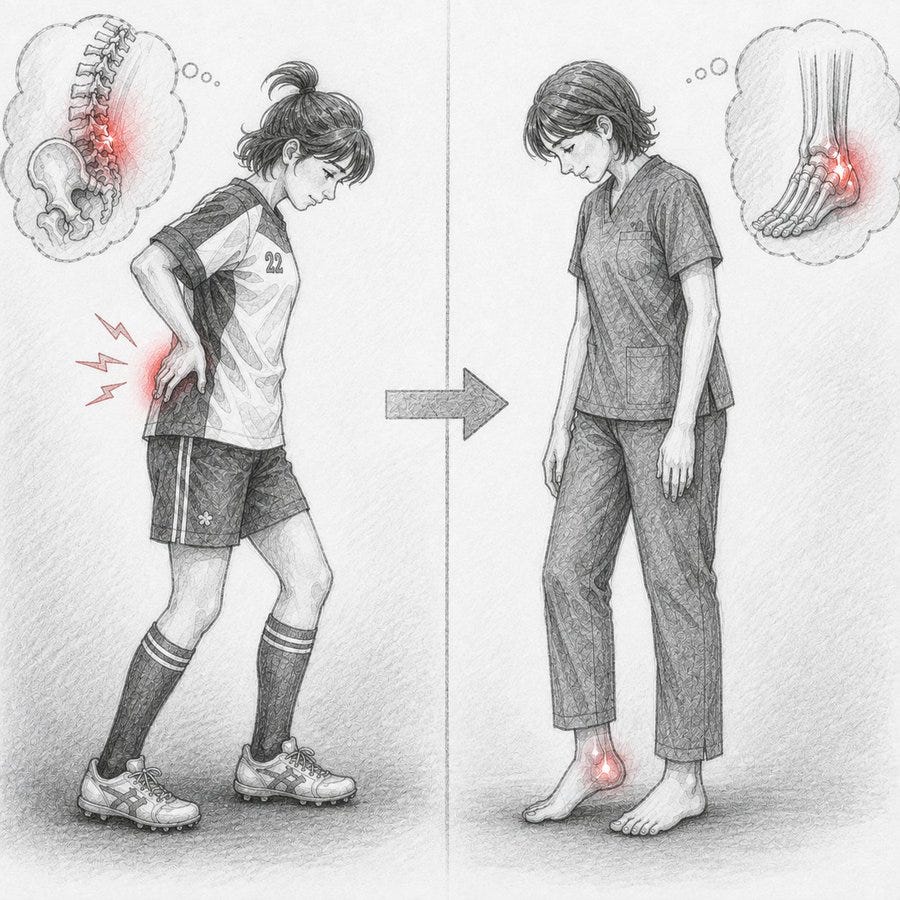
Ankles are one piece. For healthy movement, every link should function together.
Strong feet provide a stable foundation. Mobile ankles allow smooth movement. Stable knees guide efficient motion. Strong hips generate power and control. A balanced pelvis distributes force evenly. A resilient core supports the spine.
When one link struggles, another works overtime.
The goal isn’t a perfect ankle. It’s a system that moves efficiently without any one joint absorbing more than its share.
When to seek professional advice
Not every case of lower back pain is caused by movement limitations.
Severe pain, pain following a significant injury, pain that radiates below the knee, causes numbness or weakness, or is accompanied by changes in bladder or bowel control — see a qualified healthcare professional promptly.
Persistent pain lasting several weeks deserves proper evaluation rather than self-treatment alone.
If you want your movement chain assessed and a specific plan built around your ankle, hip, and back pattern:
Dylan reviews every application personally.
He says yes to roughly 3 in 10.
→ Apply here: https://tally.so/r/441DXr
No posts
Comments
Nothing yet. Say the first thing.
Sign in to join the conversation.