
I spent way too much time with this book.
Thirty years old now, and it’s the reason “EQ” exists as a phrase your manager uses badly. That’s the problem with Emotional Intelligence — it succeeded so completely that it got flattened. It became a corporate training module. It became a LinkedIn adjective. It became the thing people claim to have.
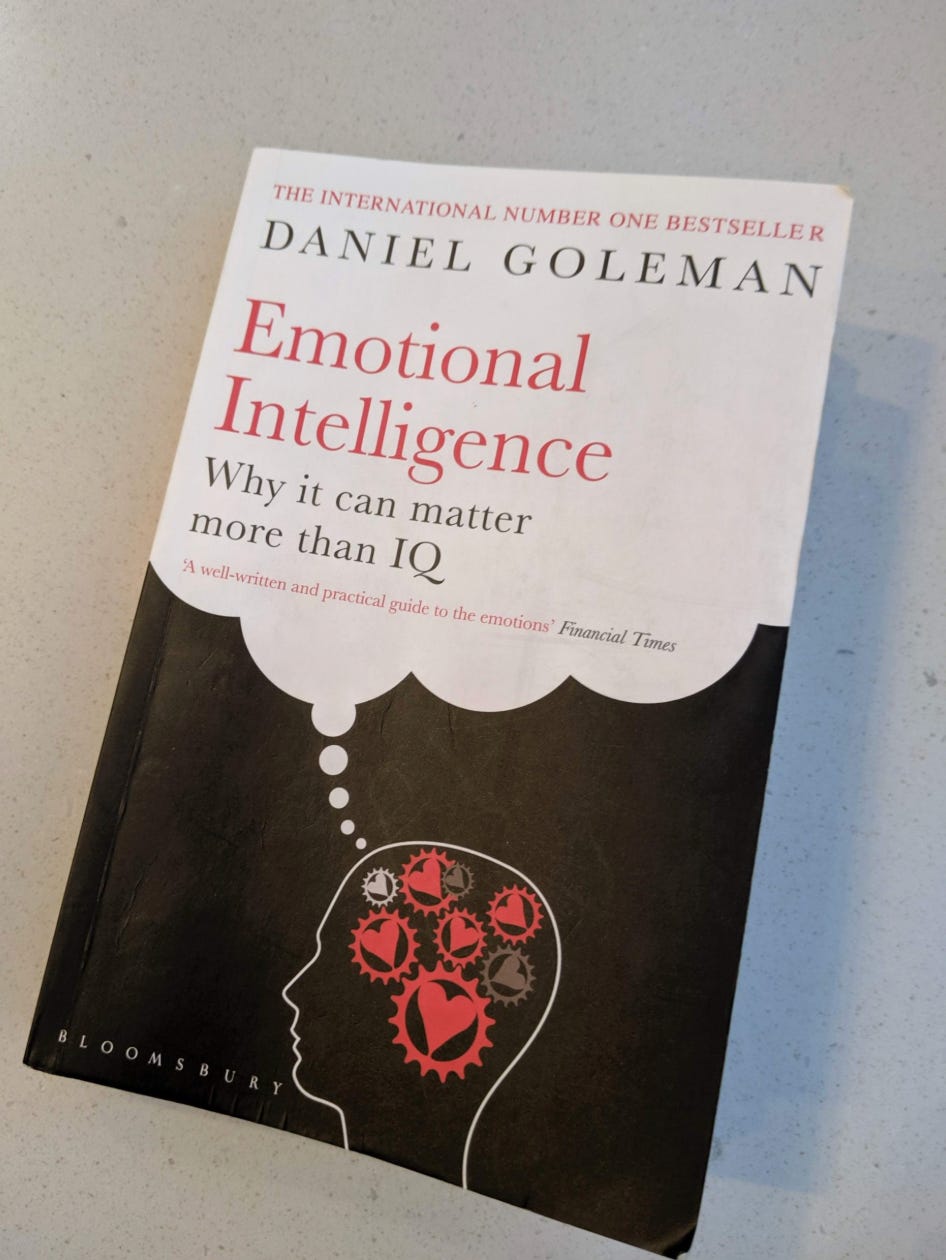
I re-read it because I wanted to know what Daniel Goleman actually argued before all that happened, and the answer surprised me.
He isn’t saying be nicer. He isn’t saying feelings matter too. His claim is structural and slightly cold: there is a specific piece of neural machinery that runs ahead of your reasoning, it was built for a world that no longer exists, and almost everything you consider a personality flaw is that machinery doing its job correctly on outdated information.
The part that stopped me was the timing. Not the concept — the timing. There’s a measurable gap, and everything else in the book sits inside it.
This is the finding the whole book rests on, and it’s worth stating precisely because the popular version is wrong.
The popular version says emotion and reason compete, and that mature people let reason win. Goleman’s version is that they don’t compete at all — because they aren’t running simultaneously. Sensory information reaches the brain’s alarm centre before it reaches the reasoning centre. The alarm fires, floods the body with emergency signals, and only afterwards does the thinking brain receive the same data and start forming an opinion.
Which means the sequence is: react, then understand. Always. For everyone.
That split second is why you can feel angry or frightened before you know why. You aren’t being irrational. You’re being fast, on purpose, by design.
And the reason this matters more than it sounds is that
the alarm centre also stores memories — and it stores them in a cruder format than your conscious memory does. It files rough resemblances. So when something in the present merely rhymes with something threatening from the past, it fires the full alarm anyway.
Goleman’s examples are exact. Someone who was in a car accident feels a jolt of anxiety at the sound of squealing brakes, perfectly safe. Someone who grew up with an explosive parent feels genuine panic when a boss raises their voice in a meeting about nothing.
Your alarm system is not malfunctioning in those moments. It is functioning correctly on old information. That’s a completely different problem, and it needs a completely different solution.
Here’s the one the book gives, and it’s almost stupidly simple. When you feel hijacked, take six deep breaths and count them. Six is not arbitrary — it’s roughly the time it takes for the stress chemicals to begin clearing your system, which is roughly the time it takes for your thinking brain to catch up and get a vote.
What people misread is what the breathing is for. It isn’t calming down. It’s waiting. You’re stalling until the second system arrives.
The uncomfortable part: this means most of your regrettable reactions happened in a window where the reasoning part of you was, in a literal sense, not yet present. You weren’t there. And you still have to live with what got said.
Comments
Nothing yet. Say the first thing.
Sign in to join the conversation.