
Ask ten people what this book says and nine of them give you the same sentence. The boss in New Zealand gave everyone Fridays off and productivity went up. I had that version too, secondhand, for about three years, and I repeated it at a dinner table once with total confidence.
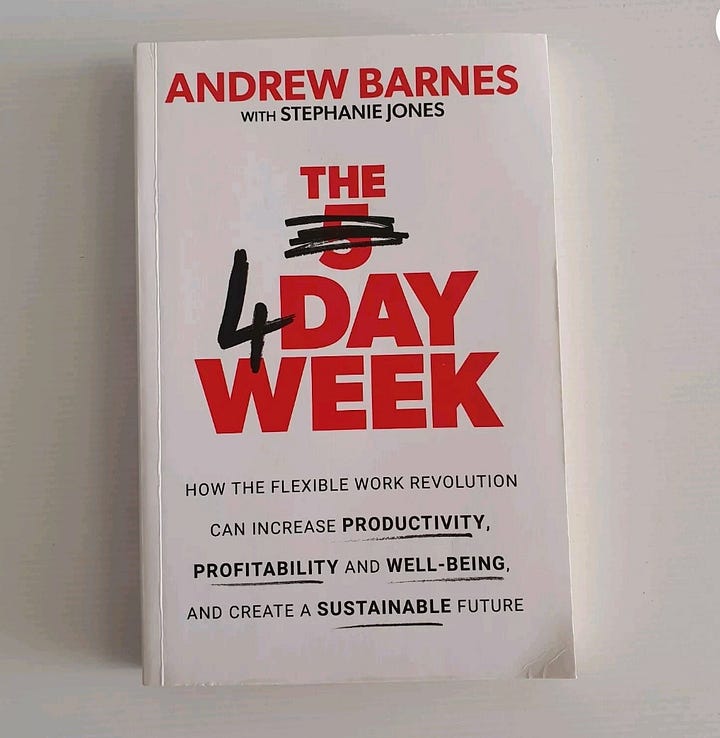

It’s wrong in a way that actually matters.
Andrew Barnes never gave anybody a day off. He wrote a trade. The day off was the currency his staff got paid in, and there was a repayment schedule attached to it that most people who quote this book have never read. I spent two evenings and one long, annoying Sunday with it, most of that Sunday on the implementation chapter, because I kept assuming I’d already understood something I hadn’t.
The origin story is smaller than the myth. Barnes was on a plane, reading an issue of the Economist, and it mentioned two productivity studies out of Canada and the UK. Office workers were producing real work for roughly 1.5 to 2.5 hours out of eight. He landed with a hypothesis and no proof, went looking for a business leader who’d tested it, and found nobody. So he used his own company.
1. The day off isn’t the policy. It’s the bill.
The formula Barnes ends up with is 100-80-100. One hundred percent of the pay, eighty percent of the time, in exchange for one hundred percent of the agreed output. All three numbers are load-bearing. Drop the third and you’ve got a pay cut in reverse.
He’s blunt about how this has to be framed to staff. The free day is a gift given in faith that the work will still get done. Not a reward for past loyalty, not a perk, not a retention tool. A gift extended forward against a promise that hasn’t been kept yet.
Most companies I’ve watched try this announce the four days and change nothing else. No output agreement, no measurement, no conversation about what “done” means. Then they’re surprised when it quietly dies by the second quarter. They copied the generosity and skipped the contract.
2. The founding statistic was about waste, not wellbeing.
This is the part that reframed the whole book for me. Barnes isn’t arguing that people deserve rest. He’s arguing that you’re already paying for five or six hours a day of something that isn’t work, and you’ve built your entire cost structure around pretending otherwise.
That distinction is why this pitch survives contact with a finance team. “People are tired” loses that meeting. “We are purchasing eight hours and receiving two” wins it, because it turns the four-day week into a recovery of money you’re currently setting on fire.
Where readers misapply it: they lead with the human case. Barnes leads with the waste case and lets the human benefits arrive as a consequence. The order isn’t decorative.
3. Your team isn’t distracted from life by work. They’re getting their life inside work.
A 2017 survey of nearly 2,000 full-time office workers found 79% weren’t fully engaged across their 37 to 40 hours. More interesting, 54% said they looked forward to the distractions. The chit-chat, the personal call, the news site at 3pm.
Barnes’s reading of this is the most humane thing in the book. Housing pushed people to the outskirts. The commute ate the mornings and the evenings. Office hours became the only window in the day where a person gets to be a person, so of course they spend some of it socializing. The gossip is doing genuine mental health work.
Which is why productivity crackdowns fail. Block the sites, ban the chatter, and you’ve removed the compensation without removing the condition that made it necessary. Give the time back and the compensation stops being needed.
“Work expands so as to fill the time available for its completion” — C. Northcote Parkinson
4. He couldn’t find anyone who’d tried it, so he made his own firm the lab.
Perpetual Guardian became the guinea pig, and the sequence is worth stealing exactly. Management consent first. Then the idea shared openly with employees. Then two external researchers brought in specifically to measure it. Then a two-month trial with a defined end.
The external researchers are the detail everyone skips. Barnes could have run this internally, declared victory, and put out a press release. Hiring outsiders to grade his own experiment is what turned a nice story into something a skeptic couldn’t wave away. It’s also what made the media coverage stick, and that coverage is why the concept now gets debated in 75 countries.
Copying the outcome is easy. Copying the instrument is what makes the outcome believable inside your own building.
What’s one thing at your job you’d have to genuinely prove before anyone would let you try it?
5. The fourth day is optional, and this is where nearly everyone gets it wrong.
Here’s the line that made me go back and reread the chapter. The 32-hour week is not a static arrangement. Staff don’t have to take a full day. They can truncate hours across five days instead, and the choice sits with them as long as the agreed output is met or beaten.
Barnes is specific about why that choice has to belong to the worker rather than the calendar, and the reason isn’t generosity. It’s that the second you fix the day,
Comments
Nothing yet. Say the first thing.
Sign in to join the conversation.