
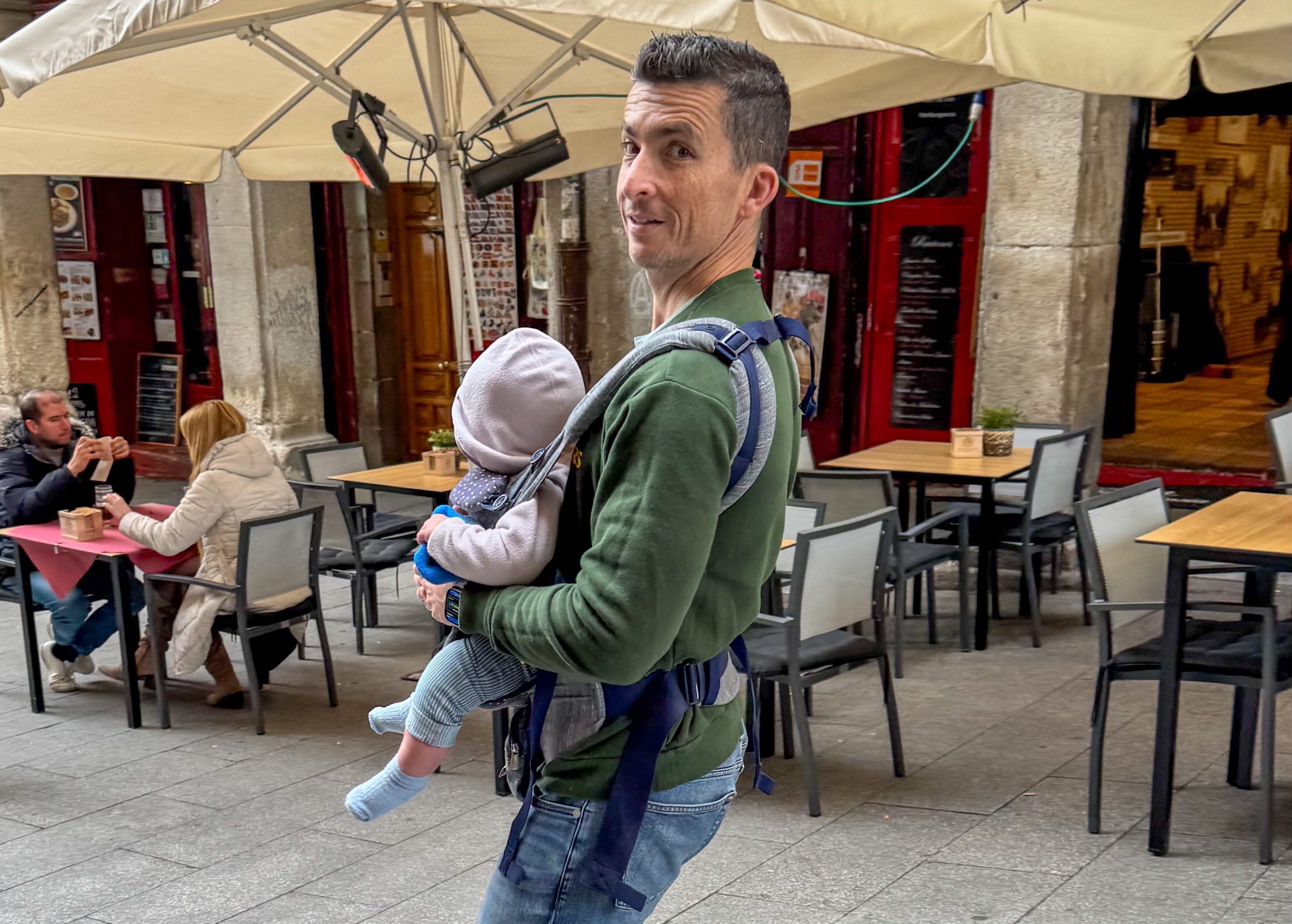
I remember walking the neighborhood with Rheo strapped to my chest.
It was after breakfast, before a nap. The quiet pocket of the morning where things felt almost spacious. We’d zigzag the streets for thirty or forty-five minutes. I’d point out trees. Cars. Dogs. Sometimes I listened to music or an audiobook, but often I didn’t need anything at all. He’d grab my finger through the carrier. He’d giggle when the leaves rustled overhead. His whole body pressed into mine.
It was perfect.
It was exactly what I imagined. Exactly what I hoped for. Exactly what I wanted.
Nothing was wrong.
That is why what came next caught me off guard.
When I got home and started packing my bag for the gym, I felt a surge of agitation I couldn’t quite place. It wasn’t sadness or regret. It was a tight, restless irritation that seemed to come out of nowhere.
It felt like hitting a wall.
Around six or seven months in, the adrenaline of being a new parent started to shift. The novelty wore off. The way you can rationalize almost anything when it’s new stopped working. The hard moments were no longer buffered by firsts. They became the rhythm of the day.
I’ve always been a routine person. I like knowing where things go. I like systems that work. For a long time, the routines I’d built, exercise, quiet time, movement, structure, were how I stayed oriented to myself. Looking back, I can see how routine once functioned as control, especially growing up queer, when so much of myself had to be managed quietly.
Parenthood didn’t erase those routines overnight. It reshaped them enough that they no longer felt like anchors. Even when the new routine technically worked, it didn’t feel like mine yet.
The space between what used to ground me and what hadn’t settled yet created a kind of unease I wasn’t used to. It gave me a rougher edge than I expected.
At the same time, I was absorbing a steady stream of parenting content that made everything feel sharper. Happy, glowing parents online. Post-bedtime dinner parties. Creative projects squeezed neatly into nap time. I knew, intellectually, that none of it was the full story. The expectation still landed. This was what parenthood was supposed to look like if you were doing it well.
It’s strange how that kind of pressure sneaks in, even when you think you’re immune to it.
Lately, I’ve been noticing how much modern parenting anxiety gets framed as a personal failing, even though so much of it seems to come from expectations that have quietly ballooned beyond what any individual can realistically carry. We’re asked to be endlessly attentive, emotionally fluent, and developmentally strategic, often without much structural support. Then we’re left to assume something is wrong with us when that feels impossible.
I’d go to the gym and feel completely unmoored. I don’t usually lift angry. It’s never been a motivator for me to go harder. Still, there I was mid-lift, slamming weights down, irritated by every small thing around me. I was putting out a contradictory signal: don’t help me, please help me, I don’t know what’s going on.
What I started to notice, slowly, was that the anger wasn’t really about the gym. It wasn’t about the walk or even the routine.
It was about expectations.
The expectations we inherit about what a parent should feel like once things settle. The expectations we place on ourselves to adapt seamlessly. The expectations amplified by a digital version of parenting that flattens everything into either aspirational perfection or total chaos, with very little room for the mundane, the boring, or the unresolved.
We talk a lot about protecting our kids from unrealistic standards. We talk less about how deeply those standards are shaping us.
As a millennial, I think a lot about how hard many of us are trying to parent differently. We want to set boundaries, stay present, and break cycles without becoming rigid or performative about it. Then we try to do all of that inside a world that’s fast, comparative, economically strained, and increasingly unkind.
No one really prepares you for how much of parenthood is not about your child. It’s about renegotiating who you are while the ground underneath you keeps shifting.
As a dad, there’s an extra layer of dissonance in all of this. Much of the language around parenting still isn’t built with you in mind. You’re either invisible or gently congratulated for being present, which doesn’t give you much room to understand or articulate what you’re feeling. It adds another quiet pressure to perform gratitude instead of honesty.
That pressure intensifies when you factor in what it means to be a gay dad navigating expectations that were never built with you in mind.
Some days still feel light. Some days feel heavy. A year later, I’m better at noticing when I need to recalibrate. That doesn’t mean the work is done. New stressors arrive. The world changes. Grief shows up. Joy does too.
I’m starting to think that a lot of what we call struggling as parents is really just the friction of being human inside expectations that were never designed to be humane.
I don’t have a clean takeaway here. I’m still inside it.
I do know this: loving your child doesn’t cancel out the disorientation of becoming someone new. Feeling unsettled doesn’t mean you’re doing it wrong. It might just mean you’re paying attention.

Comments
Nothing yet. Say the first thing.
Sign in to join the conversation.