
One day you’re getting home, taking off your clothes and as you reach for your bra clasp to unhook it, a sharp pain starts radiating through your shoulder. You decided to ignore it and just turn the clasp to the front. Problem solved, right?
Well the pain started getting worse and worse now through the following days while grabbing your tomato sauce from the shelf in the supermarket and all day activities all of a sudden feel limited. Female clients describe this as “my shoulder somehow feels stiff.”
As soon as I hear them describing their pain and limitations, I often can come to the conclusion of the dreaded “Frozen Shoulder”. That is the time I send them for medical evaluation which often confirms my suspicion.
Frozen shoulder, also called adhesive capsulitis is the term that describes a tightening of the shoulder joints which leads to inflammation and mobility as the joint literally has less room to move through its full range.
It causes pain and immobility and leads to serious limitations unable to just “push through”.
The EXACT cause has yet to be fully confirmed but it is strongly associated with being female and between 40 and 60 years old, a time that consists of major hormonal changes. Therefore, it is very common in perimenopause and menopause. A decrease in estrogen has been found to influence connective tissue changes, leading to a higher proportion of shoulder issues, specifically adhesive capsulitis.
Diabetes and thyroid conditions as well as a period of shoulder immobility (injury, or surgery) are associated with a higher risk of developing the same condition.
It is one of THE MOST semi ignored midlife issues as women are often told to just wait and avoid any movement. However, understanding the specific stages of Frozen Shoulder changes how to work through it.
1. Freezing: This is the most painful stage as pain increases and mobility decreases. This stage can last a few months and is the most painful stage.
2. Frozen: This is the stiff phase. The pain eases but range of motion is still not there and the shoulder feels very restricted in range
3. Thawing: This is the recovery stage. Range of motion and pain improves which can take multiple months, sometimes even years.
Frozen Shoulder often heals on its own but can take a very long time and knowing what to do during these stages can definitely help.
There are a few ways to test if you have truly frozen shoulder or if it might be a different shoulder condition.
One of the biggest telltale signs is the bra test. Can you reach the back of your bra without limitation and pain? Another sign is the loss of range in multiple directions, especially external rotation, reaching overhead and behind you.
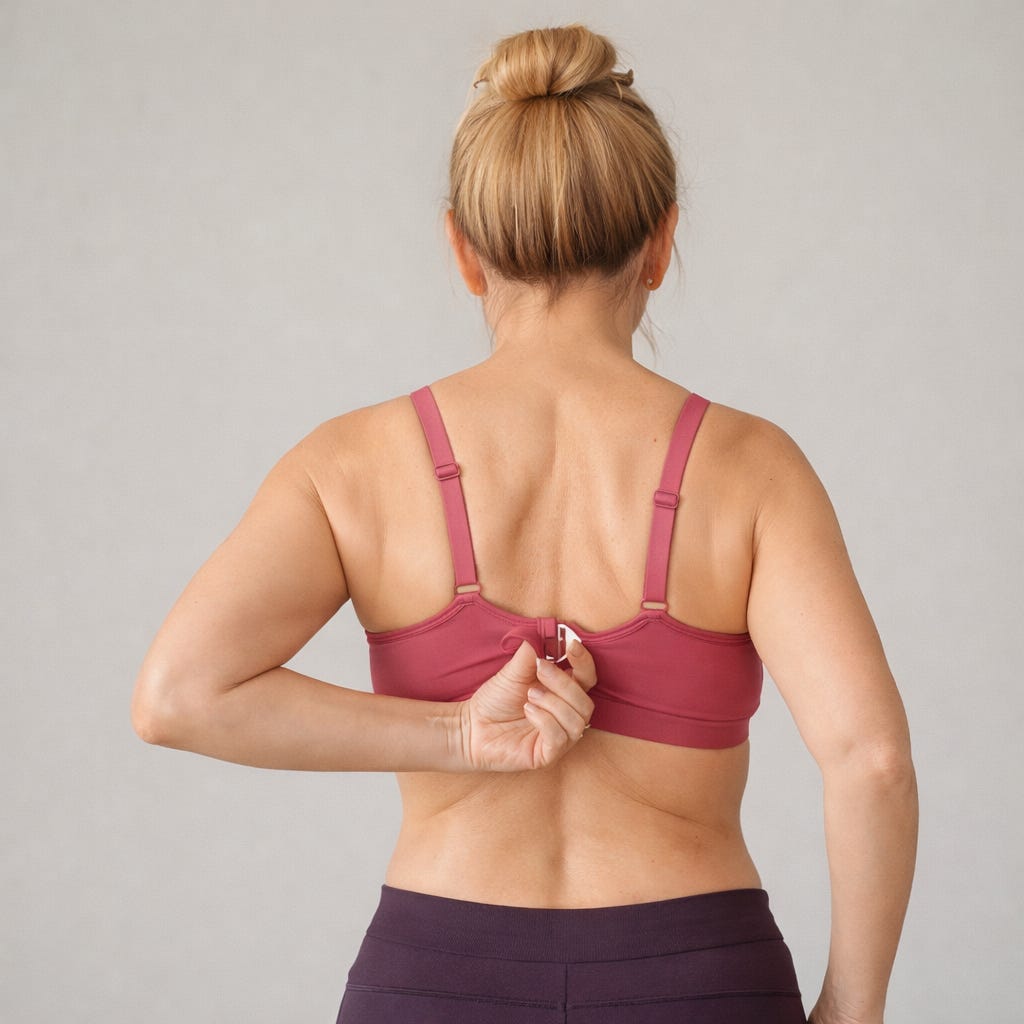
With Frozen Shoulder both of your OWN movement and someone else helping your movement by directing your arm is limited.
How to tell the difference between Frozen Shoulder and a rotator cuff injury?
Rotator cuff injuries are often due to a specific strain or tear. They are defined as pain during certain movements but can be moved through motion by someone else. Even if it hurts, range is still there. During frozen shoulder, the joint itself is stiff and restricted so neither you nor someone else can move it through range.
Before you start engaging in any form of exercise think you have Frozen Shoulder, I highly recommend getting diagnosed by a medical professional since the two conditions are treated very differently.
One exercise that you can apply within all stages of Frozen Shoulder are pendulum swings. These can be done first without and then with weight as you use gravity to your advantage. This can help ease some of the pain and increase range of motion.
You can swing forward, backwards, side to side, in a figure eight etc. Never move or through very painful ranges. This can also be done leaning against a wall with the non-affected arm and swinging with the affected arm.
Below I will go over exercises for the specific stages of Frozen Shoulder. Paid subscribers also have access to all of my exercise videos including my 21-week strength and endurance training program.
If you like to work with me on a 1:1 basis, please respond to this email or send me a message through Substack to learn more about my online coaching program
Note for all stages: use the exercise related to your specific stage and never force a movement through lots of pain, especially during the freezing stage.
Comments
Nothing yet. Say the first thing.
Sign in to join the conversation.