
A few years ago, a donor delegation met the highest political leadership in a province to discuss health financing priorities.
They came with a clear message. The province was allocating the overwhelming share of its health budget to general hospital services, with very limited investment in primary and preventive care. The data was compelling. Nearly three-quarters of health spending appeared concentrated in hospital services. Primary care barely registered.
At the time, I was setting up a team within the health department to support public financial management reforms. The issue was brought to us for review. At first glance, the numbers seemed difficult to dispute.
But they did not align with what I had seen.
Having worked closely with detailed budget documents, I knew that significant resources were being directed toward primary healthcare, outreach, and preventive programmes. Not enough, certainly, but far more than what this picture suggested.
So my team traced the numbers back to their source.
What we found was not a funding problem. It was a classification problem.
Large portions of spending on primary and preventive services were being coded under a single, broad functional category: general hospital services. Outreach activities, basic health units, rural health centres, and district-level services were all being absorbed into this category through the way cost centres were mapped.
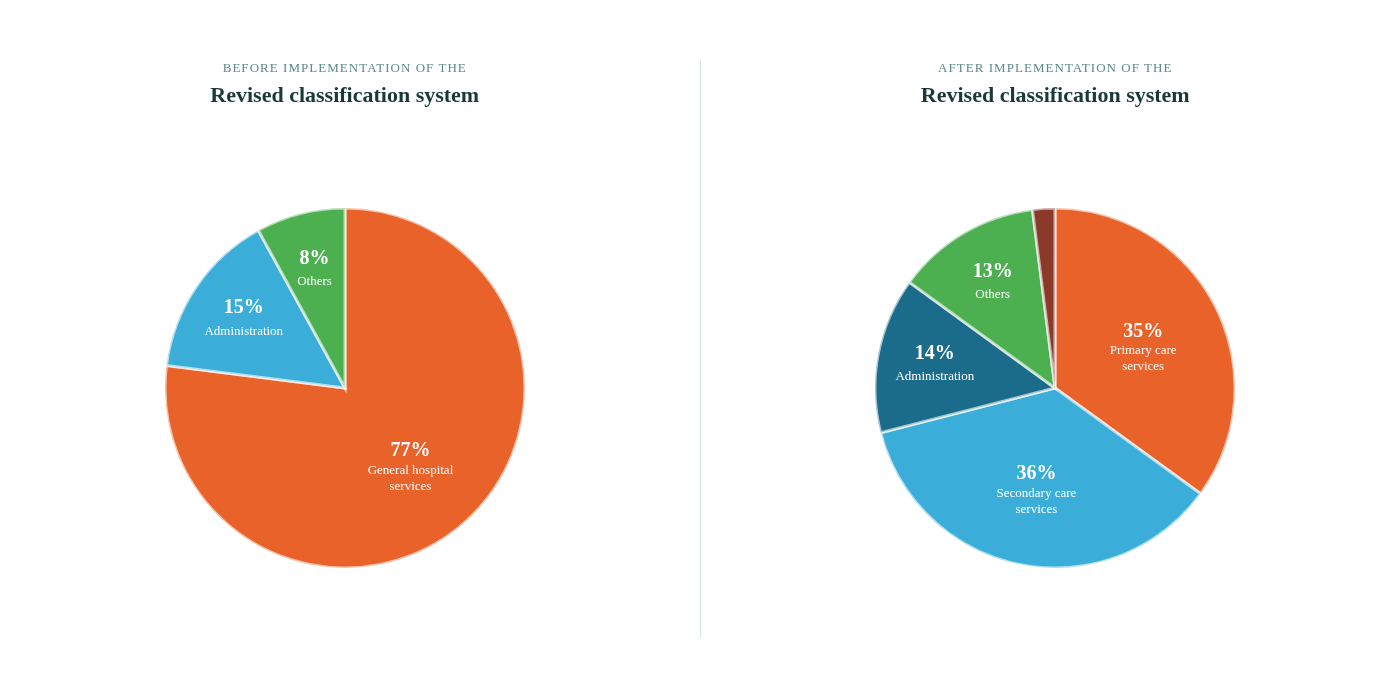
Source: Author based on actual implementation experience. Identies anonymized.
When we reclassified expenditures to reflect where they actually belonged, the picture changed completely.
Nothing about the underlying spending had changed.
Only the classification had.
Most health budgets are organised along three dimensions. Economic classification distinguishes between salaries, operational costs, and capital investments. Functional classification groups spending by purpose, such as hospitals or primary care. Administrative classification links expenditures to departments or cost centres.
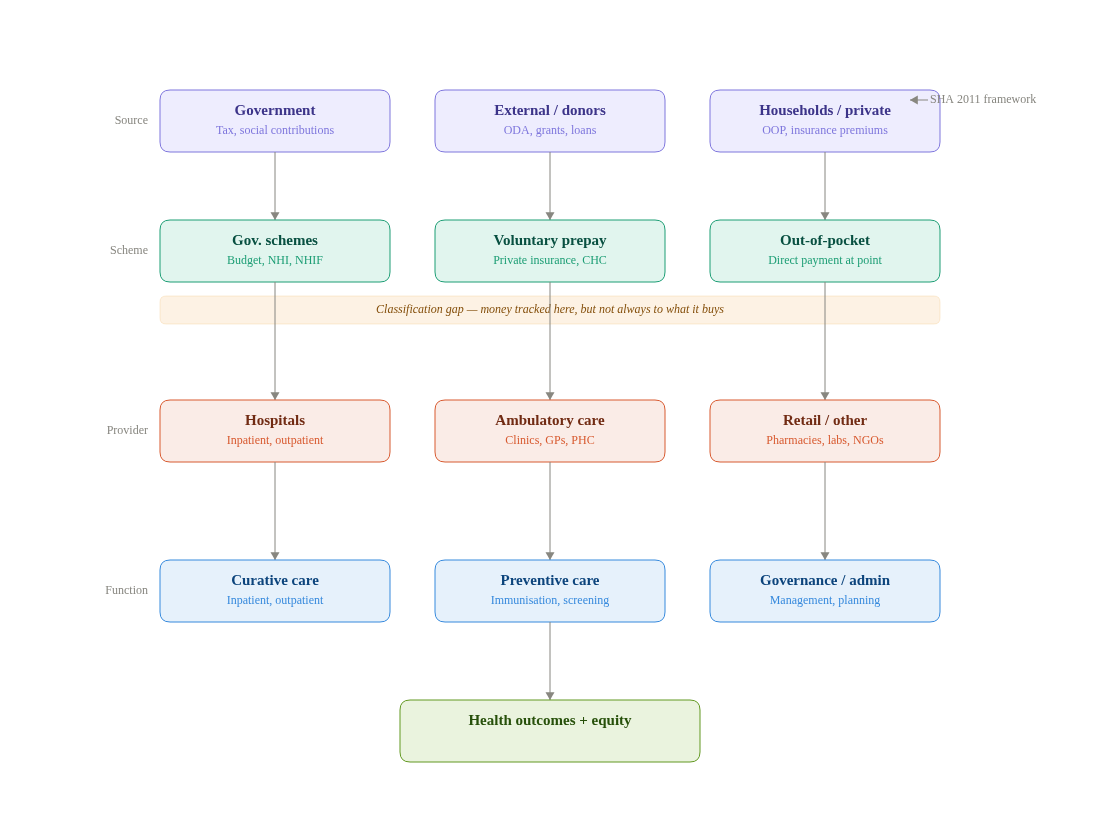
Source: System of Health Accounts 2011 (SHA 2011), WHO, OECD, Eurostat. Author’s illustration.
On paper, this appears technical. In practice, it shapes how the system understands itself.
When policymakers ask how much is being spent on primary healthcare, they are not observing reality directly. They are observing it through the lens of these classifications.
At its core, classification is meant to answer a simple set of questions: where the money comes from, how it is channelled, who delivers the service, and what that spending actually buys. In practice, most systems answer only parts of this consistently, and rarely over time. It is within these gaps that misclassification begins to shape how the system is understood.
And that lens is not always precise.
In many systems, classifications are broad, overlapping, and weakly defined. Activities that cut across service levels, such as outreach or supervision, do not fit neatly into a single category. They are often assigned based on administrative convenience rather than functional logic.
In practice, this assignment frequently happens at the point of data entry. Cost centres are mapped into predefined categories, often by junior administrative staff working with limited information about how an expenditure contributes to service delivery. Over time, these small decisions accumulate.
This is how substantial spending on primary and preventive services can appear almost entirely under hospital categories.
The structure of the budget does not always reflect the structure of service delivery.
The categories a system can measure are the categories it can argue about. What is not clearly classified is rarely prioritised.
In many cases, primary and preventive services are being financed and delivered. Outreach takes place. Supervisory systems function. Community-level interventions exist.
The issue is not absence. The issue is visibility.
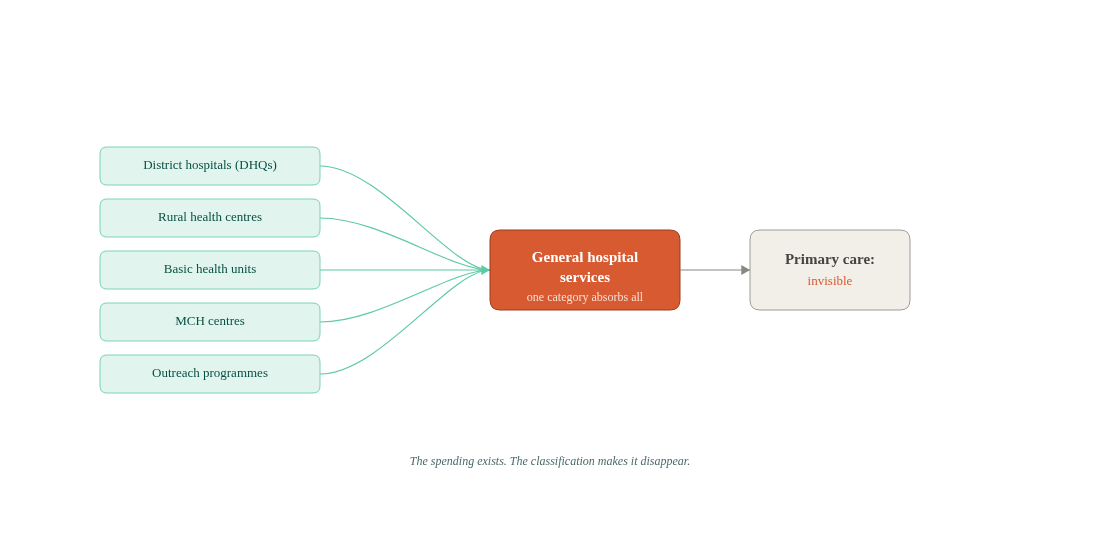
Source: Author
When these expenditures are absorbed into broad categories such as hospital services or administration, they disappear from the analytical view of policymakers.
Without clear classification, the system cannot distinguish between levels of care or types of services, making it difficult to assess whether resources are aligned with actual health priorities. Primary healthcare appears underfunded, even when meaningful resources are being directed toward it.
In many systems, facilities deliver a mix of services, but expenditure systems assign them to a single category. Preventive and primary care activities delivered through hospitals are therefore recorded as hospital spending, reinforcing the perception that resources are concentrated at higher levels of care.
At first, this seems like a measurement issue. Over time, it becomes a policy issue.
In systems where budget protection and prioritisation are applied through programmes and categories, what is not clearly identified struggles to be protected. Activities embedded within larger classifications do not attract explicit policy attention. They are not tracked, not discussed, and rarely defended.
Planning then builds on this distorted picture. Future budgets are informed by past classifications. If preventive and community-based services are not clearly visible, they do not establish themselves as distinct areas of investment.
Misclassification also shapes how governments engage with external partners. Spending that is not correctly classified can make it appear that key priorities are underfunded. This influences co-financing discussions, donor alignment, and programme design. Over time, the system continues to spend, but learns the wrong lessons from its own data.
The reclassification exercise described earlier did not change how money was spent.
It changed what the system could see about itself.
Once expenditures were mapped correctly, primary and preventive services became visible as a distinct and measurable part of the system. What had appeared as a hospital-dominated budget was revealed to be more balanced, though still imperfect.
This shift had immediate effects.
Policy discussions became more grounded. Instead of asking whether the system was investing in primary care at all, the conversation moved to whether the level and composition of that investment were adequate.
Planning also improved. Clearly identified expenditures can be tracked, compared, and linked to service delivery objectives. This allows for more deliberate decisions about scaling, protecting, or rebalancing investments.
Better classification does not solve resource constraints. It allows the system to see what it is already doing. And once that visibility exists, it becomes possible to ask better questions.
This is particularly important for activities that cut across institutional boundaries, such as outreach, supervision, and community engagement. Without clear classification, these remain embedded and difficult to manage.
Health service delivery depends on the alignment of multiple small inputs. Staff, supplies, logistics, supervision, and outreach must work together. When one element is weak, the entire chain is affected.
If these elements are not clearly identified in the budget, they are difficult to manage as a system.
This has direct implications for universal health coverage. Strengthening primary healthcare requires not only more resources, but a clear understanding of how existing resources are structured and used. Without that clarity, policy responses risk being misdirected.
In this sense, classification is not just a technical exercise. It is the foundation of accountability. Without it, spending cannot be clearly tracked, compared, or challenged. What appears as a financing gap may in part be a visibility gap.
The implications are even more pronounced in the context of transition from external financing.
As governments take on greater responsibility for programmes previously supported by donors, assessments of domestic contribution rely heavily on how expenditures are classified. If key components are embedded within broader categories, they may not be recognised as part of the government’s financing effort; even when the spending is real and substantial. This matters enormously in transition planning.
A government that is genuinely investing in health may appear to be doing far less than it is, simply because its classification system cannot make that investment legible. Decisions about aid withdrawal, co-financing thresholds, and sustainability assessments are then built on a distorted picture.
This creates a misleading picture of underinvestment and makes transition planning more difficult. In each of these situations, the issue is not only how much is spent. It is the system’s ability to see, interpret, and act on that spending.
Health systems do not operate on budgets alone. They operate on how those budgets are structured and understood.
For governments, the priority is aligning chart-of-accounts codes with functional classifications: a technical reform that sits at the intersection of health and finance ministries and rarely gets attention from either. For donors and development partners, it means investing in the institutionalisation of health accounts, not just the programmes those accounts are meant to track. And for both, it means accepting that a system which cannot see its own spending clearly is not in a position to plan, defend, or improve it.
Afeef Mahmood is a health economist and public financial management specialist with over two decades of experience advising governments and development partners across Asia, Africa, and Latin America. He works at the intersection of health systems reform, budgeting, and policy, and regularly supports evidence-based decision-making through applied economic analysis.
Mahmood, Afeef (2026). What Gets Classified Gets Seen: How classification shapes health system priorities and decisions. Field Notes. Substack.
No posts
Comments
Nothing yet. Say the first thing.
Sign in to join the conversation.