
There is a moment in health programme transition that looks like success and isn't. A worker who has spent years on a donor-funded salary moves onto the government payroll. The budget line changes hands. The officials involved feel, correctly, that something meaningful has happened. The donor counts it as progress.
And then, quietly, over the following months, the supervision visits become less frequent. The transport budget turns out not to exist. The performance incentive disappears. The worker is present. The function is not.
Notifications begin to decline months later, and by then the causal chain is hard to see.
Over the past several months I have been working on transition planning for tuberculosis programme across a group of provinces in South Asia, helping governments and development partners think through what it actually means to move from external financing to domestic financing without losing programme outcomes.
What I found is that transition planning is often organised around the wrong question.
The question being asked is: how do we move the budget line?
The question that needs to be asked is: how do we maintain the function?
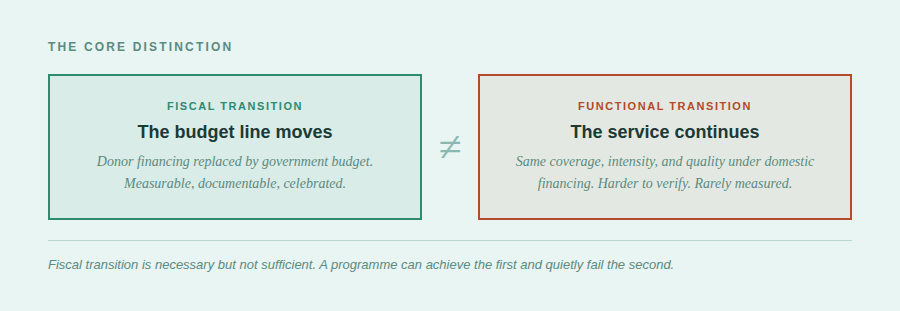
This distinction between fiscal transition and functional transition is not a technical detail. It is the central problem. Until it is named clearly, transition plans will measure the wrong things, celebrate the wrong milestones, and discover the failure too late.
In my previous article I wrote about fiscal space and argued that governments rarely discover new money for health. Most fiscal space is created through political decisions about how existing public resources are prioritised.
Working on transition planning has made the next lesson clearer.
Even when fiscal space exists, programmes can still fail.
The missing piece is institutional. Fiscal transition does not automatically produce functional continuity. Money may move from one budget line to another while the systems that actually deliver services quietly weaken. A programme can appear financially on track while deteriorating in every way that matters to patients.
Consider what this looks like in practice. A province in year two of transition is hitting its budget targets. Staff have been absorbed onto the payroll. The donor taper is on schedule. Every number in the transition dashboard is moving in the right direction. But at the facility level, the supervision officer who used to visit every district monthly now visits quarterly, because the travel budget was not included in the absorption package. The community health worker who used to follow up with drug-resistant TB patients on a daily stipend is now on salary only, and the stipend is gone, so some patients are quietly dropping out of treatment. The GeneXpert cartridges are still arriving, but pipeline planning has shifted to a general government procurement office that does not prioritise lead times, so there are periodic stock gaps.
None of this shows up in the financing tables. The budget line moved. The headcount is right. The taper is on track. What is deteriorating is service intensity, coverage continuity, and patient support: the things that actually determine whether a TB patient completes treatment or defaults.
Understanding transition therefore requires looking beyond financing volumes and examining how programmes actually operate on the ground.
What appears to be a single transition is actually four distinct problems layered on top of each other, each with a different institutional home and a different timeline.
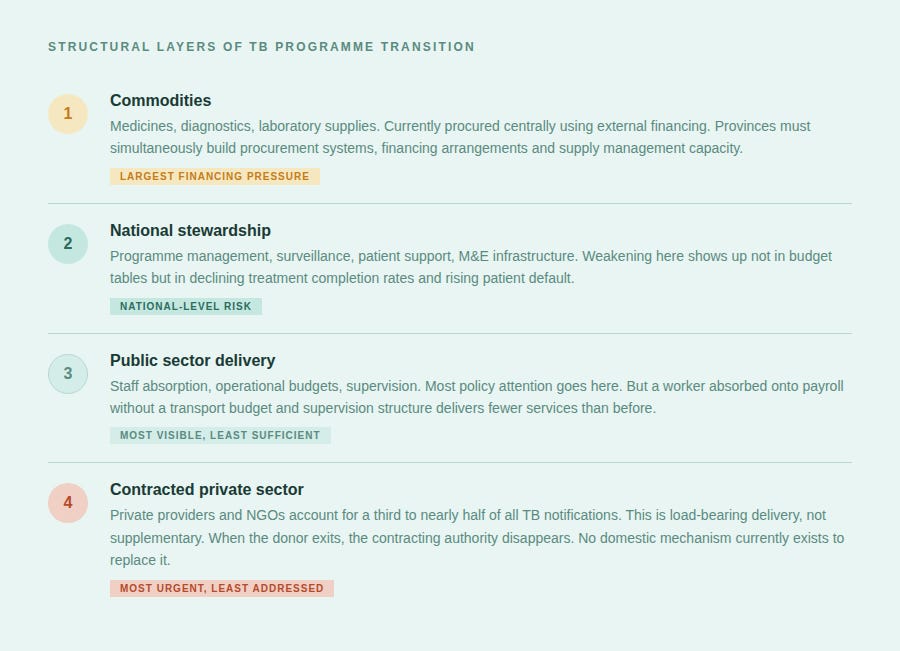
The first layer is commodities: medicines, diagnostics and laboratory supplies. In the provinces I worked in, these are currently procured centrally using external financing. When external financing ends, governments must simultaneously build procurement systems, financing arrangements and supply management structures. That is not one task. It is three overlapping institutional investments that have to happen in sequence.
The second layer is national stewardship. Programme management, surveillance systems, monitoring infrastructure and patient support programmes often sit at the national level and remain heavily externally financed. When these systems weaken, the effects do not appear immediately in budget tables. They appear later in declining treatment completion rates, weaker surveillance data and higher patient default.
The third layer is public sector service delivery. This is the layer that receives the most policy attention because it maps onto familiar government processes. But the readiness assessments I worked from revealed a consistent structural gap: existing co-financing arrangements had not covered operational costs such as travel, supervision, and patient support incentives, and no domestic budget lines existed to replace them A worker absorbed onto the government payroll without operational budgets for travel, supervision and programme management often delivers fewer services than under the previous arrangement.
The payroll transfer is not the transition. It is the beginning of the transition.
The fourth layer is the one that most governments are least prepared to discuss: the contracted private sector. In every province I examined, private providers and NGOs accounted for between a third and nearly half of all TB notifications. This is not supplementary case detection. It is a core delivery channel. Yet the contracts that sustain it are financed and managed through donor programmes, with the external funder operating as the effective contracting authority. When the donor exits, that authority disappears. In most cases no domestic mechanism yet exists to replace it.
In many transition arrangements, private sector service delivery is protected under external grants for several years and then ends abruptly. The financing does not taper gradually. It stops.
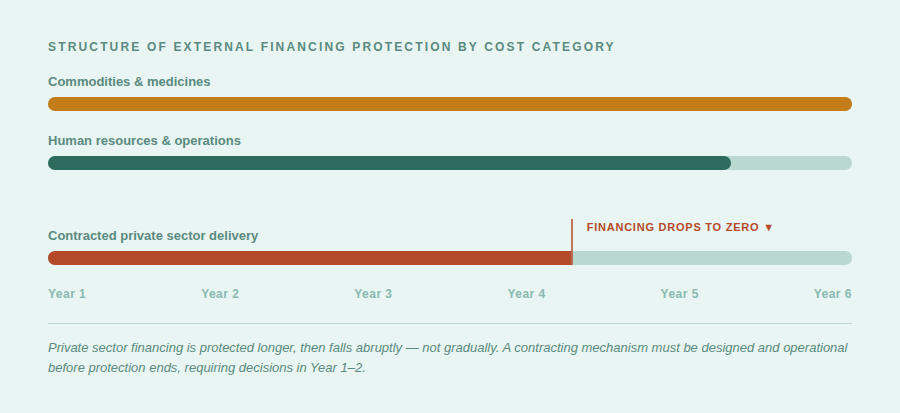
Working backwards from that endpoint reveals the real timeline problem. Designing a domestic contracting mechanism, securing financing for it and making it operational can take a couple of years. The decision therefore has to be taken early in the transition window, long before the funding cliff becomes visible.
Yet this layer often receives the least attention in transition planning. Governments are more comfortable discussing payroll absorption than contracting non-government actors for disease-specific services at scale. The result is a structural risk that becomes visible only when it is too late to design the necessary institutions.
A community outreach network built over years does not wind down gradually when the financing stops. It stops when the financing stops. Notification rates that took years to build can decline faster than they rose.
The fiscal modelling I worked on suggests that governments can substantially increase domestic financing for these programmes over a transition period through sustained reprioritisation of health budgets. The projections are achievable but politically demanding. They require consecutive annual decisions in which a larger share of health spending is allocated to TB rather than to competing priorities. That is not a technical commitment. It is a political one that has to be won year after year, not declared once.
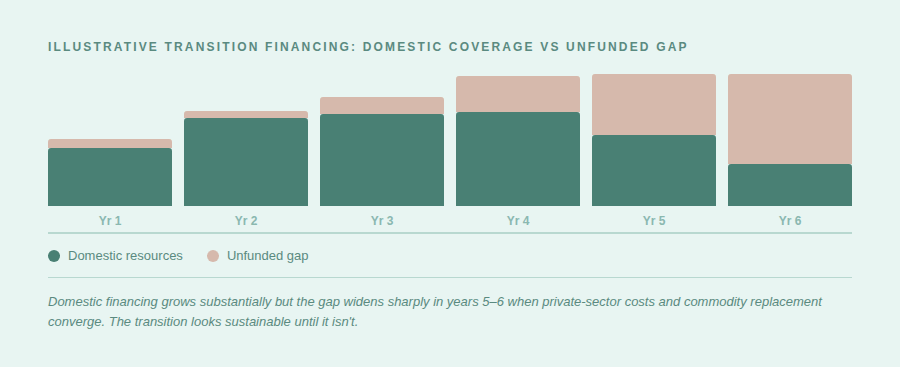
Even under ambitious scenarios, however, domestic resources in the most constrained provinces cover less than half of the total financing requirement by the end of the transition period. The gap is not a planning failure. It is an honest product of where these provinces sit fiscally and institutionally.
The implication is direct: the pace of donor withdrawal has to be calibrated to the rate at which domestic capacity can credibly be built, not to a donor’s internal grant cycle.
More striking is the timing of the pressure. In the early years of transition the financing gap appears manageable. The real pressure emerges later, when commodity replacement costs and contracted service delivery costs converge. A programme that appears financially sustainable for several years can face a steep and sudden adjustment in year four or five.
This pattern explains why transitions often look successful until they fail.
Fiscal space creates the possibility of domestic financing. Public financial management systems determine whether that financing actually reaches the programme.
This is a dimension that transition plans frequently underestimate. In many of the contexts I worked in, external financing had flowed largely off-budget, bypassing government treasury and procurement systems entirely. Transition does not just require governments to allocate more to TB. It requires them to absorb those allocations through domestic systems that were not designed to handle this volume or this type of expenditure.
The implications run across all four layers. Commodity procurement requires government systems capable of managing pharmaceutical tenders, quality assurance, and supply chain planning at scale. HR absorption requires payroll and personnel management systems that can accommodate new cadres and new cost structures. Contracting NGOs for service delivery requires procurement and contract management capacity that most health departments have not previously needed for disease-specific programmes.
Strengthening these systems is not a downstream task to be addressed after financing decisions are made. It is a parallel investment that has to begin at the same time. A government that secures the fiscal space but lacks the PFM capacity to execute will find that the money exists on paper but does not reach the worker, the medicine, or the patient.
The phrase that stayed with me throughout this work was simple.
The worker is present but the function is not.
It describes a failure mode that is almost invisible in the way transition is usually measured. Payroll absorption is easy to count. Budget lines are easy to document. Functional continuity is harder to observe until programme indicators begin to deteriorate.
The patients whose treatment outcomes quietly worsen do not appear in transition dashboards. The budget line moved. The programme is officially on track. The default rate tells a different story, but by then the window for intervention has often closed. The causal chain is obscured by time, and the political moment for correction has passed.
Getting transition right therefore requires measuring functional substitution, not only fiscal substitution. It requires asking whether services continue at the same coverage, intensity and quality after financing changes hands. It requires holding donors accountable not just for whether the budget line moved, but for whether the function survived.
Most importantly, it requires institutional decisions about procurement systems, contracting mechanisms and programme stewardship to be taken years before the financing gap becomes politically visible.
Those decisions are difficult because they require acting before the crisis appears.
But that is exactly when they must be made.
Afeef Mahmood is a health economist and public financial management specialist with over two decades of experience advising governments and development partners across Asia, Africa, and Latin America. He works at the intersection of health systems reform, budgeting, and policy, and regularly supports evidence-based decision-making through applied economic analysis.
Mahmood, Afeef (2026). The Worker Is Present but the Function Is Not: A practitioner’s account of what transition plans measure and what they miss. Field Notes. Substack.
No posts
Comments
Nothing yet. Say the first thing.
Sign in to join the conversation.