
Let’s imagine that when you think about investing, the first thing that comes to mind is buying a house.
That’s actually a great starting point.
It already shows that you understand one of the most important investing principles: long-term investments tend to deliver the best results.
But if I asked you, “Why not invest in the stock market?” your answer might be something like: “It’s too risky.”
And that’s a very common response. Most people feel the same way.
So let’s talk about how you can reduce that risk while still aiming for strong returns. The good news is that there’s a simple way to do it.
It’s called fundamental analysis.
One of the most effective ways to lower your risk in the stock market is to focus on companies with predictable and consistent growth. That means ignoring short-term price movements and instead looking at how a company has performed over many years.
The two most important metrics here are revenue and net income. Revenue tells you how much money the company is bringing in from its products and services. Net income shows how much profit it keeps after all expenses. When both of these metrics are growing steadily year after year, it usually means the business model is strong, demand is stable, and the company has a clear competitive advantage.
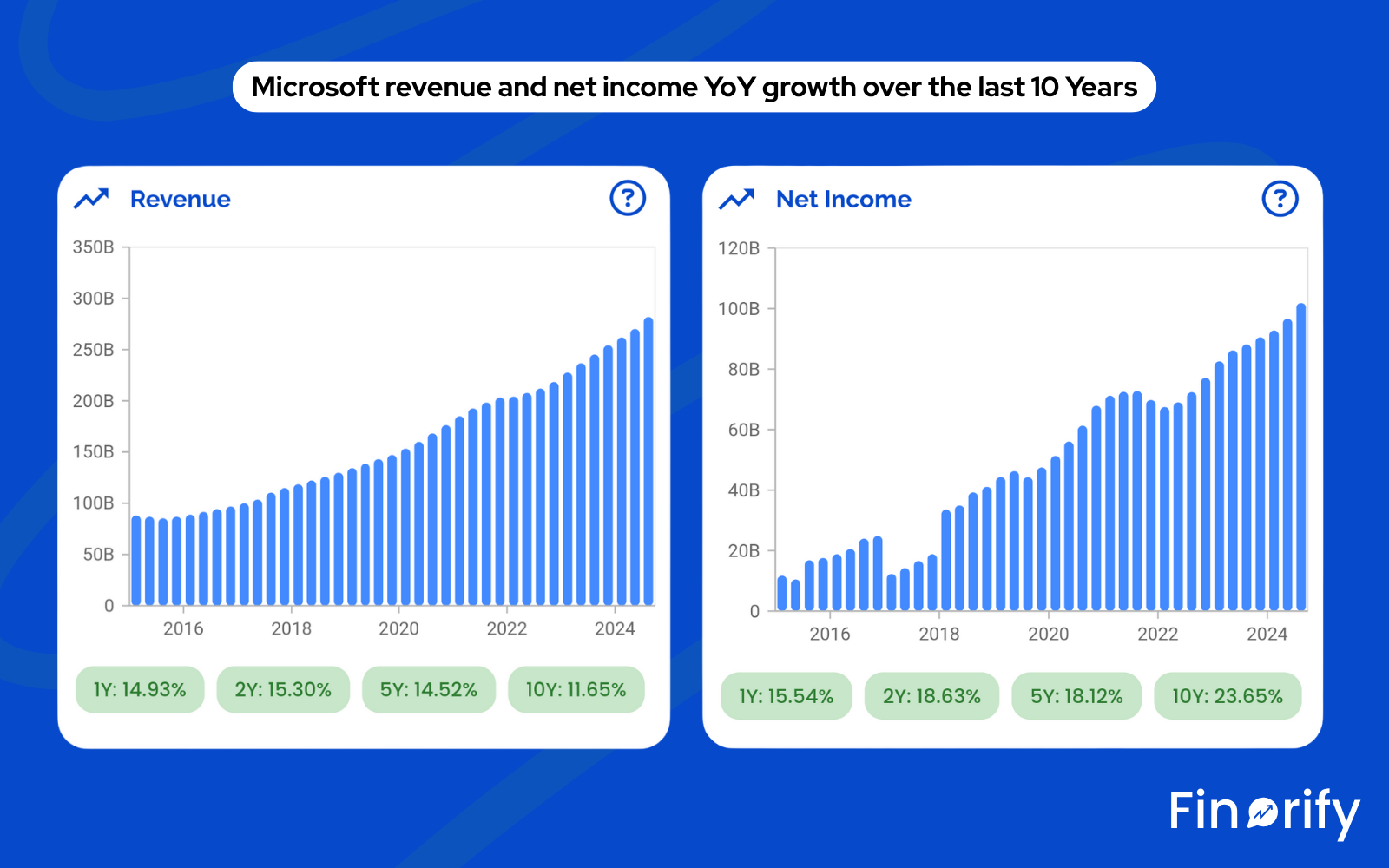
Microsoft is a great example of this. Over the past decade, its revenue and net income have increased at a steady pace almost every single year. Revenue has grown by roughly 11.6% per year, while net income has compounded by around 23.6% per year. This kind of consistency is not luck. It reflects a business that is deeply embedded in its markets and able to deliver more value over time.
When you apply this filter to other companies, you quickly narrow your list down to businesses that have proven they can grow predictably. Those are the kinds of companies that reward patient investors and tend to outperform over the long run.
The next step is to look at how a company uses the money it earns.
This tells you a lot about how shareholder-friendly the company is and how much value it might deliver in the future.
One of the most important metrics here is earnings per share (EPS). EPS shows how much profit the company generates for each individual share of stock. Ideally, EPS should rise steadily over time, and in some cases, it can even grow faster than revenue or net income. That often happens because of something called share buybacks.
A share buyback is when a company uses its own profits to repurchase shares from the market. Those repurchased shares are then retired, meaning there are fewer total shares available. With fewer shares dividing the same amount of profit, the EPS automatically goes up. It’s like splitting a pizza among fewer people: each slice becomes larger.
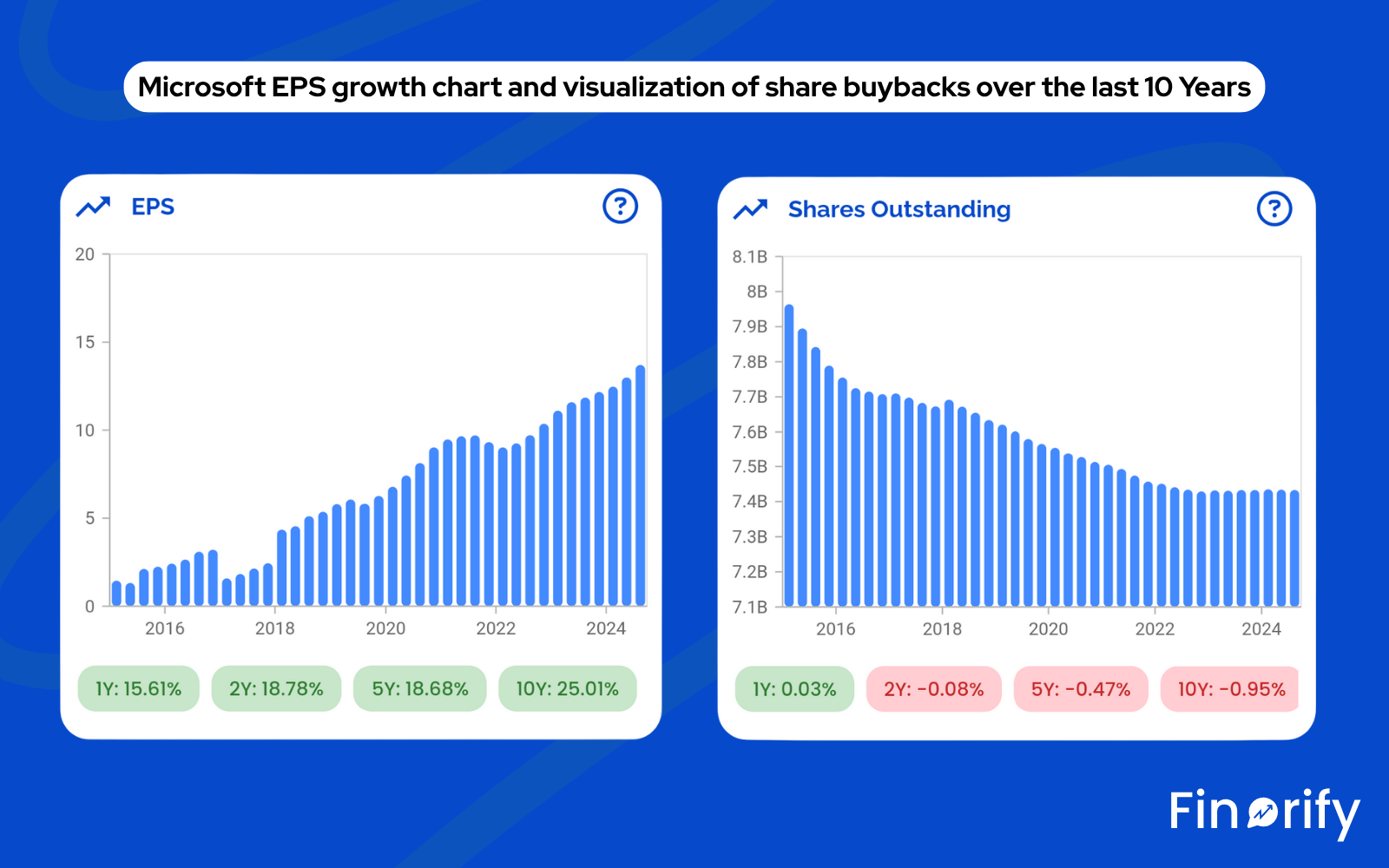
The chart above shows Microsoft’s EPS growth over the last decade alongside the total number of shares outstanding. Notice how the number of shares is steadily decreasing over time. This is a very good sign. It means Microsoft is consistently buying back its own stock, which increases the value of each share you own. Fewer shares also mean that your ownership percentage in the company becomes slightly larger without you buying anything extra.
This is one of the quiet ways strong companies reward their shareholders. Share buybacks don’t make headlines like dividends often do, but over long periods, they can have an even bigger impact on total returns. When you see a company with both rising EPS and a declining share count, it often indicates disciplined capital allocation and a management team focused on long-term value creation.
This combination of consistent growth, rising earnings per share, and shrinking share count is one of the most powerful signals you can look for in fundamental analysis. It shows that the company is not just growing, but also actively increasing the value of every share you hold.
After identifying a company with consistent growth and rising earnings per share, the next step is to look at its financial strength. This is one of the most important parts of fundamental analysis, yet many beginners overlook it. Even the best business can run into problems if it is overloaded with debt or struggles to generate enough cash.
The three key things to focus on are cash, debt, and free cash flow yield. Together, these give you a clear picture of how stable the company is and how well it can sustain its growth over time.
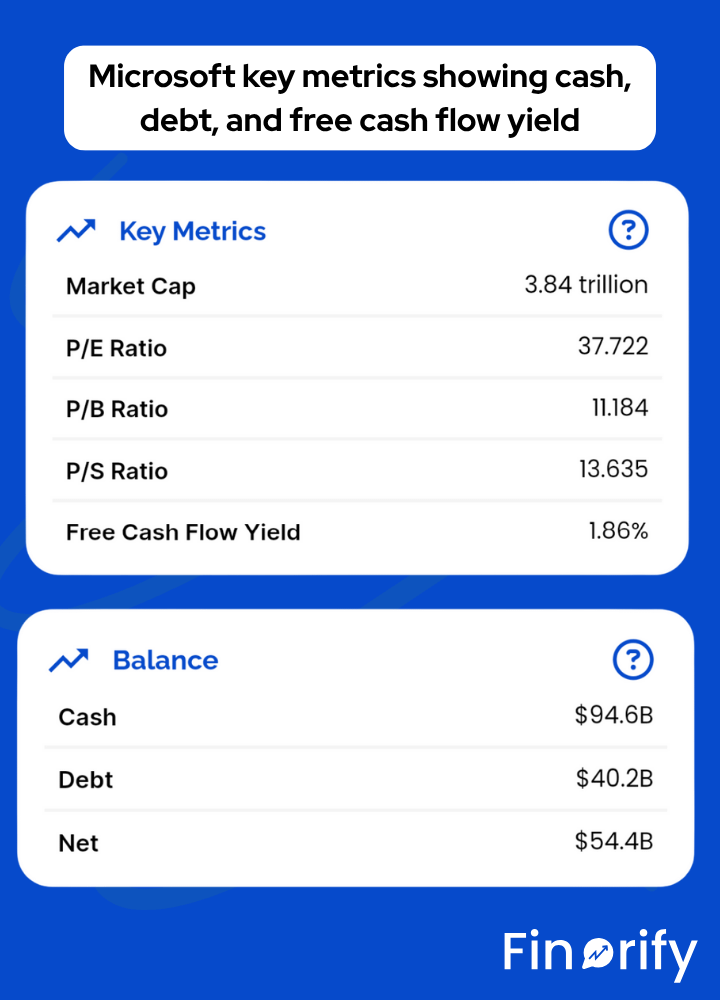
Let’s look at Microsoft again as an example. The company holds around 94.6 billion dollars in cash and carries 40.2 billion dollars in debt, leaving it with a positive net balance of more than 54 billion dollars. That means it has a strong financial cushion to invest in new opportunities, return money to shareholders, or handle unexpected challenges.
The free cash flow yield, which is about 1.86%, is another valuable metric to check. It shows how much free cash flow the company generates compared to its total market value. A healthy free cash flow yield is a sign that the business is not just growing on paper but also generating real cash. That cash can be used to pay dividends, buy back shares, acquire other businesses, or pay down debt, all of which benefit long-term investors.
It is also important to remember that having some debt is not necessarily a bad thing. Just like taking a mortgage can help you buy a home, companies often use debt strategically to finance growth or expand their operations. What matters is whether they can comfortably manage it. In Microsoft’s case, the large cash reserves and strong free cash flow make the debt easy to handle.
By checking these metrics, you are essentially assessing how resilient the company is. A business with strong cash generation, manageable debt, and a solid balance sheet is much more likely to survive economic slowdowns and continue delivering value to shareholders over time.
After applying all these steps, you’ll notice something interesting. Only a handful of companies will meet every condition. That’s not a mistake. You didn’t do anything wrong. That’s exactly how fundamental analysis works.
And that’s the point. These are the rare companies that you can hold for years, the ones that grow together with you and help you build real wealth through compounding.
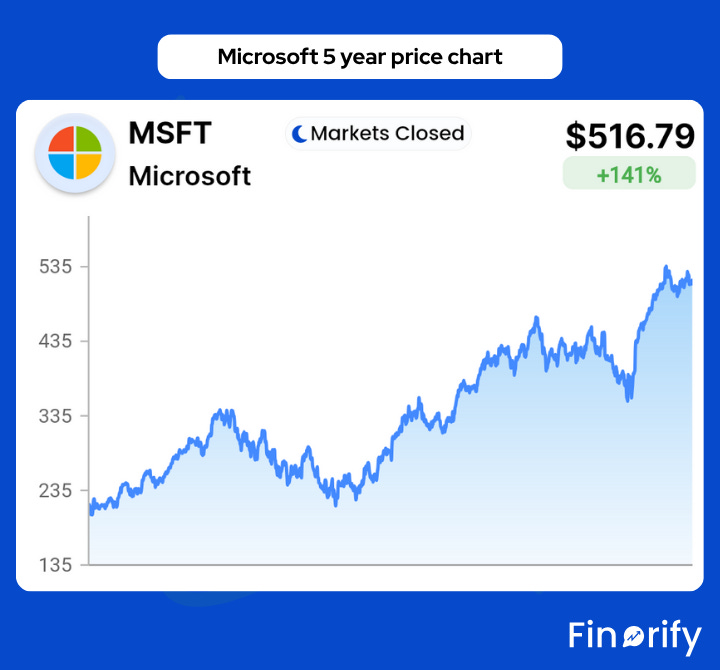
Stock investing doesn’t need to feel complicated or risky. By focusing on predictable growth, smart use of profits, and a healthy balance sheet, you’re already doing most of the work that long-term investors rely on.
If you want to put this into action, try running these checks on your favorite companies in Finorify. It brings all the key metrics together in one place, so you can spot quality businesses and start building a portfolio designed to grow with you.
No posts
Comments
Nothing yet. Say the first thing.
Sign in to join the conversation.