
In the previous chapter, we examined how the recording industry—in its relentless pursuit of maximizing margins and mitigating risk—engineers an ultra-processed “pop” product. This protocol involves a systematic slaughter of the authorial aspirations of emerging musicians, burying their rock-and-roll impulses under layers of industrial aesthetics and second-hand sequins.
However, it would be a mistake to assume that this “translation”—a euphemism for what is essentially a process of alienation—only affects unseasoned youths plucked from TikTok or talent shows. This repressive framework is applied across the board to any niche artist or those from secondary geographical markets seeking to conquer the U.S. mainstream.
Now, if you think that rock music has mellowed out for ethical reasons—that is, because rock is a genre populated by ugly, dirty, and bad artists—you’re way off the mark, and I’m saying it right here:
Rock Masculinity As An Academic Myth
·
November 5, 2025
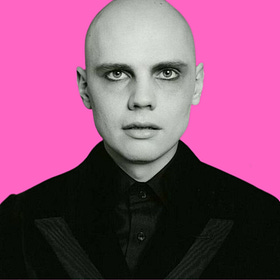
From Iggy Pop to Billy Corgan, through the lens of female listeners: how rock has always fractured gender stereotypes, revealing a complexity that defies rigid academic frameworks.
The cost of global success is almost scientifically inversely proportional to the qualitative density of the work. Entry into the hegemonic market demands formal simplification and the filing down of every ideological edge.
Welcome to a new analysis by Fine Line, where we investigate the predatory logic governing the boardrooms of major labels and management agencies.

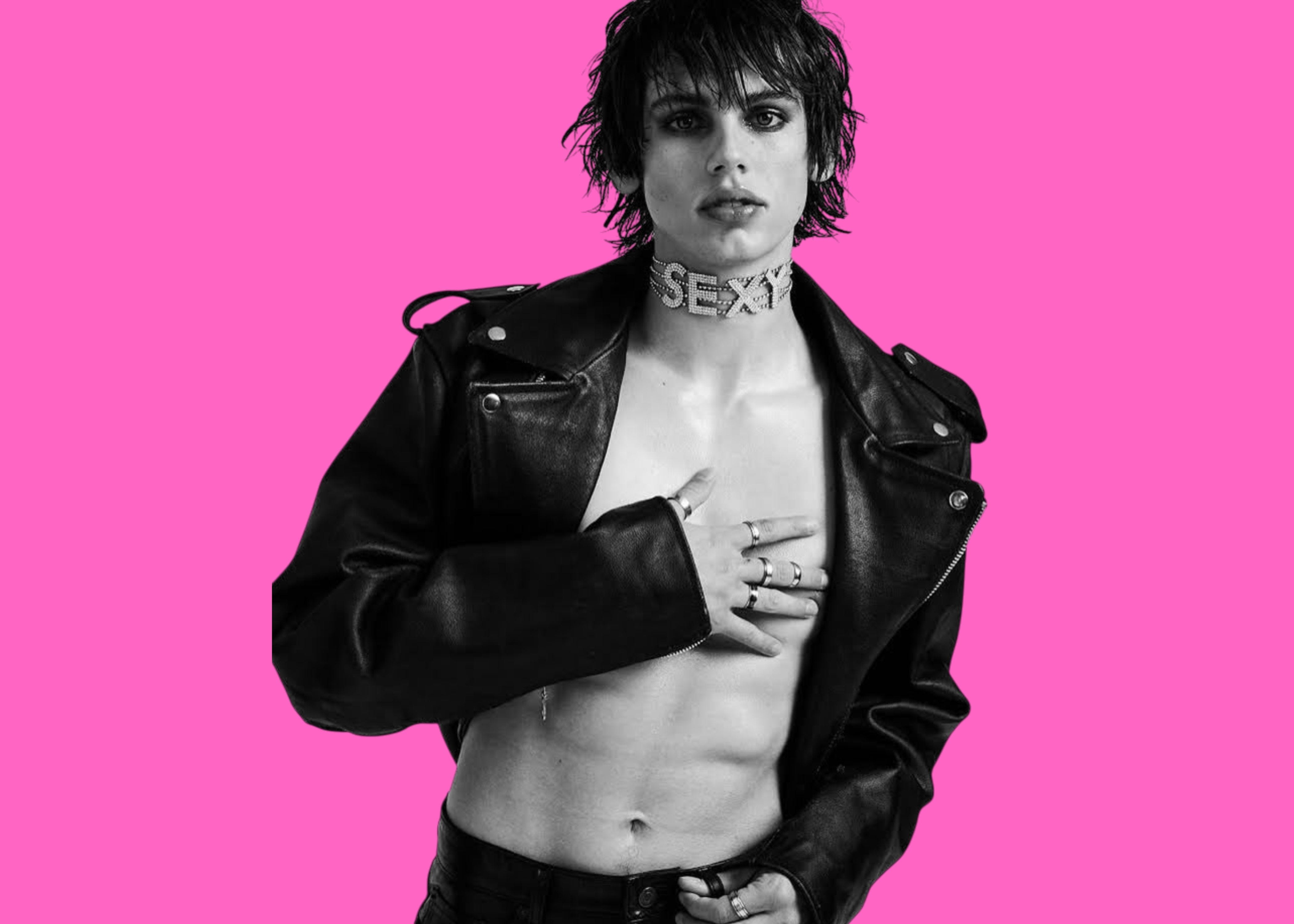
The U.S. market does not serve as a mere commercial destination; rather, it functions as an inflexible center for ontological reprocessing. An invisible but palpable “customs” exists at the border between the peripheral industry (UK, Europe, South America) and the hegemony of the Stars and Stripes majors. In this “no man’s land,” the artist aspiring to enter the North American stadium-filling machine is halted, scanned by the metal detectors of Hollywood management, and instructed to empty their pockets.
What the artist must surrender is not illicit substances, but their cultural, political, and social baggage. The “customs duty” required to cross this border and secure a green pass to mainstream success is paid through stripping—both literally and figuratively. The artist is coerced into discarding their original aesthetic “garments” to don a plastic uniform, becoming an interface compatible with the parameters of Anglophone consumption, which is historically intolerant of ideological friction.
This “Americanization” process responds to the urgent need of financial conglomerates in Los Angeles and New York—and structures such as Live Nation and the Azoff axis—to minimize the “friction coefficient” of a foreign product to ensure immediate scalability. In today’s attention economy, governed by Silicon Valley’s frantic pace, visual language—ergo, the body—is the only medium without linguistic barriers. Saturated flesh captures attention far more rapidly than a committed lyric or a political dissertation.
Global success thus coincides with a process of aesthetic pornification. The artist’s complexity and contextual roots are surgically removed and replaced by the highlighting of erotic-sexual elements, transforming them into an archetype sellable everywhere, from Ohio to Japan.
The American mass audience detests cultural esotericism. When the industry acts as a “distributor of last resort”, acquiring the rights to artists already validated in secondary markets, the primary directive is to sever ties with the context of origin.
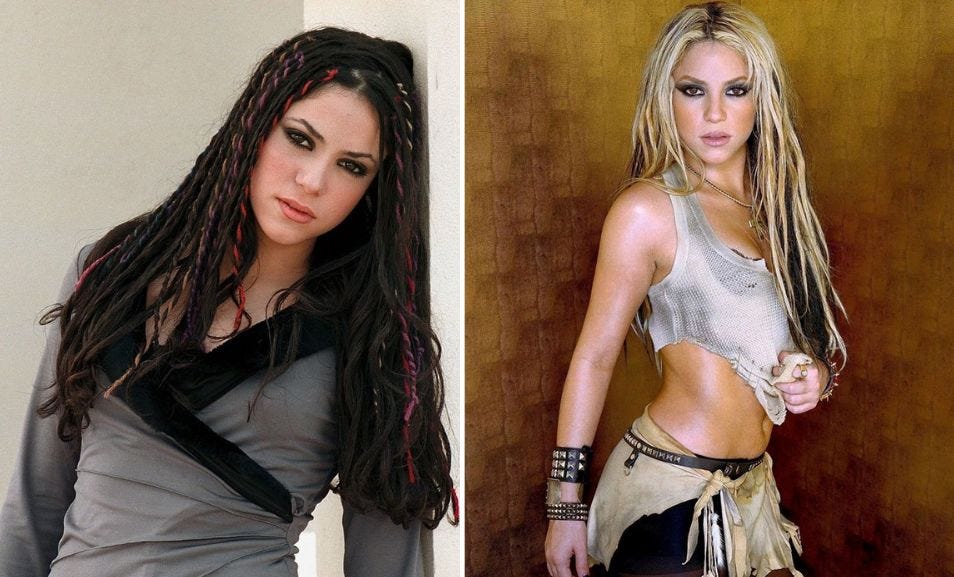
This is a process of racial and cultural simplification, for which Shakira remains the quintessential prototype. Her career serves as the ultimate model of how the industry takes a rooted cultural product (a black-haired singer-songwriter with political lyrics and acoustic-rock roots, once dubbed the “Latin Alanis Morissette”) and performs a total artistic lobotomy. The transition from the poetic density of the 1990s (Dónde están los ladroni) to the global launch of Laundry Service (2001) illustrates the subsumption of symbolic capital:
Aesthetic Bleaching: Dyeing her hair platinum blonde to appear more “accessible” and neutralize ethnic markers.
Linguistic Dilution: Banalizing lyrics into rudimentary English.
Pelvic Focus: Reducing the artist to the universal archetype of the “Latina Caliente”.
Exoticism is tolerated only when emptied of its sociological weight and bent to the service of choreography and seduction. Even the current phenomenon Rosalía, despite retaining her native tongue, has had to undergo a progressive stripping and engage North American “guarantors” (such as The Weeknd) to unlock the supreme market.
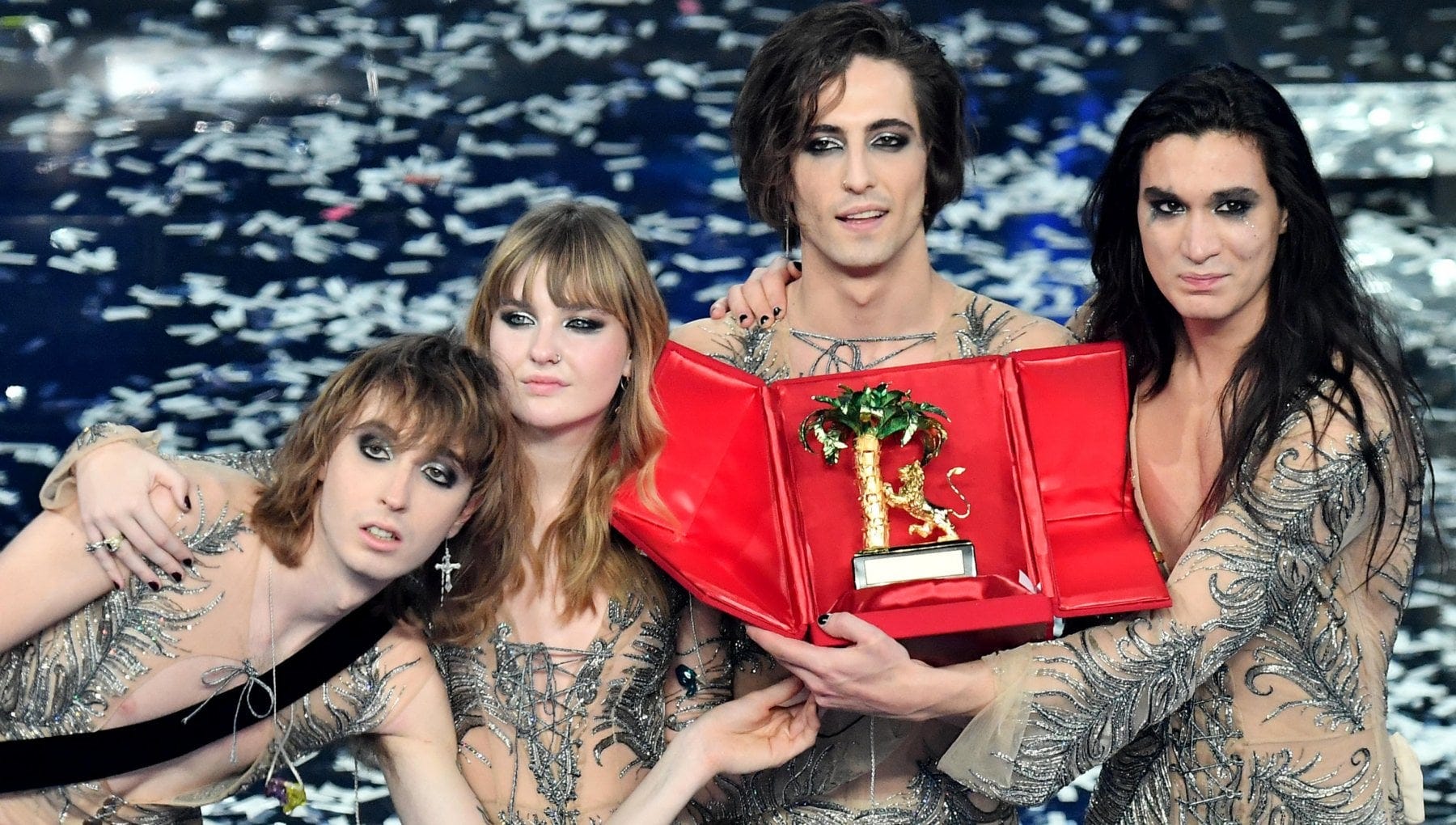
Within this landscape, Måneskin position themselves as a formidable case study for understanding not the creation, but the American hyper-fetishization of an asset. Originally launched in Italy under the wing of underground icons—such as Manuel Agnelli, the mind and body of the alternative rock band Afterhours—the Roman group triumphed at Sanremo and Eurovision 2021 by bringing a specific brand of raw, street-level glam-rock to the global stage. Coordinated sartorial suits, metallic jumpsuits, bare torsos, and heavy eyeliner defined their identity.
This aesthetic had such immense visual impact that even before formally swallowing the band, U.S. infrastructure decided to pillage its imagery for its domestic products. The American recording industry—first and foremost the management of Harry Styles—sniffed out the European trend dominating TikTok.

What followed was a swift corporate replication. In 2022, for the Love On Tour supporting Harry’s House, Styles’ stylist (Harry Lambert) abruptly outfitted him in dozens of sparkling, deep-V jumpsuits. This move produced a carbon copy—with over a twelve-month delay—of the visual shockwave originally unleashed on the Rotterdam stage by frontman Damiano David.
In short, America first “plagiarized” the aesthetic of a continental European rock band that had paid its dues busking on the streets before cutting its teeth on the television format of X Factor. It pasted this identity onto its principal asset (Styles), and only then did it move to ingest the actual creators of the trend (Måneskin).
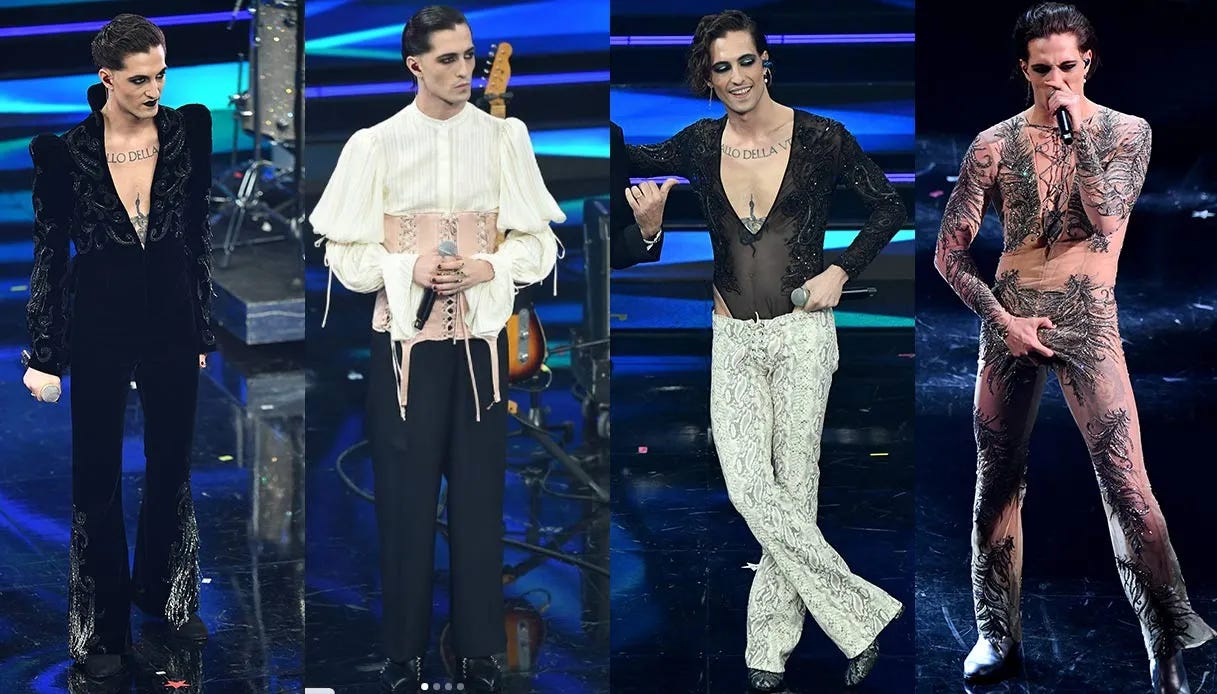
This brings us to the core mechanism: what happens when the original Måneskin physically land within the North American market?
The focal point of their “Americanization” is not the recourse to glam—which was already native to their identity—but a mandatory shift toward genderless shock-value and fetishistic BDSM aesthetics. The moment they put down roots in Los Angeles (and entered the production meat-grinders of Max Martin), North American management forced their hand. In the U.S. mainstream, nuance is non-existent; the band had to be reduced to a cartoonish caricature of a rock band engineered specifically to provoke outrage.
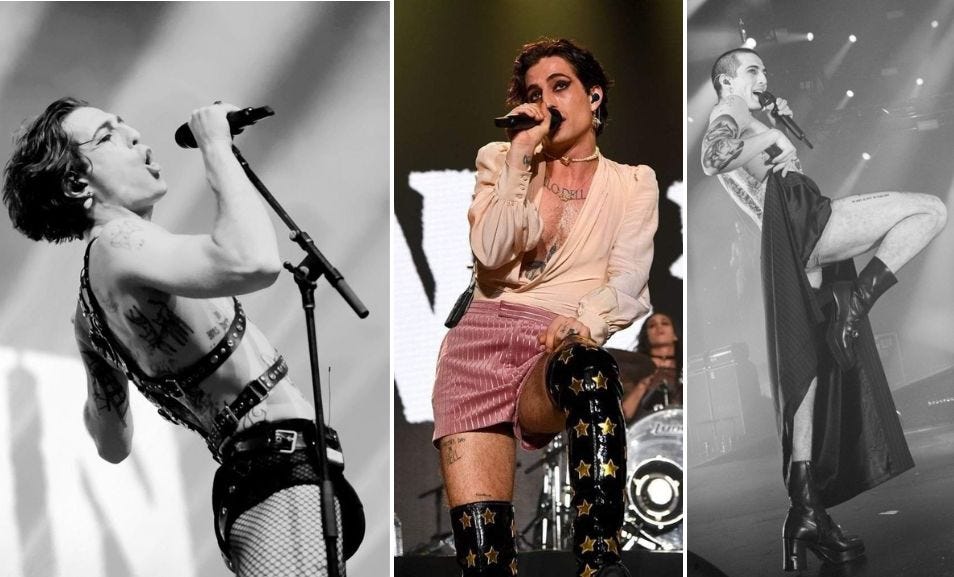
Consequently, out came the latex, the nipple covers, the ostentatious fishnets, the on-command tongue-wagging, and continuous allusions to sadomasochistic practices and orgiastic behavior, heavily documented across international red carpets—most notably the MTV VMAs.
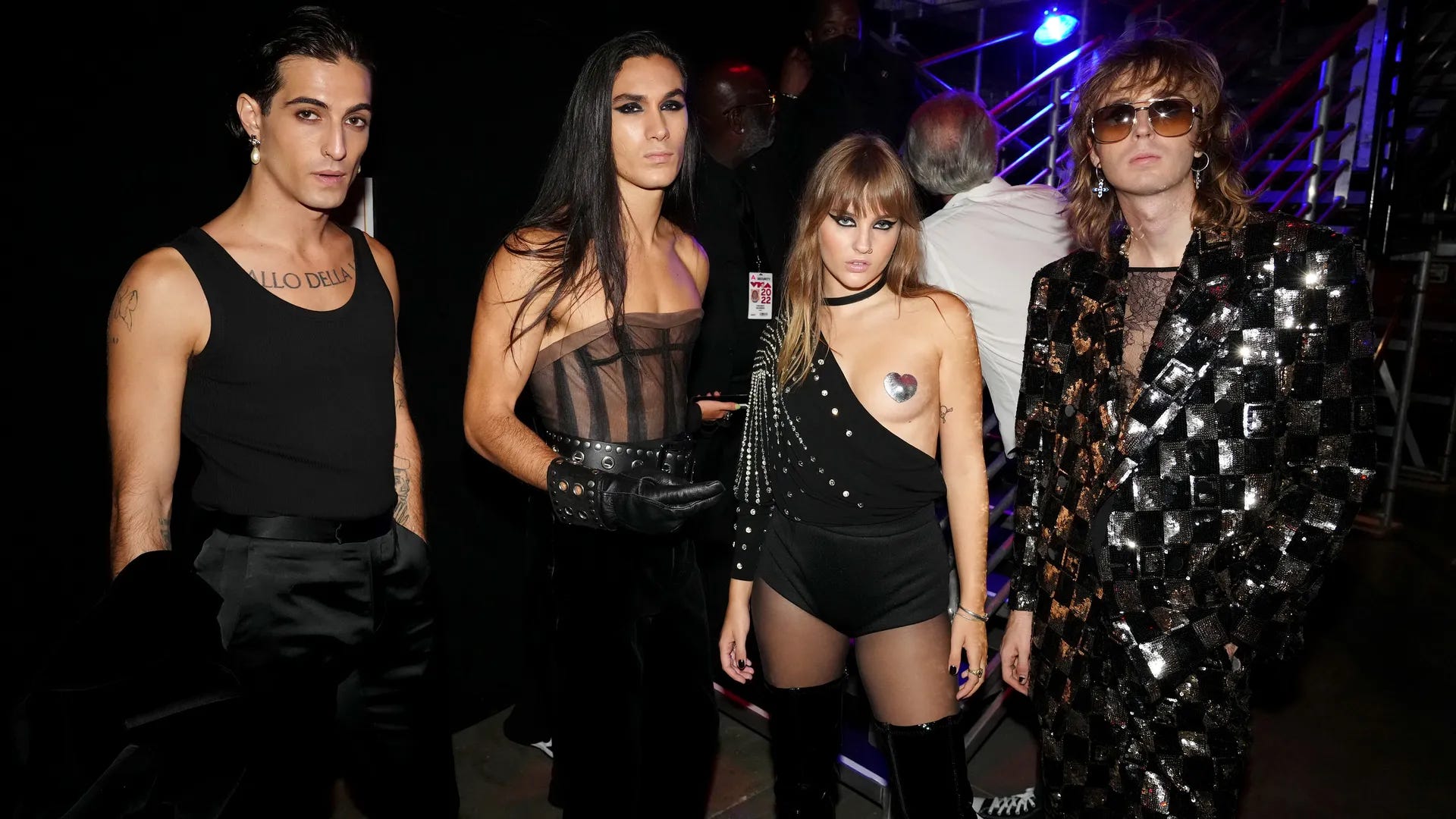
The U.S. industry thus confirms its structural inability to manage an authentic European rock band possessing a genuine, visceral charm. Their initial European phase still maintained a connection to the historicized clichés of 1970s avant-garde rock. However, their subsequent transition under the supervision of U.S. management, paired with the standardization of their sonic production, mandated the introduction of BDSM fetishism. This translated the product into a strictly hyper-sexualized, “genderless” register, demanding a caricature that mimics the worst archetype of the “sexually uninhibited band.”
This rapid pornographic acceleration fulfills the corporate need to guarantee the immediate legibility of the asset across global markets. It reduces the complexity of a continental rock band to a frictionless erotic simulacrum stripped of socio-political friction, providing final confirmation that Americanization is executed through the commercial radicalization of the body.
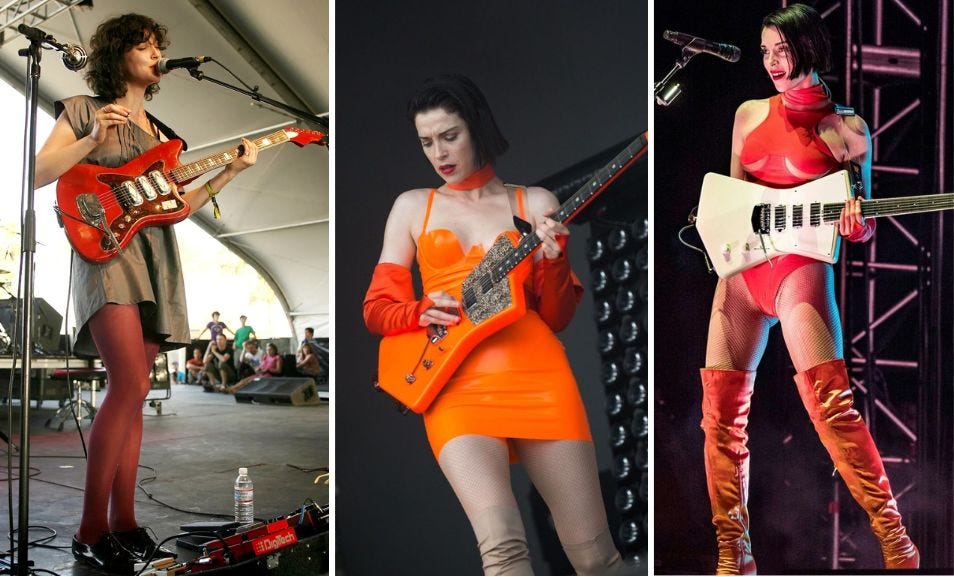
This slaughter of complexity in favor of hyper-aestheticization becomes all the more cruel (and blatant) when the industry’s framework must assimilate women of extraordinary intellectual or experimental caliber. In North American pop, if you are a woman and you think, the market becomes nervous. To be “harmless”—and therefore invoiceable—female depth must accept erotic visual saturation. It is the industry’s tax on complexity: maturation is not expressed through more evolved scores or lyrics, but through the increasing inches of exposed skin.
The case of St. Vincent (Annie Clark) is emblematic and, in many ways, painful. For years, she was acclaimed as the heir to David Byrne-esque cerebral art-rock, the spokesperson for a detached, alien aesthetic focused on pure guitar deconstruction. However, the transition from an independent label (4AD) to a major, under the protocol direction of hitmakers like Jack Antonoff (the great standardizer of this decade’s pop), coincided with the payment of the toll.
Intellectual complexity does not sell out arenas for the general U.S. market; thus, the narrative was wedded to a latex-neopunk aesthetic steeped in dominatrix fetishism. Clark had to channel her idiosyncrasies into a visually digestible sexual power, reducing the friction that would have otherwise prevented her canonization (and her Grammy wins).
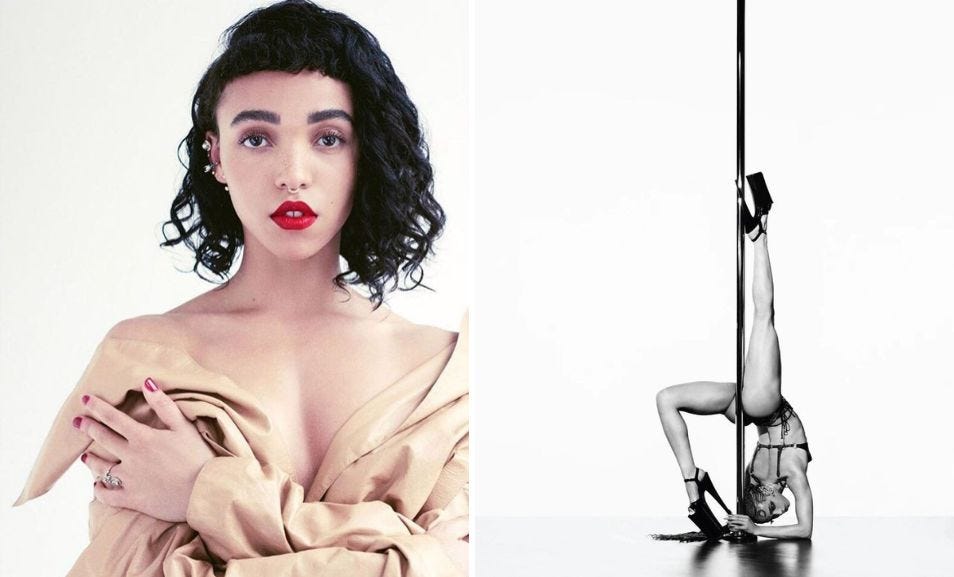
The same cynical fate befell FKA twigs, who has always used her body, but whose evolution makes the system’s voracity manifest. Her first phase under the UK label Young Turks was dark avant-garde: an alien, repellent, almost disturbing sensuality within her trip-hop reworkings. But upon landing under the control of Atlantic, with albums destined to dismantle the North American market, the narrative derailed.
The performative use of pole dancing—originally intended by the artist as an athletic and artistic reclamation—becomes pure gold for a desperate marketing department that finally found the primal hook to sell her to the average American: no longer an experimentalist, but an “auteur stripper”. Because the mass listener cannot decode the offset metrics of her tracks, the industry offers the reassuring compromise of “acrobatic sexuality”, degrading art into a pornified storefront.
The closing of this evolutionary circle for the female pop star—engineered without a single flaw from the very foundation of the major shipyard (Warner)—is Dua Lipa. In her case, there wasn’t even an arty or conflict-driven baggage to remove; nonetheless, the process of adapting to the global U.S. market required a forced bodily transition. The “cool British girl” with the low voice, famously mocked for her inability to move (the cruel “go girl give us nothing” meme), was subjected to military-grade training to requalify as an American Physical Performer.
A Global Pop Act requires microscopic Mugler bodysuits and rhythmic pelvic gymnastics. Her rise attests that the perfect overseas container is “form without conflict”: an excellent refinement of derivative sounds devoid of the slightest divisive message, promoted solely by enhancing the plastic value of the performer’s body.
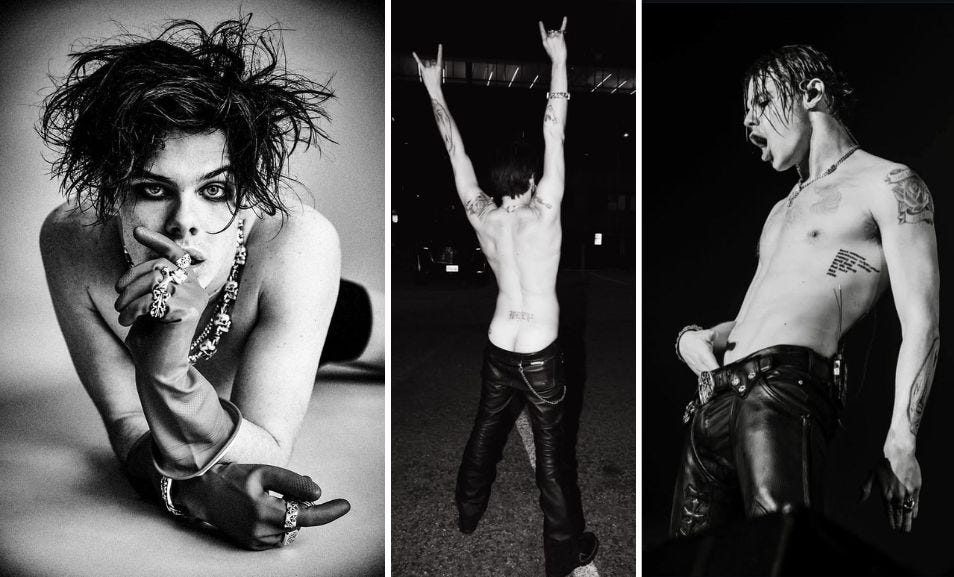
It would be naive, however, to think that this U.S. customs house imposes the “body tax” exclusively on women. While the objectification of artists like St. Vincent or Dua Lipa is literal, plastic, and undeniable, the industry has perfected a similarly brutal neutralization protocol for men: a process that masks total commercial submission behind the alibi of fluidity and rebellious transgression. If women pay the tax with latex and pole dancing, male exports pay by bartering class consciousness for mere aesthetic transgression.
The case of Yungblud (Dominic Harrison) constitutes a phenomenal “punk-coded” variant of this same export framework. In his early days, Yungblud presented as a politically active subject: his roots were sunk into a specific British class and geographical reality, featuring anti-Brexit invectives and raw social commentary. To the eyes of American management, this substratum represented an incalculable risk—a clear limit to the product’s scalability in the arenas of Missouri or Texas.
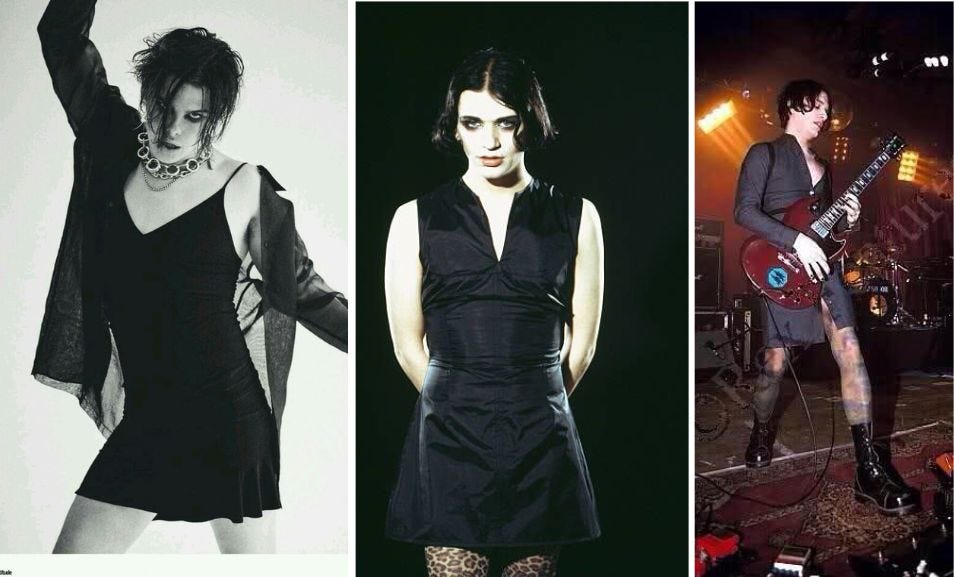
To make the Asset universally consumable, the conflict had to be shifted from the political plane to a purely aesthetic and sexual one. Thus, “plant-based punk” was born: a pornified version of past icons like Brian Molko, where rebellion no longer threatens institutions or the economy, but manifests harmlessly through skirts, heavy makeup, and carnal posturing. Yungblud stopped talking about economic policies to embody a totally abstract concept of “freedom”, rendering his dissent a sterile stylistic trope.
The system’s institutions—the Guarantors—intervene to lock in this farce. Lacking the driving force of an organic catalog that would justify “rock savior” status, Yungblud was paired with the mythological infrastructure of the Osbourne family. This is a device for forced historical legitimation—nothing more than a pre-paid handoff. Selling Yungblud as Ozzy’s heir provides marketing with a pedigree, but it is the constant supervision of Sharon Osbourne that reveals the truth. Sharon serves as a bridge to the Los Angeles power structure (the same that beatified Irving Azoff, the deus ex machina of elite entertainment), ensuring the young “rebel” stays rigidly within the production tracks established by promoters and majors.
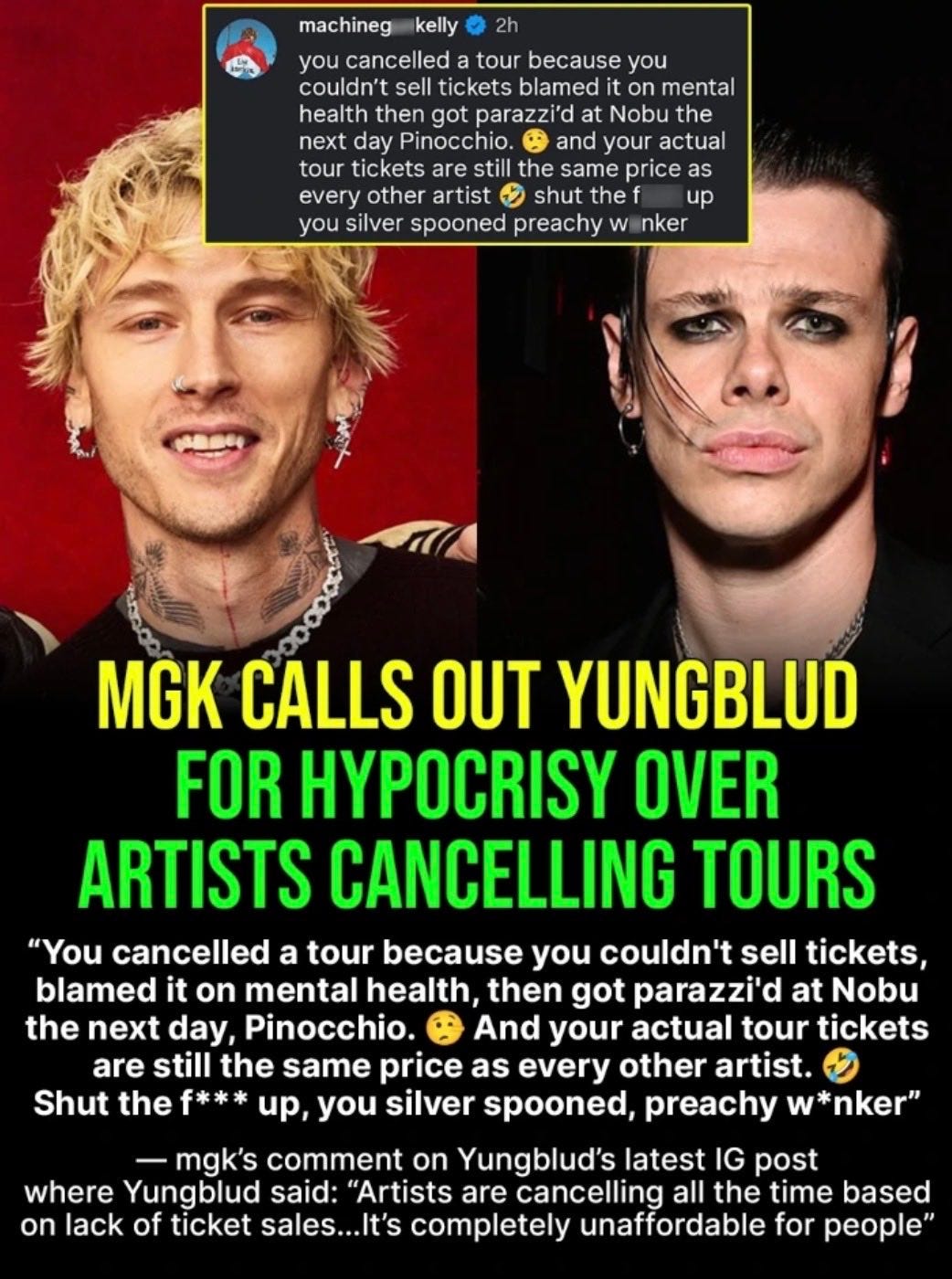
In this context, the fierce irony of institutionalized rebellion emerges. There is an abyss of hypocrisy in seeing Yungblud publicly denounce the cost of living or “low” ticket prices as an act of empathy for his audience while operating under the umbrella of elite figures like Azoff, utilizing pricing dynamics aimed at maximum extraction from the fandom (dynamic pricing and secondary ticketing). It is the same paradox of a Harry Styles who sells charity in single pounds to cover up 800-euro premium tickets.
Under this lens, the bitter truth is that Styles and Yungblud are not different artists at all, and they are certainly not two autonomous artistic entities. They are simply two flavors of the same carbonated soda, bottled by the same corporation: one is the “cinnamon” flavor, for those who long for the romantic prince in a cardigan; the other is the “chili” flavor, for those who require the archetype of the fake misfit. Both, however, serve only to extract parasocial capital.

For Harry Styles, we can pinpoint the exact date this protocol of commodification was inaugurated: January 1, 2016. The signing of the contract with Jeff Azoff took place on the family yacht in St. Barths—complete with photographs, embraces, and smiles.
In that moment, Azoff’s dual objective followed the classic textbook of power. First, to secure the loyalty of a very young asset newly emerged from a boy band by demonstrating omnipotent influence. Second, to position him in record time within the North American market using the tactic of “cultural guarantors”—the same mechanism we observed in the case of Yungblud.
No other manager in the world possesses the leverage to arrange three unreachable icons in succession for a single protégé, except for the Azoffs. Within a few months in 2016, Styles was cast in Christopher Nolan’s Dunkirk, interviewed in Rolling Stone by Cameron Crowe, and secured three distinct covers for the Autumn/Winter edition of Another Man magazine, featuring a high-profile interviewer: Sir Paul McCartney.
The contract thus became a “show of force” in pure Hollywood-mafia style. The Azoffs placed their entire arsenal of power and industry connections on the table, essentially telling Styles: “Look, kid, if you surrender your artistic agency entirely to us, I’ll make a few calls and you’ll sit at the table with McCartney, Nolan, and Crowe.”
This serves to daze the young artist while simultaneously purchasing a synthetic pedigree for the U.S. market.
By providing a twenty-two-year-old with direct access to the “Fathers of the Canon”, Azoff created a bond of psychological dependency. Styles threw himself headlong into the management’s arms to become a “ward” protected by untouchable institutions, rendering every future demand for “transgression”—namely, pornification—an acceptable price for maintaining his newly acquired status.
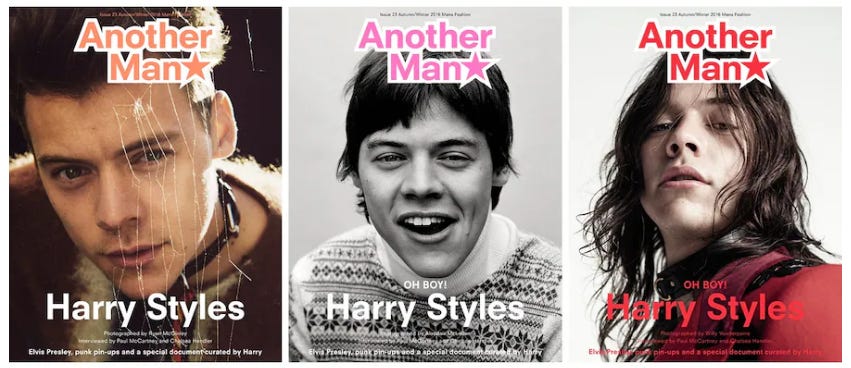
If we set aside the illustrious names and analyze the Another Man (2016) photoshoot through a marketing lens, it becomes immediately apparent that the session functioned as a corporate focus group. It served as the blueprint for the audience segmentation applied to the Styles Asset.
At the time, management had not yet determined which target demographic would respond most effectively, so they created three distinct SKUs (Stock Keeping Units) for Harry Styles:
The Boy Next Door (The Son/The Familiar): Wispy hair, understated knitwear. This version was designed to neutralize the threat of the “young rebel”, making the artist palatable to father figures and the conservative general market. It represented a reassuring return to order.
The Vintage Baronet (The Artist/The Credible): The Sgt. Pepper aesthetic and the 1964-style mop-top established a direct link to the golden age of British pop. Here, McCartney functioned as an ontological guarantor: if Paul accepts him, then Harry is “real” music. This was the lure for the demographic of mothers and vinyl collectors.
The Pornified Asset (The Fetish/The Commodity): A bare torso under sartorial jackets, wet hair, and, most tellingly, a leather BDSM collar marked the official entry into erotic fetishization. This version was dedicated to adolescent daughters, but with an “adult” update that laid the groundwork for the future devaluation of the body as the sole sellable element of interest.
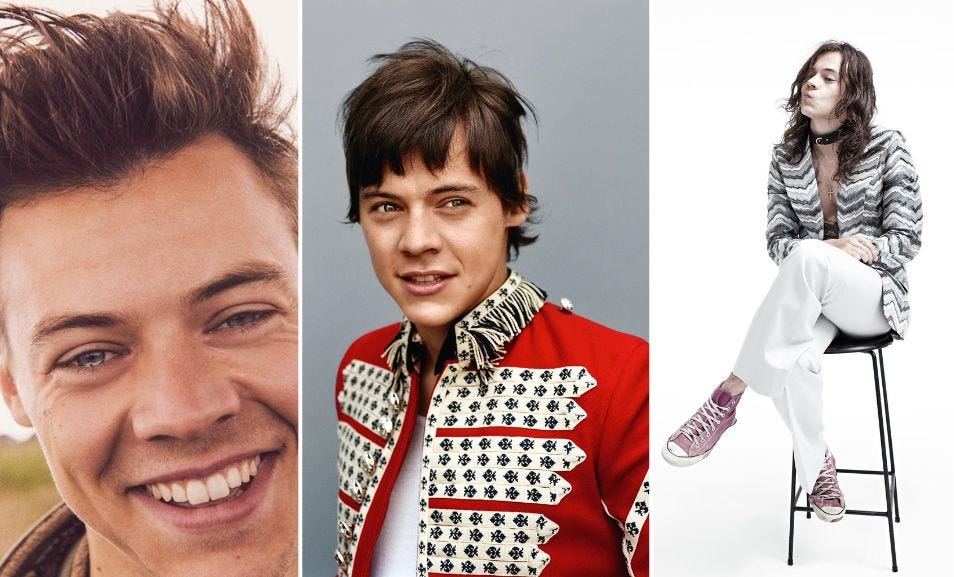
The pornification of the Asset began the day the ink dried on Azoff’s contract. The industry decided at that moment that visual fetishism and aesthetic submission—the same inflicted upon Dua Lipa or St. Vincent—were the only ways to capitalize on the desire of the most receptive demographic: young women.
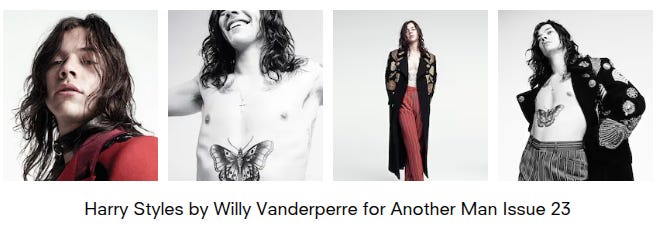
From that day in 2016 onward, every single move in Styles’ career has religiously followed this predatory script. Even the “The Whale” maneuver is nothing more than the live, cascaded transposition of that very first fetishistic cover, cold-bloodedly engineered by Irving Azoff.
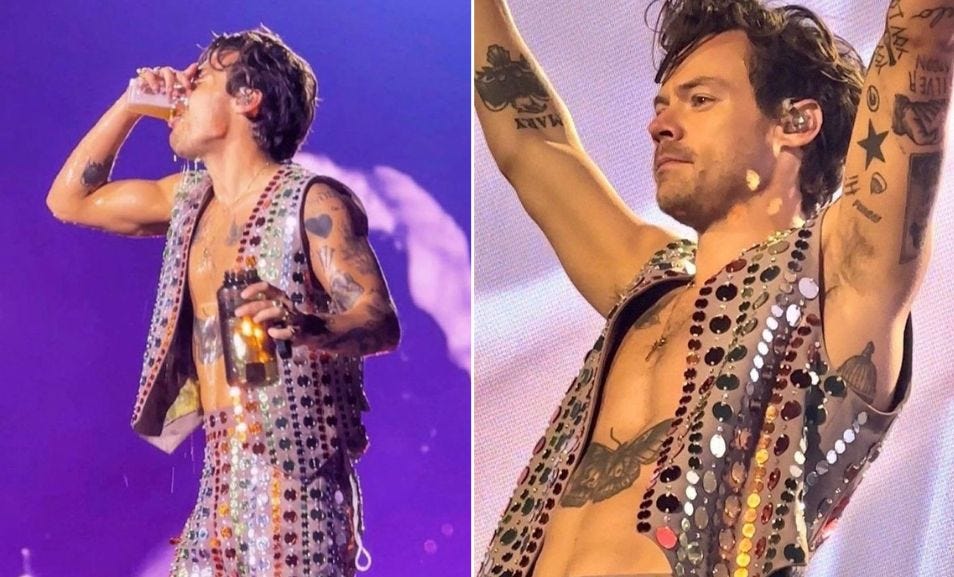
In the previous article, we saw how the “whale” gesture was the peak of Styles’ eroticization. In this context, its metamorphosis serves as an exemplary case of functional re-semantization—driven by the global pop industry—that lays bare the entire mechanism of Harry Styles’ commodification.
This operation illustrates the transition from the aesthetic regime of “fraternal collectivity” (typical of the boy band phase) to that of “individual erotic commodification,” where the childish gesture is stripped of its playful charge to be reintegrated as a device for sensory saturation.
The reconfiguration of the “whale” demonstrates how every trace of spontaneity must be filtered and codified to become a Performance Asset. What appears to be a “candid” moment is actually a calculated element of staging, where the lighting, angle, and timing are designed to transform a playful habit into an erotic climax.
The industry neutralizes the artist’s “goofy” side to replace it with a glossy, fetishized version. Harry Styles ceases to be “one of the guys” to joke around with and becomes a plastic, wet, and toned interface, perfectly conforming to the parameters of the pornified mainstream.
The Styles case confirms that “translation” for the global market never occurs upward (toward complexity), but downward (toward instinct).
The whale gesture is the archetype of how the U.S. industry recycles the detritus of artists’ youth to refine it into fuel for the industry of desire.

This process of “friction removal” is not applied solely to burgeoning export pop stars; it acts as a vice even upon the untouchable giants of international Rock. America demands that complexity evaporate, replaced by mere spectacle in a process we might define as Hyper-Hedonistic Pacification.
The case of U2 represents the archetype of the European rock “customs clearance”. In the early phase of their career, U2’s output was saturated with a violent territorial specificity; tracks like Sunday Bloody Sunday brought the unresolved friction of the Troubles and the conflict with the IRA into the pop landscape. However, the process of globalization under the aegis of Azoff/Oseary management dictated a stripping of identity. To become the definitive global asset, the band had to execute a transition from the political to the performative.
The trajectory of their career bears witness to this grotesque barter: moving from the profound introversion and European intellectual exploration of Achtung Baby with Brian Eno, they plunged into the point of no return with the Pop album and the colossal PopMart Tour. To reign in America, Irish guilt and social commitment had to vanish to make room for giant plastic lemons, massive McDonald’s-style arches, LED screens, and pure hedonistic citationism.
To break through on a global scale, Rock essentially had to stop asking questions and become the background music for a global supermarket. And for those wondering if the web of this American pacification always follows the same power structures, one need only look at the current landscape: for several years now, the management of U2’s immense live portfolio—including the gargantuan, multi-billion-dollar residency at the Las Vegas Sphere—has been handled by none other than Full Stop Management, the agency of Irving Azoff.
The logic of the closed system strikes again, and the stadium reaffirms its status as the archetype of lobotomized entertainment.
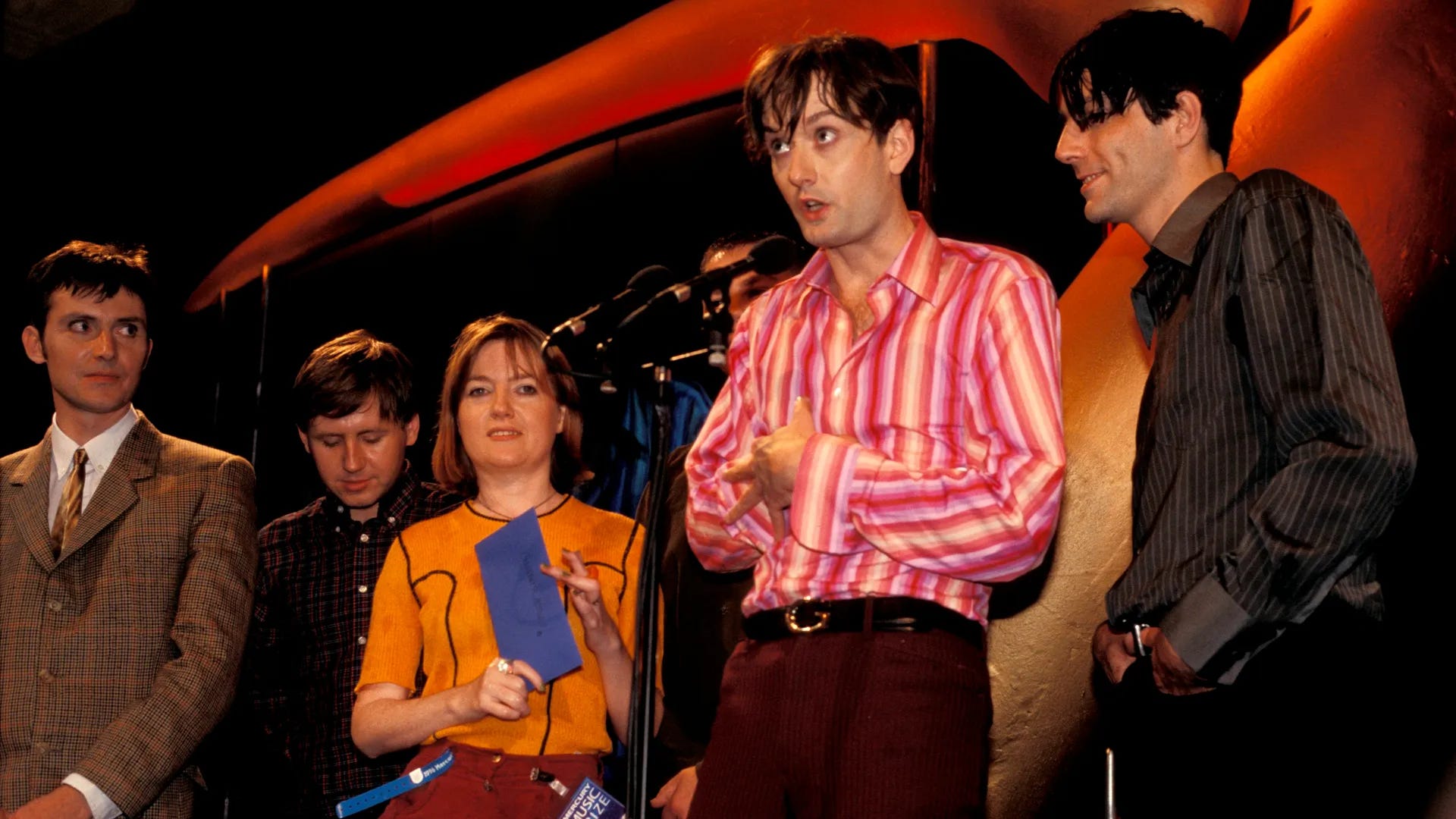
At this point, a crucial question arises: why does the U.S. entertainment machine—despite being capable of lab-growing technically perfect pop stars within the gilded cages of the Disney Club or performing arts schools (from Sabrina Carpenter to Olivia Rodrigo)—feel such a desperate need to import foreign artists only to lobotomize them?
The answer lies in the quintessentially American obsession with Commercial Universalism and a profound terror of structured social conflict. The overseas infrastructure operates on a staggering continental scale. To generate revenue in every corner of such a vast and fragmented market, the supreme directive is the maximization of scalability. But scalability does not tolerate complexity: every ideological, political, or class-based friction must be purged, because a stance that is too specific segments the audience.
Politics divides; trauma and instinct unite. This is where the great operation of cultural extractivism occurs: they buy the urgency, the “fervor,” and the credibility developed by an artist in their peripheral market (the UK, Italy, Colombia), import it to the United States, and distill only its surface.
What we witness is the definitive triumph of the individualist paradigm over the collective—a historical constant documented by comparing the musical movements on both sides of the Atlantic.
Take Punk: a genre that perfectly illustrates the ontological divergence between the American “commodity-form” and the European “message-form.” U.S. punk (led by the Ramones) codified an eminently aesthetic and behavioral rebellion: suburban boredom, formalist nihilism, the desire to “switch off the brain”. It entirely lacked a program for social rupture.
Conversely, British punk, spearheaded by The Clash, was born from the mud of a collapsing nation: unemployment, economic crisis, hatred for Thatcherite conservatism, and fierce anti-colonialism. It was class warfare armed with guitars.
To summarize with a quip: the Americans wanted to destroy the stage; the British wanted to set fire to the House of Lords.
This same mirror-image fracture reappeared punctually in the 1990s. America exported Seattle Grunge—an undisputed masterpiece, yet the quintessence of “ailing individualism.” In the brilliant pens of a Kurt Cobain or a Billy Corgan, the enemy was invisible, abstract (“society”), or internalized (alienation, family trauma, heroin, psychiatric malaise).
At that very moment, across the pond, Britpop was dissecting post-imperial England with a meat cleaver. Blur mocked the bourgeois working class, and Jarvis Cocker (Pulp), with Common People, wasn’t singing about his childhood traumas; he was shredding the “class tourism” of the wealthy playing at being poor. Skunk Anansie proudly shouted “Yes, it’s fucking political,” reminding the world that existing as a black, lesbian, bald woman was not an aesthetic statement, but a political fact.
Even where music is ostensibly plastic or dance-oriented (consider the sharply anti-capitalist lyrics of Depeche Mode’s Everything Counts), social denunciation managed to find its space. In the USA, it does not. Narrative density is judged an impediment to commercial “transversality.” The U.S. industry far prefers emotional vagueness (or blatant pornification) to political precision.
It is within this gap that we definitively understand the trajectory of St. Vincent, Yungblud, Rosalía, Måneskin, and, of course, the clinical case of Harry Styles. The U.S. recording industry acts as a titanic oil refinery for aesthetic surplus value. It extracts the form from the rest of the world—the catchy sound, the British vocal inflection, the Latin grit, or the Italo-European glamour—and surgically discards the content: the class, the critique, the State.
This systematic extraction of meaning leaves behind a void that the industry fills with hyper-saturated imagery. By decoupling the artist from their sociological roots, the American apparatus ensures that the "Global Pop" product remains politically inert—a frictionless commodity that circulates within a closed circuit of consumption, never challenging the economic structures that finance its existence.
In the rest of the world, pop is not inherently regarded as a hollow genre. On the contrary, it is frequently utilized as a scalpel to dissect the social pyramid and its attendant hypocrisies. This is evidenced by a fascinating cross-cultural thread: a fierce irony directed at the mechanisms of Capital, articulated across vastly different languages and demographics. It is a phenomenon that serves as a mirror image to exactly what is forbidden within American entertainment.
We might trace a definitive “Triangle of Class Consciousness.” On one side, we find the planetary explosion of K-pop via PSY’s Gangnam Style. Far from being a senseless ditty, beneath the horse-riding choreography lies a scathing condemnation of Seoul’s “nouveau riche”: vulgar social climbers mimicking Western standards and drinking expensive Americanos for the sole purpose of performing a facade of luxury.
Conversely, the United Kingdom responds by vivisecting the dynastic “old money.” Damon Albarn and his cohort in Blur, in tracks such as Charmless Man, dismantle hereditary capital: the aristocrat who flaunts a costly education to mask a desolate human failure, where every witty citation is merely a shield to preserve a foundationless status quo.
Both of these clinical portraits—the global East and West, the new and old bourgeoisie—find a perfect synthesis in 1990s Italian hip-hop. In Quelli che benpensano, Frankie hi-nrg mc demolished the social climber with a rhyme that acts as the sociological glue for the entire global capitalist industry: “They live in terror of appearing poor / They flaunt everything they have / They envy everything else.”
Here lies the neurosis uniting the Korean parvenu and the arid British scion: Marcuse’s One-Dimensional Man played at 120 bpm.
We are confronted with three worlds, three disparate genres (K-Pop, Britpop, Hip-hop), and three distinct markets that all possess the same undeniable DNA: a fierce critique of the class system.
This social critique reveals the dark core of the contemporary pop industry. If the artist is “stripped” to become an asset, the audience is simultaneously trained to consume only the surface of success. The Mainstream absorbs the social critiques of PSY or Blur, depriving them of their satirical acumen and transforming them into simple “choruses” for consumption—ignoring the fact that behind the 4/4 beat hides a description of our collective human failure.
In this scenario, Styles’ leather collar and U2’s stadium stage become tools of the same operation: the total abdication of the artistic subject to the commodity.

FLP is an independent publication dedicated to demystifying the music industry by revealing the intricate, often ruthless interplay between finance, art, and politics.
Our goal is to shed light on the inner workings of the ‘Machine’, empowering consumers of cultural products to make fully informed choices and reject corporate manipulation.
All articles are freely accessible. In a market that monetizes division and ignorance, I believe that undeniable facts and deep-dive knowledge have the power to unite divergent viewpoints.
True independence, however, relies entirely on its readers. If you appreciate this deep-dive journalism and wish to support the ongoing research behind FLP, a voluntary donation is greatly appreciated.
Comments
Nothing yet. Say the first thing.
Sign in to join the conversation.