
I have never held a corporate sustainability role, despite years of consulting in the space. Today, I am sharing the brilliant account of someone who had such a role, and who left it to follow other dreams and another vision of how to live and who to be. My dear friend Stephanie Dolmat inspires me every day, and I think she will inspire you too! Please enjoy this delightful summer read.
xx Alison
“I am SO here for Creative Boat Stephanie,” my dear soul friend Lis Best said back to me in early 2024. We were talking about a version of me that did not yet exist, although I had been writing about her in my journal over and over, as if I could will her into existence. I wanted more time and space in my life to be rather than do. I yearned to be someone with spaciousness, who could write what wanted to be written, who centered joy and pleasure and played with new ways of being, all while living and sailing on her boat.
My partner and I had dreamed of sailing to other countries since the moment I met him in 2009. Back then, I was largely unfamiliar with and mildly terrified of the ocean. However, as an adventurous woman with lots of experience on other conveyances (see: bicycles, skis), I was game to learn the ocean from him as a natural extension of my love of the outdoors. We showed up again and again for this sailing dream over the years with many twists, turns, stops and starts along the way. 2024 felt promising, a time we could actually finish the many boat projects, untie the lines and sail down the California coast to Mexico for an extended adventure.
At that point, however, Creative Boat Stephanie felt light-years away from my day-to-day existence. I was Tired Corporate Stephanie, putting on a mask each day of positive, we-got-this attitude to do my job. I led sustainability and social impact at a large company: also known as rolling giant rocks up mountains. I was living on land, running a household full of all the normal yet overwhelming adult logistics, holding space for alarmingly frequent meltdowns from my partner who also worked full-time in a stressful job, and numbing myself by playing Candy Crush after wildly long work days filled with endless meetings and emails topped by evenings filled with boat projects. Never mind trying to be a person who takes care of her body and self and has interests and friends (and fun? What was that again?) somewhere in there.
Grief was omnipresent at that time too. I was trying to be there for our friends whose young son had died on Christmas Day, three days shy of his sixth birthday. There is no way to comprehend a child’s death. The only thing to do was show up imperfectly in heartbreak. In our own home, I keenly felt the absence of the sound of paw steps on the floor after the recent loss of our doggo, our adventure companion for our entire marriage. These new bereavements piled onto the nagging thought that my own mother had died suddenly of a heart attack, too young and in the midst of life. Tomorrow isn’t a given rattled around in my body every day, and the last thing I wanted was to die young in front of a computer, Tired Corporate Stephanie wondering what else could have come to be.
Finally (finally!) after years of working toward this big dream of sailing to another country, we were ready. By summer 2024, the million steps had been taken: the boat was ready, the midyear bonus had hit the bank account, the lease was up, and I had decided not to continue working remotely from the boat given the omnipresent, bone-deep exhaustion I carried with me everywhere. All that was left was to quit what I had once thought of as my dream job.
I was practically levitating when I gave my two weeks’ notice, giddy with the thought of freedom and of no longer being tethered to my computer screen. The easiest thing to tell people who asked was “we’re going sailing.” The people I worked with were generally excited about the prospect of my adventure to Mexico, and I fielded a lot of questions about the sailing world. These ranged from “how do you eat?” (it’s like a floating RV, there’s a kitchen and a refrigerator and a stove and a microwave) to “where do you get your food?” (you aren’t at sea constantly, sailors spend a lot of time at anchor or in marinas with access to everything you have access to like supermarkets, only we take a dinghy to get to shore instead of a car) and “How long will you be gone for?” (until the fun or the money runs out, hopefully several years).
My teams threw me a gorgeous sendoff replete with well wishes and Zoom backgrounds with ocean puns like “So sad to SEA you go” and “O-fish-ally sending you off on your journey.” We turned the boat left out of the Golden Gate Bridge, and we were off. I left with a heart full of gratitude for all the incredible people I met along the way and for all the ways I grew in my career. So, sure, saying “I’m going sailing” was an easy, straightforward answer about why I left my job. It just wasn’t the whole story.
Like many people in the sustainability and social impact field, I got into the space because I give a shit and think we can do wildly better than we are. As someone who loves the outdoors and nature, I wanted to help reverse the damage that humans and capitalism were perpetrating on our beautiful planet. I was a do-gooder, a believer in change, a solution finder, an ambitious person, a natural extrovert, someone who enjoyed finding where the levers of influence lie.
And as Anne Helen Peterson articulated in her Culture Study community, and I feel uncomfortably but appropriately seen by, I also largely had subscribed to “type A eldest-daughter people-pleasing bourgeois white lady perfectionism.” I gave so much of myself to my jobs, seeing the change narrative of the sustainability field as an expression of living my values. The inherent challenge of the sustainability job felt like the ultimate validation.
And yet. It was not easy. I doubt anyone in the sustainability and social impact field would be surprised to hear this:
No, leadership did not really want change. Yes, it was wrenching to have a boss who “got it” and then suddenly get another boss who didn’t. Yes, it felt like backsliding to be unceremoniously moved from an integrated functional team to an island disconnected from company operations. Yes, I was super frustrated that my new boss had too many jobs and didn’t have time for me. Yes, I was constantly scrambling to find ways to get things done while trying to protect my teams. Yes, the endless emails and meetings crushed my soul to the point where my day-to-day felt entirely outside of my control. No, it didn’t seem normal to me either to be crying nearly every day about work. When I was described as a “firecracker” to the Board of Directors, I knew it was not a compliment. When the person who made it all bearable left the company abruptly, I was told “you’ll find a new work wife.” I didn’t. That’s not how any of this works.
Most sustainability professionals will also understand that the job context had shifted considerably by 2024, even before Monsieur L’Orange was re-elected. The European regulations continued to be murky and ever-shifting, yet imposingly omnipresent in sustainability teams’ lives. We worked on seeking more budget, hiring consulting help, and trying to conjure more resources (and senior commitment) out of thin air. Meanwhile, we drowned in one-off tick-box questionnaires from customers, none of which made sense. My team spent an inordinate amount of time trying to wrangle various nonsensical ratings platforms (Alison wrote about them just two weeks ago). So much time was spent on the busy work, and everything involved review, layer after layer, lawyer after lawyer. The social impact side of the job was relegated to rah-rah employee volunteerism, despite the huge potential to align business with impactful social outcomes. Still, we packaged all of that up into shiny reports replete with endless photos of smiling faces, as if everything in the world is all hunky-dory. I was told that I worried too much and that everything was going to be fine. Things didn’t feel fine.
Did I worry too much? I certainly worried about my teams’ well-being amidst clear overwork. I worried about my own mental health while making sure I had cucumbers in the fridge to heal my puffy eyes from crying if a video meeting was looming, which was basically always. I worried about who I would be when I eventually quit my job and no longer had this “proof” that I was here for big change in the world, but knew I wasn’t living my values anyway. And so at the California Women’s Conference in March 2024, I heard something that changed my perspective on my worries. Speaker Tara Schuster, author of Glow in the F*cking Dark, told a story about a time where she was anxious and worried and in the throes of burnout, and her therapist said to her: “You’re not anxious, you’re furious.”
I felt that sentence to my core. I wasn’t anxious, I was furious. Furious at leadership that represented the systems I deeply wanted to change but that didn’t really have any desire to change. I was furious that I had been sold a false bill of goods that our worth as humans is tied to how productive we are, spending our best years and most sunlit days in front of a screen. I was furious at the entrenchment of ruthless capitalism, white supremacy, and patriarchy, as we march onward while the billionaires make even more money and inequality reaches epic proportions, the climate crisis makes our planet unrecognizable, and we are frozen in a trance of overwork and fear that prevents us from imagining what else could be possible in our lives and in this world. I could not continue to pretend that making business as usual appear “responsible” was enough. Yeah, I wasn’t anxious. I was furious, though it wasn’t acceptable to express that anger or even acknowledge the disconnect. Suck it up and smile, Stephanie. Stop worrying. It will all be fine.
This continuous emotional drain is often described as burnout. However, Pooja Lakshmin calls this betrayal, not burnout. In her book Real Self Care, she underscores, “While burnout places the blame (and thus the responsibility) on the individual and tells women they aren’t resilient enough, betrayal points directly to the broken structures around them.” So although I had it better than many, I was betrayed by the same broken systems that I was unwillingly bolstering by my presence within them, and was supposed to be grateful for the opportunity.
I was also curious. I wanted to see what else might be possible outside of my identity as a change agent in corporate America, how else I might live my values. On the surface, I was worried about all kinds of logistics: from health insurance, to keeping in touch with loved ones, to the insanity of abandoning the most financial security I’d ever had. But underneath this, I trusted my gut feeling that told me that untangling myself from the known path would lead to unexpected treasure. As Tricia Hersey writes in Rest is Resistance, “Instead of fearing the unknown of what’s on the other side of slowing down, begin to see it as a sacred place that is ready to hold and make space for your gifts and inherent talents. Grind culture has placed fear as our only compass and keeps us frozen in a way that is a habit.” Who would I be if I let my desires and dreams unfold?
I am very cognizant of what an utter privilege it is to have been able to choose to walk away. There are a number of inherent factors in how I show up in the world that made it possible for me to leave where others cannot, including, but not limited to, being a white, able-bodied woman with an American passport and access to mental health care. I also had a partner at the time, am child-free by choice (which is a choice that continues to be purposefully eroded in the US), and have savings from both corporate jobs and from a small but meaningfully influential inheritance after my mother’s death. None of what came next would have been possible without this mixture of unearned advantages, support, and inherent privilege. I want to acknowledge all this, and to keep advocating for systemic support that makes flexibility and freedom of choice available to all of us.
Two years into quitting my corporate job and career, my desires and dreams have unfolded in surprising, difficult, and joyful ways. The journey I’ve been on is not the journey I expected — as a friend wisely pointed out, that’s why it is called an adventure. The boat never ended up heading to Mexico. An unsolvable administrative issue from a prior owner meant that this version of the dream was not possible. I knew with every fiber of my being that I wanted to keep sailing this boat, and I convinced my partner to sail with me to the South Pacific. For a whole host of reasons, the ocean crossing included, he then left the boat and divorced me, which is a completely different story. I did not quit my job expecting to sail thousands of miles across the Pacific or to lose my marriage, and yet here I am, more alive than ever to tell the tale.
I am now captain of my boat, which is currently moored in the South Pacific on various tropical islands, depending on the week and my whims. These islands have been the place where my body and soul have found actual rest and joy beyond my imagination, amidst heartbreak and grief. I have befriended people from across the world and shared laughter, dinners, and sunsets galore. I have been in, on, and under the water every day, allowing the marvels and power of the ocean to guide and delight (think: swimming with whales and manta rays and kissy-faced fish). I have learned countless skills in boat repair and life repair. I have launched my freelance business working with some seriously incredible women who inspire me every day. I’m experiencing, collecting and writing stories of sensuality and adventure that I will be telling the rest of my life. Creative Boat Stephanie has emerged, and she astonishes me every day.
There is no map for how to step outside of the strictures of the “normal” life of corporate America that I lived before, so if you were looking for the answer, I can’t give it to you. I don’t know how you personally can make a big change work. I do know it will require courage to follow what’s true in your heart; if you’re in corporate sustainability America trying to effectuate change, you’ve already got that in spades.
At many points, this new life has felt like jumping out of an airplane into freefall. As an adventurous person, I do rather enjoy the feeling of freefall, most of the time anyhow, though it also comes with facing the associated fears you didn’t even know you had, over and over. I’m still the same person I was, I still give a shit, I still think we can do way better than we are doing as humans, and I also have far more space to be different, unmasked versions of myself. I’m still here for big change, and my life has been the biggest change to date.
So did I leave my job and my career to go sailing? Yes. And I also left to experience other possibilities and horizons. It turns out that I’m the kind of person that abandons her corporate career, then writes about it. The kind of person that jumps into the ocean from her boat and floats, sometimes even in between meetings. The kind of person who is writing a book. The kind of person who is open to so many futures and who will keep leading with kindness, and will continue discovering how to keep advocating for a world other than this hellscape of cruelty we apparently call business as usual. The kind of person who continues to work with people who are in sustainability and social impact, because wow, we need love and support. The kind of person who will 100% cheer you on if you too decide there just might be something else beautiful beyond the routine overwhelm that we could create, if only we give ourselves the space to do so.
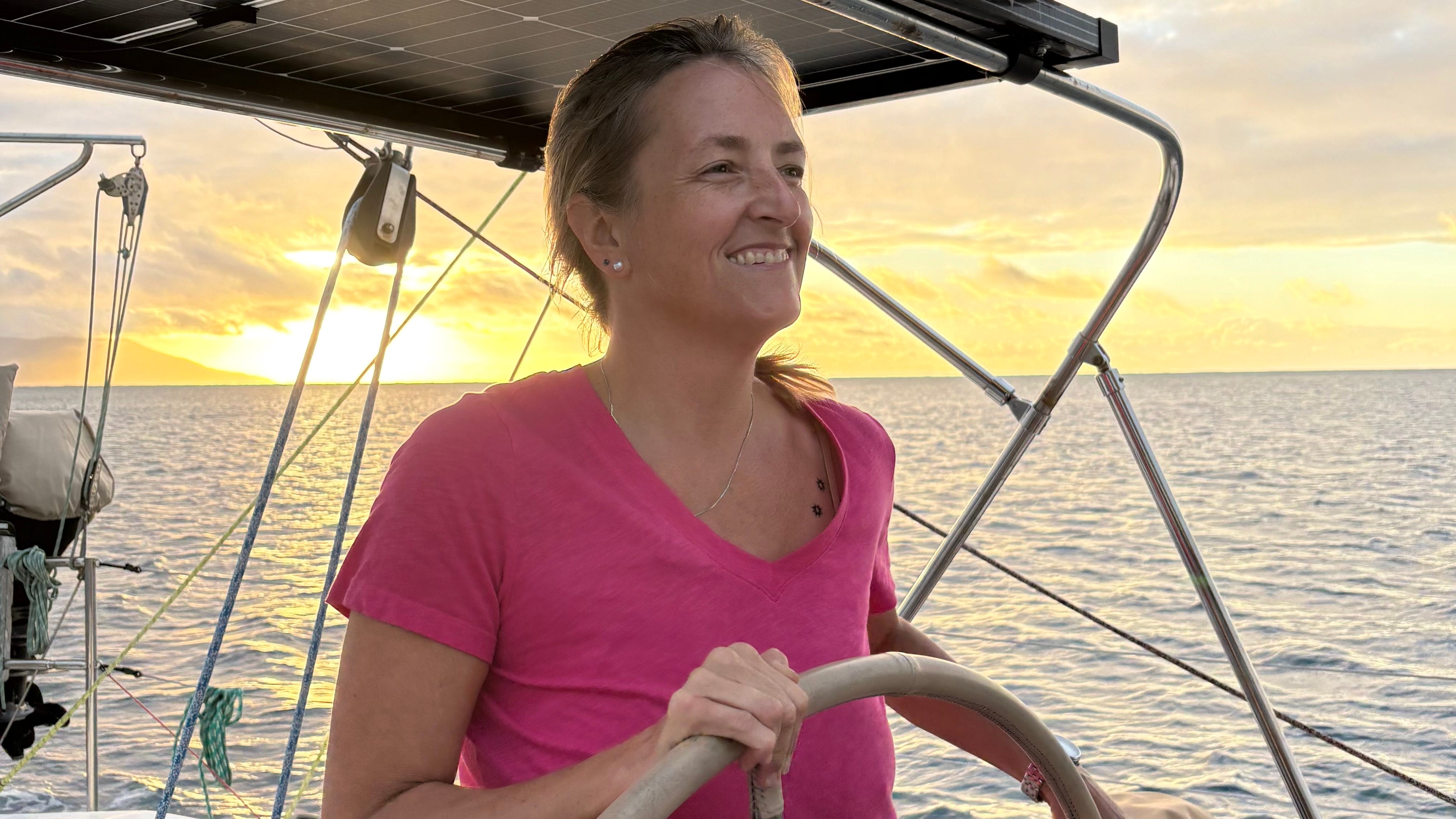
Stephanie Dolmat is a sea witch, adventurer, captain, relational alchemist, facilitator, and strategic communications advisor. She writes about feminine leadership on the water, desire in all its forms, and imagining different futures on her Substack, Sea Witch Diaries. You can also follow her on LinkedIn.
Comments
Nothing yet. Say the first thing.
Sign in to join the conversation.