
At Finance School, we simplify complex topics in finance, business, and economics into simple, actionable insights, explained clearly, logically, and practically, so you can think independently and make better financial decisions.
No noise. No hype. Just clarity.
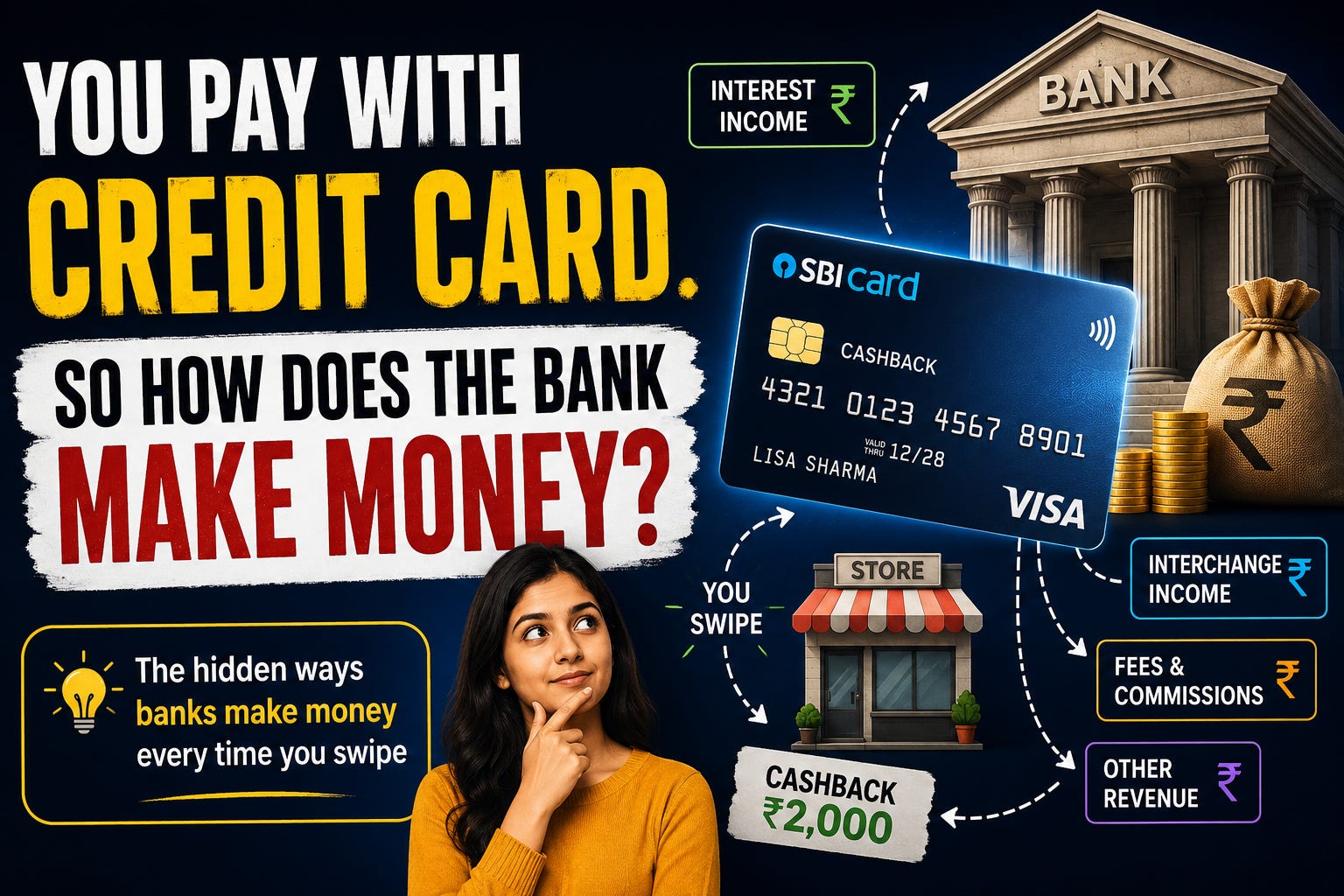
Lisa had been thinking about getting a credit card for quite some time. She already spent a fair amount online, so when she came across the SBI Cashback Card, the proposition seemed simple enough: if she was going to spend the money anyway, why not get some of it back?
So, last month, she finally got one.
Over the month, Lisa spent nearly ₹40,000 through the card, mostly on her regular online purchases. Nothing unusual. She was simply shifting some of the spending she was already doing to her new credit card.
A month later, she opened the app to pay her credit-card bill, but before making the payment, something caught her attention.
₹2,000 in cashback had already been credited to her account.
Lisa paid her entire bill. She had no outstanding balance but after making the payment, a question stayed with her.
If the bank is giving me cashback every time I spend, how is the bank making money from credit card business?
Until then, like most people, Lisa thought banks mainly made money by charging joining and annual membership fees.
But if someone like her could spend ₹40,000, receive ₹2,000 back, and still pay the entire bill on time, the economics didn’t seem to add up. The bank was giving her money for using its card.
So where was the bank’s money coming from?
When Lisa used her SBI Cashback Credit Card to spend ₹40,000 last month, she wasn’t simply using another way to pay. She was using a financial product that gave her access to credit, a billing cycle, rewards, and the flexibility to pay later.
That distinction is important because a credit card isn’t really free money. The bank is effectively giving Lisa access to a predetermined amount of credit and allowing her to use it before she repays the amount. The bank takes on the responsibility of funding that spending upfront, while Lisa gets a period of time before the payment becomes due.
When the billing cycle ends, the bank sends her a statement showing her total amount due. Lisa can then repay the amount by the due date.
If she pays the entire ₹40,000, she generally avoids interest on those purchases. From Lisa’s perspective, this can feel like the best of both worlds: she gets the convenience of credit, earns rewards or cashback, and doesn’t pay interest.
But from the bank’s perspective, something very different is happening.
The bank has given Lisa access to its money, taken on the risk that she may not repay it, and still has to make the credit-card business profitable.
Let’s go back to Lisa’s ₹40,000 of spending.
She paid her entire credit-card bill on time, so the bank didn’t earn any interest from her. On top of that, she received ₹2,000 in cashback. If anything, it looked like the bank was giving her money rather than making money from her.
But there was something Lisa couldn’t see when she used her card.
The merchant pays a fee when you pay by credit card. (Note: Some merchants even pass this cost to customers by charging an extra 2% on card payment, or encourage them to pay via other methods instead.)
When Lisa spends ₹40,000 at a merchant, the merchant may not receive the entire ₹40,000. A small percentage of the transaction can be charged as a Merchant Discount Rate (MDR). This is part of the economics of accepting credit-card payments, with the revenue generated from the transaction being distributed among the parties involved in processing it.
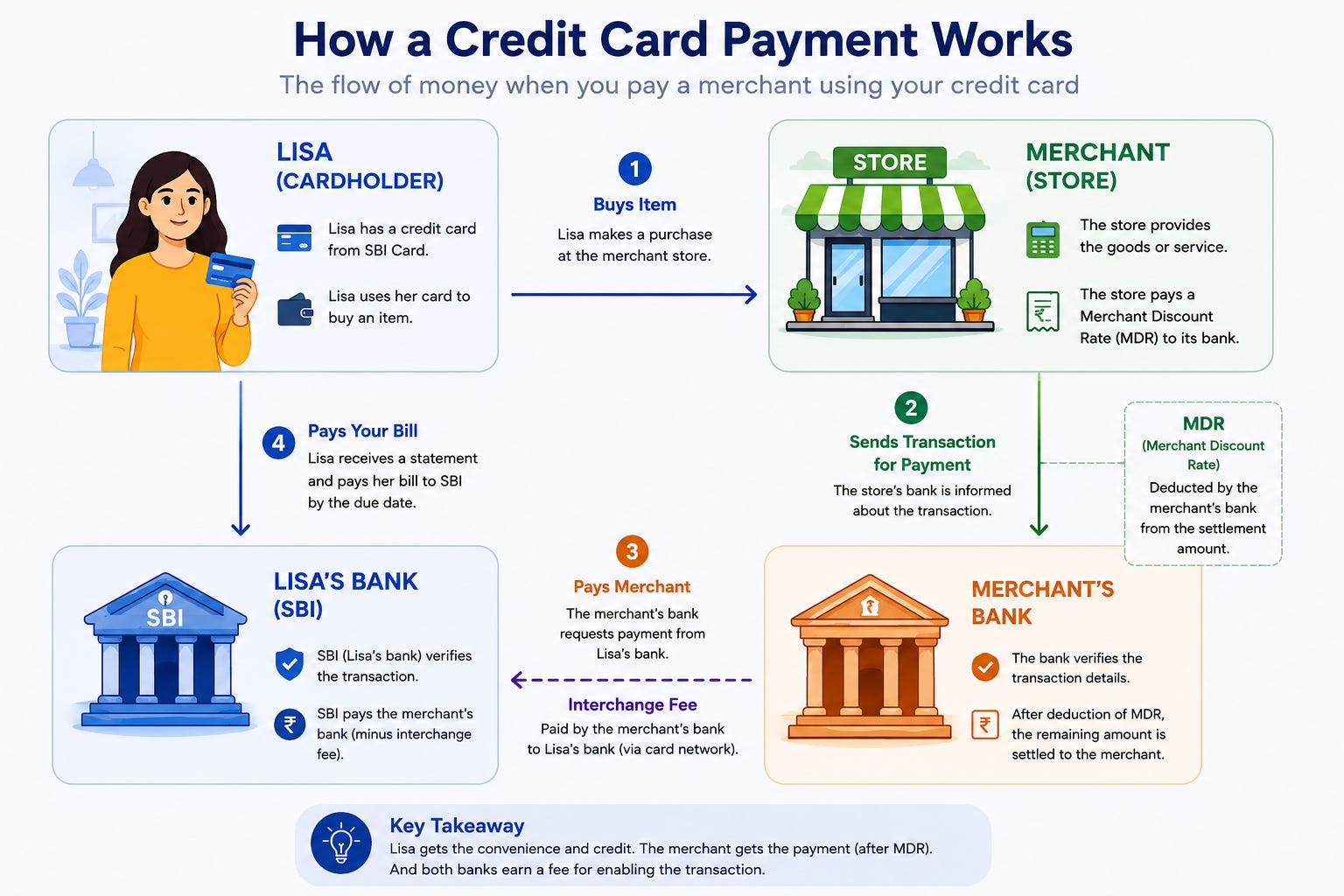
So, for example, let’s look at how the money from Lisa’s ₹40,000 transaction gets divided.
To understand this, we are using standard industry estimates for premium credit cards in India, where the total MDR is roughly 2.0% and the Interchange Fee is roughly 1.5% of the transaction value.
The Math Behind Lisa’s ₹40,000 Spend
Transaction Amount = ₹40,000
1. Total MDR Deducted
MDR = ₹40,000 × 2% = ₹800
The merchant does not receive the full ₹40,000. They receive ₹39,200 after the ₹800 MDR is deducted.
2. Interchange Fee Sent to the Card-Issuing Bank
Approximately ₹600 of the ₹800 MDR represents interchange paid to the card-issuing bank.
Interchange Fee = ₹40,000 × 1.5% = ₹600
Lisa’s card-issuing bank, SBI, receives approximately ₹600 from this transaction through the network’s fee-sharing structure.
3. The Leftovers
The remaining amount stays with the merchant’s bank and the card network to cover processing, technology, infrastructure, and other related costs.
Remaining Balance = ₹800 − ₹600 = ₹200
So, on a ₹40,000 credit-card transaction, approximately ₹800 is deducted from the merchant as MDR, of which approximately ₹600 goes to Lisa’s card-issuing bank as interchange income.
In simple terms, interchange is a fee associated with a card transaction that flows to the card issuer.
That means Lisa doesn’t necessarily need to pay interest for the bank to make money from her. She can pay her entire bill on time, avoid finance charges, collect her ₹2,000 cashback, and the bank can still earn revenue because she chose to spend through its credit card.
And this is where the scale of the credit-card business becomes interesting.
In FY2025–26, SBI Card reported ₹4.30 lakh crore of total spends across its cards. Out of this, ₹3.54 lakh crore came from retail spends and the company reported ₹5,110.88 crore (25% of overall revenue) of interchange income during the year.
Suddenly, Lisa’s ₹40,000 transaction doesn’t look like an isolated purchase anymore. Multiply that spending across millions of cards and billions of transactions, and even a relatively small amount earned from individual transactions can become a very large revenue stream.
But this is only one side of the credit-card business.
Lisa pays her bill in full every month. Another customer may spend just as much but carry part of the balance into the next month and that customer behaves very differently from Lisa.
So far, Lisa looks like an ideal credit-card customer.
Now imagine another customer, Rahul.
Rahul also spends ₹40,000 during the month. But when his credit-card bill arrives, he doesn’t have enough money to pay the entire amount. Instead of paying the full ₹40,000, he decides to pay only the minimum amount due and carry the remaining balance into the next billing cycle.
A customer like Rahul is called a revolver.
A revolver is a credit-card customer who carries a portion of the outstanding balance beyond the due date. Once the balance is carried forward, applicable finance charges can start accumulating on the unpaid amount.
Lisa’s ₹40,000 spending generated transaction-related revenue for the bank. Rahul’s spending can generate that revenue and, if he carries a balance, potentially generate interest income as well.
The difference becomes clearer when we look at the math behind Rahul’s ₹40,000
What Happens When Rahul Pays Only the Minimum Due?
Assume Rahul has a ₹40,000 credit card bill with no previous outstanding balance, fees, or EMIs. Based on SBI Card's current published rates, he pays a minimum due of 2% of the outstanding amount.
Minimum Amount Due = ₹40,000 × 2% = ₹800
Rahul pays ₹800.
Balance Carried Forward = ₹40,000 − ₹800 = ₹39,200
The remaining ₹39,200 doesn’t disappear. It gets carried into the next billing cycle, where applicable finance charges can be levied on the outstanding balance.
Let’s assume the entire ₹39,200 remains outstanding for one month and use a 3.75% monthly finance charge.
Finance Charge = ₹39,200 × 3.75% = ₹1,470
GST on Finance Charge = ₹1,470 × 18% = ₹264.60
So, before Rahul makes his next payment:
Total = Carried Forward Balance (₹39,200) + Finance Charge (₹1,470) + GST (₹264.60) = ₹40,934.60
Rahul originally owed ₹40,000.
He paid ₹800.
Yet after carrying the remaining balance for another month, his outstanding can rise again because of finance charges and the applicable taxes.
This is the fundamental difference between Lisa and Rahul. Lisa spends ₹40,000 and clears the entire bill. Rahul spends the same ₹40,000 but continues borrowing against the unpaid balance.
The same ₹40,000 of spending can therefore create very different economics for the bank.
The bank earns interest from Rahul because it is extending credit for longer, but it also takes on greater credit risk. If Rahul continues carrying balances, the bank earns interest income. If he eventually stops repaying, however, the bank may have to make provisions or write off part of the outstanding amount.
So the bank’s objective isn’t simply to create as many revolvers as possible.
It is to build a credit-card portfolio where spending generates transaction revenue, interest income comes from customers who carry balances, and the overall revenue is sufficient to compensate for cashback, rewards, operating costs and credit losses.
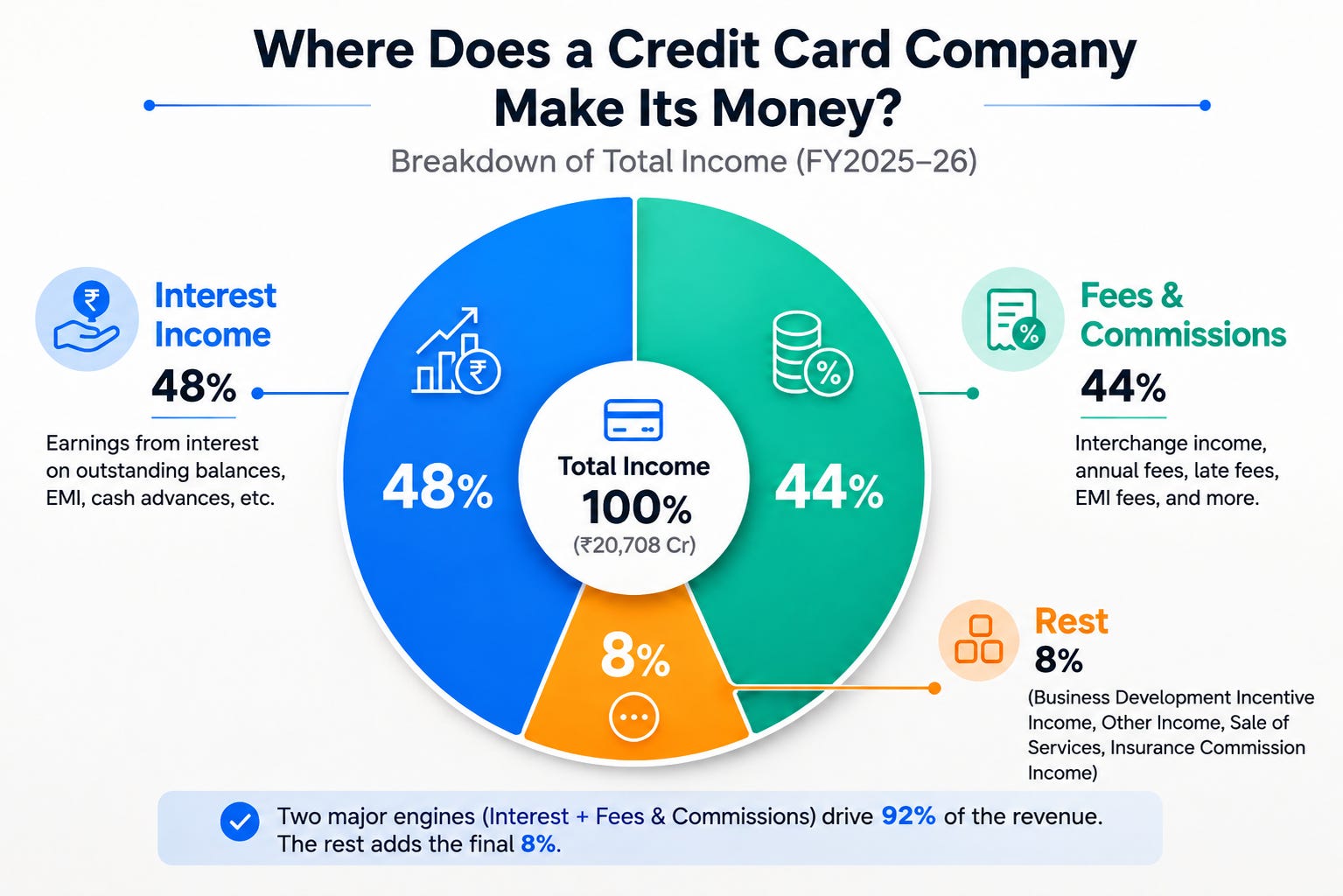
And SBI Card’s FY2025–26 numbers show how significant the interest side of this business can be. The company reported ₹9,901.13 crore (48% of overall revenue) in interest income during the year, making it one of its largest sources of revenue.
And interest income is still only one piece of the puzzle. A credit-card company has several other ways to generate revenue from the same customer relationship.
Note: The calculation above is illustrative, not an exact SBI Card statement calculation. Actual minimum dues and finance charges depend on the card’s applicable terms, transaction dates, payment dates, outstanding balances and other charges.
Rahul’s example shows one of the most obvious ways a credit-card company earns money: interest income.
But if interest were the only source of revenue, the business would be far more limited than it actually is. A credit-card company can earn money from a customer even when that customer never carries a balance.
Think about Lisa again. She paid her entire ₹40,000 bill on time, so she didn’t generate finance-charge income for the bank. Yet her card still generated interchange income from her spending.
And then there are other charges attached to the credit-card relationship.
A customer may pay an annual membership fee for holding the card. A customer who misses the required payment may incur late-payment charges. Someone withdrawing cash using the credit card can face cash-advance fees and finance charges. Customers converting purchases into EMIs may generate processing fees and interest income. Balance-transfer facilities can also generate fees or interest depending on the product.
None of these necessarily happens with every customer. That’s precisely the point.
A credit card gives the issuer multiple ways to generate revenue from the same customer.
SBI Card’s FY2025–26 numbers make this particularly clear. The company reported ₹9,166.23 (~44% of overall revenue) crore in fees and commission income during the year.
That included:
Interchange Income = ₹5,110.88 crore (25% of overall revenue)
Fee-Based Income = ₹2,817.46 crore (14% of overall revenue)
Annual Membership Fees = ₹1,237.89 crore (6% of overall revenue)
This tells us something important about the credit-card business.
The bank doesn’t need every customer to be a revolver. Some customers generate revenue primarily through their spending. Some pay annual fees. Some use EMI facilities. Some carry balances and generate interest income. And some may use several of these services.
The business model is therefore not built around one charge. It is built around multiple revenue streams generated by different ways customers use their cards.
And this also explains why banks are willing to spend money offering cashback, reward points and other benefits. If giving Lisa ₹2,000 in cashback encourages her to spend ₹40,000 or perhaps even more, the bank is making a calculated trade-off.
Give the customer an incentive to spend more, and earn revenue from the activity that follows.
Interest income (48%) and fees and commissions (44%) may account for the bulk of SBI Card’s revenue, but they aren’t the only ways the company makes money.
Beyond interest and fees, SBI Cards has small income sources like
Business Development Incentive Income - ₹756.67
Other Income - ₹807.99
Sale of Services - ₹73
Insurance Commission Income - ₹2.60
Together they contribute ₹1,640.26 crore, or ~8% of total income in FY2025–26.
If banks can make money from your spending, interest charges, fees and other sources then why give any of that money back to customer?
The objective is simple: get customers to use the credit card more often and move more of their everyday spending onto it. Also, it is an incentive designed to influence customer behaviour.
Imagine Lisa normally spends ₹20,000 a month online using different payment methods. Her cashback card gives her an incentive to put more of that spending through the card. If she starts spending ₹40,000 instead, the bank has doubled the amount of spending flowing through its card.
The bank has given away some cashback, but it has also created a larger base on which it can potentially earn transaction-related revenue.
This is why credit-card rewards should not be viewed in isolation.
₹2,000 cashback may look like a cost to the bank. But the ₹40,000 of spending that generated it is the bigger number the bank is watching.
The same logic applies to reward points, discounts, welcome offers and other benefits. They are designed to make the card more attractive, encourage customers to use it more frequently, and ultimately increase the economic value of the card relationship.
Once a customer starts using a particular card for groceries, online shopping, travel, dining and other regular expenses, the card becomes part of their everyday financial behaviour, then it creates a much bigger opportunity for the bank.
The more frequently you use the card, the more transactions the bank can earn from. If you later convert a purchase into an EMI, carry a balance, pay an annual fee, or use another credit-card feature, the relationship can generate additional revenue.
So Lisa’s ₹2,000 cashback wasn’t necessarily the bank’s loss.
It was the price the bank was willing to pay to make Lisa use its card more.
At the beginning of the article, Lisa had one simple question: If the bank is giving me cashback every time I spend, how is the bank making money from credit card business?
Now we can finally put the entire picture together.
The answer is that a credit-card company does not depend on one source of revenue. It can earn interchange income every time you spend, interest income when customers carry balances, annual membership fees, EMI and other fee-based income, business development incentives, and several smaller sources of revenue.
For SBI Card, this translated into ₹20,708 crore of total income in FY2025–26.
So, when Lisa received ₹2,000 cashback, the bank wasn’t simply giving away money. It was spending a portion of its revenue to encourage her to keep using the card, while earning from the broader relationship.
The real business isn’t the credit card sitting in your wallet. It is everything that happens after you start using it.
And that is how a bank can give you cashback, reward points and discounts and still make money from your credit card.
Lisa and Rahul are using the same financial product, but the outcome for both can be completely different.
Lisa spends ₹40,000 on online purchases through her cashback card and earns ₹2,000 (5% cashback).
She then pays the entire ₹40,000 bill before the due date.
In Lisa’s case, the credit card has effectively given her access to the bank’s money for a short period without her paying interest on that spending. She also earned ₹2,000 in cashback. The key is that she didn’t treat the credit limit as additional income. She simply used the card for expenses she could already afford and repaid the bank in full.
Now look at Rahul’s case.
He also spends ₹40,000, but instead of paying the entire bill, he pays only the minimum amount due and carries the remaining balance forward. The moment Rahul starts carrying the balance, the economics change. The bank can charge finance charges on the outstanding amount, and the interest he pays can quickly outweigh the cashback or rewards he earned.
The same credit card can therefore be a source of savings for Lisa and a source of expensive borrowing for Rahul.
There’s another important detail: cashback rates can vary by spending category. If Lisa spends the same ₹40,000 offline at 1% cashback, she earns only:
Cashback = ₹40,000 × 1% = ₹400
Lisa would still earn cashback, but much less than the ₹2,000 she earned from her online spending.
This is why understanding the reward structure of your card matters. Different categories and merchants can have different cashback or reward rates, and the benefit is meaningful only when the underlying spending is something you would have made anyway.
Now compare this with the bank’s interchange income. If the bank earns roughly 1.5% interchange:
Interchange Income = ₹40,000 × 1.5% = ₹600
So, at 1% cashback, the bank earns ₹600 while giving ₹400 back to Lisa, before other costs and revenues.
At 5% cashback, the reward cost can exceed the interchange income on that transaction, which means the bank may rely on other revenue streams and the broader customer relationship to make the economics work.
The lesson: don’t chase cashback. Understand the card’s reward structure and use it only for spending you would make anyway.
A credit card works best when you use the interest-free credit period, earn the rewards available on spending you would have made anyway, and then pay the entire statement balance on time.
The moment you start spending beyond your ability to repay, the equation changes. A 5% cashback benefit can look attractive, but it becomes insignificant if the balance you carry starts accumulating finance charges.
Lisa is using the credit card as a payment and rewards tool. Rahul is using it as a borrowing tool and the difference between the two isn’t the card. It’s discipline.
Here Are 6 Non-Negotiable Rules of Using a Credit Card:
Never spend more than you can repay in full.
Always pay the full statement balance, not just the minimum amount due.
Never chase cashback by spending more.
Know the reward and cashback conditions of your card.
Never withdraw cash from a credit card unless it is genuinely necessary.
Set automatic payment reminders or autopay for the full statement amount.
Like, Comment, Share, and Subscribe for more thoughtful insights on Finance.
If this article helped you understand how credit cards actually make money, why banks can offer cashback and rewards, and how the same credit card can either work in your favour or become expensive debt, consider supporting the newsletter by buying me a coffee.
Your contribution funds deeper research, clearer breakdowns, and practical financial frameworks — so you can make decisions based on logic, not emotion.
No pressure. Only if it adds value.
Have feedback, questions, or a topic you’d like Finance School to explore? Write to us at: financeschool.research@gmail.com
We read every email, and many of our best article ideas come directly from readers.
Sources:
https://www.sbicard.com/sbi-card-en/assets/docs/pdf/key-fact-statement.pdf
No posts
Comments
Nothing yet. Say the first thing.
Sign in to join the conversation.