
At Finance School, we simplify complex topics in finance, business, and economics into simple, actionable insights, explained clearly, logically, and practically, so you can think independently and make better financial decisions.
No noise. No hype. Just clarity.

Emma had just graduated from college. After months of interviews, she finally received her first job offer from TCS. On her very first day, the HR team asked her a list of onboarding documents.
PAN Card, Aadhaar card, educational certificates and one final instruction:
Please open a salary account with HDFC Bank.
Emma said, I already have an ICICI Bank saving account. Can’t we convert that to salary account and get salary there?
The HR executive smiled, you certainly can keep using your ICICI account. But for salary credits, we have a tie-up with HDFC Bank. Every employee is required to have their salary account there.
Emma didn’t think much of it. Opening another bank account only took a few minutes. A week later, her first salary landed in her brand-new HDFC Bank account. Life moved on but one question stayed in the back of her mind.
Why did the company care so much about which bank received her salary?
After all, money is just money. Whether it lands in ICICI, SBI, Axis Bank, or HDFC Bank shouldn’t really matter… Or should it?
As Emma began asking around, she noticed something interesting her friends working at different companies had completely different salary accounts. One had SBI. Another had Axis Bank. Someone else had ICICI Bank. Every employer seemed to have a preferred banking partner.
Which raised an even bigger question.
If banks are willing to compete so aggressively just to receive your monthly salary, what are they really gaining from it?
Because maintaining a salary account isn’t free. Yet they continue chasing salary accounts every single year.
What makes a monthly salary so valuable that banks fight to win it? That’s exactly what we’re going to uncover.
When Emma opened her HDFC salary account, nothing felt different. She received a debit card, activated mobile banking, linked the account to UPI, and could withdraw cash from any ATM. To her, it looked exactly like the ICICI savings account she had been using since college.
If both accounts let you save money, transfer funds, pay bills, and make UPI payments, then what exactly makes one a salary account and the other a regular savings account?
The answer is much simpler than most people think.
A salary account is not a separate category of bank account. It is essentially a savings account that is linked to an employer through a payroll arrangement. Instead of you depositing money into the account whenever you choose, your employer deposits your monthly salary directly into it. As long as your salary continues to be credited through that employer, the account retains its salary account status.
This arrangement is beneficial for employees because banks usually remove many of the charges associated with a normal savings account. Most salary accounts come with a zero minimum balance requirement, lower service charges, a complimentary debit card, higher ATM withdrawal limits, and, depending on the employer’s agreement with the bank, additional benefits such as insurance cover, airport lounge access, or preferential loan offers.
From Emma’s perspective, it almost felt as if the bank was rewarding her simply for opening a salary account.
But banks don’t offer these benefits out of generosity.
Every debit card issued, every insurance policy bundled, every waived fee, and every relationship manager assigned comes at a cost. If serving a salary account holder costs the bank money, then why are banks willing to compete so aggressively for these customers?
When Emma’s first salary was credited to her HDFC Bank account, she thought the transaction was complete.
Her employer had paid her. The bank had received the money. Now it was simply her choice whether to spend it, transfer it, or leave it untouched but from the bank’s perspective, something far more valuable had just happened.
For the next few days or sometimes even weeks that money remained inside HDFC Bank. During that period, the bank could use those deposits as part of its funding base to lend money to home buyers, businesses, vehicle purchasers, and thousands of other borrowers.
This is precisely why banks compete so aggressively for salary accounts. They are not chasing the salary itself. They are chasing the deposit that comes with it.
In banking, these deposits are broadly classified into two categories.
The first is Current Accounts, mainly used by businesses for daily transactions. These accounts typically do not earn any interest.
The second is Savings Accounts, where individuals keep their money and banks pay a relatively low rate of interest.
Together, these two categories are known as CASA deposits, which stands for Current Account Savings Account deposits. For banks, CASA deposits are extremely valuable because they represent one of the cheapest ways to raise money.
Think about it from the bank’s perspective.
If a customer parks ₹1 lakh in a savings account, the bank may pay around 2.5–3.5% annual interest. If the same bank raises money through fixed deposits (FD), it may have to pay 6.5–7.5% or even more depending on market conditions.
The difference is significant.
The lower the cost of raising deposits, the higher the bank’s potential profit when it lends that money at interest rates of 8%, 10%, or even 14%.
That is why every salary account matters.
Salary accounts continuously feed fresh savings deposits into the banking system every single month. Unlike many other deposits, these inflows are predictable because salaries arrive on fixed dates month after month.
Now imagine this happening across millions of employees.
Every month, companies credit salaries worth thousands of crores into their employees’ accounts. Even if each employee keeps only a small portion of that salary in the bank after paying rent, EMIs, groceries, and bills, the combined amount becomes enormous.
This steady flow of low-cost deposits is one of the strongest competitive advantages a bank can have.
And the numbers clearly demonstrate why.
Over the past decade, India’s largest banks have built massive CASA deposit franchises running into several lakh crore rupees. These deposits have become the foundation upon which banks fund loans, generate interest income, and expand their businesses.
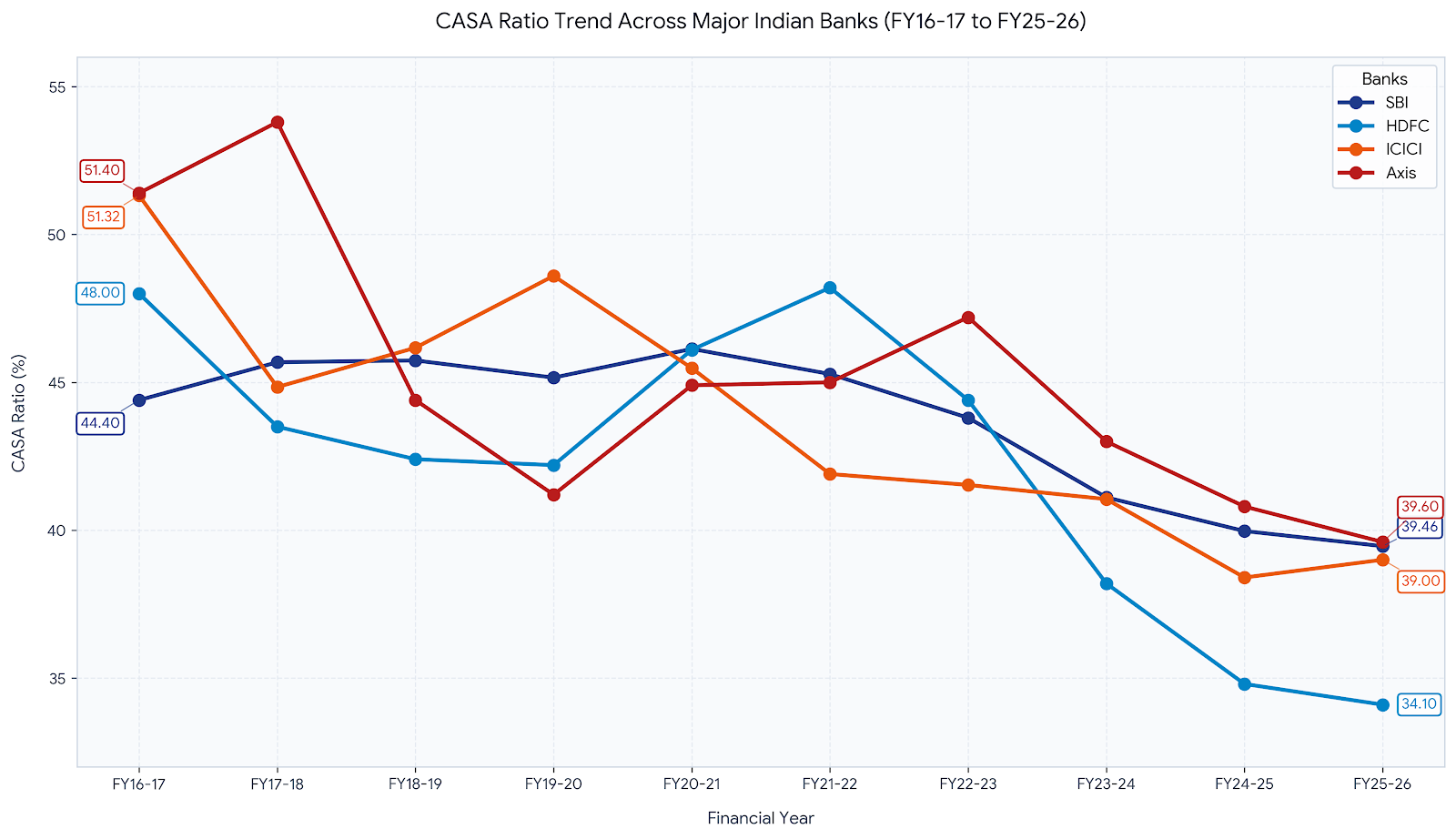
The chart above tells an interesting story.
While the absolute CASA deposits of banks have continued to grow year after year, the CASA ratio, the percentage of total deposits coming from current and savings accounts has gradually declined for most banks. As competition for deposits has intensified, banks have increasingly relied on higher-interest fixed deposits to attract customers. Even then, HDFC Bank, SBI, ICICI Bank, and Axis Bank continue to hold CASA deposits worth ~₹46 lakh crore rupees, these aren’t temporary deposits. They represent the everyday money that millions of Indians leave in their current and savings accounts, making salary and savings account customers among the most valuable relationships they can acquire.
As of FY 2025–26:
State Bank of India holds the largest ₹22.62 lakh crore of CASA deposits.
HDFC Bank follows with ₹10.60 lakh crore.
ICICI Bank has built CASA deposits of around ₹6.99 lakh crore.
Axis Bank has accumulated roughly ₹5.29 lakh crore.
Together, these four banks alone hold nearly ~₹46 lakh crore in low-cost deposits.
Note: While researching this article, we also tried to identify which bank holds the largest number of salary accounts in India. However, banks generally do not disclose the number of salary accounts in their public filings or annual reports. Instead, they report CASA (Current Account Savings Account) deposits and CASA ratios, which include salary accounts along with all other current and savings accounts. As a result, the analysis in this article uses CASA data as the closest publicly available indicator of a bank's salary account franchise.
After all, every bank reports its CASA ratio every quarter. Investors closely watch it, analysts discuss it during earnings calls, and management often highlights it in annual reports.
So what CASA ratio is actually considered good for a bank?
There isn’t a single number prescribed by regulators. Instead, the banking industry follows broad benchmarks based on funding quality and profitability.
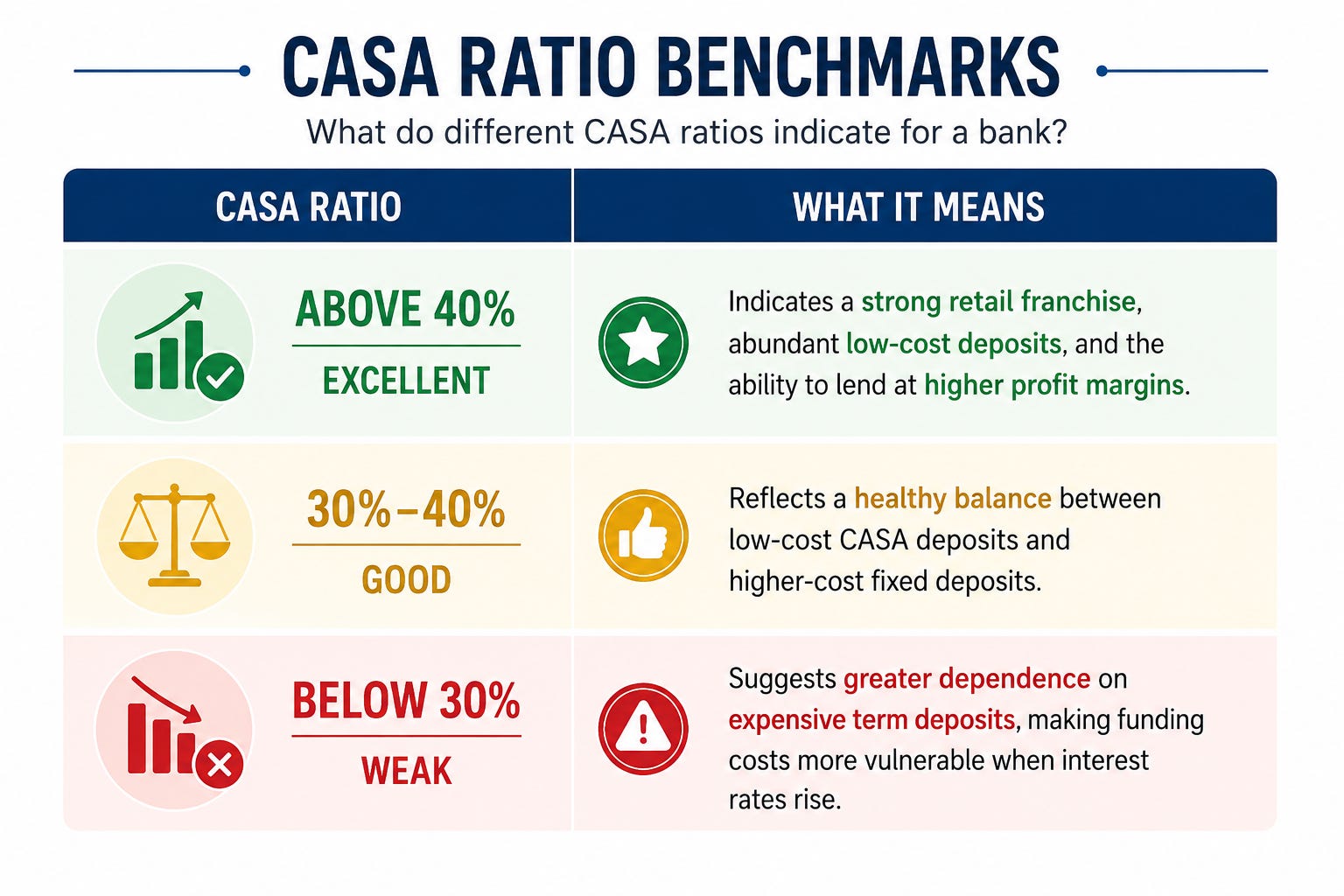
The logic behind these benchmarks is fairly straightforward.
Imagine two banks lending the same home loan at the same interest rate. The bank that raises money more cheaply earns a higher profit on every loan it gives. That’s why a higher CASA ratio is often viewed as a sign of a stronger and more efficient banking franchise.
A bank with a healthy CASA ratio doesn’t just have cheaper deposits, it has greater flexibility. It can compete more aggressively on loan rates, protect its profitability during periods of rising interest rates, and rely less on attracting expensive fixed deposits to fund its lending business.
This is one of the reasons why CASA is often referred to as the lifeblood of a bank’s balance sheet.
By now, Emma had understood why HDFC Bank wanted her salary account. Every month, her salary became part of the bank’s low-cost deposit base, helping it fund loans across the country.
She assumed that was where the bank’s interest in her ended.
It didn’t.
After a few months of receiving her salary consistently, she starts receiving notification from the HDFC Bank like: You’re eligible for a lifetime free credit card, Pre-approved Personal Loan up to ₹2 lakh. Soon came offers for health insurance, fixed deposits, SIPs, a Demat account, and even a pre-approved car loan.
Emma found it surprising.
She had only been working for a couple of months, yet the bank seemed eager to sell her almost every financial product it had. What she didn’t realise was that this wasn’t random marketing. It was a carefully planned business strategy.
For banks, a salary account is rarely the final product.
It is the starting point of a long-term customer relationship.
The day your salary starts getting credited into a bank account, the bank begins learning about your financial behaviour. It knows when your salary arrives each month, how much you earn, how regularly you spend, how much you save, whether you pay your credit card bills on time, and whether you already have loans with the bank. Over time, this information helps the bank understand your income stability, spending habits, repayment capacity, and future borrowing potential.
That makes salary account holders very different from ordinary customers.
Unlike someone who deposits money occasionally, a salaried customer generates a predictable stream of financial activity every single month. For a bank, predictability reduces uncertainty. And in banking, lower uncertainty usually translates into lower credit risk.
This is why salaried customers often receive pre-approved offers much earlier than others.
When Emma eventually wanted to buy her first car, HDFC Bank already knew her monthly income and transaction history. When she planned to purchase a house a few years later, the bank already had years of salary credits to assess her repayment capacity. Instead of acquiring a completely new borrower, the bank simply expanded its relationship with an existing customer.
This is significantly cheaper than finding a new customer from scratch.
Acquiring a new customer requires advertising, sales teams, documentation, verification, and onboarding costs. But once a salary account holder is already inside the bank’s ecosystem, offering additional products becomes far easier and far more profitable.
That is why banks don’t stop at giving you a salary account. They gradually try to become your primary financial partner.
A typical customer journey often looks like this:
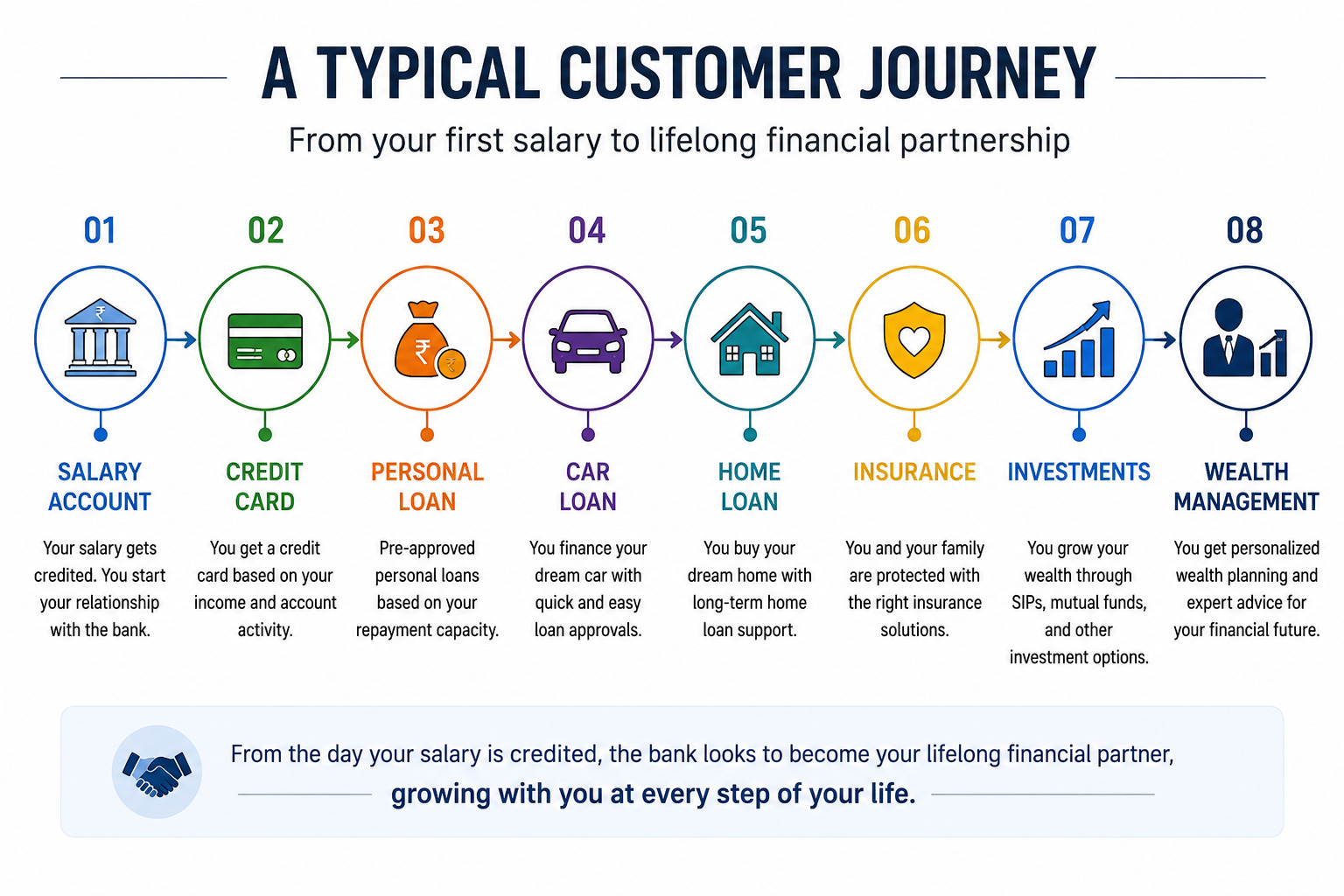
Each additional product increases the value of that relationship, not just for the customer, but also for the bank.
In business, there is a concept known as Customer Lifetime Value (CLV). Instead of measuring how much profit a customer generates today, companies estimate how much revenue that customer could generate over an entire lifetime.
Banks follow exactly the same philosophy.
Emma’s first salary account might earn the bank very little in its first year. But if she continues banking with HDFC for the next 25 or 30 years, taking a home loan, investing through SIPs, purchasing insurance, and using its credit cards, she could become one of the bank’s most valuable customers.
By now, Emma finally understood why HDFC Bank was so eager to open her salary account.
It wasn’t doing her a favour. It was making an investment. That made her wonder about something else.
“If my salary account is so valuable to the bank, then what am I getting in return?”
It’s a fair question.
After all, banks compete aggressively for corporate salary mandates. They dedicate relationship managers, deploy onboarding teams inside offices, simplify account opening, and spend heavily to acquire salaried customers.
The answer is simple.
Banks share a small part of that future value with you.
That’s why salary account holders often receive benefits that ordinary savings account holders don’t.
As mentioned above, many banks waive minimum balance requirements on salary accounts, removing penalties that regular savings accounts may impose. They also provide higher ATM withdrawal limits, complimentary debit cards, free cheque books, and reduced service charges.
But the bigger benefits usually appear over time. Once your salary starts flowing into the account consistently, the bank gradually becomes more comfortable lending to you.
From the customer’s perspective, these look like attractive perks.
From the bank’s perspective, they are customer retention tools. Every benefit has one objective, to ensure that your salary and your broader financial relationship stays with the bank for years.
Also, the benefits of salary account can vary significantly depending on the employer, the bank, and sometimes even your salary bracket. Two employees working in different companies may both have salary accounts with the same bank yet enjoy entirely different privileges because their employers have negotiated different corporate banking arrangements.
In other words, the value of a salary account isn’t determined only by the bank. It is often determined by the agreement signed between the bank and your employer.
Every month, millions of Indians receive a simple notification on their phones.
“Salary Credited.”
Most of us see it as income but banks see it as one of the cheapest sources of capital they can ever acquire. That’s why they compete so fiercely for salary accounts.
Because behind every salary account isn't just a monthly paycheck. It's a low-cost deposit that strengthens a bank's CASA, lowers its cost of funds, supports future lending, and begins a financial relationship that can generate business for decades.
And the next time when you open a salary account with a particular bank, you’ll know that the bank isn’t just opening an account. It’s making one of the most valuable investments on its balance sheet.
Banks don't compete for your monthly salary. They compete for the financial relationship/ opportunity that your salary creates.
Like, Comment, Share, and Subscribe for more thoughtful insights on Finance.
If this article helped you understand why banks compete so fiercely for your salary account, how salary accounts strengthen their business, and what really happens after your salary gets credited every month, consider supporting the newsletter by buying me a coffee.
Your contribution funds deeper research, clearer breakdowns, and practical financial frameworks — so you can make decisions based on logic, not emotion.
No pressure. Only if it adds value.
Have feedback, questions, or a topic you’d like Finance School to explore? Write to us at: financeschool.research@gmail.com
We read every email, and many of our best article ideas come directly from readers.
Sources:
https://en.wikipedia.org/wiki/CASA_ratio
https://sbi.bank.in/web/investor-relations/annual-report
https://www.hdfc.bank.in/about-us/investor-relations/annual-reports
https://www.icici.bank.in/about-us/annual
https://www.axis.bank.in/shareholders-corner/shareholders-information/annual-reports
No posts
Comments
Nothing yet. Say the first thing.
Sign in to join the conversation.