
At Finance School, we break down complex financial topics into simple, actionable insights — explained clearly, logically, and practically — so you can think independently and make better financial decisions.
No noise. No hype. Just clarity.
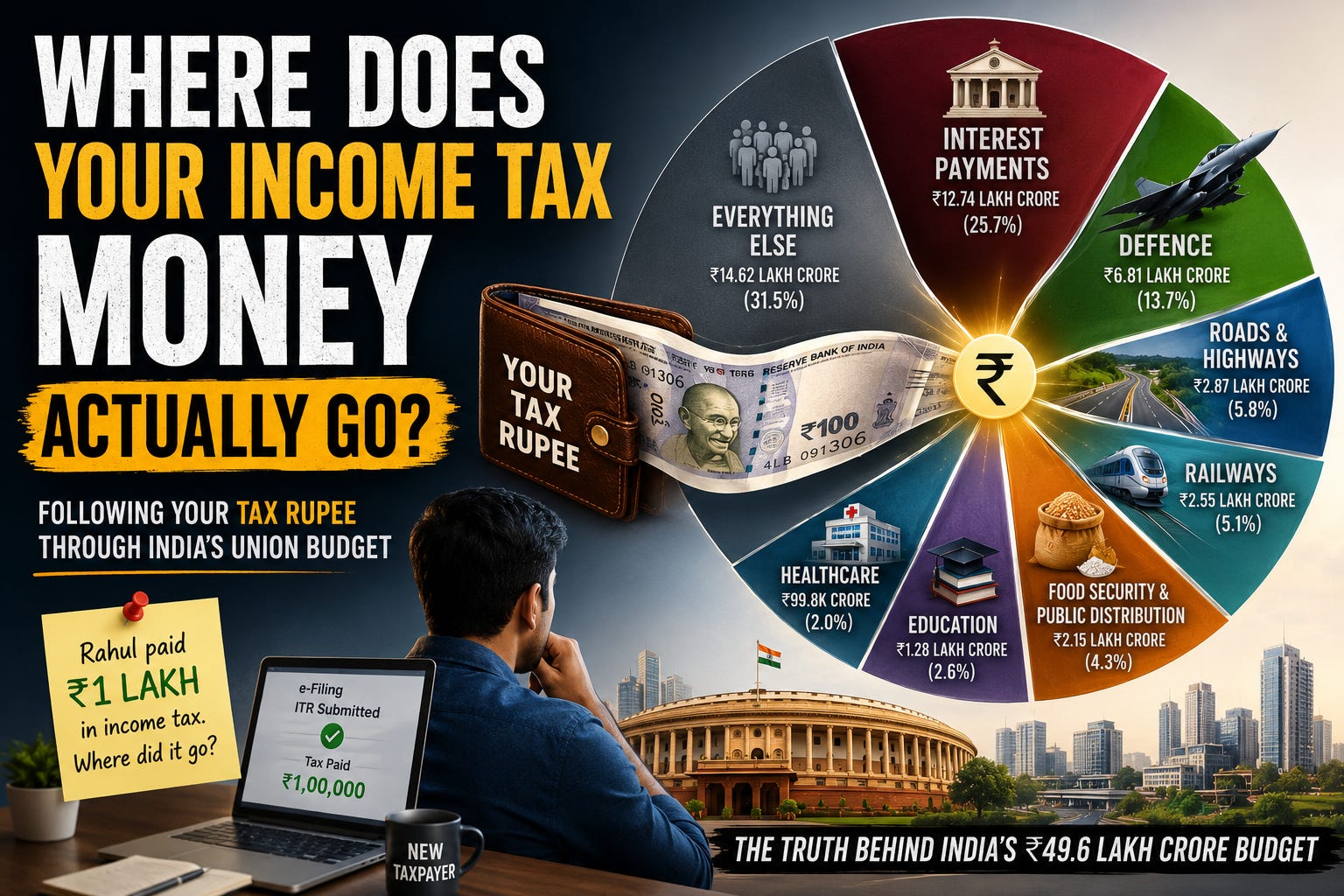
July is around the corner.
Across India, millions of salaried employees, professionals, and business owners are busy filing their Income Tax Returns.
Among them is Rahul.
This year feels different because Rahul isn’t just filing another tax return.
He’s filing his very first one.
After gathering his salary slips, Form 16, investment proofs, and bank statements, Rahul finally completes his ITR. A few clicks later, he pays his final tax liability for the year.
₹1 lakh.
The money leaves his bank account and reaches the government. A few days later, Rahul finds himself wondering about something he has never really thought about before.
What actually happened to that ₹1 lakh?
Did it help build a highway? A new railway line? Buy fighter jets for the Indian Air Force? Pay the salaries of government employees? Or did it simply disappear into a giant government account that nobody really understands?
The more he thinks about it, the stranger the question becomes. Every year, millions of Indians pay income tax. Collectively, taxpayers contribute lakhs of crores of rupees to the government.
Yet very few people can clearly explain what happens to that money once it leaves their bank account. Most of us know how much tax we pay and very few of us know where the money actually goes.
The answer is far more surprising than most people realise. In fact, one of the largest uses of taxpayer money isn’t roads, isn’t railways, isn’t education and isn’t even defence.
The government’s biggest expense is something entirely different.
So if you paid ₹1 lakh in income tax today, where would that ₹1 lakh actually end up?
To answer that question, we need to follow your tax rupee through India’s Union Budget.
Before we can understand where your tax money goes, we first need to understand how much money the government collects in the first place.
For FY 2025-26, the Government of India expects to collect approximately ₹26.7 lakh crore in net tax revenue.
That sounds like an enormous amount of money.
But here’s something most taxpayers don’t realize.
Income tax is only one part of the government’s revenue. In fact, the government earns money from multiple sources.
Some of the largest include:
Income Tax
Corporate Tax
Goods and Services Tax (GST)
Customs Duties
Excise Duties
Non-tax revenues such as dividends from public sector enterprises and the RBI
Together, these revenues help fund the day-to-day functioning of the country.
However, there’s an important catch. While the government expects to collect roughly ₹34 lakh crore through taxes, loan recovery and other receipts, it planned to spend nearly ₹49.6 lakh crore during FY 2025-26.
In other words, the government planed to spend far more money than it expects to receive. This gap is known as the fiscal deficit.
To bridge it, the government borrows money by issuing bonds and securities to investors, banks, insurance companies, pension funds, and other institutions. Which means something surprising happens every year.
Even after collecting trillions of rupees in taxes, the government still needs to borrow additional money to run the country.
Let’s go back to Rahul and his ₹1 lakh tax payment.
Most people imagine that once the money reaches the Government of India, it stays in New Delhi and is then distributed across various ministries and departments.
But that’s not how India’s financial system works. In reality, the Central Government doesn’t get to keep all the taxes it collects. A significant portion is shared with state governments across the country.
Why?
Because India is a federal system, while the Centre is responsible for areas such as defence, foreign affairs, national highways, railways, and central administration, state governments are responsible for many of the services citizens interact with every day.
These include:
Government schools
State hospitals
Police forces
Local roads
Agriculture programs
Water supply
State welfare schemes
Naturally, states need money to perform these functions. That’s where tax devolution comes in. Under the recommendations of the Finance Commission, approximately 41% of the divisible tax pool is transferred from the Centre to the states.
In FY 2025-26 alone, the Central Government transferred an estimated ₹13.9 lakh crore to state governments as their share of taxes, illustrated below.
Pause for a moment and think about that number.
₹13.93 lakh crore is:
Roughly five times the annual allocation for highways
More than five times the railway budget
Nearly twice the defence budget
Which means something most taxpayers never realised, before New Delhi spends money on defence, railways, highways, healthcare, education, or subsidies, nearly ₹13.9 lakh (41% of total taxes collected) crore has already been earmarked for states.
So Rahul’s ₹1 lakh tax payment doesn’t remain entirely with the Central Government. Part of it may eventually fund a government hospital in Tamil Nadu, another portion may help build rural roads in Uttar Pradesh, another part may support irrigation projects in Maharashtra and another may fund welfare programs in West Bengal.
In other words, your tax rupee begins spreading across the country long before it reaches any specific ministry in New Delhi.
And once that transfer to states is complete, the remaining money still needs to be divided among dozens of competing priorities like Defence, Railways, Roads, Education, Healthcare, and Subsidies.
And the government must decide how to divide every tax rupee among them.
Now let’s zoom out from Rahul’s ₹1 lakh tax payment and look at the bigger picture.
In FY 2025-26, the Government of India expects to collect approximately ₹26.7 lakh crore in net tax revenue.
That money, along with non-tax revenues, loan recoveries, other receipts, and borrowings, helps fund a total expenditure budget of roughly ₹49.6 lakh crore.
So where does all that money go?
Let’s follow the numbers.
The single largest expenditure in the entire Union Budget is not defence.
It is not railways. It is not healthcare.
It is interest payments on past borrowing.
In FY 2025-26, the government expects to spend approximately ₹12.74 lakh crore servicing existing debt. This alone accounts for nearly one-fourth of every rupee spent by the government.
In simple terms, before a new road is built, a railway line is upgraded, or a welfare scheme is funded, the government must first pay interest on money it borrowed in previous years.
Defence is India’s second-largest expenditure category.
The allocation funds: The Army, the Navy, the Air Force, border security, military modernisation and defence infrastructure
Many taxpayers assume defence is the government’s largest expense.
the reality is that India spends almost twice as much on interest payments as it does on defence.
India continues to invest heavily in transportation infrastructure.
This allocation supports: National highways, Expressways, Economic corridors, Logistics infrastructure
Every major road project designed to improve connectivity and reduce transportation costs draws funding from this budget.
Indian Railways receives one of the largest infrastructure allocations in the budget.
The funding supports: New railway lines, Station modernisation, Safety upgrades, Rolling stock and Freight corridors
Given the scale of India’s railway network, continuous investment remains critical to both passenger and freight movement.
This allocation funds: Central Armed Police Forces, internal security, border management, disaster management and intelligence and law enforcement agencies
In short, it helps maintain internal stability and security across the country.
A significant portion of government spending goes toward ensuring food security.
This allocation funds the Public Distribution System and helps provide subsidised food grains to hundreds of millions of Indians.
Rural development spending supports: Rural housing, village infrastructure, employment programs, livelihood initiatives and poverty alleviation schemes
These programs directly impact a large share of India’s population living outside urban centres.
The agriculture budget supports: Farmer welfare programs, agricultural development, Crop productivity initiatives and research and extension services
Given the importance of agriculture to India’s economy, this remains a major area of government spending.
This allocation helps fund: Schools, Universities, Scholarships and skill development initiatives
Education spending represents an investment in India’s future workforce and long-term economic growth.
The healthcare budget supports: Public hospitals, National health missions, disease prevention programs and healthcare infrastructure while healthcare receives significant funding, it remains far smaller than allocations for interest payments and defence.
The remaining portion of the budget funds dozens of government functions, including:
Subsidies
Pensions
Scientific research
Urban development
Water resources
Judiciary
Foreign affairs
Government administration
Social welfare programs
At this point, Rahul has finally discovered where his tax money goes.
Some of it funds defence, some of it builds roads and railways, some of it supports healthcare, education, and welfare programs.
And a surprisingly large portion goes towards interest payments.
But that raises an obvious question.
If the government already collects trillions of rupees in taxes every year, why does it still need to borrow money?
The short answer is simple:
Because taxes alone are not enough to fund everything the government wants to do. In FY 2025-26, the Government of India expects to spend approximately ₹49.6 lakh crore. However, its total receipts are significantly lower than that amount.
The gap between what the government earns and what it spends is known as the fiscal deficit and that gap must be financed through borrowing.
You can read and understand it in Finance School’s past article, Why Does The Government Borrow Money Instead Of Printing It?
Now that we know where the money goes, a more important question emerges.
Is the money being spent well?
After all, taxpayers don’t just want to know where their money goes.
They want to know what they get in return.
Every year, Indians contribute trillions of rupees to the government through income taxes, GST, corporate taxes, customs duties, and various other levies.
In return, taxpayers expect:
Better roads
Reliable railways
Quality healthcare
Stronger national security
Better education
Efficient public services
This is where budgets become more than just accounting documents.They become report cards. A budget reveals what a government prioritizes, what it is willing to invest in, and what trade-offs it chooses to make.
For example, when infrastructure spending increases, it signals a focus on long-term economic growth. When welfare spending rises, it signals support for vulnerable sections of society.
When interest payments consume a large portion of the budget, it reveals the cost of past borrowing decisions.
In other words, the Union Budget is not just a list of numbers. It is a reflection of national priorities.
And understanding those priorities is one of the most important skills any citizen, taxpayer, or investor can develop.
Because the better we understand where taxpayers' money goes, the better we can evaluate whether it is creating value for the country.
Like, Comment, Share, and Subscribe for more thoughtful insights on Finance.
If this article helped you better understand where your tax money actually goes and how the Indian government allocates trillions of rupees every year, consider supporting the newsletter by buying me a coffee.
Your contribution funds deeper research, clearer breakdowns, and practical financial frameworks — so you can make decisions based on logic, not emotion.
No pressure. Only if it adds value.
Sources:
https://www.indiabudget.gov.in/doc/Budget_at_Glance/bag1.pdf
No posts
Comments
Nothing yet. Say the first thing.
Sign in to join the conversation.