
At Finance School, we break down complex financial topics into simple, actionable insights — explained clearly, logically, and practically — so you can think independently and make better financial decisions.
No noise. No hype. Just clarity.
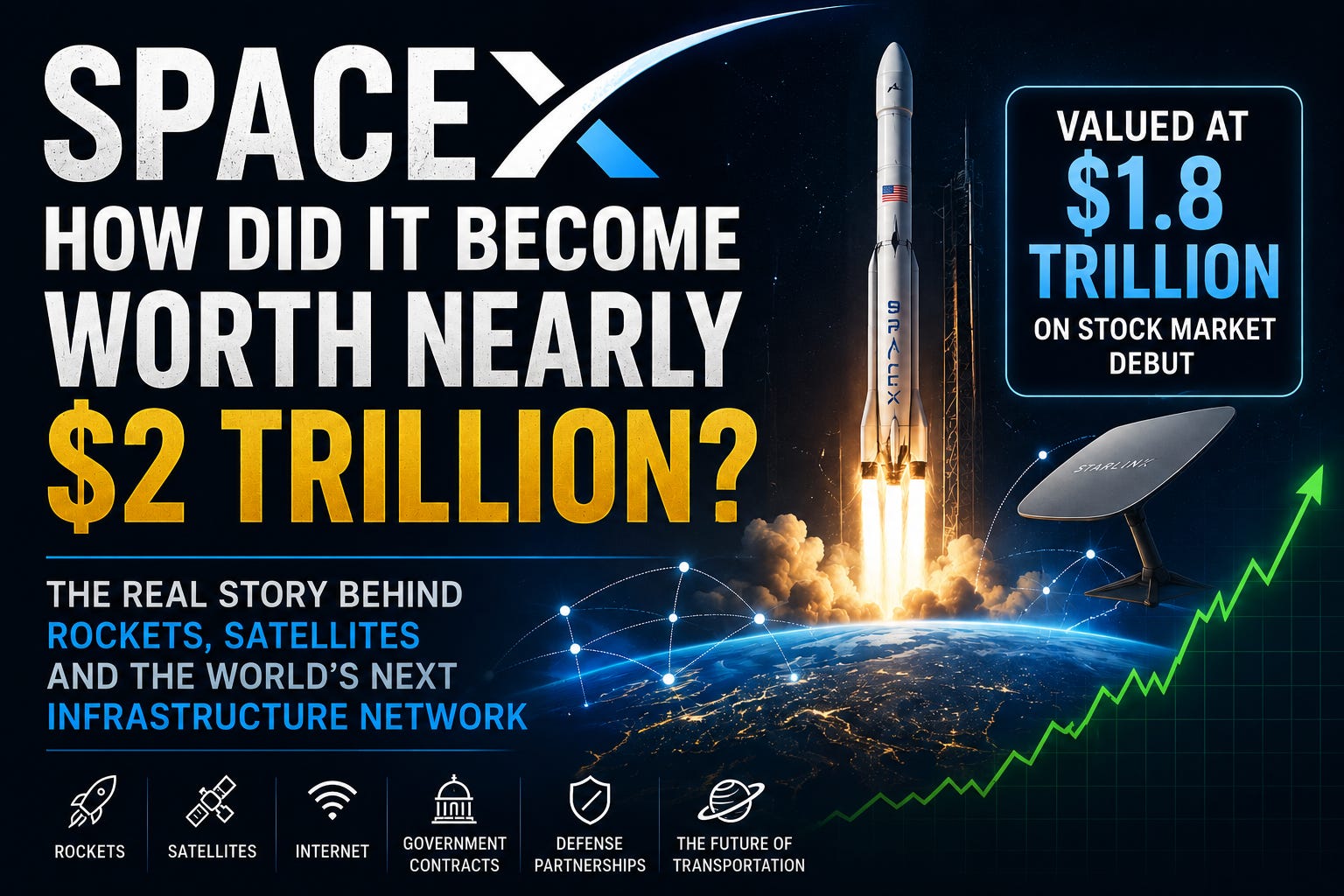
Imagine waking up to discover that a company generating less than $20 billion in annual revenue is now valued at nearly $2 trillion.
Not Apple.
Not Microsoft.
Not Google.
A company that launches rockets.
On June 12, 2026, SpaceX made its stock market debut at $135 per share, valuing the company at roughly $1.8 trillion. Within hours, the valuation briefly crossed $2 trillion mark the same day.
To put that into perspective, SpaceX’s valuation exceeds the GDP of more than 170 countries around the world.
And that’s where the story becomes interesting. Because if you ask most people what SpaceX does, the answer sounds surprisingly simple.
“They launch rockets.” That answer isn’t wrong.
SpaceX has transformed the global space industry through reusable rockets. Its Falcon 9 rockets have completed hundreds of successful launches and recoveries, dramatically reducing the cost of reaching orbit.
But even that doesn’t explain a valuation approaching $2 trillion.
Yet investors are willing to value SpaceX at levels usually reserved for the world’s most dominant technology companies.
Why?
The answer becomes even more puzzling when you look at the numbers. In 2025, SpaceX generated an estimated $18.7 billion in revenue.
For comparison, Microsoft generated $281 billion, Alphabet $402 billion, Amazon $716 billion, and Meta $201 billion in revenue during the same period. In other words, these companies generated 10 to 38 times more revenue than SpaceX, yet SpaceX’s valuation was already approaching the same league.
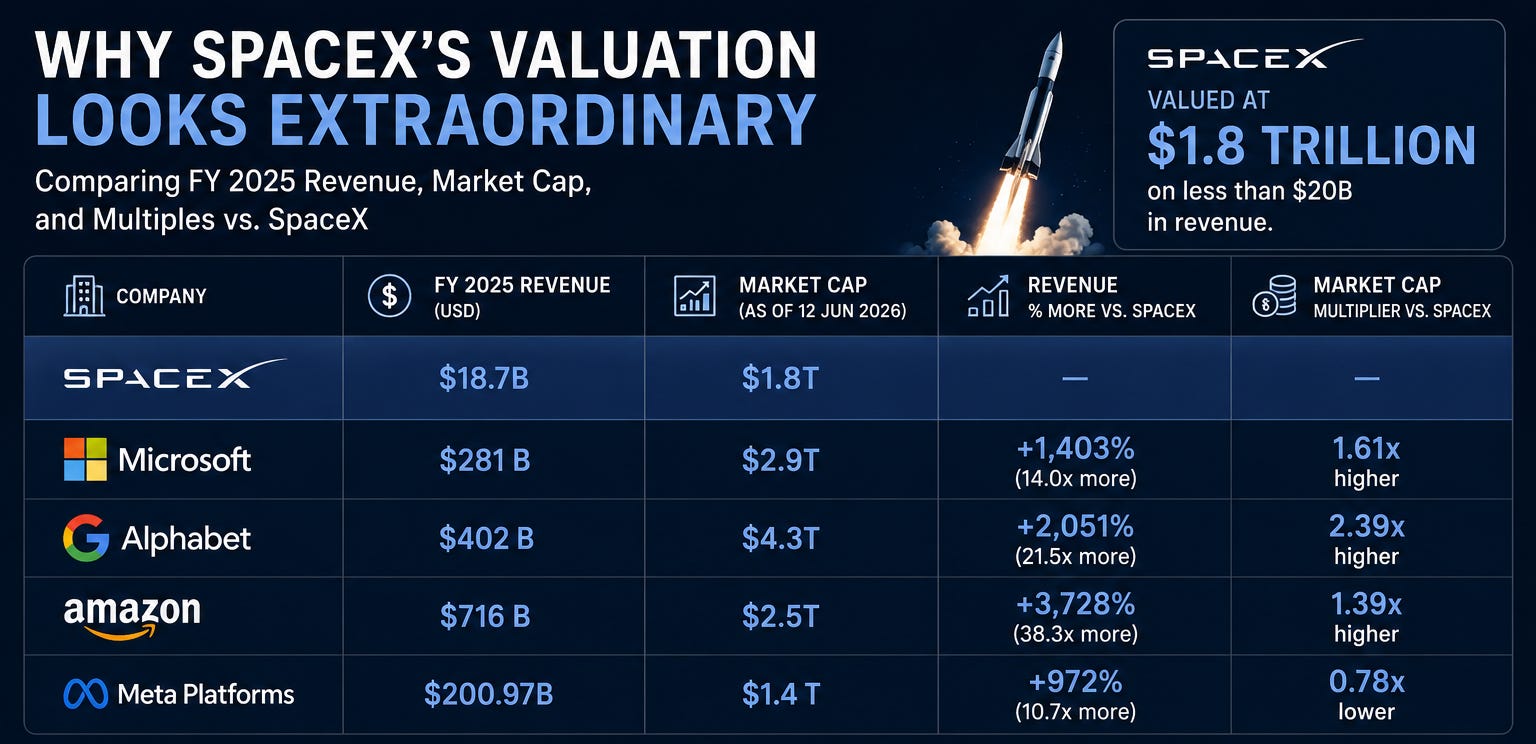
If investors were simply valuing rocket launches, the numbers wouldn’t add up. In fact, rocket launches account only a portion of SpaceX’s business today.
Something else is happening beneath the surface.
Something far bigger than rockets.
Because over the past decade, SpaceX quietly evolved from a company that transports satellites into space into a company that owns one of the largest satellite networks ever built.
When SpaceX debuted on the stock market on 12th June 2026, investors valued the company at roughly $1.8 trillion.
At first glance, that number seems almost impossible to justify.
After all, SpaceX generated an estimated $18.7 billion in revenue during 2025. That sounds impressive until you compare it with some of the world’s largest aerospace and defence companies given that these companies operate in similar markets.
For example:
Boeing generated ~$89 billion in revenue for 2025 and carried a market capitalization of roughly $172.6 billion.
Airbus generated ~€73.42 billion ($85 billion) in revenue for 2025 and was valued at around €139.6 billion ($161.6 billion).
Lockheed Martin generated ~$75 billion in revenue for 2025 and had a market capitalization of roughly $124.5 billion.
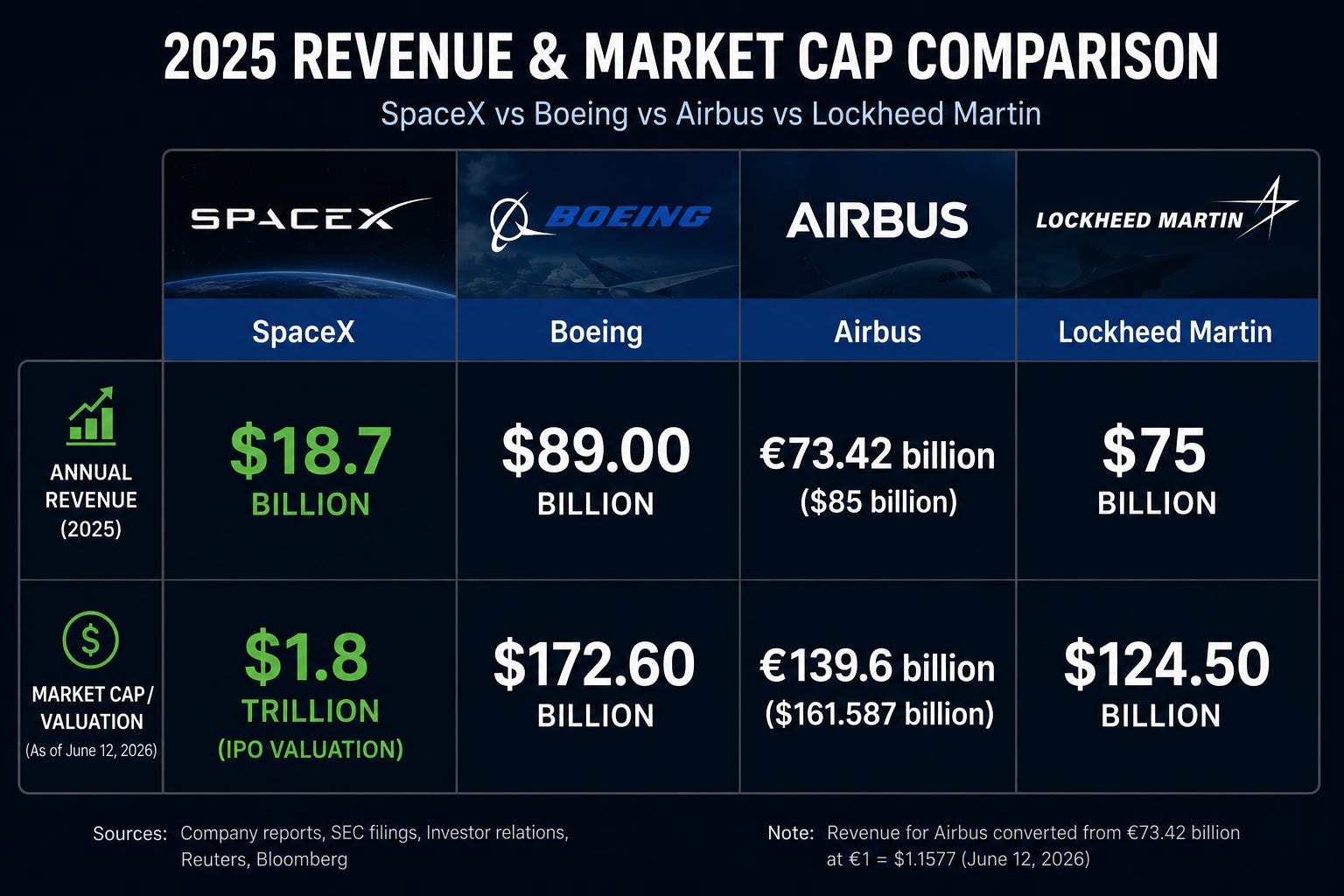
Yet despite generating significantly less revenue than all three companies, SpaceX entered the public markets with a valuation that exceeded each of them by an enormous margin. In fact, SpaceX’s valuation was larger than the combined market value of Boeing, Airbus, and Lockheed Martin ($1.8T vs ~$458B combined).
And the numbers become even more astonishing when viewed through the lens of valuation multiples.
With a valuation of roughly $1.8 trillion and annual revenue of approximately $18.7 billion, investors were valuing SpaceX at nearly 96 times revenue.
To understand how extraordinary that is, consider this:
Most mature industrial businesses typically trade between 1x and 5x annual revenue. Even highly successful technology companies rarely sustain valuations above 20x revenue for long periods.
SpaceX was being valued at levels that suggested investors were looking far beyond its current business and the story becomes even more interesting when you examine where the company’s revenue actually comes from.
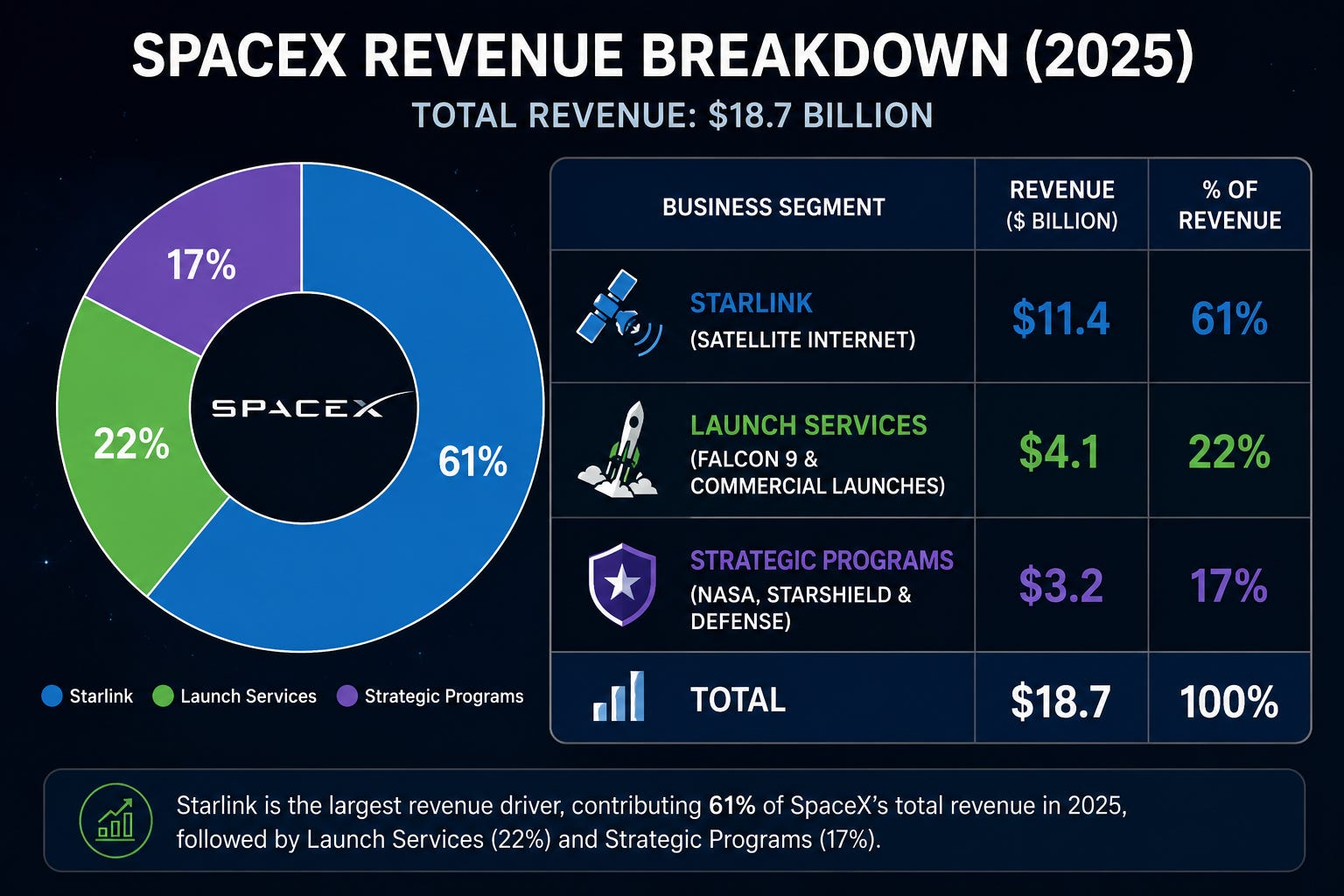
Most people assume SpaceX makes its money by launching rockets. But in 2025, Rocket Launch Services generated an estimated $4.1 billion in revenue.
Meanwhile, Starlink, the company’s satellite internet business, generated approximately $11.4 billion. In other words, nearly 61% of SpaceX’s revenue came from Starlink, not rockets.
Suddenly, the story begins to look very different. Investors weren’t valuing a company that launches rockets.
They were valuing a company that owns rockets, satellites, internet infrastructure, government contracts, defense relationships, and one of the most ambitious transportation projects ever attempted.
When most people think about SpaceX, they think about Mars. They think about giant rockets. They think about astronauts, satellites, and science fiction becoming reality.
But that’s not the problem Elon Musk was trying to solve when he founded SpaceX in 2002.
The real problem was much simpler: Space was too expensive.
At the time, launching anything into orbit was an incredibly costly exercise. Whether it was a communication satellite, a weather satellite, or a scientific experiment, getting it into space required spending tens or even hundreds of millions of dollars.
The reason was surprisingly straightforward.
Rockets were essentially disposable. Imagine boarding a Boeing 787 from New York to London. After landing, instead of preparing the aircraft for its next flight, the airline throws the entire plane into the ocean and builds a brand-new one for the next passenger.
The idea sounds ridiculous, no airline could survive operating that way right?
Yet that was exactly how the space industry worked for decades. Once a rocket completed its mission, most of it was lost forever.
The engines were destroyed. The boosters fell into the ocean. The hardware that took years to build was used only once. Every launch required building another rocket from scratch and when you repeatedly throw away multi-million-dollar machines, the cost of every launch remains painfully high.
This made access to space affordable only for governments, militaries, and a handful of large corporations. For everyone else, space remained out of reach.
Elon Musk believed the problem wasn’t a lack of ambition. It was economics. If the cost of reaching orbit could be dramatically reduced, entirely new industries could emerge.
More satellites could be launched. Internet could be delivered to remote regions. Scientific missions could become cheaper and perhaps one day, humanity could even become a multi-planetary species.
But before any of that could happen, SpaceX had to solve one fundamental problem:
How do you make rockets reusable?
Because if rockets could be reused like airplanes, the economics of space would change forever.
And that is exactly what SpaceX set out to prove.
In theory, making rockets reusable sounds obvious. In practice, it was considered nearly impossible.
SpaceX wanted to change that.
The company’s breakthrough came with the development of Falcon 9, a two-stage rocket designed with one revolutionary goal: Bring the most expensive part of the rocket back to Earth and use it again.
After delivering its payload into space, Falcon 9’s first-stage booster doesn’t simply fall into the ocean. Instead, it performs a carefully choreographed series of maneuvers, re-enters the atmosphere, and lands vertically on a drone ship or landing pad.
The first time SpaceX successfully landed a Falcon 9 booster in December 2015, many viewed it as a technological achievement.
What they failed to realize was that it was also an economic breakthrough. Because the moment a rocket becomes reusable, the economics of space begin to resemble the economics of aviation.
Airlines don’t build a new aircraft for every flight. They reuse the same aircraft hundreds or even thousands of times. SpaceX wanted to bring that same logic to rockets.
And it worked.
Today, Falcon 9 has become one of the most reliable launch systems ever built. Some boosters have flown more than 35 times, something that would have been considered unimaginable just a decade ago.
By 2026, SpaceX had completed more than 500 successful booster recoveries, turning what was once an experimental concept into routine operations.
The impact on launch frequency has been extraordinary. In 2025 alone, SpaceX completed approximately 165 launches, more than any launch provider in history.
To put that into perspective, SpaceX now launches rockets at a pace that was once considered impossible for the entire industry.
But the real significance wasn’t the number of launches. It was the reduction in cost. Every time a booster is reused, SpaceX avoids building an entirely new rocket from scratch.
Lower costs allow more launches. More launches create more customers. More customers generate more revenue and more importantly, lower launch costs unlock entirely new business opportunities that were previously uneconomical.
For the first time in history, access to space was becoming dramatically cheaper and that’s when SpaceX made a decision that would change the company’s future forever.
Instead of using its rockets solely to launch other people’s satellites, SpaceX decided to build a satellite network of its own.
That network would eventually become known as Starlink.
And as investors would later discover, Starlink not Falcon 9, which becomes the primary driver behind SpaceX’s trillion-dollar valuation.
If you ask most people what SpaceX does, the answer is almost always the same. It launches rockets and to be fair, that’s what made the company famous.
The dramatic rocket landings. The missions to the International Space Station. The launches carrying astronauts and satellites into orbit. These are the events that capture headlines.
But when investors looked at SpaceX’s financials before its IPO, they discovered something surprising.
The rockets weren’t the biggest business anymore.
As discussed previously:
In 2025, SpaceX generated approximately $18.7 billion in revenue. But only about $4.1 billion came from launch services that’s roughly 22% of total revenue.
The majority of the company’s revenue came from somewhere else. A business that most people rarely associate with SpaceX.
Starlink.
In 2025, Starlink generated an estimated $11.4 billion in revenue, accounting for roughly 61% of SpaceX’s total sales.
That means Starlink generated nearly three times as much revenue as the company’s launch business. Think about that for a moment. The business that attracts the most attention isn’t the business generating the most money.
The satellites are.
Starlink began as an ambitious idea.
Instead of launching satellites for other companies, SpaceX would build its own constellation of satellites and provide internet connectivity directly to customers around the world.
At the time, many people viewed it as an experiment.
Today, it has become one of the largest satellite internet networks ever created.
As of 31st Mar’26, Starlink had surpassed 10 million subscribers across more than 164 countries, serving everyone from homeowners and businesses to ships, airlines, emergency responders, and remote communities.
And unlike rocket launches, which generate revenue only when a launch occurs, Starlink generates recurring revenue every month. Every subscriber pays a monthly fee. Every new customer increases the network’s revenue base and every additional satellite expands the network’s reach.
This distinction is incredibly important rocket launches are transactional Starlink subscriptions are recurring. One depends on continuously winning new contracts. The other builds a predictable stream of revenue that compounds over time.
This is exactly the type of business model investors tend to reward with higher valuations.
Because investors don’t simply pay for revenue, they pay for future cash flows.
And recurring cash flows are usually worth far more than one-time transactions.
Suddenly, SpaceX begins to look less like an aerospace company and more like a telecommunications company operating from space.
But Starlink isn’t the only reason investors are excited.
Because once you understand how Starlink works, think of it this way:
If SpaceX used rockets to build the world’s largest satellite internet network, what other businesses could it build once access to space becomes even cheaper?
At this point, the valuation begins to make a little more sense.
But not completely.
After all, even if Starlink generated $11.4 billion in revenue and became the world’s largest satellite internet network, a valuation approaching $2 trillion still appears extraordinary.
So what exactly are investors paying for?
The answer lies in a simple principle of investing.
Markets don’t value companies based solely on what they earn today. They value companies based on what they could earn tomorrow. A century ago, investors bought railroad companies because railways were becoming critical infrastructure.
Later, they bought oil companies because energy powered economic growth then they bought internet companies because digital networks became the backbone of modern commerce.
Today, many investors believe SpaceX is building a new layer of infrastructure and Starlink may only be the beginning.
Consider the company’s next major project: Starship.
Standing nearly ~400 feet tall, Starship is the largest and most powerful rocket ever built unlike Falcon 9, which was designed primarily to lower launch costs, Starship is designed to lower them even further.
The goal is ambitious. Make access to space so cheap that activities previously considered impossible suddenly become economically viable. More satellites, more scientific missions, more cargo, more lunar exploration and eventually, perhaps even missions to Mars.
Whether Starship succeeds remains uncertain but investors are paying for the possibility that it does.
Then there is Starshield.
While Starlink provides internet connectivity to consumers and businesses, Starshield focuses on government and defence applications. Secure communications, military connectivity, intelligence capabilities and national security infrastructure.
Historically, defence contracts have produced some of the most stable and predictable revenue streams in the world and if Starshield follows a trajectory similar to Starlink, it could become a major business in its own right.
There is also the growing role SpaceX plays in government space programs.
From transporting astronauts to the International Space Station to supporting NASA’s lunar ambitions, SpaceX has become deeply integrated into America’s future plans for space exploration.
The result is a company that increasingly resembles multiple industries at once. Part aerospace company, part telecommunications provider, part defence contractor, part infrastructure platform and perhaps that is why traditional valuation comparisons often fail.
Because investors are not comparing SpaceX to Boeing. They are not comparing it to Lockheed Martin and they are certainly not comparing it to a traditional internet provider. Instead, they are attempting to value what SpaceX could become if its long-term vision succeeds.
A future where launching rockets becomes routine. A future where satellite connectivity reaches every corner of the planet. A future where space itself becomes a commercial marketplace.
Whether that future arrives remains to be seen but the valuation tells us something important.
Investors aren’t paying $2 trillion for the company SpaceX is today. They’re paying for the possibility of the company SpaceX could become tomorrow.
At first glance, SpaceX’s valuation looks irrational.
How can a company generating less than $20 billion in annual revenue be worth nearly $2 trillion?
The answer becomes clearer once you stop looking at SpaceX as a rocket company because rockets are only the first chapter of the story.
SpaceX didn’t become valuable because it launched rockets. It became valuable because it reduced the cost of reaching space. Lower launch costs enabled Starlink, and Starlink created a global communications network that network generated recurring revenue and recurring revenue transformed how investors viewed the business.
In many ways, the rockets were never the destination. They were the vehicle that made everything else possible. This is a pattern that has repeated throughout history.
Railroads weren’t valuable because people liked trains. They were valuable because they connected economies. The internet wasn’t valuable because people liked cables. It was valuable because it connected the world.
Likewise, SpaceX’s long-term value may not come from the rockets themselves. It may come from the infrastructure those rockets make possible. Whether that infrastructure ultimately justifies a $2 trillion valuation remains to be seen.
Markets are often optimistic. Sometimes excessively so.
But the valuation tells us something important. Investors do not believe they are buying a rocket company.
They believe they are buying a company that is building the next layer of global infrastructure.
And if SpaceX succeeds, it won’t merely be another aerospace company. It could become the infrastructure layer upon which future space-based industries are built.
And perhaps that is the real story behind SpaceX. Not a story about rockets. Not a story about Elon Musk but a story about how lowering the cost of access to a new frontier can create entirely new industries.
Because in the end, the most valuable businesses are rarely those that sell products. They are the ones that build the infrastructure that everyone else depends on and SpaceX is attempting to do exactly that, one launch at a time.
Like, Comment, Share, and Subscribe for more thoughtful insights on Finance.
If this article helped you better understand why investors are willing to value SpaceX at nearly $2 trillion and why the company may be building far more than rockets, consider supporting the newsletter by buying me a coffee.
Your contribution funds deeper research, clearer breakdowns, and practical financial frameworks — so you can make decisions based on logic, not emotion.
No pressure. Only if it adds value.
Sources:
https://www.macrotrends.net/stocks/charts/LMT/lockheed-martin/revenue
No posts
Comments
Nothing yet. Say the first thing.
Sign in to join the conversation.