
At Finance School, we simplify complex topics in finance, business, and economics into simple, actionable insights, explained clearly, logically, and practically, so you can think independently and make better financial decisions.
No noise. No hype. Just clarity.
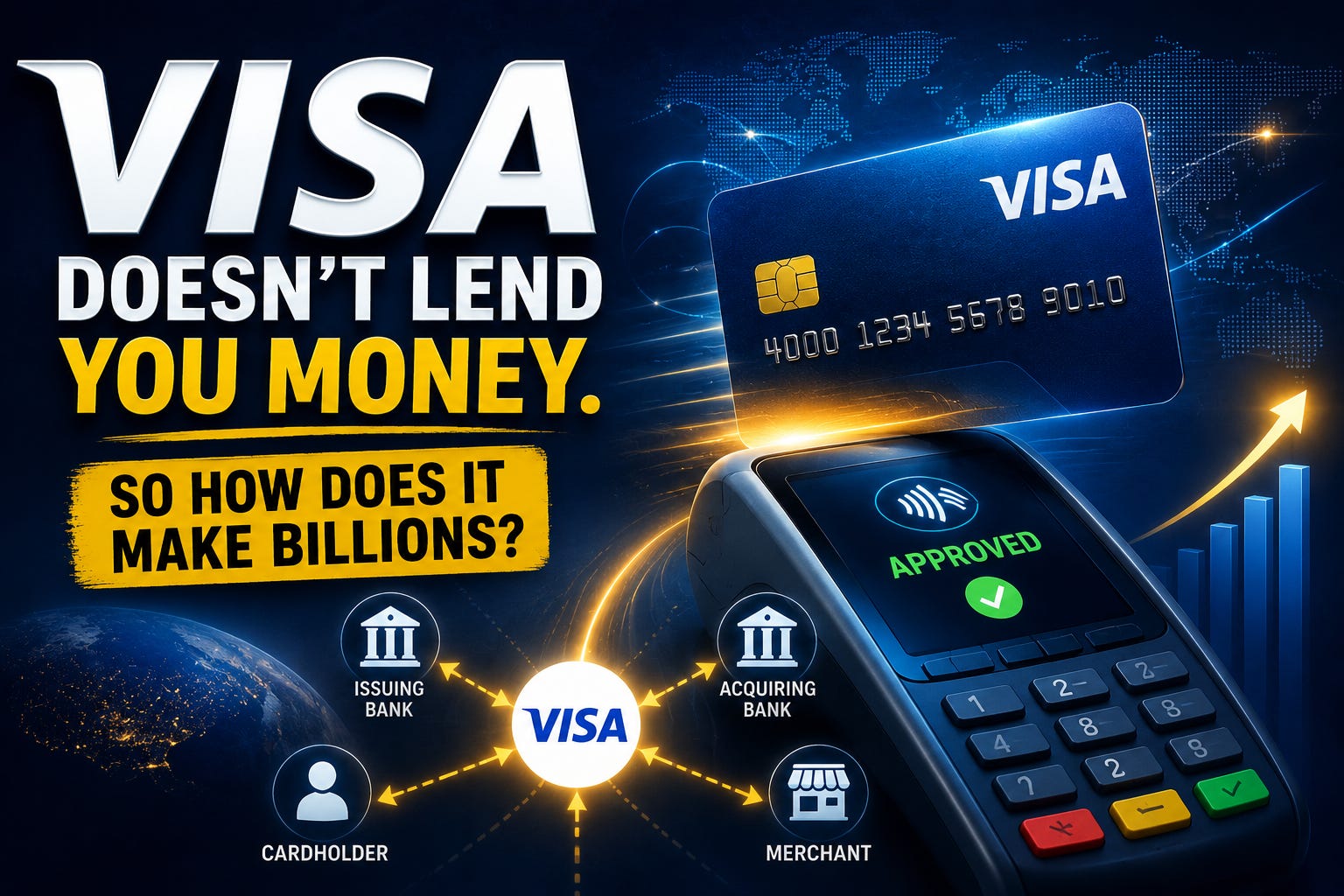
Lara had been using her VISA card for years.
She had tapped it at cafés, supermarkets, airports, shopping malls, petrol pumps, and countless online stores. Paying had become so effortless that she barely thought about what happened after she heard the familiar “Beep.”
One Monday morning, she stopped by her favourite café before heading to work. She ordered a cappuccino and a sandwich, and the cashier smiled as the billing machine displayed the total: ₹540.
Lara took out her VISA card and gently tapped it against the payment terminal.
Beep.
The payment was approved almost instantly. As she picked up her breakfast and walked towards the office, a strange thought crossed her mind.
“What exactly does Visa do?”
It sounded like a simple question but the more she thought about it, the more confused she became.
She knew her money was kept in her bank account, her credit card had been issued by her bank, her monthly statement came from her bank. If she ever had a problem with her card, she would call her bank.
So where did VISA fit into all of this?
Like millions of people, Lara had always assumed that VISA was simply the company that gave her the card. It seemed like a perfectly reasonable assumption.
After all, the word Visa was printed prominently on the front of the card.
But that assumption was wrong.
What Lara was about to discover was far more fascinating.
In less than two seconds, the café’s payment terminal had communicated with its bank. That bank had contacted VISA’s global payment network, which had then reached Lara’s bank to verify whether she had enough money or available credit. Sophisticated security systems had checked for fraud, the payment had been authorised, and the approval had travelled back to the café before Lara had even put her card back into her wallet.
Thousands of kilometres of digital communication. Multiple financial institutions, advanced security systems. All working together in less time than it takes to blink.
And here’s the most surprising part.
Not a single rupee involved in that transaction belonged to VISA.
VISA didn’t lend Lara the money. It didn’t hold her bank balance. It didn’t decide whether the payment should be approved.
Yet every day, billions of people around the world tap, swipe, or insert a VISA card and Visa earns billions of dollars from those transactions.
How is that possible?
If VISA isn’t a bank and never owns your money, what exactly does VISA do?
If I asked you a simple question: “What does VISA actually do?”
Most people would probably answer something like this:
“VISA gives me my debit card.”
“VISA is the company that provides my credit card.”
“VISA approves my card payments.”
Some might even think VISA is the bank where their money is stored.
These answers sound reasonable because the word VISA is printed prominently on millions of debit and credit cards around the world. Naturally, we associate the card with the company whose logo we see every time we make a payment.
But almost every one of these assumptions is wrong.
In reality, VISA is not a bank and here’s something that surprises many people:
VISA doesn’t even decide whether your payment is approved or declined.
The simplest answer is this:
VISA is one of the world’s largest payment networks.
But what does a payment network actually mean?
Imagine you want to call a friend who uses a different mobile network. You don’t have to worry about whether they’re using Jio, Airtel, or VI. You simply dial the number, and within seconds, your call reaches them.
That’s because there’s a communication network working behind the scenes, connecting different telecom operators and ensuring your call reaches the right person.
VISA works in a very similar way, but instead of connecting people, it connects financial institutions.
Every day, millions of people shop using their VISA cards. In each of these transactions, the customer’s bank and the merchant’s bank need to communicate with each other almost instantly.
The customer’s bank needs to answer questions like:
Does this customer have enough money in their account?
Is there sufficient credit available?
Is this transaction genuine, or could it be fraudulent?
Meanwhile, the merchant needs a quick response because no shopkeeper wants customers waiting at the checkout counter for several minutes.
This is where VISA steps in.
It provides a secure and standardised communication network that allows these banks to exchange information within seconds.
Now that we understand VISA’s role. Let’s meet the four key participants involved in every card payment. Once you know who these players are, the entire payment process becomes very easy to understand.
Let’s meet them one by one.
This is the easiest one. The cardholder is simply the person making the payment.
In our case, Lara is the cardholder. She wants to buy a coffee worth ₹540 using her VISA card, her only expectation is that the payment should be quick, secure, and hassle-free.
She doesn’t care how the system works behind the scenes, as long as she hears that familiar “Beep” and sees the words “Payment Approved.”
The merchant is the business accepting the payment.
It could be a neighbourhood grocery store, a café, a supermarket, an airline, an online shopping website, or even a multinational retailer.
The merchant’s goal is simple “I want to receive my money safely and know that this payment is genuine.” However, the merchant has no direct way of checking Lara’s bank account or credit limit.
That’s where the banking system comes into play.
The issuing bank is the bank that gave Lara her card. Suppose Lara’s VISA credit card was issued by HDFC Bank.
HDFC Bank is the institution that:
Opened Lara’s credit card account.
Set her credit limit.
Sends her monthly credit card statement.
Collects payment from her every month.
Decides whether a transaction should be approved or declined.
Notice something important. Although Lara carries a VISA card, her financial relationship is actually with HDFC Bank, not VISA. If she has any issue with her credit card bill, credit limit, or rewards points, she contacts HDFC Bank, not VISA.
Now let’s move to the other side of the transaction.
The café where Lara bought her coffee also has a bank. This bank is known as the acquiring bank, or simply the merchant’s bank.
Its job is to provide the payment terminal, accept card payments on behalf of the merchant, and eventually deposit the money into the merchant’s account.
Think of it as the merchant’s financial partner, just as HDFC Bank is Lara’s financial partner.
Let’s go back to Lara standing at the café counter. She has just ordered a cappuccino and a sandwich worth ₹540. The cashier enters the amount into the payment terminal and turns the machine towards her.
Lara taps her VISA card.
Beep.
The payment is approved almost instantly. For Lara, the transaction is over but behind that tiny beep, an extraordinary process has just unfolded.
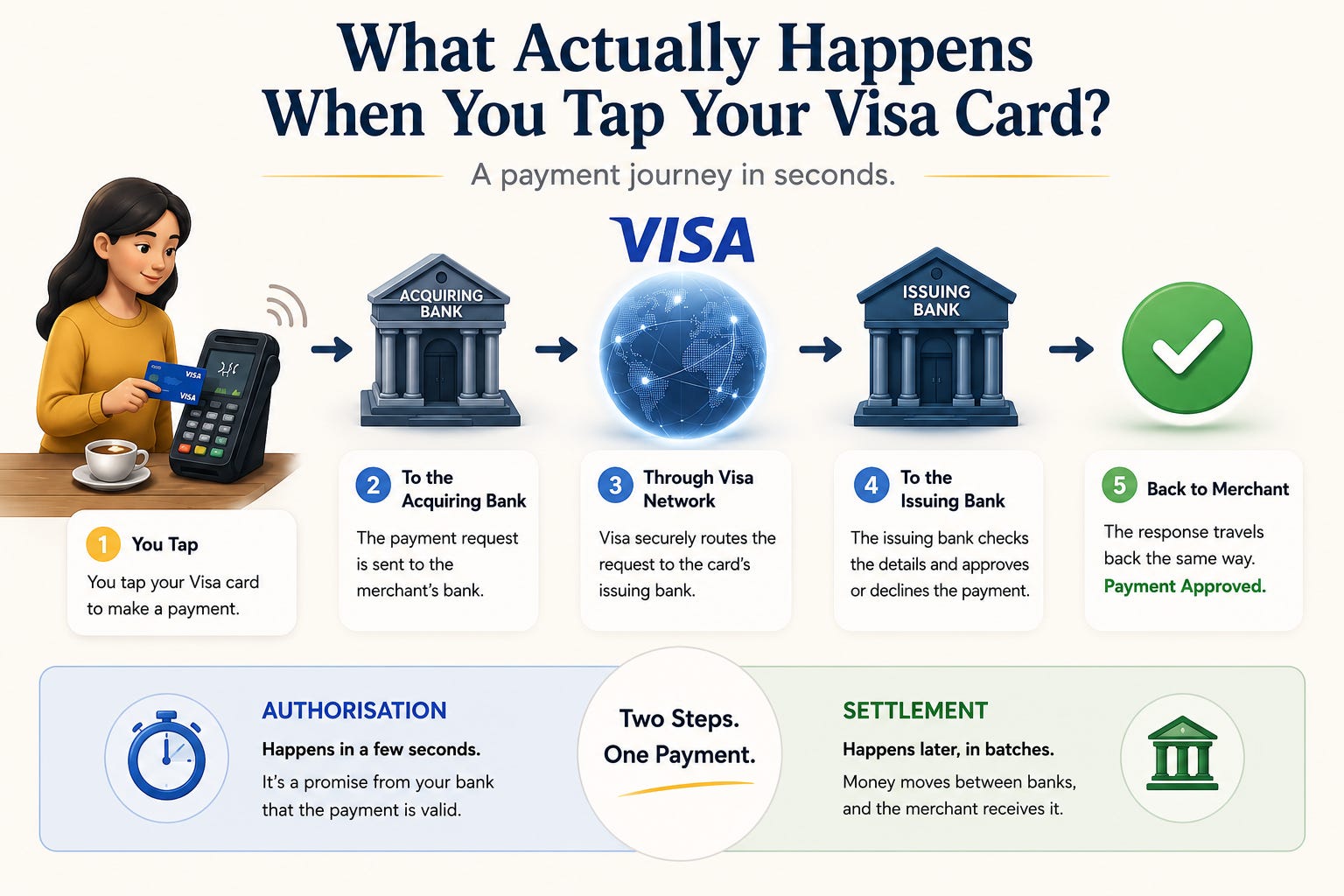
The payment terminal immediately creates a digital request containing details such as the purchase amount, the merchant’s identity, and information stored on Lara’s card. This request is first sent to the café’s bank, known as the acquiring bank.
The acquiring bank doesn’t know whether Lara has enough money or available credit. Its job is simply to forward the request to the VISA network, then VISA identifies which bank issued Lara’s card and securely routes the request to Lara’s bank (which is HDFC Bank)
The real decision is made by HDFC Bank.
HDFC Bank checks whether Lara’s card is active, whether she has sufficient funds or credit available, and whether the transaction appears genuine. If everything looks normal, it sends back a simple response:
Approved.
If any of these checks fail, the response becomes:
Declined.
VISA never makes this decision. It simply ensures that the payment request reaches the correct bank and that the bank’s response returns safely to the merchant.
Once HDFC Bank approves the transaction, the confirmation travels back through VISA to the acquiring bank and finally reaches the café’s payment terminal.
Within seconds, the screen displays:
Payment Approved.
The cashier hands over Lara’s order, and she walks away.
Most people assume that this message means the café has already received its ₹540 but that’s not actually what happened. The approval only means that Lara’s bank has confirmed the payment is valid and has promised to honour it. This stage is known as authorisation.
The actual movement of money happens later through another process called settlement.
Rather than transferring money separately for every single purchase, banks group together thousands or even millions of approved transactions and settle them in batches. This makes the entire payment system faster, more efficient, and far less expensive to operate.
Depending on the merchant’s agreement with its bank, the funds are usually credited within one or two business days, although some merchants receive them even sooner.
This distinction between authorisation and settlement is one of the reasons the global payment system can process billions of transactions smoothly every year.
By now, we’ve established that VISA doesn’t issue your credit card. So here’s the obvious question: How does VISA make money?
The answer is surprisingly simple.
VISA gets paid for operating the network that makes these transactions possible.
Think about it this way.
Every time you use a VISA card, multiple financial institutions use Visa’s network to communicate with each other. Providing this network isn’t free. Banks pay VISA for the services it provides. The merchant’s bank pays VISA. The cardholder’s bank also pays VISA.
Each individual fee is tiny, often just a fraction of the total transaction value. Most people would never even notice it, but now imagine this happening not once or twice, but hundreds of billions of times every year. Tiny fees collected on an enormous number of transactions eventually become billions of dollars in revenue.
This is one of the reasons VISA’s business model is so powerful.
Now we know that VISA gets paid whenever banks use its network.
But not every transaction is the same.
A payment made at your neighbourhood supermarket is very different from buying something on an international website or sending money across borders because of this, VISA doesn’t rely on a single source of income. Instead, it earns revenue from multiple services that together support its global payment network.
Let’s look at them one by one.
Every time a bank issues a VISA card and its customers make purchases, the bank is using VISA’s payment network.
For providing access to this network, VISA charges financial institutions a fee based largely on the total value of payments processed through its network.
Think of it as paying for access to one of the world’s largest payment highways. The more payment volume flowing through VISA’s network, the more service revenue VISA earns.
In FY2025, VISA generated approximately US$17.5 billion from service revenue.
Every time Lara taps her VISA card, VISA’s systems receive the payment request, identify the issuing bank, securely route the transaction, and return the respons, all within a matter of seconds.
Processing billions of transactions requires enormous investment in technology, cybersecurity, data centres, and network infrastructure. Banks pay VISA for processing these transactions.
This income is known as Data Processing Revenue.
Unlike service revenue, which depends on the total value of payments, data processing revenue depends largely on the number of transactions flowing through VISA’s network, and the scale is astonishing.
In FY2025, VISA processed approximately 329 billion payment transactions worldwide, an average of about 901 million transactions every single day, or more than 10,433 transactions every second.
From these processing services alone, VISA generated approximately US$20 billion, making it another major contributor to the company’s revenue.
Imagine Lara travels to Paris for a vacation. She uses the same VISA card to pay for a meal at a local restaurant. Now the transaction becomes much more complicated.
The merchant is in France. Lara’s bank is in India.
The payment may involve different currencies, additional security checks, foreign exchange conversion, and compliance with regulations in multiple countries. Facilitating these cross-border transactions requires additional infrastructure and risk management.
For providing these services, VISA earns International Transaction Revenue.
In FY2025, this business generated approximately US$14.2 billion, making international payments one of VISA’s fastest-growing and most profitable businesses.
Today, VISA does far more than simply move payment messages between banks.
It also offers fraud prevention tools, cybersecurity solutions, tokenisation technology, risk management systems, consulting services, loyalty programmes, and data analytics that help banks and merchants operate more efficiently.
Think of these as premium services built on top of VISA’s payment network.
Banks don’t have to use them but many choose to because they improve security, reduce fraud, and enhance the customer experience.
In FY2025, VISA earned approximately US$4.1 billion from this segment, and this segment has been one of the company’s fastest-growing businesses over the past few years.
See below chart for revenue details:
Gross Total ($55.8 Billion): This is the raw mathematical sum of all four primary operational fee categories before any deductions or commercial rebates are taken out.
Net Revenue ($40.0 Billion): This is the official “top-line” revenue figure featured in VISA’s financial. It is calculated by taking the $55.8 billion gross total and subtracting $15.8 billion in client incentives (volume discounts and rebates paid out to financial institutions and merchant partners)
Imagine you decide to launch a new social media platform tomorrow. On day one, you’re the only user.
Would anyone join? Probably not.
Now imagine a platform with one billion users. Suddenly, joining becomes much more attractive because all your friends, family, colleagues, and favourite creators are already there. The platform becomes more valuable simply because more people use it. This phenomenon is called a network effect.
And VISA has one of the strongest network effects in the world.
To understand why, let’s go back to Lara.
When Lara receives a VISA card, she expects to use it almost everywhere. At the same time, merchants want to accept the payment methods that customers already carry in their wallets. This creates a powerful cycle. More cardholders encourage more merchants to accept VISA. More merchants make VISA cards more useful for consumers. More consumers make VISA even more attractive for banks to issue. More banks increase the size of the network further.
The cycle then repeats itself.
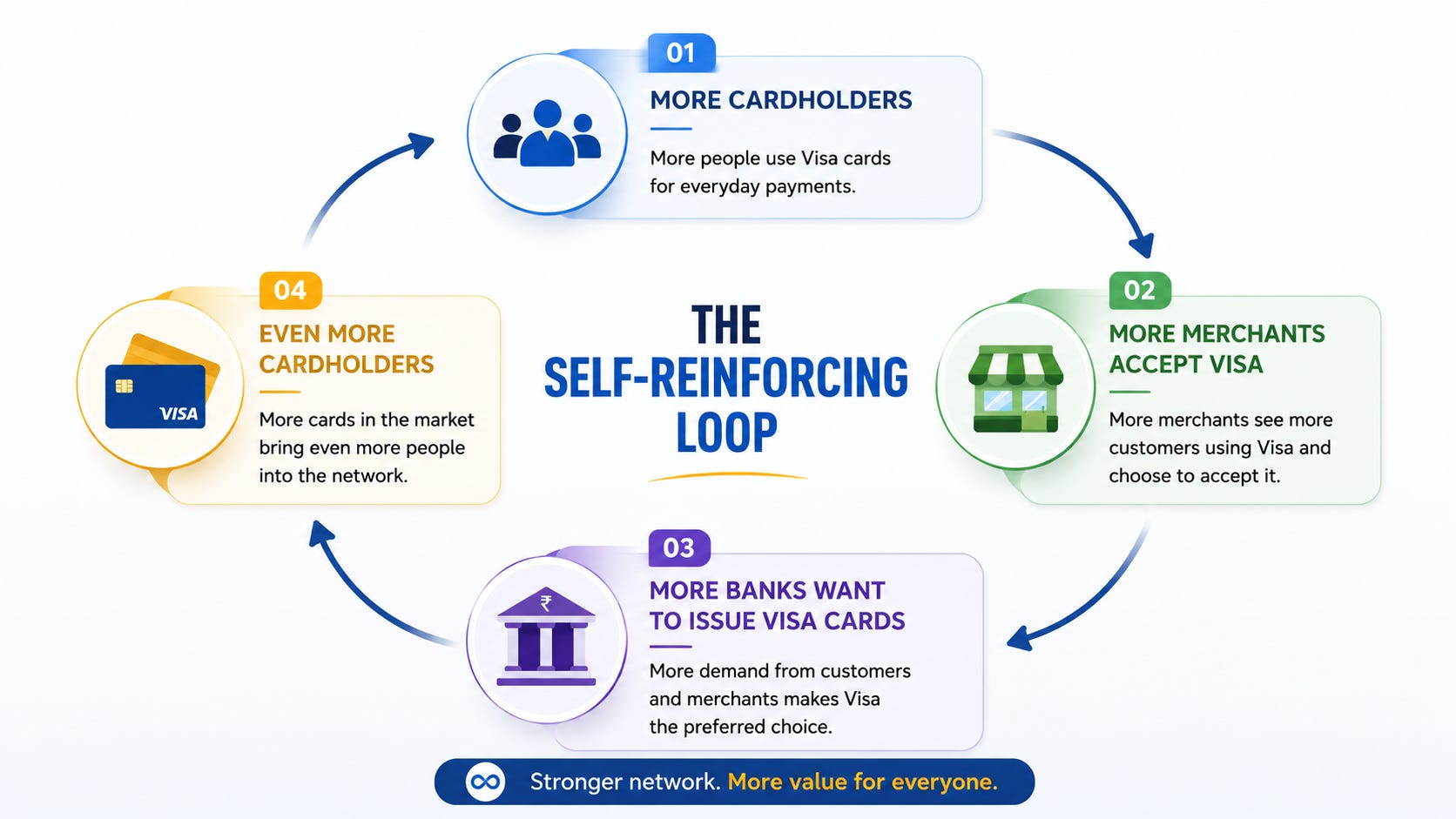
This self-reinforcing cycle creates what's known as an economic moat. A competitive advantage that becomes stronger as the network grows.
At first glance, creating a payment network sounds simple. Build some software. Connect a few banks. Process transactions. The reality is far more complicated.
A new competitor would need to convince:
Consumers to carry its card.
Merchants to accept its card.
Banks to issue its card.
Regulators to approve its operations.
Businesses around the world to trust its security systems.
And all of this must happen simultaneously. The challenge is obvious. Consumers won’t carry a card that isn’t widely accepted. Merchants won’t accept a card that nobody carries. Banks won’t issue cards that customers can’t use.
Everyone is waiting for everyone else.
VISA solved this problem decades ago.
Today, nearly 4.9 billion VISA payment credentials are in circulation globally.
Its network connects thousands of financial institutions and is accepted in more than 200 countries and territories. That scale creates a competitive advantage that cannot be replicated overnight.
If there’s one company that truly resembles VISA, it’s Mastercard.
Like VISA, Mastercard isn’t a bank. It doesn’t issue credit cards. It doesn’t accept deposits. It doesn’t lend money. Instead, it operates a global payment network connecting banks, merchants, and consumers.
In other words, Mastercard follows almost the same business model as VISA.
When a bank decides to launch a new credit or debit card, it often chooses between VISA and Mastercard as the payment network powering that card.
From a customer’s perspective, both cards work almost identically.
The real competition happens behind the scenes, where banks negotiate fees, technology, security features, and partnership agreements before deciding which network to use.
Let’s go back to where we started.
The next time Lara taps her Visa card and hears that familiar “Beep,” she’ll know that it isn’t just the sound of a successful payment.
It’s the sound of one of the world’s largest payment networks doing exactly what it was designed to do, securely connecting banks, merchants, and consumers across the globe in less time than it takes to blink.
And perhaps the most remarkable part is that VISA never owned Lara’s ₹540. It didn’t lend her the money but distributed its network to financial institutions.
Yet, in FY2025, VISA facilitated around US$14.2 trillion in payment volume, processed approximately 329 billion transactions, generated US$40 billion in revenue, and earned nearly US$20 billion in net profit.
That’s the power of building infrastructure.
It built the network that allows everyone else to do business.
And once enough banks, merchants, and consumers joined that network, every new participant made it even more valuable. This is why VISA has become one of the world’s greatest examples of a network-effect business.
Its biggest asset isn’t a factory. It isn’t a warehouse. It isn’t even the trillions of dollars flowing through its network. Its biggest asset is trust. Trust from thousands of banks, millions of merchants and billions of consumers who rarely think twice before tapping their card.
Perhaps that’s the biggest lesson investors can take away from VISA.
The next time you tap your VISA card at a café, book a flight, or shop online, you’ll probably still hear the same familiar “Beep.”
But now you’ll know that behind those two seconds lies one of the most remarkable business models ever created.
“VISA didn’t build the product. It built the infrastructure that allows everyone else to do business.”
Like, Comment, Share, and Subscribe for more thoughtful insights on Finance.
If this article helped you better understand how Visa actually makes money without lending a single rupee, how payment networks quietly power the global economy, and why every card swipe is a business transaction rather than a loan, consider supporting the newsletter by buying me a coffee.
Your contribution funds deeper research, clearer breakdowns, and practical financial frameworks. So you can make decisions based on logic, not emotion.
No pressure. Only if it adds value.
Have feedback, questions, or a topic you’d like Finance School to explore? Write to us at: financeschool.research@gmail.com
We read every email, and many of our best article ideas come directly from readers.
Sources:
https://en.wikipedia.org/wiki/Visa_Inc.
https://s29.q4cdn.com/385744025/files/doc_downloads/2025/Visa-Fiscal-2025-Annual-Report.pdf
No posts
Comments
Nothing yet. Say the first thing.
Sign in to join the conversation.