
At Finance School, we simplify complex topics in finance, business, and economics into simple, actionable insights, explained clearly, logically, and practically, so you can think independently and make better financial decisions.
No noise. No hype. Just clarity.
It was a Saturday evening.
Jay had taken his parents out for dinner at one of their favourite family restaurants. After a long meal filled with good food and even better conversations, the waiter placed the bill on the table.
The total came to ₹2,480. As Jay looked at the bill, the waiter smiled and said,
“You can just scan the QR, sir.“
Jay picked up his phone, opened his Google Pay app, scanned the QR code, entered his UPI PIN, and within a couple of seconds, his phone displayed a familiar message:
Payment Successful.
The waiter thanked him, wished the family a pleasant evening, and walked away.
As Jay and his parents stepped out of the restaurant, something crossed his mind. The entire payment had taken less than five seconds.
The restaurant had received the payment confirmation almost instantly. His bank had processed the transaction. The restaurant’s bank had received the payment request. The UPI app had worked flawlessly. Somewhere in the background, NPCI’s payment network had connected everything together.
Yet Jay hadn’t paid a single rupee as a transaction fee.
The restaurant hadn’t added any convenience charge for accepting UPI. His bank hadn’t deducted any processing fee. Even the UPI app he used every day hadn’t asked him to pay for using its service.
It felt almost too good to be true.
Running one of the world’s largest real-time payment systems couldn’t possibly be free. Banks have to maintain technology infrastructure. Payment apps employ thousands of people. NPCI operates the network that connects hundreds of banks across the country.
Someone had to be paying for all of it, but if it wasn’t Jay, then who was?
If someone asked Jay who made his payment possible that evening, his answer would probably be straightforward.
“Google Pay.”
After all, that’s the app he opened. That’s the app he used to scan the QR code. And within seconds, it was the app that displayed the familiar message:
Payment Successful.
Most of us think the same way.
We associate the entire payment with the app on our phone. If you use Google Pay, you might assume Google processed the payment. If you use PhonePe, you might think PhonePe transferred the money. And if you use Paytm, you probably give the credit to Paytm.
But that’s one of the biggest misconceptions about UPI. In reality, Google Pay, PhonePe, Paytm, and BHIM are not the payment system itself. They are simply the applications that allow you to access it.
Think of them as different web browsers.
Whether you use Google Chrome, Safari, Firefox, or Microsoft Edge, you’re still accessing the same internet. Changing your browser doesn’t create a different internet, it only changes how you access it.
UPI works in much the same way.
Whether you pay using Google Pay, PhonePe, Paytm, BHIM, or any other UPI-enabled app, every transaction ultimately travels through the Unified Payments Interface (UPI). A payment infrastructure developed and operated by the National Payments Corporation of India (NPCI).
This distinction is more important than it might seem.
The app you use is simply the interface. Behind that interface lies an entirely different financial ecosystem involving your bank, the merchant’s bank, NPCI, and several security and settlement systems working together in the background.
In other words, when Jay scanned the restaurant’s QR code, he wasn’t really making a Google Pay payment.
He was making a UPI payment.
When Jay scanned the QR code at the restaurant, it looked like a simple payment between two people.
Jay paid. The restaurant received the money and transaction completed.
But behind those few seconds was an entire ecosystem working together to make that payment possible. Let’s meet each of the participants involved in that single UPI transaction.
Every UPI transaction begins with the customer. In this case, it was Jay. Using his Google Pay app, he instructed his bank to transfer ₹2,480 to the restaurant. Although Jay interacted only with the app on his phone, he had unknowingly set an entire payment ecosystem into motion.
The restaurant was the recipient of the payment. Like millions of businesses across India, it had a UPI-enabled QR code linked to its bank account. Once the transaction was successfully completed, the money would eventually be credited to that account.
When Jay used Google Pay, he interacted with the app on his phone. However, behind the scenes, the app worked through a Payment Service Provider (PSP) — a participating bank or banking partner connected to NPCI's UPI network. The PSP securely carried Jay's payment request from the app into the UPI ecosystem for further processing.
Jay’s money was always held by his bank not by the UPI app. When he authorised the payment, his bank verified his credentials, checked whether sufficient funds were available, and approved the transfer.
On the other side of the transaction was the restaurant’s bank. Its responsibility was to receive the payment request and credit the funds to the restaurant’s account once the transaction had been successfully processed.
Connecting these two banks was NPCI the organisation that operates the UPI infrastructure. Think of NPCI as the central highway that allows more than 703 banks across India to communicate with one another securely and almost instantly. Every UPI transaction, regardless of which app you use, ultimately passes through this network.
Let’s go back to Jay.
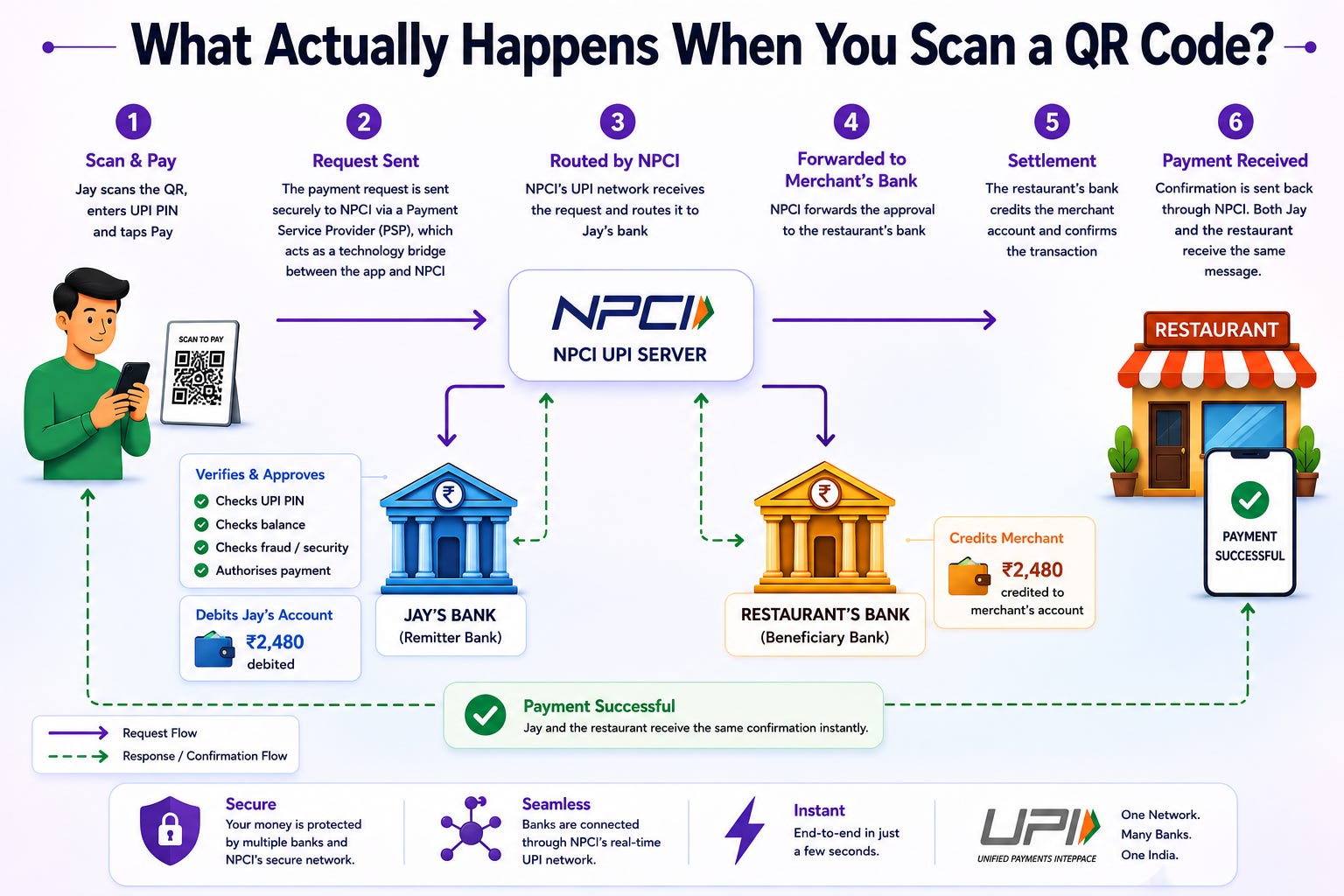
The moment Jay scans QR and taps Pay, his UPI app doesn’t transfer the money directly to the restaurant. Instead, it uses Payment Service Provider (PSP) and creates a secure payment request containing important information such as the payment amount, the merchant’s UPI ID, Jay’s bank account, and a unique transaction reference.
That request is then sent to the NPCI’s UPI network . Just as Visa's global payment network securely routes card payment requests between banks (Published previously), NPCI's UPI network performs a similar role for UPI payments.
Think of NPCI as the central traffic controller for UPI payments. Its job is to securely route the payment request to the right banks. NPCI immediately identifies Jay’s bank and forwards the payment request to it. Now the real decision-making begins. Jay’s bank verifies several things almost instantly.
Is Jay’s UPI PIN correct?
Does his account have enough balance?
Has the transaction triggered any fraud or security alerts?
Is everything valid?
If all these checks are successful, Jay’s bank authorises the payment by debiting ₹2,480 from his account.
That approval is sent back through NPCI, which forwards it to the restaurant’s bank. The restaurant’s bank then credits the merchant’s account and sends a confirmation back through the same network.
Within seconds, both Jay and the restaurant receive the same message:
Payment Successful.
When UPI was launched in April 2016, very few people imagined that it would completely transform the way India pays.
At launch, the network connected just 21 banks. Fast forward to today, and UPI has become the backbone of India’s digital payments ecosystem. As of March 2026, the UPI network connects more than 703 banks, allowing customers from hundreds of financial institutions to transfer money instantly using a single common platform. Below are the key statistics published by NPCI on the completion of 10 glorious years.
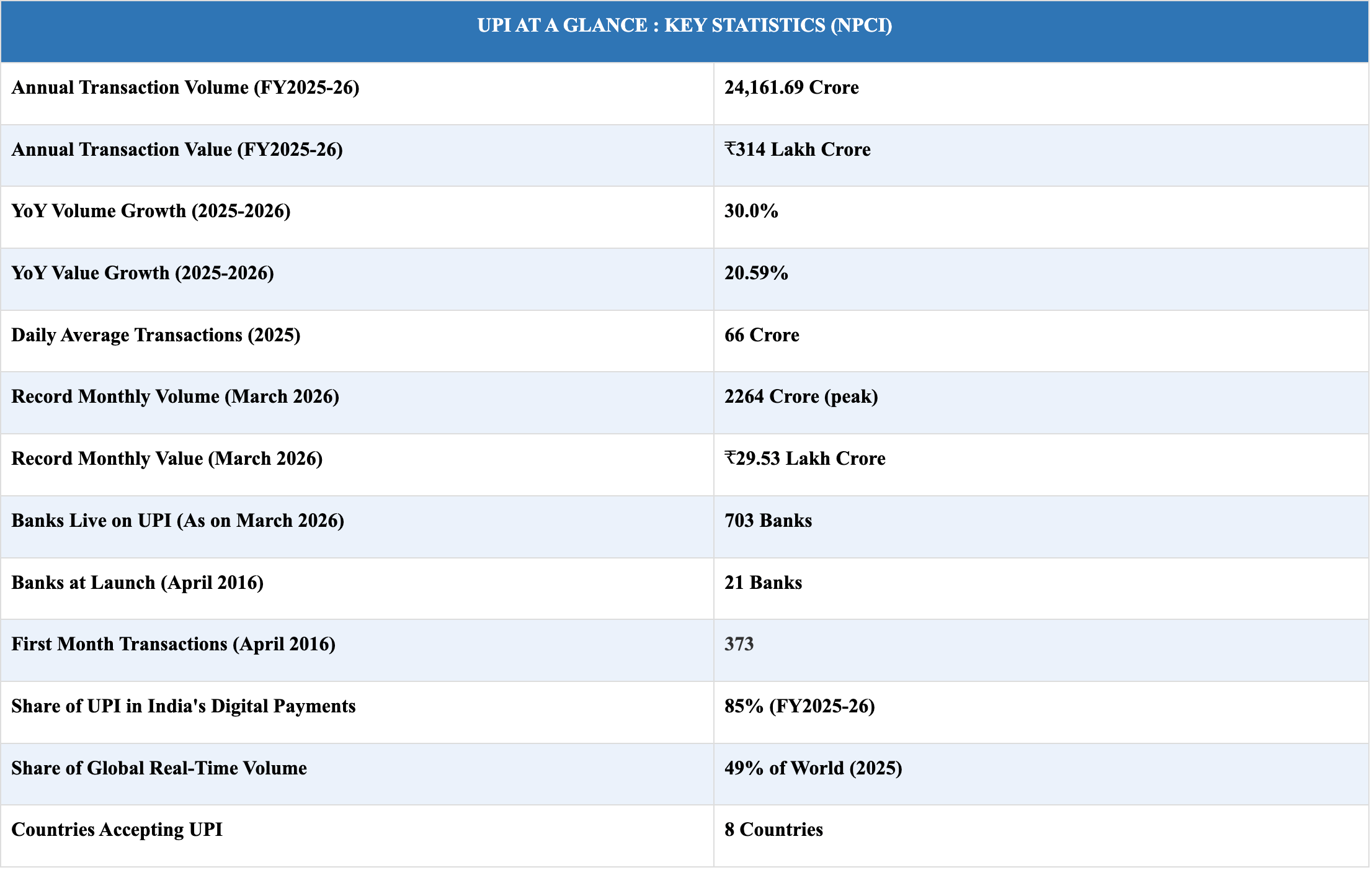
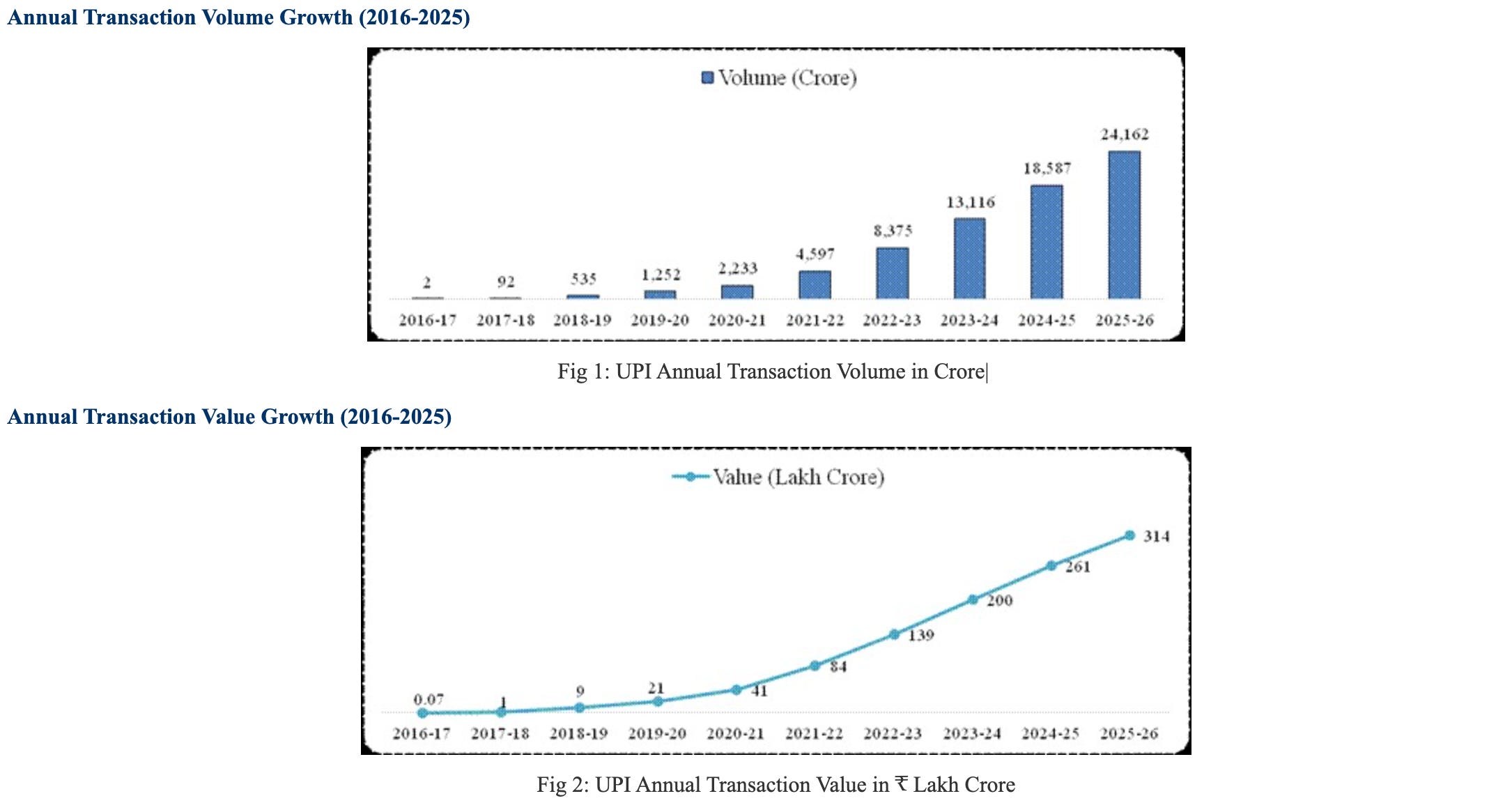
The scale is nothing short of extraordinary. During FY2025–26, Indians made 24,161.69 crore UPI transactions, collectively moving an astonishing ₹314 lakh crore across the network.
Did You Know?
UPI now processes nearly 66 crore transactions every single day. That means, on average, more than 7,639 payments happen every second.
In FY25-26, UPI transactions volume have reached a robust growth of 30%, with 20.5% growth in transaction value. Refer to the below graphs for YoY change in the volume and value of the UPI.
If we talk about UPI market share, the statistic reveals just how concentrated the UPI ecosystem has become. Although dozens of UPI apps are available in India, the overwhelming majority of transactions are handled by just a handful of players.
As of June 2026, the market share by transaction volume is:
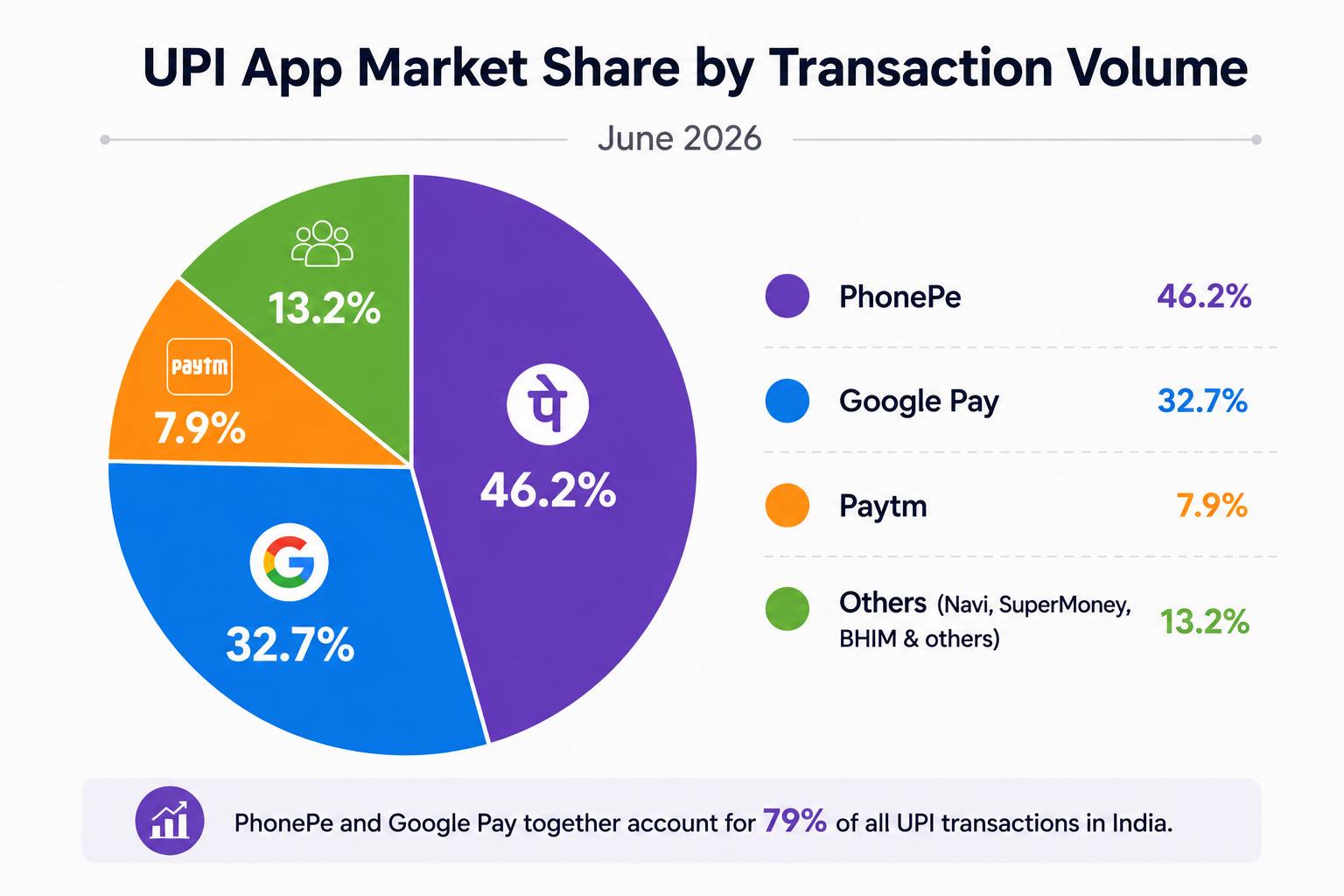
Together, PhonePe and Google Pay process nearly 79% of all UPI transactions in India. In other words, almost four out of every five UPI payments made in the country are processed through just these two apps.
Perhaps the most remarkable statistic is this — UPI now accounts for nearly 85% of all digital retail payments in India. In less than a decade, it has evolved from a new payment system into the country’s default way of paying.
This isn’t simply the success of a payment app or a banking product.
It’s the success of an entire digital payments infrastructure that quietly powers millions of businesses and hundreds of millions of consumers every single day.
Every UPI transaction relies on secure data centres, banking infrastructure, fraud detection systems, cybersecurity, software development, customer support, and continuous monitoring. Thousands of servers and banking systems work together every second to ensure that millions of payments are completed safely and instantly.
All of this costs money.
So if Jay isn’t paying, who is?
The answer is that there isn’t just one payer. The cost of keeping UPI free is shared across multiple participants because each of them benefits from a larger and more active digital payments ecosystem.
One of the biggest reasons UPI feels free is because of a conscious policy decision taken by the Government of India.
In January 2020, the government removed the Merchant Discount Rate (MDR) on UPI transactions. Before that, merchants typically paid a small fee whenever they accepted digital payments. By bringing MDR down to zero, the government ensured that neither customers nor merchants had to worry about transaction charges while using UPI.
But removing MDR didn’t eliminate the cost of processing payments.
It simply shifted the responsibility elsewhere.
To support the ecosystem, the government introduced the Incentive Scheme for Promotion of RuPay Debit Cards and Low-Value BHIM-UPI Transactions, under which it compensates banks and other ecosystem participants for processing eligible merchant transactions.
The scale of this support is remarkable.
FY2021–22: ₹1,389 crore disbursed
FY2022–23: ₹2,210 crore disbursed
FY2023–24: ₹3,631 crore disbursed
FY2024–25: ₹1,500 crore disbursed
FY2025–26: ₹2,196 crore Budget Estimate
FY2026–27: ₹2,000 crore Budget Estimate
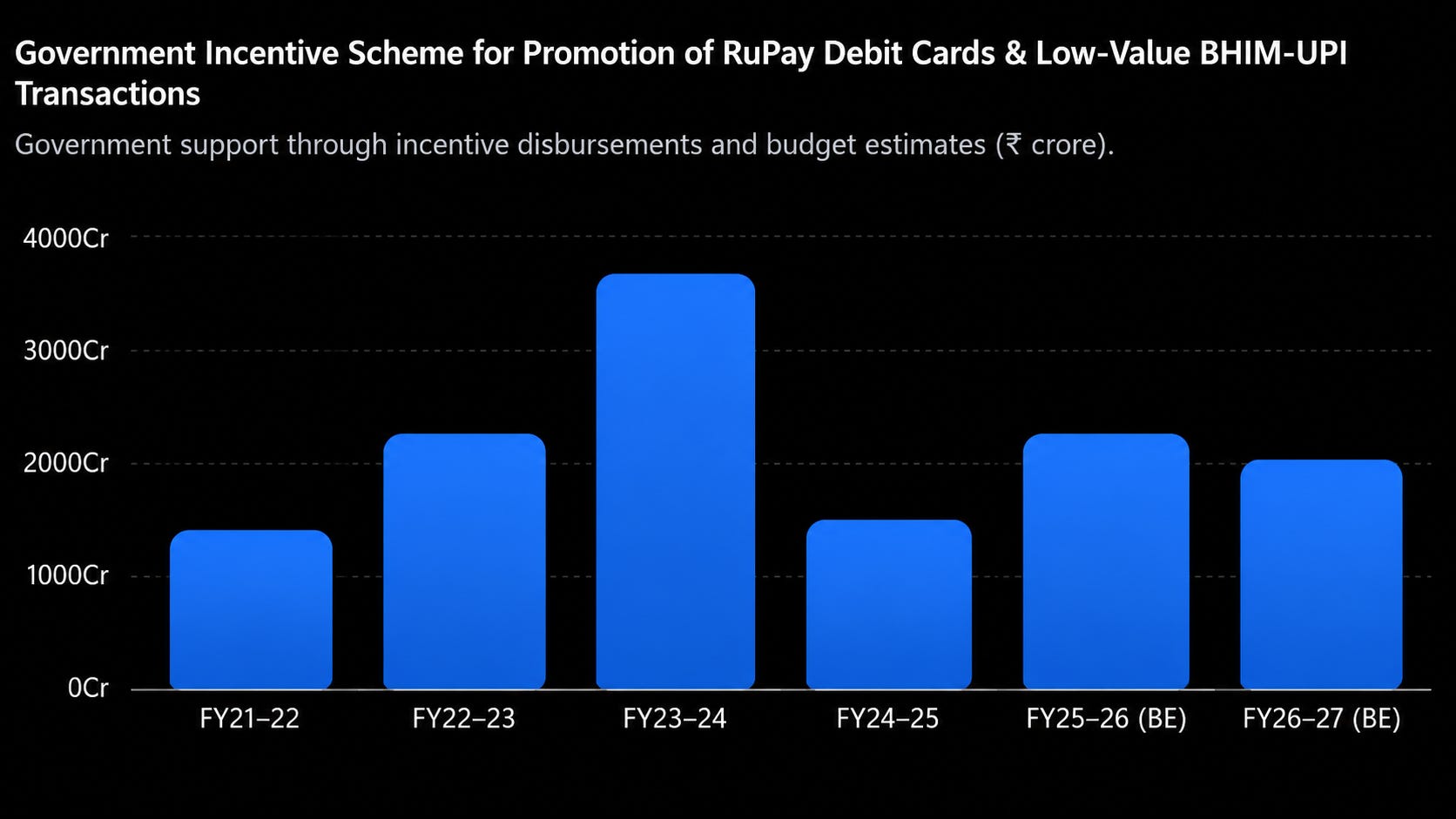
These incentives are distributed among acquiring banks, issuing banks, PSP banks, and other participants involved in processing eligible low-value merchant transactions.
In other words, every time millions of Indians scan a QR code without paying a fee, the government is quietly helping fund the infrastructure that makes those transactions possible.
Banks also bear a significant share of UPI’s operating costs.
Every time customer scans a QR code, his bank verifies his UPI PIN, checks his account balance, performs fraud detection, communicates with NPCI, authorises the transaction, and settles the payment, all within a matter of seconds.
Maintaining this infrastructure requires continuous investment in technology, cybersecurity, servers, compliance, and customer support.
So why are banks willing to bear these costs?
Because UPI has become one of the most powerful customer-retention tools in Indian banking. The more frequently customers use their bank account for daily payments, the more likely they are to continue using the same bank for salaries, savings, fixed deposits, loans, investments, and other financial services.
For banks, processing UPI payments isn’t merely a cost. It’s an investment in building long-term customer relationships.
Companies like Google Pay, PhonePe, and Paytm also invest heavily in the UPI ecosystem. They build the apps, maintain the technology, prevent fraud, handle customer support, and continuously improve the user experience.
Yet they don’t charge customer every time he scans a QR code.
Why?
Because UPI helps them acquire hundreds of millions of users. Once users regularly open these apps to make payments, companies can offer additional financial products such as personal loans, insurance, mutual funds, gold investments, credit products, and merchant solutions.
In other words, UPI isn’t their primary source of revenue. It’s their customer acquisition engine.
Finally, there is NPCI, the organisation operating the UPI network itself.
Unlike a private company focused solely on maximising profits, NPCI was created to build and operate India’s retail payments infrastructure. Its responsibility is to ensure that hundreds of banks can communicate securely, instantly, and reliably, regardless of which UPI app people choose to use.
Every successful payment strengthens the network. Every new bank that joins makes the ecosystem more valuable. Every new merchant accepting UPI makes digital payments more convenient.
That’s why UPI isn’t just another payment product. It has become a piece of national digital infrastructure, supported by the government, operated by NPCI, strengthened by banks, and expanded by payment apps.
If the Government has already spent thousands of crores promoting UPI, why not simply introduce a small transaction fee? Even a nominal charge on billions of annual transactions could generate a significant amount of revenue. So why has the Government consistently chosen to keep UPI free for users?
The answer lies in the way the Government views UPI.
UPI was never designed to become a revenue-generating platform. It was built as a piece of Digital Public Infrastructure (DPI) — a common payment network that every bank, merchant and citizen could use without worrying about compatibility or high transaction costs. The idea was simple: if digital payments became easier than cash, people would naturally adopt them.
And that’s exactly what happened. In a decade, UPI has become India’s default payment method. It accounts for nearly 85% of all digital retail payments in the country.
The benefits of this shift extend far beyond convenience.
When payments become digital, money moves directly between bank accounts, reducing the need to print, transport and manage physical currency. Merchants receive payments instantly, customers no longer need to carry cash, and government benefit transfers can be credited directly into beneficiaries’ bank accounts with greater speed and transparency.
However, that brings us to an equally important question.
Can this model continue forever?
As UPI continues to grow, so does the cost of running it. Banks must continuously invest in servers, cybersecurity, fraud detection systems, compliance, customer support, and technology upgrades. NPCI has to expand the infrastructure capable of handling billions of transactions every month. Payment apps continue investing heavily in improving user experience, preventing fraud, and acquiring new customers.
In other words, the success of UPI has also made it more expensive to operate.
This has led to an ongoing discussion within the payments industry. Many banks and payment companies have argued that processing billions of transactions without earning direct revenue from most of them becomes increasingly difficult as volumes grow. Unlike credit and debit card payments, where merchants usually pay a Merchant Discount Rate (MDR), most UPI person-to-merchant transactions do not generate a comparable source of income for the institutions processing them.
The Government, however, has taken a different view.
Its priority remains expanding digital payments across the country. Introducing transaction charges too early could discourage small merchants and consumers from using UPI, slowing the momentum that has taken years to build. For now, the Government appears to believe that the long-term economic benefits of widespread digital payments outweigh the short-term revenue that could be generated by charging users.
That doesn’t necessarily mean the ecosystem will remain unchanged forever.
Charging UPI payment was never the final objective. Building a payment system that every Indian could trust, afford, and use every day was.
Let’s go back to where we started.
Jay has paid the bill using QR and in just a few seconds, his payment has travelled through a network connecting banks, payment apps, NPCI, and sophisticated security systems. Multiple institutions have communicated with one another, verified his identity, checked his account balance, protected the transaction from fraud, and completed the payment, all before he could put his phone back into his pocket.
What’s remarkable is that none of this cost Jay anything.
Yet behind every “free” UPI payment lies an ecosystem that costs thousands of crores to build, operate, and continuously improve. Banks invest in technology and cybersecurity. Payment apps invest in products and customer experience. NPCI operates one of the world’s largest real-time payment networks. The Government continues to support the ecosystem because it sees digital payments as an investment in India’s economic future rather than a source of revenue.
Today, more than 703 banks participate in the network. Around 66 crore payments are made every single day. More than ₹314 lakh crore moved through UPI during FY2025–26, making it the backbone of India’s digital payments ecosystem.
And the story is no longer just about convenience.
UPI has helped millions of small merchants accept digital payments without expensive hardware. It has enabled instant bank-to-bank transfers for families, businesses and individuals. It has supported financial inclusion, reduced dependence on cash, and become a foundation upon which countless financial services are now being built.
The next time you scan a QR code at a restaurant, pay a cab driver, buy groceries, or purchase something from a roadside vendor, you’ll probably complete the payment in just a few seconds. But now you’ll know that behind those few seconds lies one of the most ambitious pieces of digital public infrastructure ever built by India.
And perhaps that’s the true story of UPI.
It didn’t just change how India pays. It quietly changed how India moves money.
Because in the end, the greatest technologies are the ones we stop noticing.
Like, Comment, Share, and Subscribe for more thoughtful insights on Finance.
If this article helped you better understand how UPI works, why it's free, and the invisible infrastructure powering every QR scan, consider supporting the newsletter by buying me a coffee.
Your contribution funds deeper research, clearer breakdowns, and practical financial frameworks. So you can make decisions based on logic, not emotion.
No pressure. Only if it adds value.
Have feedback, questions, or a topic you’d like Finance School to explore? Write to us at: financeschool.research@gmail.com
We read every email, and many of our best article ideas come directly from readers.
Sources:
https://www.npci.org.in/product/upi
https://www.pib.gov.in/PressReleasePage.aspx?PRID=2257087®=3&lang=2
https://www.npci.org.in/product/ecosystem-statistics/upi
https://www.pib.gov.in/PressReleasePage.aspx?PRID=2112771&lang=2®=48
No posts
Comments
Nothing yet. Say the first thing.
Sign in to join the conversation.