
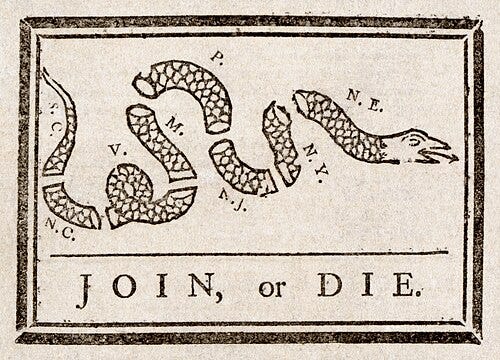
The image is so familiar it barely registers as an image anymore. A snake chopped into eight pieces, laid out head up in a curve, each segment marked with the initials of a colony, and underneath, in blunt capital letters, the command: JOIN, OR DIE. It is on flags, bumper stickers, tattoos, and the merchandise tables of every gun show and every protest, left and right, in the country. It is the first political cartoon printed in an American newspaper, and almost everyone reads it the same way, as the thirteen colonies deciding to become one nation and stand against Britain.
It was drawn to do the opposite. When Benjamin Franklin cut this snake into a woodblock in 1754, he was not calling for independence from Britain. He was calling for the colonies to bind themselves more tightly to Britain, and to go to war on Britain’s behalf. The most recognizable symbol of the American Revolution began its life as an advertisement for the British Empire. The snake has not changed since. Only the thing at the far end of it has.
Start with the year, because the year is the whole thing. Franklin published the snake in his newspaper, the Pennsylvania Gazette, on the ninth of May, 1754. That is twenty-two years before the Declaration of Independence. There was no Revolution on the horizon, no Stamp Act yet, no Boston Massacre, no tea in the harbor. The colonies were British, thought of themselves as British, and the men who would later break with the Crown were, in 1754, loyal subjects of it, including Franklin, who spent much of the next two decades trying to hold the empire together rather than leave it.
The enemy in 1754 was France. The colonies were sliding into the long, continental war that Americans would come to call the French and Indian War, the North American front of a struggle between Britain and France for control of the continent, fought with Native nations allied to both sides. Word had just reached Philadelphia that a British position on the frontier had fallen to the French. Franklin ran the snake directly beneath an editorial warning that the colonies, divided, would be picked apart one by one, while the French moved as a single force under a single command. A body cut into pieces is a dead body. Only a whole snake is dangerous.
What Franklin wanted, concretely, was a colonial union, and he had a specific plan for it. A few weeks after the cartoon ran, he went to Albany for a congress of the colonies and proposed what became known as the Albany Plan of Union. It called for the colonies to join under a single grand council, with a president general appointed by the Crown, to coordinate defense and manage relations with Native nations. This is what the snake was selling: not a nation, not independence, just a tighter imperial machine, a colonial union built to fight France better and headed by an officer of the king. Franklin’s union was a way to be better at being British.
The folklore underneath the picture is older and stranger than the politics. There was a common superstition in the eighteenth century that a snake cut into pieces would come back to life if you gathered the parts and joined them before the sun went down. Franklin was drawing on that. The image is not just a metaphor about strength in numbers. It is a clock. The colonies are the severed snake, and there is still time, but not much, to put the pieces together before dark. Assemble in time and the thing lives and can strike. Wait too long and it is simply meat drying on the road.
There is a detail in Franklin’s own writing that sits uneasily against everything the snake would later come to mean. Searching for a model of how separate peoples might bind into a lasting union, he pointed to the Haudenosaunee, the Iroquois Confederacy, six Native nations already joined in exactly the kind of union he wanted. He found it almost embarrassing. It would be a strange thing, he wrote, if six nations he was rude enough to call ignorant savages could form a durable union and a dozen English colonies could not. So the model for colonial unity was Native. And the war the snake was drawn to help win was, among other things, a war over Native land, waged by a union that would go on taking that land for the next century and a half.
In 1754, the snake failed. The Albany Plan was a rare thing, a proposal rejected by everyone at once. The colonial assemblies would not approve it, because they had no intention of surrendering their own power to a central council. And the British government would not approve it either, because a united bloc of colonies looked less like a convenient tool and more like a potential problem. Both sides looked at Franklin’s union and saw a threat to their own authority. The snake had asked the colonies to come together, and the colonies, and the Crown, both said no. The image did its work in the newspapers, was reprinted here and there, and then went quiet.
It stayed quiet for about a decade. What woke it up was not France. It was Britain.
In 1765 Parliament passed the Stamp Act, the first direct tax on the colonies, and the same colonists who had ignored Franklin’s call to unite for the empire suddenly discovered the value of uniting against it. The severed snake came back, reprinted in newspapers up and down the coast, but the enemy at the far end of it had changed. The picture that had once meant come together to fight France for the king now meant come together to resist the king’s own government. The words were often identical. Sometimes the slogan shifted from JOIN to UNITE. It was the same snake.
It kept working because it did not care. Symbols don’t have politics. They only need a target. Franklin built a nearly perfect one, a picture so simple and so charged that it could be pointed at anything and it would aim. In 1754 it aimed at France. In 1765 it aimed at Parliament. In 1774 Paul Revere set a version of it into the masthead of a Boston newspaper, and it aimed at the whole British project in America. Later, some printers added a segment for Georgia, the colony Franklin had left off, and gave the snake its thirteenth piece. The snake will serve whoever picks it up. That is the whole design.
Franklin himself ended up on the opposite side from where the snake started. The man who drew it in 1754 to strengthen the empire spent the 1760s in London as a colonial agent, still trying to keep the empire whole, still a loyalist by temperament. What turned him was personal. On the twenty-ninth of January, 1774, hauled before the Privy Council in the room called the Cockpit, he stood in silence for the better part of an hour, in a full suit of spotted Manchester velvet, while the solicitor general Alexander Wedderburn tore into him before a jeering crowd of officials, branding him a thief and an incendiary. Franklin did not move a muscle of his face. He went home a revolutionary. Four years later, as the story goes, he wore that same velvet suit to sign the treaty of alliance with France, the deal that would help destroy British power in America. By the time he put his name to the Declaration in 1776, he had traveled the same distance his snake had, from a man arguing for union under the Crown to a man signing the document that dissolved it. The difference is that Franklin changed his mind. The snake never had one to change.
So this is the object. A woodcut of a chopped snake, drawn by a loyal British subject in 1754 to fight France for the empire, picked up a decade later and turned, without altering a single line, against the empire itself. The old folk deadline still ticks under it, join before the dark or die in the dust. The country simply walked around to the other side and found that it pointed just as well the new way.
We remember it as the picture of Americans deciding to become Americans. It was first the picture of Americans deciding to be better Englishmen. The snake does not know the difference, and it never did. It only knows that the pieces are apart, and that the sun is going down, and that there is still, for a little while, time to join.
No posts
Comments
Nothing yet. Say the first thing.
Sign in to join the conversation.