
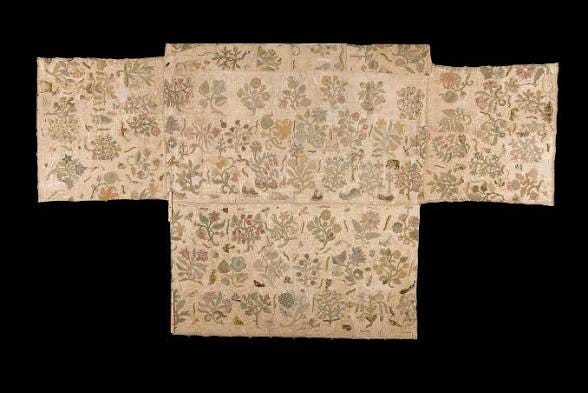
For four hundred years there was a piece of embroidered silver cloth on the altar of St Faith’s Church in Bacton, a village in Herefordshire near the Welsh border. It was old and it was obviously fine, and the parish knew it. Local tradition held that it had something to do with Blanche Parry, who had been born in the village and had gone to court, and something to do with the Queen. Villages hold these stories about themselves. They are usually wrong.
In 2015 a curator named Eleri Lynn went to look at it, and it was not wrong.
What Lynn found was a piece of cloth of silver, meaning silk woven with real silver thread, embroidered all over with flowers and animals in coloured silks and gold. She could see, in the way it had been cut and pieced, the shapes of a bodice, sleeves, and two sections of a skirt. Somebody had taken a dress apart and sewn the good parts flat.
The material alone narrows the field of possible owners to almost nobody. Tudor sumptuary laws regulated who was permitted to wear what, and cloth of silver sat at the very top, restricted to the monarch and the highest ranks of the nobility. The point was not taste. The rule existed to stop people looking like they outranked their station, and it was enforced. The silver in this one surviving panel would have been worth a substantial house.
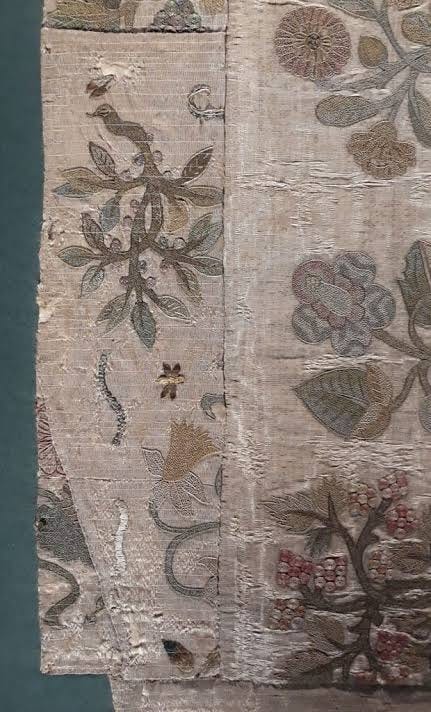
The embroidery is the part that unsettles specialists. Ordinarily a motif of this complexity would be worked on linen and then applied to the expensive fabric, because a slip of the needle on cloth of silver ruins something irreplaceable. On this dress the embroidery was worked directly through the silver. Whoever did it was not planning to make a mistake.
And the materials are not local. The silk itself is almost certainly Italian. The red of the Tudor rose was tested and found to be cochineal from Mexico, one of the first luxury goods to cross the Atlantic, and the blue is Indian indigo, which came through Portugal. Somebody sat and stitched a caterpillar, a stag, a frog, a bear, a fish, and a spray of flowers into a garment for a woman who was in the process of sending ships to all of it.
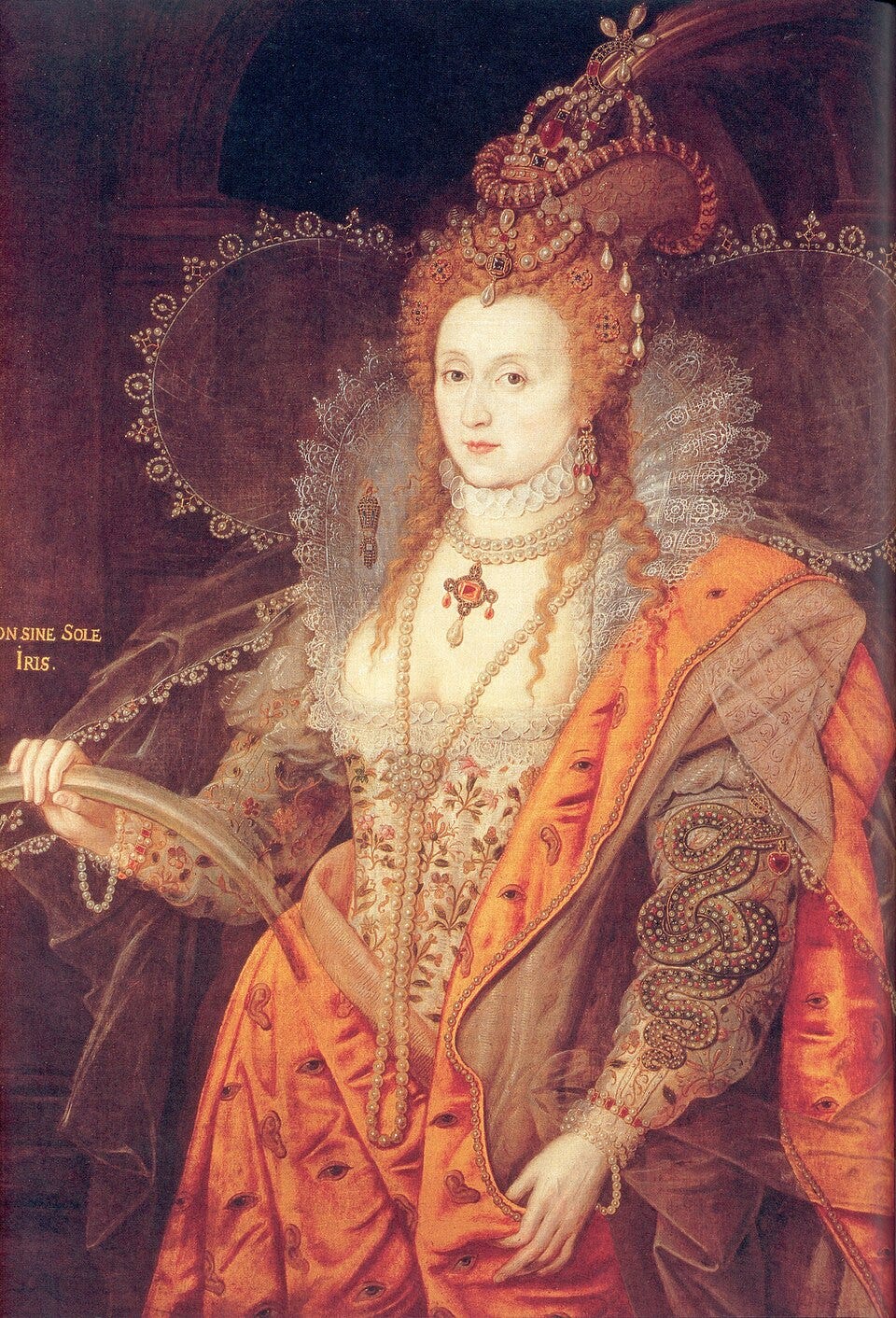
Then there is the Rainbow Portrait. Painted around 1600 by Marcus Gheeraerts the Younger, it shows Elizabeth ageless and orange-haired in a bodice covered with exactly this kind of flowering embroidery, of exactly this quality, in the same style and the same period. It is not proof. It is the strongest circumstantial match anyone could ask for.
The dating is tight for other reasons too. The floral style belongs to the 1590s, before the scrolling stems that came in under the Stuarts, and only the inventories from the latter part of Elizabeth’s reign list garments this expensive in her possession. The object sits precisely in the window where it would have to sit.
Historic Royal Palaces now describe it as almost certainly the only surviving garment worn by Elizabeth I.
Which raises the obvious question, because she owned thousands.
The Wardrobe of Robes was an enormous institution. Inventories run to hundreds of gowns, kirtles, doublets, forepartes and sleeves, many of them arriving as New Year gifts from courtiers who understood exactly what buying favour cost. And essentially none of it survives, from any English monarch of the period. It was not lost. It was consumed.
Court clothing was not archived. It was worked. Gowns were unpicked and remade, sleeves detached and paired with new bodices, trimmings moved from one garment to the next as fashion moved. Fabric was given to servants as part of their wages, and they sold it or cut it down. And at the end of the line, cloth woven with precious metal had a final use: burning. You could set fire to the silk and recover the silver from the ash. A dress like this had a scrap value that made destroying it a rational decision.
So the wardrobe of the most painted woman of the sixteenth century went into the fire, and into other people’s clothes, and into ash. What survived is the one piece somebody decided was too sacred to burn.
How it got to Bacton is where the record thins out. Blanche Parry was born there around 1508, and she went into the household of the infant Elizabeth and stayed for fifty-six years, rising to Chief Gentlewoman of the Privy Chamber and Keeper of Her Majesty’s Jewels. She never married. She was the longest-serving person in Elizabeth’s life. She died in 1590, and her monument stands in St Faith’s, showing her kneeling before the Queen.
The embroidery dates to the 1590s, which means Blanche was probably already dead when the dress was made, so the neat version, that Elizabeth gave it to her friend, does not quite work. The likelier reading is that it was sent to Bacton after Elizabeth’s death in 1603, during the strange three-week interval before James was proclaimed, when the household was being broken up and the women of the bedchamber were dividing what was left. Somebody sent a queen’s dress to a country church in memory of a woman from that village who had spent her whole life in that queen’s rooms.
Nobody wrote down who. That decision, the single act that preserved the only surviving garment of Elizabeth I, was made by a woman whose name is not recorded, on grounds we can only guess at.
At Bacton it was cut up and laid on the altar. It stopped being a dress. It became furniture, in a building where nothing much happened for four centuries, and that is exactly why it is still here. It was not stored, catalogued or protected. It was demoted into something too holy to burn and too ordinary to steal, and it sat there through the Civil War, the Restoration, the Georges, two world wars, and several generations of parishioners who put candles near it.
It took a thousand hours of conservation to stabilise. It hung at Hampton Court in 2019 beside the Rainbow Portrait, the painting next to the cloth, the image next to the thing itself.
The rest of the wardrobe was worth too much to keep. This one was saved by being made worthless, sewn flat and forgotten on a table in a village of a few hundred people, which turns out to be the safest place in England to leave something you cannot afford to lose.
No posts
Comments
Nothing yet. Say the first thing.
Sign in to join the conversation.