
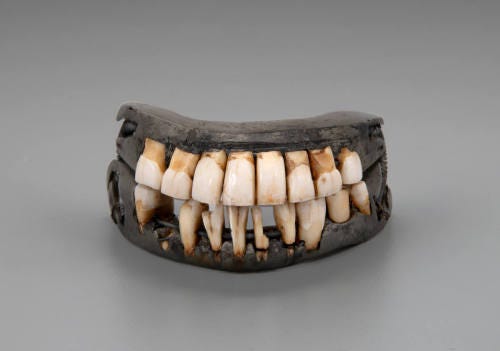
You learned this one as a child. George Washington had wooden teeth. It comes packaged with the cherry tree and the silver dollar across the Potomac, the small harmless facts that make a founder feel folksy and reachable, a great man with a homely little flaw. Wooden teeth. You can almost picture him whittling them himself.
They were not wooden. There is not a single wooden tooth anywhere in the story, and there never was. The myth probably comes from the way stained ivory darkens and grains over time until it looks like wood, which means the folksy version is not even a misunderstanding of the object. It is a misreading of the object’s decay, prettied up into a bedtime fact.
Here is what the surviving set at Mount Vernon is actually made of. Hippopotamus ivory, carved for the base. Animal teeth, horse and cow. A lead foundation to hold it together. Brass and gold fittings, metal springs. And human teeth, set into the ivory, fixed with gold pins. This was one of at least four sets he wore, and by the time he was inaugurated in 1789 he had exactly one natural tooth left in his head. The most recognizable face in the country, the one now on the money, was working with a mouth almost entirely rebuilt from other creatures and other people.
The human teeth are the part the wood was covering.
In May of 1784, Washington’s plantation manager Lund Washington made an entry in the account books at Mount Vernon. Under the heading of cash paid on the General’s account, he recorded a payment to enslaved people for nine teeth. The going rate a good dentist advertised to free sellers at the time was around two guineas a tooth. Washington paid about six pounds for nine, a fraction of that, for teeth pulled from the mouths of people he owned.
Read the entry the way it was written and the horror is in how ordinary it looks. It sits in the ledger in the same clerical hand, under the same kind of heading, as the payments for chickens and eggs and garden produce that Washington also bought from the enslaved. Nine teeth, six pounds, on account. A line item. The bookkeeping does not flinch, because good bookkeeping never does. It records that a transaction occurred and declines to record that it was monstrous.
The archive protects him twice.
The first protection is the names. The people who gave up those nine teeth are not named. They are “Negroes” in the ledger, a category, a payee with no identity, and so we cannot tell you whose teeth these were, how old they were, whether the extraction was done by a dentist or a plantation hand, or what the loss of them cost a person who still had to work a full day with a torn-up mouth. The record keeps Washington’s accounts in perfect order and keeps the people in his accounts perfectly anonymous. That is not an accident of the era. That is what the accounting was for.
The second protection is subtler, and it is the reason careful historians will not let you say the simple viral sentence “Washington wore his slaves’ teeth” as flat fact. The 1784 entry notes the teeth were purchased on account of his dentist, a Frenchman named Le Mayeur, which Mount Vernon reads to mean they went into the dentist’s general supply for his patients, not necessarily into Washington’s own mouth. And the surviving dentures that contain human teeth were built a few years later, with no paper trail proving that these specific teeth traveled from those specific people into that specific device. So there is a gap. A real one. The ledger records the purchase and then loses the teeth, and we cannot follow them the last few inches to his jaw.
The gap is worth staring at instead of papering over, because the gap is the object. This is what the archive does around powerful men. It writes down enough to balance the books and not one word more. It confirms he bought teeth from enslaved people at a cut rate. It confirms the dentures hold human teeth. Wealthy denture wearers of his moment routinely wore teeth bought or taken from the enslaved and the poor, a known and unremarkable practice. All of it lines up, and then, at the final step, the record goes quiet and leaves the country a little pocket of uncertainty it can keep like a keepsake. Maybe not his. Maybe those teeth went to some other patient. Maybe.
What is not uncertain is the shape of the thing. A white body was made presentable using pieces of Black bodies, bought below cost, entered in a book, and left unexplained. Whether the specific nine crossed the specific inch into his specific mouth is the one detail we are allowed to be unsure about, and it is remarkable how much comfort the whole culture has managed to extract from that one permitted doubt.
The dentures are the founding in miniature. A figure kept upright and presentable and fit to be looked at, running on the uncredited use of people he owned, all of it carefully recorded and none of it truly faced. And it is all still there in the object, the ivory and the lead and the human teeth pinned into place, sitting in a case in Virginia. He wrote it down. That is the astonishing part. He kept such meticulous books that the evidence against him survives because of his own hand. The habit that damns him is the one that kept the proof.
There is a coda, and it happened recently, and it is almost too neat. A few years ago the gift shop at Mount Vernon sold a refrigerator magnet of the dentures. The little label on the packaging described them as made of ivory and human teeth. It did not mention that the humans were enslaved. A historian saw it, photographed it, and said so publicly, and Mount Vernon pulled the magnet from its shelves.
Sit with what that magnet was. A souvenir of the object, sold a short walk from where the teeth were taken, that reproduced the dentures and reproduced the erasure at the same time, right down to the phrasing. Human teeth, it said, the exact two words the ledger used to keep a person from having a name. The object exists to record what was done to those people. The merch existed to sell the object with that record quietly removed. More than two centuries apart, the same edit, made by the same kind of institution, for the same reason, which is that the truth of the thing is bad for the room it hangs in.
They stopped selling the magnet. The teeth are still in the dentures. The names are still not in the book.
No posts
Comments
Nothing yet. Say the first thing.
Sign in to join the conversation.