
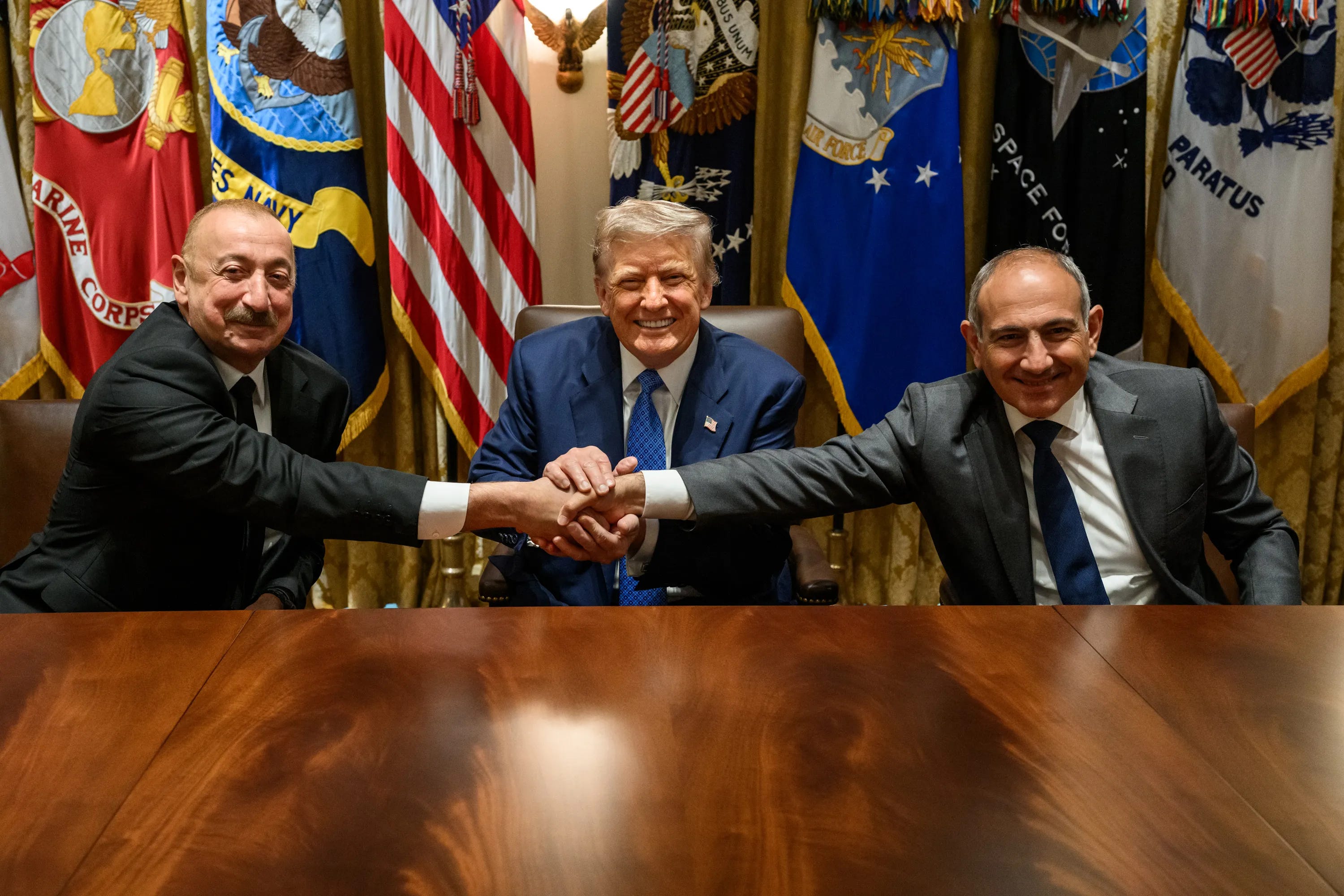
On 8 August 2025, after more than three decades of conflict over Nagorno-Karabakh, Azerbaijani President Ilham Aliyev and Armenian Prime Minister Nikol Pashinyan signed a joint declaration in Washington in Donald Trump’s presence. Their foreign ministers initialled the peace agreement. The declaration also launched work on TRIPP (Trump Route for International Peace and Prosperity), a transport link through Armenia connecting Azerbaijan with the Nakhchivan exclave, while respecting Armenia’s sovereignty and jurisdiction.
I have to admit: a year ago, I was surprised.
After years of negotiations, failed meetings, and peace talks that seemed to produce little more than another round of meetings, Donald Trump managed to get Nikol Pashinyan and Ilham Aliyev into the White House and produce something that had repeatedly eluded the EU, the former administration in Washington, and everyone else who had tried before.
I remember watching the two leaders that day. They looked nervous about being in the White House, then started joking together to break the tension. It was an oddly human moment in a conflict that had spent decades producing almost the opposite.
Since then, I have heard the word peace everywhere.
I follow Azerbaijan mostly from a distance, but I have listened to both Nikol Pashinyan and Armenia’s foreign minister, Ararat Mirzoyan, in person, in Armenia and in Poland. Wherever I heard them, the message was the same: peace was the achievement, peace was the priority, peace was the future. After a while, there was almost too much peace in the air.
And I kept wondering: what exactly are we calling peace?
There is still no signed and ratified treaty.
So, a year later, I decided to ask a more basic question: if this is not yet a formal peace, is it at least behaving like one?
The answer, surprisingly, is yes.
There has been no return to fighting. Neither side is trying to change the new reality by force. Instead, both governments are beginning to build their relationship as if this time the new reality is here to stay.
The border is being mapped out, slowly, painfully, but unmistakably. Officials meet directly. Trade has started. Azerbaijan is supplying Armenia with fuel. Legal and investment arrangements are being prepared around TRIPP, the planned transport link through southern Armenia.
None of this is a peace treaty. But it is no longer just a ceasefire either. What Armenia and Azerbaijan have been doing over the past year tells us something more interesting: they are beginning to organise their relationship around the assumption that the war will stay stopped.
What happens outside government offices is harder to see. But if we are asking whether this is really peace, that is where we should look next, at the societies that have to live with it. In Armenia, there are already some signs of movement. By February 2026, security and border issues had become much less important to Armenians. Comparable independent polling from Azerbaijan is largely unavailable.
And frankly, I would be suspicious of anyone expecting reconciliation after three decades of conflict to happen within twelve months. Governments can change their language overnight. Societies do not.
That leaves the problem of dependency, and with it the bigger question of what happens next.
The peace is still unfinished, and still depends heavily on the people who made it happen.
Pashinyan won Armenia’s June election with 49.8 per cent of the vote and a parliamentary majority. He now has five years to turn the current political course into something more permanent: through constitutional reform, the implementation of TRIPP and the growing network of economic and institutional links around the new regional order.
The logic is straightforward. The more interests, institutions and legal commitments are tied to the new reality, the harder it becomes for a future government to simply undo it.
The calculation is different in Baku. Aliyev is an authoritarian leader facing no credible challenge to his hold on power, making Azerbaijan’s course easier to predict. For him, the Zangezur Corridor (TRIPP) and Armenia’s constitutional changes matter more than the ceremony of signing a treaty. For Aliyev, the priority is clear: secure Azerbaijan’s key interests in the new regional order while reinforcing his own grip on power.
But the peace does not depend on the two regional leaders alone.
Trump is a third variable.
The US has moved beyond the role of mediator. American political backing, investment plans and the president’s personal involvement are now part of the process itself. Trump has reasons of his own to keep it alive. It is a foreign-policy success he can point to, and a useful piece of evidence for his favourite argument: that deals can achieve what years of diplomacy cannot.
That makes Washington important. It also makes the process vulnerable.
What happens when American attention moves elsewhere?
The EU can support the process, but I am not convinced it can replace Washington’s political weight. Russia has lost influence in Armenia, but not its interest in the country. Strong Armenia, the largest new opposition force in parliament, has given Moscow a potential new opening. Whether it becomes a political vehicle for Russian influence is still an open question.
So, is this peace? I am still not sure. But after a year, Armenia and Azerbaijan are increasingly acting as if they expect it to last. The question now is whether the peace can outlive the politics that produced it.
The South Caucasus is more than a regional story. It is a window into the forces reshaping international politics, from democratic backsliding and geopolitical rivalry to the difficult choices facing small states. If you want to understand today’s world, start here.
If you’re looking for in-depth reporting, analysis, and webinars on the South Caucasus, find my channel on WA.
No posts
Comments
Nothing yet. Say the first thing.
Sign in to join the conversation.