
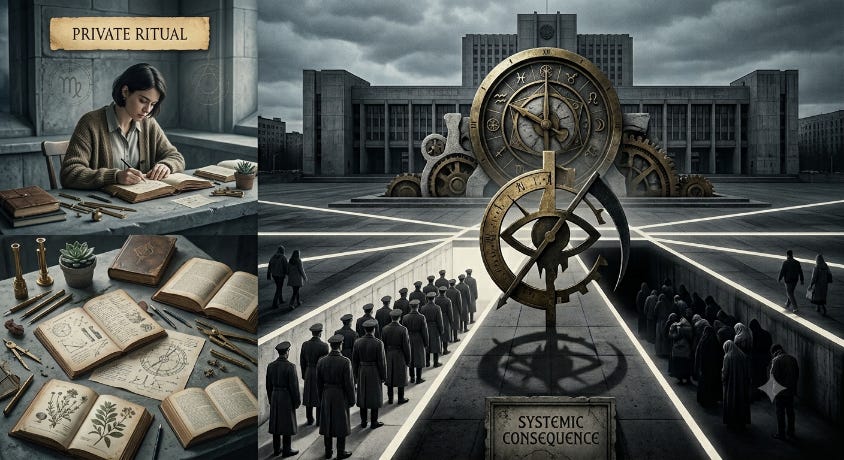
There is a reassuring little argument that surfaces whenever a skeptic complains about pseudoscience, and it goes like this: “lighten up.” So your aunt reads her horoscope over breakfast, your neighbor keeps a bowl of amethyst on the windowsill to “cleanse the energy,” and a surprising number of otherwise sensible people will not schedule surgery during a Mercury retrograde. Where’s the harm? Nobody’s forcing you to join in. Life is hard and strange, let people have their little comforts.
I don’t have a lot of sympathy for this attitude. While it is true that much private, low-stakes pseudoscience is fairly harmless, there’s also mounting evidence that accepting beliefs without warrant reduces critical thinking and makes one more inclined to believe further nonsense. But even if we grant the harmlessness hypothesis, the argument has a hidden premise: that pseudoscience remains private and voluntary. Change those two variables, make it public and make it coercive, and the comfortable little horoscope grows teeth. Unfortunately, the historical record on this point is not ambiguous: it is a mass grave.
Before we proceed, a few words about definitions, because the word “pseudoscience” gets thrown around as a generic insult and deserves better. Pseudoscience is not simply “science that turned out to be wrong.” Being wrong is the ordinary condition of science and indeed error, honestly acknowledged and corrected, is the very engine of the whole enterprise. Nor is pseudoscience merely “stuff I find implausible.” The distinction I have defended at length elsewhere is that pseudoscience is a body of claims that borrows the costume of science, the vocabulary, the confident tone, the gestures toward data and studies, while at the same time lacking its substance: genuine responsiveness to evidence, openness to disconfirmation, and the machinery of self-correction.
There is no single litmus test that cleanly separates the two. Philosopher of science Larry Laudan infamously declared the “demarcation problem” dead back in 1983, and he had a point against the old dream of finding a single necessary-and-sufficient criterion (Popper’s falsifiability, say). Things are just not that simple in the real world. But the better response, which some colleagues and I have argued, is that demarcation survives as a cluster concept, a family resemblance. Pseudoscience characteristically cherry-picks confirming cases, insulates its core claims from refutation with endless ad hoc rescues, mistakes the accumulation of anomalies for the persecution of heretics, and treats the scientific consensus not as a provisional best estimate but as a conspiracy to be exposed. Not one of these is decisive, but together they form a recognizable syndrome.
In this essay I wish to explore what happens when pseudoscience gets power, specifically the power of governments. Unfortunately, as soon as we start talking about politics most people immediately confuse it with partisanship. They are not at all the same thing. Indeed, it is precisely because I wish to positively engage in politics (i.e., the improvement of our polis) that I will draw examples from the entirety of the political spectrum, to show that pseudoscientific nonsense is dangerous no matter what the source.
The key point to keep in mind for what follows, then, is that what makes a claim pseudoscientific is structural, how it relates to evidence, not political.
The graveyards of the twentieth century
For once, let’s skip the deep past: the alchemists and astrologers of antiquity operated without CDCs and five-year plans, and the state was rarely in a position to enforce their errors on millions. The more instructive cases are recent, and they are horrifying precisely because they are modern, bureaucratic, and equipped with the full apparatus of the state.
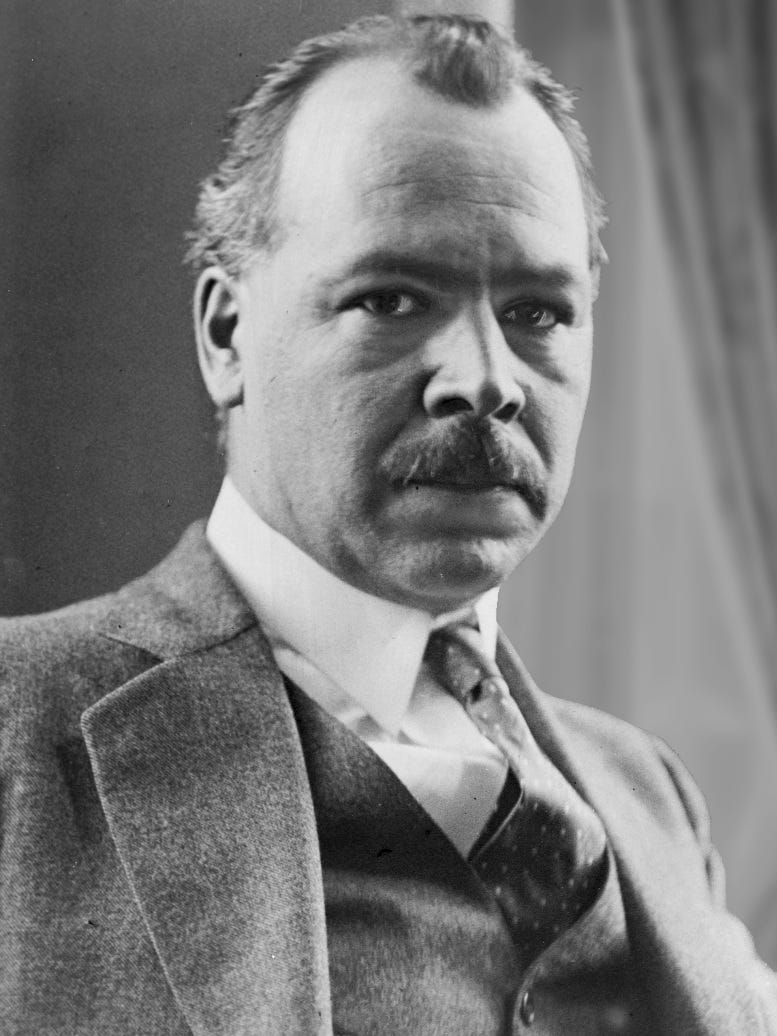
Lysenkoism is arguably the canonical example, and note well: it was a phenomenon of the left. Trofim Lysenko, an agronomist with a peasant’s touch and a demagogue’s instincts, rejected Mendelian genetics as “bourgeois” and “idealist,” insisting instead that acquired characteristics could be inherited and that crops could be trained, almost re-educated, to thrive. This was not merely a bad theory, it was a bad theory with Stalin’s seal of approval on it. During Lysenko’s ascendancy, genetics was banned as a discipline in the Soviet Union. Nikolai Vavilov, one of the great botanists of the century, was arrested and died in prison of starvation, an irony too bitter to be fiction. Soviet and later Chinese agriculture, reorganized around Lysenko’s fantasies of close planting and deep plowing, contributed materially to famines. When Mao imported the doctrine during the Great Leap Forward, the resulting agricultural catastrophe killed tens of millions. That is what a pseudoscientific theory costs when it is protected not by evidence but by power.
Nazi science supplies an example from the other end of the political spectrum, lest anyone imagine this is a communist specialty. The regime denounced relativity and quantum mechanics as “Jewish physics” and promoted a nationalist Deutsche Physik in their place, driving out precisely the talent (Einstein among them) that might have won them the war. Himmler was an enthusiast of the World Ice Theory, a cosmological crank doctrine holding that the universe was essentially made of ice. And of course the deadliest pseudoscience of the century was Nazi race “science,” a vast pseudo-biological edifice of measurements and typologies that provided the intellectual architecture for genocide.
Comments
Nothing yet. Say the first thing.
Sign in to join the conversation.