
This is an ongoing series on Epictetus’s Discourses, a book that literally changed my life and that, I think, is grossly underestimated nowadays, despite Epictetus’s major influence throughout the Middle Ages up to the Enlightenment and the founding of the American republic. Read what follows with an eye to its practical applications, the Master would have thrown you out of his school if he thought you were doing philosophy as a purely theoretical exercise! In these essays I’m using Robin Waterfield’s annotated translation. Two good public domain versions are collected in the Delphi Classics edition. Previous entries can be found by consulting the Figs in Winter Index.
_____
One of the problems with practicing philosophy is that people tend to expect the wrong thing from the practice. We constantly hear of nonsense along the lines of “do Stoicism to be a winner” or “to become rich,” or “to become famous.” As if any of the above were the actual goals of Stoic philosophy. Even more modest achievements, like developing a lasting happy relationship with your partner, or getting on a satisfying career path, are outside of the scope. Which is why when some of my students’ parents ask how much money their daughters and sons will make if they major in philosophy I have to explain to them that that’s precisely the wrong question.
One day someone with a similarly misguided, yet sincere attitude, approached the Master:
“[He] asked Epictetus to tell him how he could get his brother to stop being angry with him, [to which Epictetus] said, ‘Philosophy doesn’t promise to help anyone get anything external.’
‘What about my brother’s life, then?’
‘Again, that’s the material for his art of living, but as far as your art of living is concerned, it’s an external, like farmland, health, and popularity.’” (Discourses 1.15.1-3)
Epictetus always insisted that the fundamental rule of his philosophy is that some things are up to us and others are not up to us, and that a smooth life follows from focusing our attention on the first category while at the same time developing an attitude of equanimity toward the second one.
Your brother’s anger is up to him, not to you, therefore – says the Master – you should treat it accordingly, as an external, akin to things like property, health, and fame.
What, then, is up to us?
“‘Under all circumstances, I shall keep the command center aligned with nature.’ Whose command center? ‘That of the individual in whom I am to be found.’” (1.15.4)
The “command center” is what Marcus Aurelius calls the hegemonikon, the seat of the most crucial human faculty: prohairesis, the faculty of judgment. While the ancient Stoics were mistaken in thinking (together with Plato and Aristotle) that the hegemonikon is located in the heart (Galen, Marcus’s personal physician, harshly corrected them), they were right that there is such thing as a command center of our conscious faculties. It’s what modern neuroscientists call the executive functions of the brain.
These functions are more or less located in the prefrontal cortex (PFC), specifically its dorsolateral portion (dlPFC), which is the outermost part of the frontal lobes, roughly behind the forehead. It’s the most recently evolved and most extensively expanded region in humans relative to other primates.
It’s core functions include: working memory, that is, holding and manipulating information in the mind; cognitive flexibility, the ability to shift between tasks or mental sets; inhibitory control, which allows us to suppress impulsive or automatic responses; planning and goal-setting, making it possible to sequence actions toward a future outcome; decision-making, meaning weighing options, especially under uncertainty; and attention regulation, the capacity to direct and sustain focus.
The dlPFC doesn’t work alone, it coordinates closely with the anterior cingulate cortex (conflict monitoring, error detection) and the orbitofrontal/ventromedial PFC (emotional regulation, value-based decisions). Damage in this area, as in the classic case of Phineas Gage, tends to spare IQ and memory but devastates planning, impulse control, and social judgment, which is part of why the executive functions are treated as a distinct cognitive domain rather than just “general intelligence.”
The last function listed, attention regulation, is what Epictetus calls prosoche, often rendered as Stoic mindfulness, and he and Seneca say that nothing ever got improved by not paying attention to it, so prosoche is a particularly important aspect of the hegemonikon.
From the brief description of the modern neuroscience of the executive functions we can see just how good the ancient Stoics’ intuitions were in these matters, and also why Epictetus thought that taking care of one’s prohairesis amounts to taking care of oneself: the two are one and the same.
Notice also that equating the self with the executive functions of the brain does not make Stoic psychology essentialist, since the dlPFC is a constantly changing structure, updating itself as a result of our experiences (external inputs) and (internally driven) evaluations of such experiences. It should also make clear why it is unfair to accuse the Stoics of dualism: they were not making some kind of fundamental ontological distinction between body and mind. They, rather sensibly, saw that a relatively small part of our anatomy accounts for all our conscious decisions, the ones for which we can reasonably be held accountable. And that’s why, in an important sense, we are our prohairesis.
[Just ask yourself the following question: if you were given a choice between losing your mind and losing a leg, or an eye, which one would you choose? Why?]
Epictetus’s student, however, still wasn’t entirely convinced:
“‘So how am I to stop him being angry with me?’
‘Bring him here and l’ll talk to him, but I’ve nothing to say to you about his anger.’” (1.15.5)
While someone else’s anger is not up to us – neither to the student nor, of course, to Epictetus himself – it is very much up to us to talk to people and try to reason with them. Since the Master is more practiced than the student in this, Epictetus is basically saying, bring your brother to me and I’ll do my best. He also reminds the student that good things take time, and one should not be in a hurry to get results:
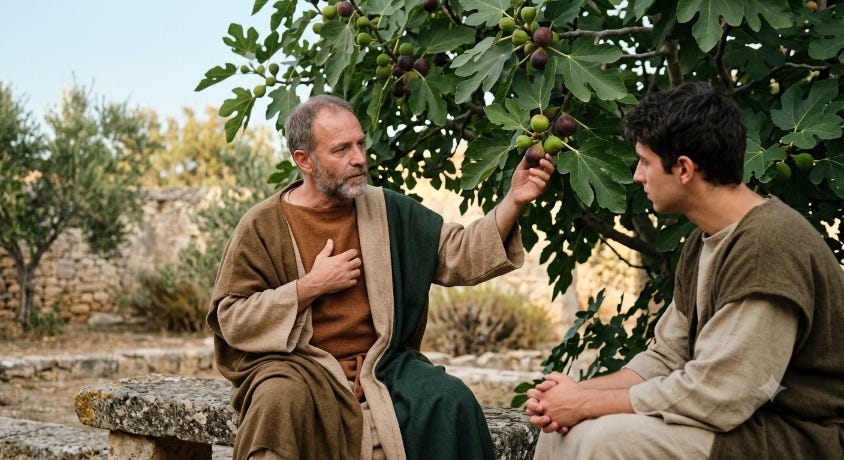
“‘Anything of any importance takes time,’ said Epictetus, ‘even a bunch of grapes or a fig. If what you were telling me now was ‘I want a fig,’ I’d reply ‘Be patient. First let the tree flower and then fruit and then wait for the fruit to ripen.’ So given that it takes time for even a fig tree’s fruit to mature, and it doesn’t happen overnight, are you wanting to get the fruit of human intelligence so quickly and easily?” (1.15.7-8)
I’ll try to remember these words the next time I find myself inclined to get impatient with one of my own students, imagining him in my mind as a yet unripened fig, which – given time, patience, and nurturing – might just become ripe and delicious to the world.
Comments
Nothing yet. Say the first thing.
Sign in to join the conversation.