
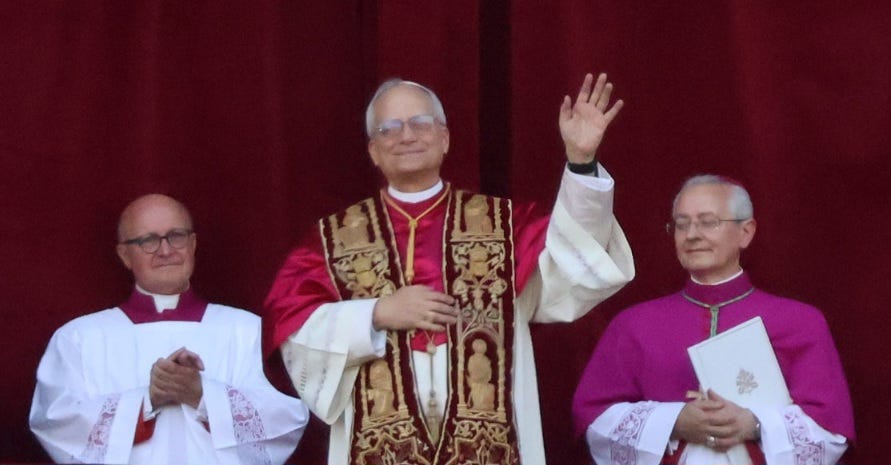
I am an atheist and a Stoic. Nevertheless, I also seek convergence with other philosophical traditions, and even religions, whenever I think we can work together. So I recently read the much publicized encyclical on artificial intelligence written by Pope Leo XIV, in order to aid my own thinking on the complex ethics of AI as well as to see just how much I might agree with someone who, though he belongs to a tradition I left when I was a teenager, seems like a very reasonable and compassionate human being.
What I intend to do in what follows is: (i) summarize the basic arguments of Leo’s encyclical; (ii) highlight where, once we strip away all the (in my mind unnecessary) religious language, I can wholeheartedly agree with the Pope; and (iii) comment on the parts where, even with the best of intentions, I need to part ways with him.
Leo’s central claims
Leo’s core move in Magnifica Humanitas (Magnificent Humanity) is to refuse the simplistic framing “should we accept or reject AI?” on the grounds that it is a category error. Technology is not, in itself, good or evil, he argues, but it is also never neutral in practice, because every system inherits the priorities of those who design, finance, regulate, and deploy it.
So the only meaningful question is whose values are embedded, toward what ends, and under whose control. The Pope deploys two architectural images: the tower (of Babel), built for self-aggrandizement, power, and homogenization, versus the city (of Jerusalem) rebuilt collaboratively, piece by piece, with shared responsibility. Such images are just a vivid way of contrasting technology that concentrates power and flattens human difference against technology that distributes agency and serves a genuinely shared good. Strip the Biblical scaffolding and you get a fairly standard (and strong) claim from the philosophy of technology: artifacts encode politics, and the politics here are trending toward unaccountable concentration.
Leo then supports his main contention with a number of arguments, which I am going to briefly summarize in a secularized fashion:
Power has migrated from states to private actors. Innovation used to be steered largely by governments, but it’s now driven by transnational firms whose resources exceed those of many states. This makes technological power harder to scrutinize or direct toward collective ends, leading to the assertion of a private power with public consequences and little democratic accountability.
AI is a tool, not a mind. Artificial intelligence imitates functions of human cognition and often beats us on speed and scale, but it has no experience, embodiment, or moral conscience, and it doesn’t understand what it produces. Leo makes a nice empirical point: these systems are “cultivated more than built,” in the sense that even their designers don’t understand their internal representations. The normative consequence is that moral judgment cannot be delegated to a calculation.
The artifact itself is not morally neutral. A system embeds choices through what it measures, ignores, and optimizes, and through how it classifies people. So ethics can’t stop at “are we using it well?,” it also has to interrogate the design and the implicit model of the person baked into the data and the objective function.
Responsibility must stay traceable. Opaque automated decisions about employment, credit, services, and reputation diffuse accountability, no one “accounts for” the judgment and it’s easy instead to blame the machine. Leo rightly wants identifiable chains of responsibility, contestability, and redress, and is willing to say that prudence sometimes means slowing down. This is not an anti-progress position, it’s responsible care.
Concentration and “new monopolies.” AI, according to the Pope, amplifies whoever already holds capital, data, and expertise. But data, arguably, is a collective product and shouldn’t be treated as private property to be sold off. Leo therefore gestures toward managing it as a common or shared good.
“Alignment” is necessary but not sufficient. Moralizing the machine is empty if the morality is set by a handful of unaccountable actors and their ethics becomes an “invisible infrastructure.” The ethical frameworks themselves must be openly contestable and subject to shared (political, not merely technical) standards. Hence the notion of “disarming” AI: freeing it from arms-race logic – military, but also economic and cognitive (i.e., the race for ever-larger models and datasets to secure dominance) – and rejecting the assumption that technical power confers the right to govern.
The transhumanist/posthumanist critique. The real issue – again according to Leo – isn’t enhancement per se but the underlying anthropology: if the human is something to be optimized or surpassed, it becomes easier to treat some lives as less worthy and to justify “necessary sacrifices” borne by the vulnerable. Against this, the Pope defends finitude – limitation, error, vulnerability, even suffering – as constitutive of a meaningful life rather than mere defects to be engineered away. His epigram “having more without being more” carries the whole argument.
Truth as a common good. Disinformation predates AI but is now massively amplified. Truth has both a rational dimension (verification, sourcing, argument) and a relational one (trust). Democracy depends on a shared “concordance with the facts” and indifference to truth corrodes it. Here Leo leans on Hannah Arendt’s point that the ideal subject of totalitarianism is the person for whom the distinction between fact and fiction has collapsed.
Education, work, freedom. AI’s frictionless answers erode the patience that genuine inquiry and judgment require, and risk de-skilling thought. Leo refers to Plato’s famous Seventh Letter, arguing that the deepest things “are learned only after much time and effort, by engaging in discussion with others, striking upon ideas and experiences together like flint until the spark of understanding is kindled within us.” Morevoer, work is not merely income but identity, relationship, and contribution and automation can de-skill, surveil, and subordinate workers to machine pace. The Pope wants social criteria attached to innovation (like retraining, participation, dignity-of-work as a success metric), and warns against the attention economy engineered to exploit vulnerability and against algorithmic social control via mass profiling.
Hidden labor and the “new slavery.” The supply chain behind frictionless AI includes data labelers and content moderators (often poorly paid, frequently women), mineral extraction (sometimes by children), and trafficking conducted through the same digital infrastructure. Leo extends talks of “data colonialism,” the extraction of health, genetic, and demographic data from structurally weak regions of the world. The demand here concerns supply-chain transparency and due diligence.
War and autonomous systems. AI lowers the threshold for force, makes killing impersonal, and reduces victims to data. Leo articulates a number of criteria to counter this trend: traceable responsibility; the imposition of a “moral timeframe” (i.e., speed must not drive irreversible decisions); strict combatant/non-combatant distinction; and a hard line that lethal or irreversible decisions cannot be delegated to opaque automated processes as meaningful human control is non-negotiable. Interestingly, the Pope declares the “just war” framework too easily abused to remain useful, and calls for international constraints on the arms race, a revival of diplomacy, and a realism that is neither idealist (selecting facts to fit a worldview) nor cynical (assuming that force always prevails).
Overall, Leo’s undergirding principles, expressed in secular form, amount to the following:
(i) Persons have worth not reducible to their productivity or output;
(ii) We need to think in terms of a common good that is more than the sum of private interests;
(iii) Resources, now including data and infrastructure, are to be shared by all rather than monopolized;
(iv) Subsidiarity: decisions need to be made as close as possible to those affected, with higher powers supporting rather than supplanting the process;
(v) Solidarity as interdependence ought to be consciously chosen;
(vi) Justice is to be pursued at the structural, not merely individual, level.
Where I agree
None of the six principles above is distinctively Catholic. That is the striking thing. When I read them stripped of their scriptural dress, I kept recognizing conclusions I had arrived at from an entirely different starting point, and not by coincidence. Here is where a Stoic atheist finds himself nodding along with the Bishop of Rome.
I suspect that most serious ethical traditions – including virtue ethical ones – would land near the above regardless of foundation. And I think this holds for the load-bearing claims. Let us briefly review:
Leo says almost verbatim that persons are ends, not means, and this is, of course, Kant’s famous formula of the categorical imperative. The dignity-vs-price distinction does the same work in Kant that “ontological dignity” does for Leo, minus the Christian metaphysics.
“Having more without being more” is nearly Senecan, and the Stoic indifference to externals gives us an independent route to the same critique of the optimization mindset. Worth is not earned by efficiency.
Judgment, says Leo, can’t be outsourced. The Stoic prohairesis, that the faculty of assent and choice, is what’s “up to us” and it maps directly onto the Pope’s insistence that conscience and freedom must guide the tools, not be displaced by them.
Leo’s encyclical is also clearly cosmopolitan in scope. Analogously, Stoic oikeiôsis extended to all of humanity arrives at the same result as his “common good” and “solidarity,” without needing a creator God.
The Stoic acceptance of mortality and necessity gives us a non-theological version of Leo’s case against transhumanism: a life without limit is not a fuller human life but a different (and arguably impoverished) thing.
Finally, the Pope quotes Tolkien: “do what is in us for the succour of those years wherein we are set” thereby reminding his readers of an essentially Stoic role-ethics whereby each of us is ethically bound to play our several roles in life to the best of our abilities.
What unites these points of contact is that none of them needs God to do its work. Kant’s persons-as-ends, Seneca’s indifference to externals, Epictetus’s prohairesis, the cosmopolitan reach of oikeiôsis – each gives me an independent road to Leo’s conclusions. Which raises the obvious question of where those roads finally fork.
Where I honestly disagree
All of the above said, there are a few passages in Magnifica Humanitas that are distinctively Catholic and will not survive into Stoic or broadly secular ethics. The roads fork in three places, and it is worth being honest about each.
There is a right-to-life passage (§55: abortion and euthanasia as “gravely wrong”) that is doctrinally specific. A Stoic, who could regard a rational exit from life as licit (e.g., Epictetus’s concept of the “open door”) would here diverge outright, as do most secular ethicists.
Also, grounding dignity as infinite in virtue of infinite divine love (§53) is irreducibly theological. The secular versions ground dignity in rational agency, sentience, or the capacity for relationship, and a thoroughgoing naturalist will treat dignity as a normative posit we have good reasons to adopt, not a metaphysical given. That’s a difference in foundation even where the conclusion coincides, but it is this coincidence that I think is ultimately of utmost interest.
Finally, Leo says that the family is “founded on the enduring union between a man and a woman” (§165), which is a conservative commitment doing no real work in the AI argument and convergent traditions don’t need it.
Notice the shape of what has emerged. The divergences, when they come, are not about AI at all: they are about abortion, the metaphysics of dignity, and the definition of the family. On the actual subject of the encyclical, the disagreement is essentially nil.
So we have an interesting situation where different traditions converge robustly on the conclusions and on mid-level principles like non-instrumentalization, suspicion of unaccountable concentrated power, non-delegable moral judgment, and the value of finitude.
At the same time, though, there is a clear divergence on foundations and on a handful of bioethical specifics. This, however, may actually strengthen my suggestion that it is worthwhile to engage in the sort of exercise I presented above, since convergence-despite-different-grounds is better evidence that the conclusions track something real than mere agreement among people who already share premises.
This is not merely an academic pleasure. The ethics of AI is being written right now, and it is being written largely by the very actors whose concentrated, unaccountable power Leo and I both distrust. In that contest, the people who care about human dignity cannot afford to be fractured along sectarian lines — atheists waiting for believers to abandon their metaphysics, believers dismissing secular ethics as rootless. When a Stoic unbeliever and a Catholic pope, reasoning from incompatible first principles, arrive at the same six conclusions about what technology owes to human beings, that convergence is not a curiosity to be noted and filed away. It is a coalition waiting to be built. The tower, after all, is already under construction. If the rest of us mean to rebuild the city instead, we had better be willing to lay bricks alongside people whose blueprints, in the margins, differ from our own.
Comments
Nothing yet. Say the first thing.
Sign in to join the conversation.