
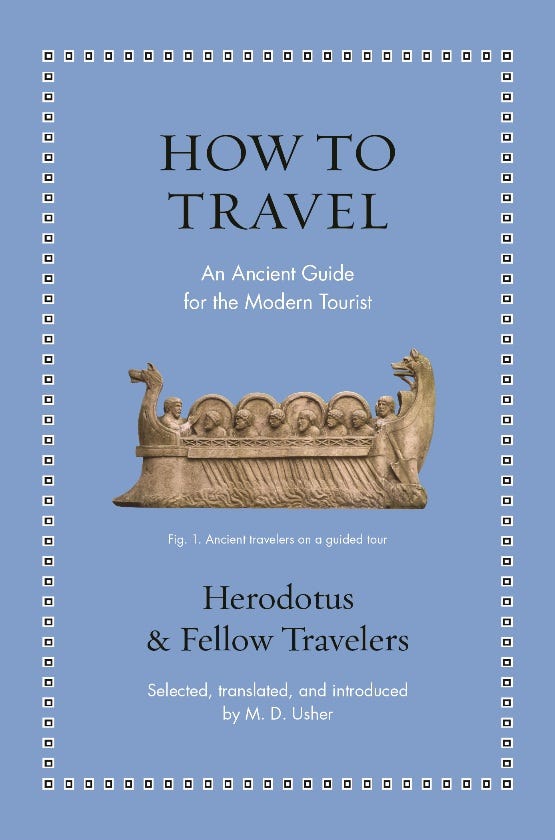
[Based on How to Travel: An Ancient Guide for the Modern Tourist, translated by Mark D. Usher. Full book series here.]
Traveling is arguably one of the oldest human activities. After all, that’s how we got out of Africa, our evolutionary cradle, and colonized the rest of the planet – for good or for ill. We live in an unprecedented era of travel: thanks to modern technology I have just returned to New York from a trip to Turin, in northwestern Italy, during which I managed also to visit the beautiful city of Verona, on the east side of the country. And then there’s virtual travel, a perhaps less satisfying but more affordable and safe type of adventure that allows us to visit the remotest places on our planet, or even get to the Moon or Mars.
How to Travel, a collection of excerpts from ancient Greco-Roman texts, is a marvel in its own right, thanks to the varied and intriguing choices made by the translator, Mark D. Usher, whom I last interviewed about Cynicism back in 2024. The goal is “to reinsert some sanity and solidity into our experience of travel,” which these days can feel a bit too predictable, canned, and commodified.
At its best, traveling isn’t about collecting an endless series of Instagram moments, but about curiosity toward how other people live and what places that are different from our home look like and feel. It’s about broadening our experience and therefore – if we’re paying attention – our minds. Usher invites us to consider that one of the major authors appearing in his collection is the historian Herodotus, whom Cicero called the father of history (though Plutarch, a bit less positively, referred to him as the father of lies…). The very word, “history,” means inquiry, and that is – at its best – what Herodotus was attempting to do: to inquire into people’s customs and motives, so as to better understand humanity itself.
While the stated goal of Herodotus’s Histories is to help explain the enmity between the Greeks and the Persians, he also says that he wants “to ensure that human achievements not be lost to time and that the wondrously magnificent accomplishments of Greeks and non-Greeks alike not go uncelebrated.”
Usher presents us two essays by Herodotus, one about pharaonic Egypt, the other about the Scythians. The two couldn’t possibly be further apart: Egypt was an ancient, sedentary, and regimented place, while the Scythians were nomads and, Usher reminds us, alarmingly violent. The contrast between the two peoples is at the same time enlightening and troublesome, and still very good food for thought for a modern mind.
A completely different essay is the one by the Stoic philosopher Seneca, who explains to his friend Lucilius why travel is no panacea to solve one’s problems. The reason is that we tend to forget that we travel carrying with us the very source of our troubles: ourselves. What we need is to work on our issues, regardless of where we happen to be, and only then we will be able to truly enjoy hopping from place to place.
We are then treated to a piece by the Roman historian Tacitus, based on a now lost book by Pliny the Elder, which praises the Germans, the northern neighbors of Rome. The Nazis misunderstood this source, conveniently taking out of context phrases like “[the Germans] are like no other ethnicity but themselves, unique and pure.” Usher points out that Tacitus’s goal was actually to contrast Germans and Romans in order to chastise the latter for what he saw as their increasingly decadent customs. It may help to remember that Tacitus lived through the reign of terror instituted by the emperor Domitian (the same one who expelled the Stoic Epictetus from Italy), an experience that triggered a lasting hatred of tyranny in the historian, though he managed to survive and thrive through three of the five good emperors: Nerva, Trajan, and Hadrian.
A fascinating, possibly forged, tale is the one told by Hanno and entitled Periplus, which describes a voyage outside the Mediterranean and into the African side of the Atlantic, with the explicit purpose of forcefully colonizing new lands. Usher calls it “an object lesson in how not to travel,” and for good reasons. Nevertheless, he says that few scholars doubt that the voyage really happened, regardless of whether this particular account of it is original or, perhaps, a Greek copy of an earlier Punic text.
Comments
Nothing yet. Say the first thing.
Sign in to join the conversation.