
The following article was originally published in The St. Louis Republic on October 25, 1901, under the title Rare Bene Marenti Medal Worn by St. Louis Gardener. It is a remarkable account of heroism in defense of the Pope that merits republication. The article contains several historical inaccuracies, likely stemming from the author's limited familiarity with the Italian unification movement and its key players, which have been addressed in the footnotes. The personal account of Hynes's bravery, however, appears credible as it derives from his own testimony. As context for the reader, the conflict described took place in 1860, in which the Papal Army faced the forces of the Kingdom of Piedmont-Sardinia — not the Garibaldians, as the article suggests — during the broader struggle for Italian unification known as the Risorgimento.
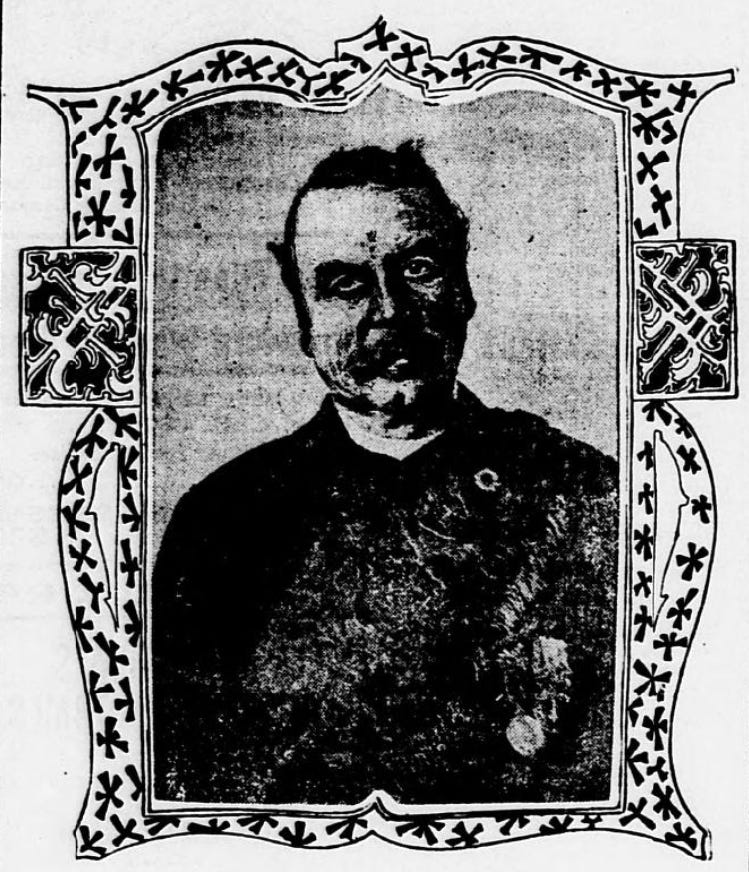
Portrait of John Hynes wearing his Bene Merenti medal (Left) and Pro Petri Sede Medal (Right).
John J. Hynes of No. 1721 Carr Street Is a Veteran of the Papal Army and Won the Highest Reward From the Vatican by a Daring Act of Heroism During the Revolution Against the Roman Church.1
John J. Hynes of No. 1721 Carr street is the proud possessor of the Bene Merenti medal, conferred upon him by Pope Pius IX in recognition of his distinguished bravery at the siege of Ancona during the Garibaldi revolutionary war in Italy in 1859.2
The medal, one of the only two in existence, is the highest distinction that can be conferred by the Pope upon a Catholic layman, and is analogous to the French cross of the Legion of Honor, in that it was bestowed as a reward for extraordinary courage and daring in action.3
The Bene Merenti medal is of silver, suspended by a tri-colored ribbon from a gold bar, beneath which is a gold reproduction of the coat of arms of the Pope, the cross-keys and crown. On the obverse of the medal appears the profile of the head of Pope Pius IX, surrounded by the inscription “Pius IX, Pontifex Maximus,” and on the reverse the inscription “Bene Merenti” (well merited).
In addition to this medal Mr. Hynes also has the St. Peter’s medal awarded to all surviving soldiers of the Pope’s army at the siege of Ancona. This is also of silver, suitably inscribed. The Sergeant Major’s sash, which he won at the siege of Ancona, is also one of Mr. Hynes’s prized possessions.4
Mr. Hynes was a Sergeant Major in the Papal army when the honor was conferred. Brigadier General Coppinger, a son-in-law of James G. Blaine, and now in the Orient, who was a Lieutenant in the Papal army, is the possessor of the other medal.5 It was conferred upon him after the battle of Castlefidordo, in the same war, for distinguished personal bravery. These are the only two medals conferred, as no occasion has since arisen in which the personal safety of the Pope has been threatened by an organized uprising.6
Mr. Hynes was a youth of 19, studying for the priesthood in All Hollows College, Dublin, when Garibaldi began his revolutionary movement against Pope Pius IX in 1859. When the revolutionists threatened the personal safety of the Pope, Hynes joined a brigade formed of young Irishmen devoted to the Catholic faith, to join the army being organized to defend the Pope. The brigade was hurried to Italy via Antwerp, Belgium, Germany and Austria, where, after a short time spent in drilling the raw recruits, the brigade was attached to the Pope’s army, numbering 8,000, recruited from Ireland, Austria, Switzerland and French Canada, under command of General La Moricière, a French officer.
Comments
Nothing yet. Say the first thing.
Sign in to join the conversation.