
The following article was written by Lieven Gorissen, a leading international authority on Papal Zouave history, and originally published in Pro Petri Sede magazine (Benelux): 2015-2 p.31-41. It has been translated from the French using Claude AI and is republished here with the author’s permission.
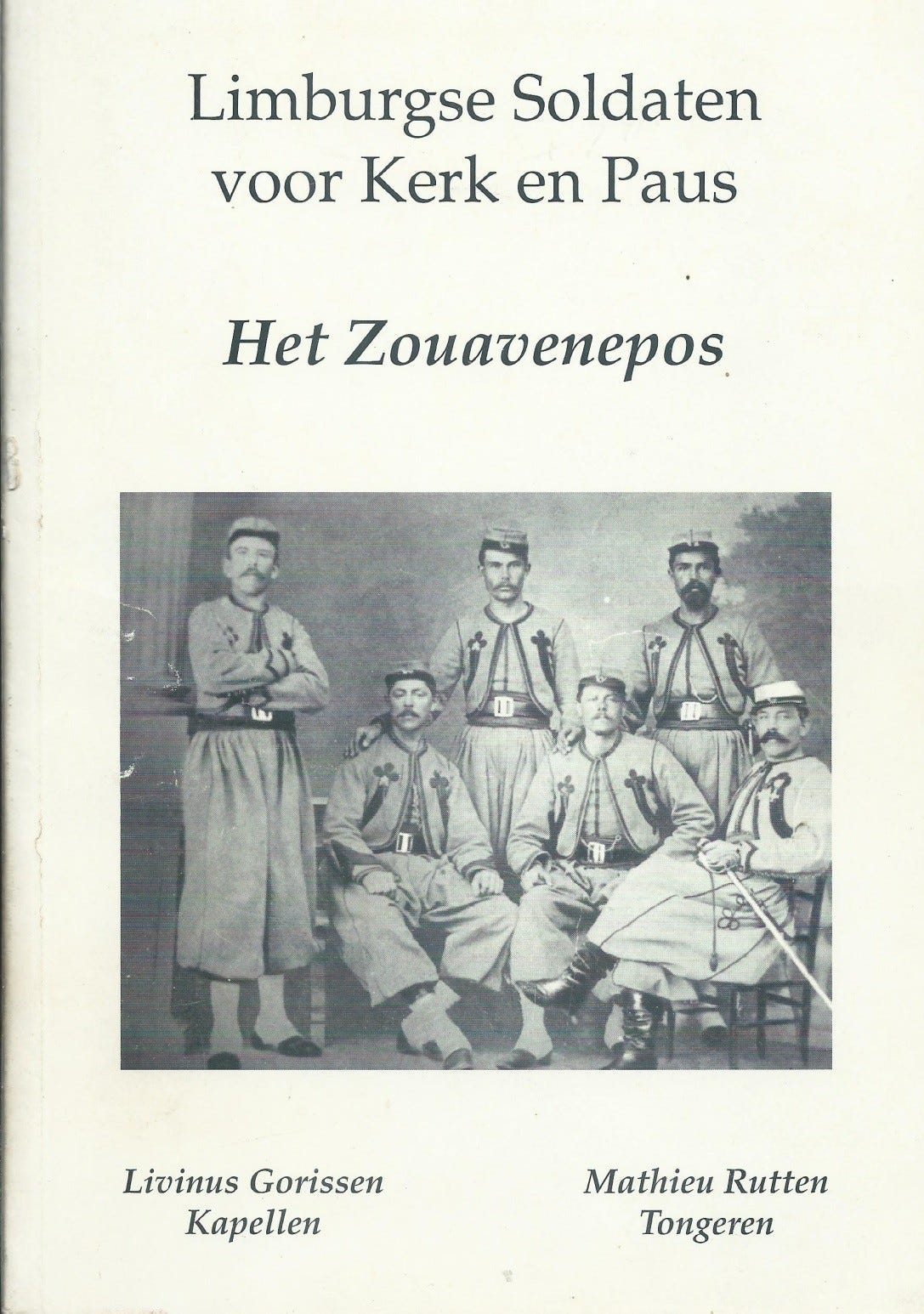
Cover of L. Gorissen & M. Rutten, Limburgse Soldaten voor Kerk en Paus (Soldiers of Limburg for Church and Pope), ), Kapellen-Tongeren, sd. (1994). Pictured: Herman Vandevenne, Lambert Rutten, Jan Brouns, Jaak Rutten, Mathiis Henckens, René Rutten
As early as 1970 I had published the 187 enrolments among the Papal Zouaves of Belgian Limburg[1], a study that has served as a basis until this day for quite a lot history circles that made use of it. Thus René Deckers in 1977 took up the zouaves of Kessenich, Kinrooi, Molenbeersel, Geistingen and Ophoven on the occasion of the meeting of the Hasselt section of Pro Petri Sede on 2 July at Geistingen[2]. Indeed, they grouped together above all the two great Zouave families of Geistingen: 3 “Rutten” and 5 “Henckens”. For quite a number of years their descendants Jan and Mathieu Rutten formed the leadership of the Hasselt section of Pro Petri Sede[3].
The best known was certainly Corneille René Rutten, who became a sub-lieutenant in the Papal Zouaves. As I have already described his time with the Zouaves and his activities after his return from Rome[4], I will limit myself to clarifying a few additional points, such as his enrolment in Rome. He was born on the farm “Hoezerhof” at Ophoven-Geistingen[5], on 22.2.1834, son of Jan Renier and Petronella Segers. As the second of ten children, he attended primary school and actively helped his parents on the farm, thus contributing to the cost of the studies of his brothers and sisters, including Martin-Hubert, who would go on to become Bishop of Liège (1902–1927). At the age of 17, he spent a year in Liège to learn French at the Jesuit college, rue Saint Gilles. Afterwards he returned to work on the farm. He supplemented “his education by reading books of ancient and modern history of which he was particularly fond”[6].
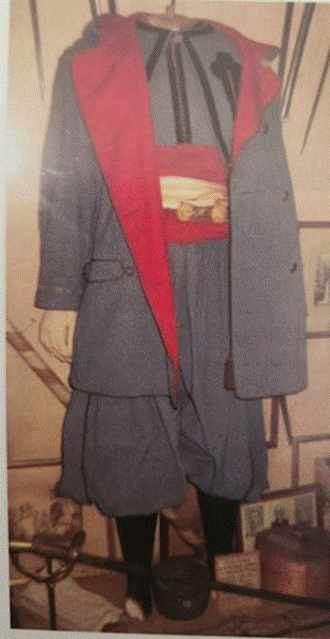
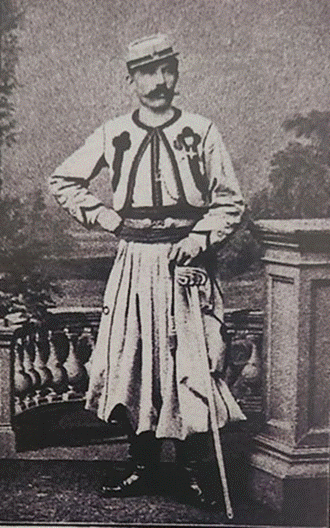
Sub-Lt. Corn. René Rutten (1834–1918). Portrait (late 1867?), copy of original photograph, MRAB, arch. L.Gorissen. With his dress uniform, MRAB, photo 14.1.2015, L.Gorissen
Finally he left for Liège to take the train to Brussels[7] where he signed his enrolment nr. 356 on 6.11.1863 as “Rutten René”, farmer residing at Ophoven, “for four years with a bonus of thirty Roman écus”. He presented his militia certificate, that of the parish priest and of the doctor. His description was: 1.64 m., dark hair and lashes, blue eyes, ordinary nose, medium mouth, round chin and oval face[8]. He left for Rome with 14 Belgians and 3 Dutch, including Adrien Looymans (a future officer like himself) and Jacques van Steen of Oudenbosch, to sign their engagement on the 12th, for only two years! His matricule states:
“No. 1392 / Rutten Cornelio / Ultimo domicilio Ophoven / Provincia Belgica / Professione cultivatore / Nato il 22 Febbraio 1832 a Ophoven / Provincia di Belgica / Figlio de Giov. Renato e di Petronilla Seegers / Altessa (height) 1 metro (sic) / Viso ovale (oval face) / Fronte scoperta (open forehead) / Occhi blu (blue eyes) / Naso medio (medium nose) / Bocca medio (medium mouth) / Mento tondo (round chin) / Capelli e soppracciglia castagno (chestnut hair and eyebrows) / Incorporato a contare del 12 Novembre 1863 (incorporated from 12.11.1863) / Ingaggiare volontare per anni due (volunteered for two years) / Giunta al corpa il 12 Novembre 1863 (entered the corps 12.11.1863) / Zuave de 2e cle le 12 Novembre 1863 / Caporale 2e Cl le 15 Novembre 1865 /”
Cavalieri delle Ordini di S Sylvestre / 4 D / Tempo finito le 12 Novembre 1867 (end of engagement 12.11.1867 – sic) / Congedare per tempo finito come caporale 2e Cl le 15 9br 1865 (discharged at end of term as 2nd class corporal on 15.11.1865)[9]. He served his time in the 4th Company. His first letter is dated 24.11.1863. Martin-Hubert Rutten published his letters in 159 pages through the St-Paul editions in Paris in 1949[10]. Thus one can easily follow René Rutten throughout his entire journey as a Papal Zouave! Let us simply note that he followed Italian language courses with a professor in Rome. After his two years he returned home on 18.11.1865.
After a year of work on the family farm “Hoezerhof,” he returned to Rome where he signed a new engagement on 22.12.1866:
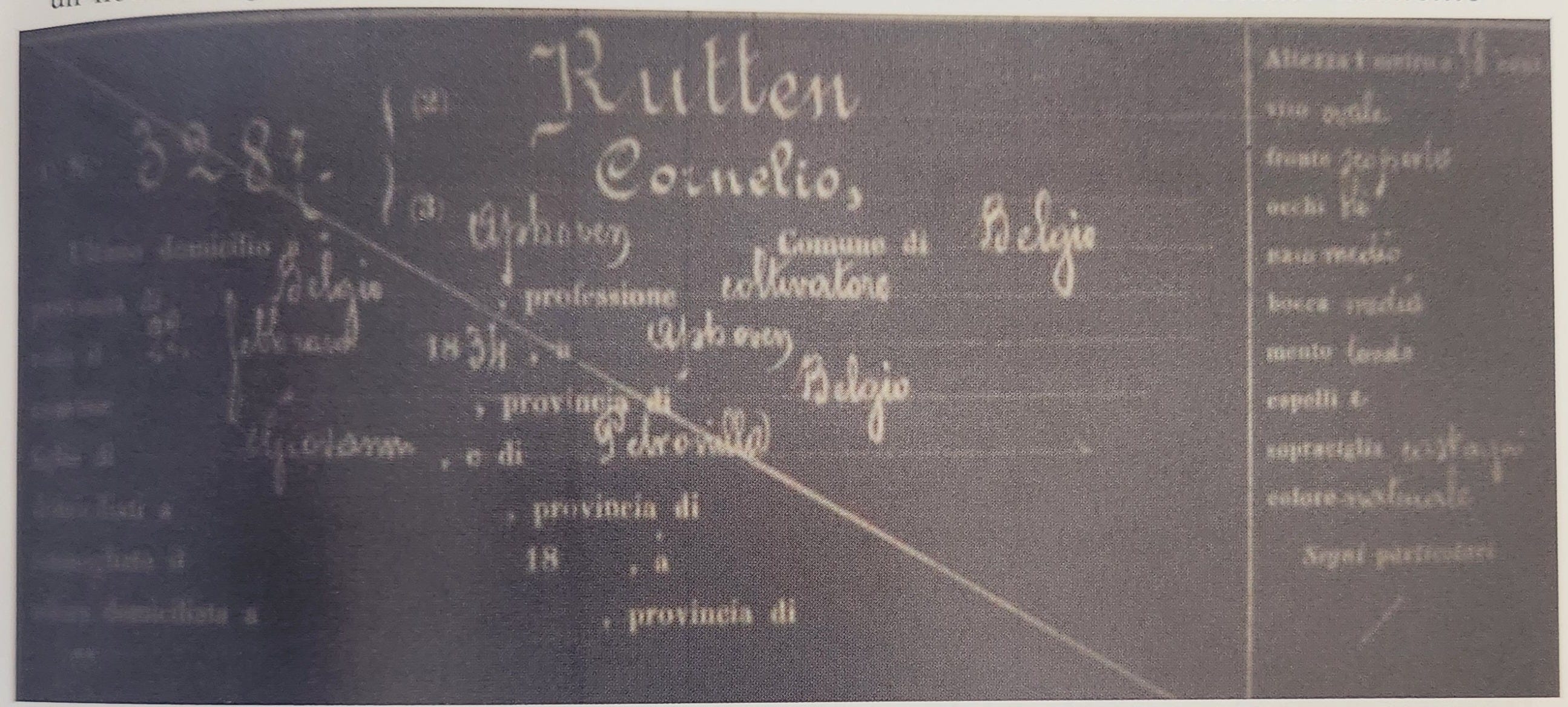
Archivo di Stato di Roma, Matricola Zuavi Pontifici, nr. 3287 — Rutten Cornelio, born 22 February 1832
“No. 3287 / Rutten Cornelio / Last domicile: Ophoven / Province of Belgium / Profession: farmer / Born 22 February 1832 at Ophoven / Province of Belgium / Son of Giovanni and Petronilla / Height: 1 metre 98 centimetres / Oval face / Open forehead / Blue eyes / Medium nose / Medium mouth / Round chin / Chestnut hair and eyebrows / Natural complexion / Incorporated 22 December 1866 / Volunteered for two years / Joined the corps 22 December 1866 / 2nd class Zouave 22 October 1866 / Served at the Zouave Battalion, matricule 1392, from 12 November 1863 to 18 November 1865, and was discharged as a 2nd class corporal / 2nd class Corporal 16 April 1867 / 2nd class Sergeant-Fourrier 6 May 1867 / Sergeant-Major 31 October 1867 / Decorated with the Commemorative Medal Fidei et Virtuti for the 1867 Campaign / Knights of the Orders of St. Sylvestre / Company Hors Rang I / 2nd Battalion 3rd P° / Service ended 22 October 1868 / Promoted Sub-Lieutenant 14 December 1867” [11].
Let us simply note that he became corporal on 16.4.1867 and already by 6.5.1867 sergeant-fourrier. This is how he actively participated in the campaign of 1867. Let us highlight especially his participation in the affair of the Arsini bomb factory on 25.10.1867 in Rome and the assault on the Monte Rotonde station the following day. He was made sergeant-major on 1.11.1867 and two days later participated in the Battle of Mentana, with his 3rd Battalion II under the command of Captain de Saisy, in the column of Major de Troussures, which attacked the right flank of the Garibaldists, after having made a detour via the Via Salaria.

Order detaching Sub-Lt. Rutten to the Compagnie Hors Rang as officer in charge of armament
Promoted to sub-lieutenant on 14.12.1867 in the 6th Infantry, he was registered in the officers’ roll at no. 137, a roll that reports no new information. From 1.1.1868, he worked in the C.H.R. (Company Hors Rang[12]) in charge of armament. René wrote to his parents (Rome, 30.12.1867):
“Since my return to Italy I had climbed the service echelons with unusual speed; but eight days ago I made a much greater step. At the audience of 14 December, His Holiness graciously agreed, on the proposal of the Colonel and the Minister of War, to name me an officer. That day I was on detachment at Arsoli, 13 or 14 leagues from Rome; I was not at all expecting such a promotion, when suddenly a telegram came to inform me. I was naturally very surprised, and all the more happy at the thought of the pleasure this news would give you” [13].
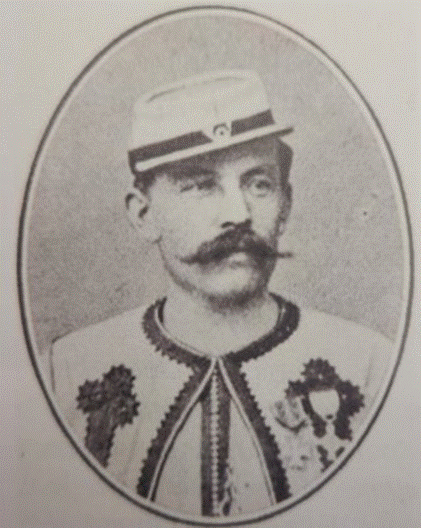
Sub-Lt. Corn. René Rutten (1834–1918). Portrait (late 1867?), copy of original photograph, MRAB, arch. L.Gorissen. With his dress uniform, MRAB, photo 14.1.2015, L.Gorissen
He was decorated on 8.12.1867 as a knight of the Order of St. Sylvester, presented the following day, and like all the others on the 23rd received the decoration “Fidei et Virtuti”, popularly known as the Cross of Mentana[14]. It was with his Compagnie Hors Rang that he took part in the defense of Rome on 20.9.1870 in the first sector of zone 2: between the Tiber and the Porta Pinciana[15]. Five minutes after the first cannon shot, at 5:15 a.m., “the attack began at the Pincio, occupied as well as the Villa Medici by a company of zouave subsistants, formed partly of recruits. The combat began at first with a lively exchange of fire between our zouaves, posted behind the walls, and the enemy riflemen established at the Villa Borghese, near the isolated stables facing the Villa Medici”[16].
At 6:45 a.m., a pontifical cannon was struck and overturned, as were the artillerymen[17]. These zouaves were helping the cannoneers. After the capitulation, they were taken prisoner in the gendarmerie barracks at Maccao[18] (Officers went to the military casino). They all left on the 23rd at 5 a.m. for Civita-Vecchia[19]. Rutten himself recounts how he was attacked by an enraged mob before leaving Rome, when he returned to his apartment to retrieve his luggage. It was an Italian patrol that saved him.
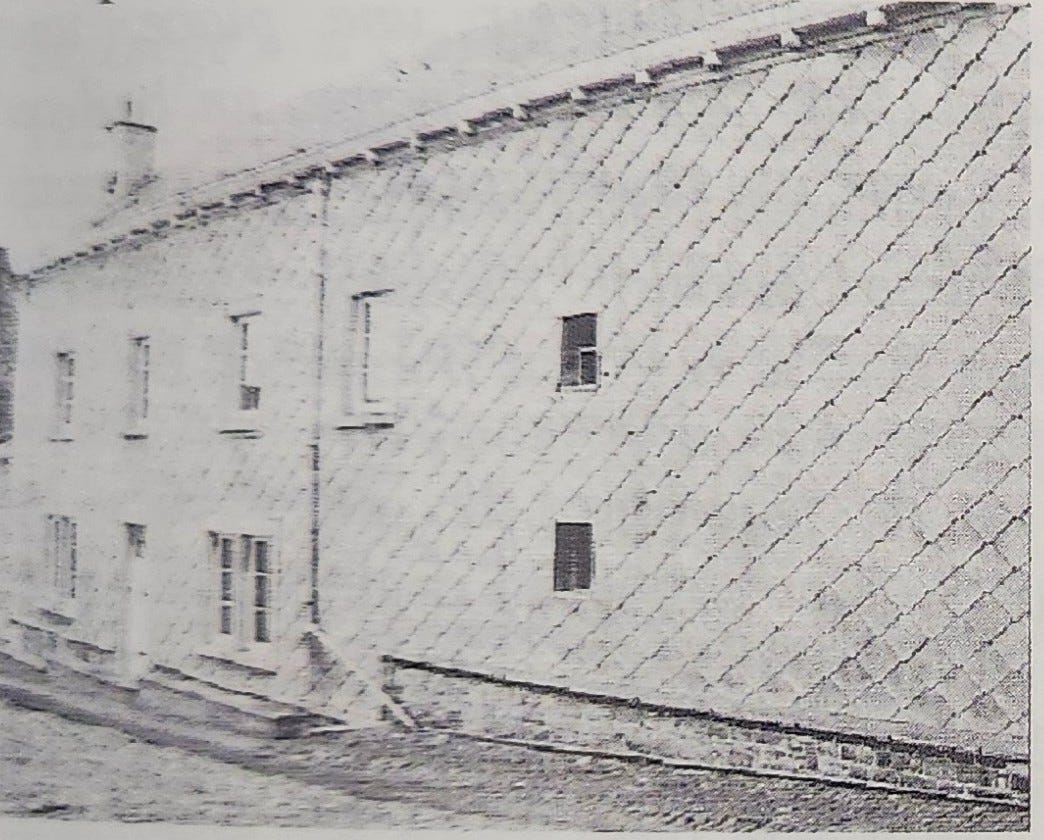
House of C.R. Rutten in Clermont, in NN., Clermont, its shops and houses, ed. Cultural Committee of Clermont, 25.10.2002"
Back in Belgium, René Rutten met the sister of a friend and colleague of his brother, Bishop Martin Rutten, and on 16.4.1872 he married at Clermont-sur-Berwinne Elisabeth Joseff, daughter of Nicolas-Joseph and Marie-Marguerite Pirenne, and settled in Clermont as a farmer on the street that today bears his name, connecting the Place de la Halle to the Chaussée Charlemagne. They had six children:
• Marguerite (1873–1873)
• Joseph (15.10.1874 – Pau 18.3.1950), who became a missionary in Mongolia (1901) and Superior General of the Congregation of Scheut (1920)
• Martin (12.6.1876 – Brussels 31.12.1944), married to Yvonne Vanderheyden, went to the Congo Independent State (1901), becoming Governor-General of the Belgian Congo[20]
• René (18.9.1878 – Liège 30.3.1948), Jesuit
• Marie-Hubertine (6.3.1880), Sister of Charity in Tilburg
• Hubert (20.12.1880–2.10.1945), married to Maria Teller, who took over the family farm, inhabited after him by his youngest daughter Jeanne, married to Camille Domken, and finally their daughter Dewez-Domken in 2002[21]
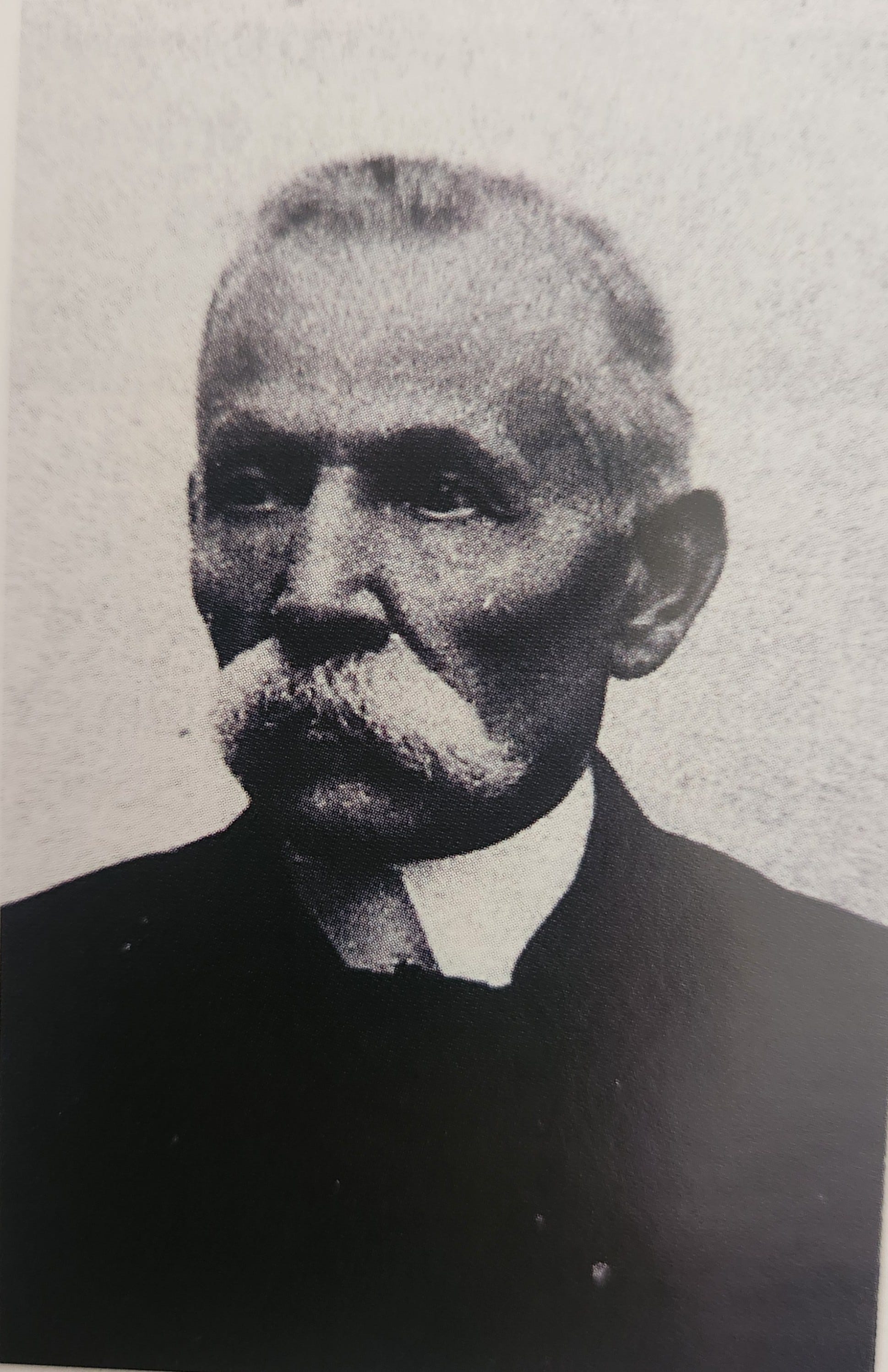
Corneille René Rutten (1834–1918) in later life. Copy of an original photograph, MRAB, arch. L.Gorissen
With two regimental comrades, he set off in 1876 on a pilgrimage to Rome where he was received by Pius IX in audience, then visited the various battlefields[22]. The new radical Liberal government Frère–Van Humbeeck (18.6.1878–10.6.1884) created the new Ministry of Public Education with Pieter Van Humbeeck, a prominent Freemason, as minister. The schools war erupted after the speech from the throne (12.11.1878): “education given at the expense of the state must be placed under the exclusive direction and supervision of civil authority”, and especially through the law on education of 10.7.1879[23].
Already in September 1876 there had been school conflicts between the Bishop of Tournai and the municipal administration of Soignies, which led to a meeting with our ambassador Baron Auguste d’Anethan with Pius IX (report dated 5.12.1876). The Holy See issued an explicit approval of the conduct of the Episcopate on 2.4.1880[24]. The watchword of the Belgian Church was: “He who is not with us is against us”[25]. Each parish had its Catholic Schools Committee and Rutten was chosen as president of the Committee, a position he held until his death. He was thus elected municipal councillor of Clermont in 1885 and appointed mayor (bourgmestre) in 1885.
Let us cite the speech of municipal councillor Detry at Rutten’s grave:
“With what dedication he fulfilled, for thirty-three years, these honorable yet thankless functions above all others. It is to the mayor, indeed, that one turns for the slightest problems: quarrels, disputes, disagreements between neighbors, even between members of the same family. With what tact he knew how to restore peace where discord reigned. A charitable man par excellence, his heart and his purse were open to all and his aid softened many sorrows. Was support needed? It was to him that one turned first. Whether to obtain a position, a promotion of some kind, a reduction of sentence, a lease or any other favor… for one knew that he had never refused these services, and his influence in higher circles was such that few are those who did not obtain satisfaction through his intercession.”
At the same time he became one of the most active members of the Catholic political associations of the canton of Aubel and the arrondissement of Verviers. He was thus elected provincial councillor in 1892 for the canton of Aubel and kept his seat until his death. Under his impetus, this canton became the fortress of the Catholic party in the arrondissement. Let us cite the speech of Viscount Simonis at his grave on behalf of the Catholic Association of the arrondissement of Verviers:
“At the municipal council as at the provincial council, of which he was the dean by age,[26] Mr. Rutten knew how to earn the respect and sympathies of all, adversaries as well as friends, and these sympathies did nothing but grow over the long years he spent in these assemblies. Great, ever greater, was the confidence that the Catholics of the Verviers region placed in him, who on 30 May 1896 named him vice-president of their arrondissement association”[27].
At the legislative elections of 27.5.1900, the first held under plural universal suffrage[28] with proportional representation, Rutten was proclaimed the party’s candidate and elected 2nd substitute deputy[29] for the arrondissement of Verviers with 393 (+ 9,273 = 9,666) votes. Also at the elections of 29.5.1904 and 24.5.1908 he was respectively elected as 2nd substitute and 1st substitute[30], as on 2.6.1912 and 24.5.1914. After the death of the Minister of Foreign Affairs, Viscount Julien Davignon, on 12.3.1916 in Nice[31], Rutten became an effective deputy. In the meantime he received, like all living Papal Zouaves, the Bene Merenti medal in 1891. As a representative of the electoral body, he received in Brussels on the occasion of national holidays the 1st class Civic Cross after 35 years of public service. He also received the commemorative medal of the reign of Leopold II, instituted in 1905 for 20 years of loyal service[32]. On 12.9.1911, he became an Officer of the Order of Leopold[33].
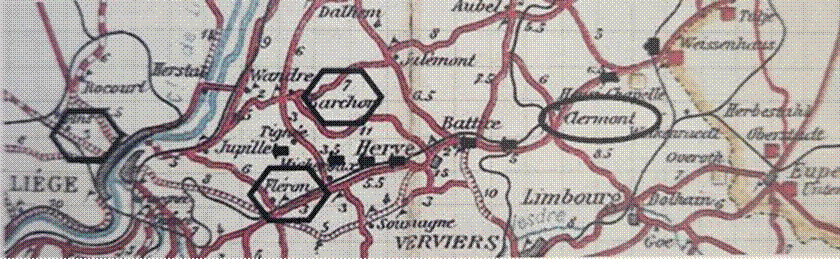
The Fortified Position of Liège and its forts: hexagons mark major forts; arrow shows German advance of 4–6 August 1914 (14th Brigade). Clermont-sur-Berwinne is circled. Based on the Automobile Club of Antwerp periodic road map of Belgium, scale 1:350,000, 1st ed. 1914. Arch. L.Gorissen
Martin Rutten returned from Katanga to spend the summer of 1914 with his parents in Clermont, but the sounds of war were not far away. As the works on the “Fortified Position of Liège” were not complete, his commander, Lt. Gen. Gérard Leman (1851–1920), was ordering urgent works carried out by military personnel and also mobilizing civilians to dig trenches between the fortifications. The German “Army of the Meuse”, under the command of General Otto von Emmich (1848–1915), numbered 60,000 men of active units, not counting the cavalry and artillery with the famous “Grosse Bertha” of 42 cm weighing 150 tonnes. Its Infantry Brigades crossed the border on 4.8.1914 from 8 a.m. with the intention of infiltrating between the forts. Thus the next day the forts of Barchon and Fléron were heavily bombarded and a battalion of infantry of the 27th German brigade attacked Barchon. During the following night, six infantry brigades began a concentric attack. The 14th brigade advanced between the fort of Fléron and the little village of Evegnée, between those of Barchon and Fléron. On the morning of the 6th it entered Jupille and Lt. Gen. Leman ordered the retreat of the 3rd division of the Belgian army toward Borgworm[34]. The 2nd cavalry corps preceded these brigades with the help of a battalion of chasseurs. The advance during the night was probably facilitated by former German miners from the Bellaire mine, where 1,000 Germans worked and served as guides or spies[35].
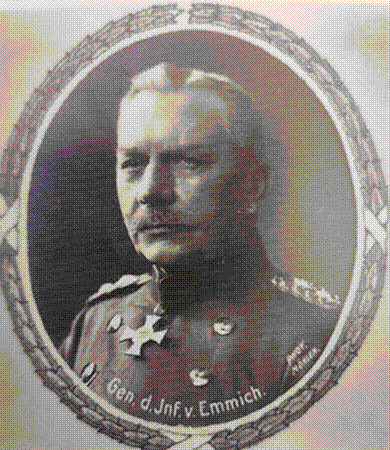
General Otto von Emmich (1848–1915), Commander of the 10th German Corps, in L. De Vos, T. Simoens, D. Warnier & F. Bostyn, 14-18 Oorlog in België, sl.nd. (Leuven, 2014), p.89.
Lt. Gen. Leman received on 31 July by telegram from General de Selliers of the General Staff the prohibition to carry out defensive works between the forts, for reasons of neutrality. Thus it was only on the evening of 3 August that he could order work to build redoubts and dig trenches. He also ordered the roads to be blocked[36]. As mayor of Clermont, René Rutten organized on 2 and 3 August the supply of the Liège fortress by the farmers of his commune. In the night of the 3rd to the 4th, on the instructions of Lt. Gen. Leman, he proceeded to the destruction of the main road. He directed a team of approximately 170 volunteer workers, of all ages, all ranks, all conditions, who, without rest until 9 a.m., rendered the road unusable over a length of one and a half kilometres. They did not abandon the work until the arrival of the first German cavalry. Clermont is only about six kilometres from the German border, on the main road going directly from Aix-la-Chapelle to Liège.
René Rutten, his two sons Martin and Hubert, and two other inhabitants were arrested around noon and brought before General von Emmich, with the threat of being shot if they could not explain the damage done to the road. Here is Rutten’s response:
“I ordered this work, I take responsibility for it and you have no right to detain anyone other than me; I acted on orders of the military authority. Formerly an officer, I too have made war; I too served nearly fifty years ago; and I have no doubt that if you had been in my place today, you would have had the courage to act as I have done.”
The witnesses and hostages who assisted at the scene reported that General von Emmich found no other response than the following: “You are free, but the road must be repaired within three hours.” In his in memoriam in L’Avant-Garde that recounts this story, one reads that it was under blows of rifle butts and sword flats from the soldiers[37] that the mayor and the peasants were forced to fill in the trenches on the road that morning. The enemy cannons could only pass in the evening[38].
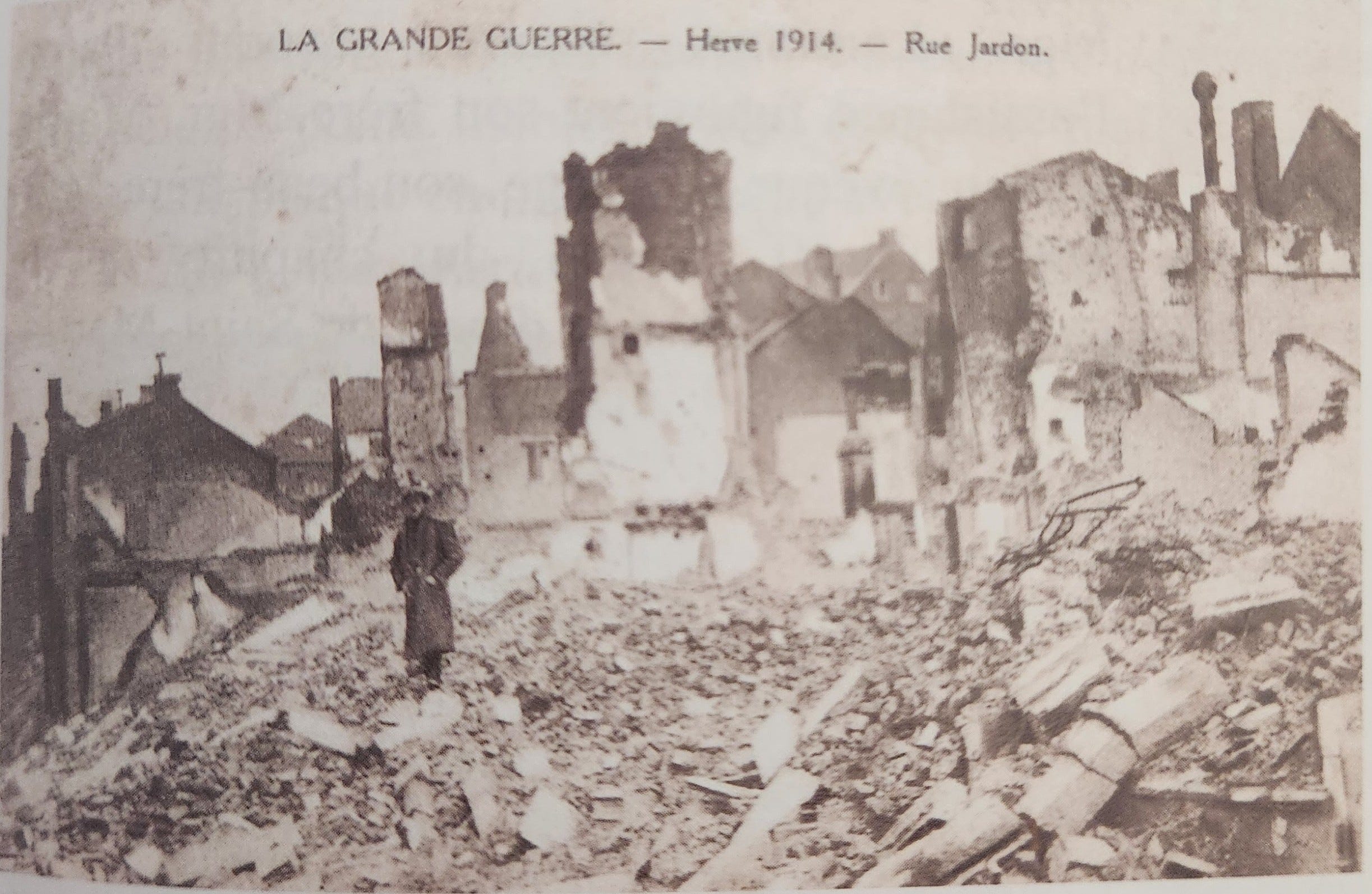
The Great War — Herve 1914 — Rue Jardon. The devastation wrought by German forces on the villages along their route from Clermont toward Liège
At Thimister they encountered at the Bolsée farm German cavalry, and Antoine Fonck, former storekeeper of the Grand Bazar de Liège, 21 years old, fell as the first Belgian military fatality on the field of honor, around 10:30 a.m.[39]. Around 10 a.m., these German cavalry, coming from Clermont 2 kilometres further along, entered Thimister, very embarrassed and nervous because of the obstructions also on the road there, and ordered the inhabitants to clear the road. As the septuagenarian Théodore Pauchenne, hard of hearing and busy cutting grass on the roadside for his rabbits, did not react, they interpreted this as resistance and killed him. Émile Xhauflaire was also shot. It was thanks to an abbot who spoke to them in German that they only burned eight houses, including the Bolsée farm[40]. Further along their route they shot three inhabitants around 8 p.m. at Battice, and every day until 8–9 August there were pillages, murders and arson. In total, 23 inhabitants were killed, as well as 13 from other communes and 10 inhabitants elsewhere. The church and 146 farms and houses were burned[41]. From 4 to 10 August, 34 inhabitants and 4 from Battice were killed at the following village, Herve, and around 300 houses, farms and factories burned, including the town hall and its archives[42]. The next on this sad route was Soumagne with the terrible record of 55 men shot in the field of Fond Le Roy, before the eyes of their wives and children. 23 inhabitants were deported to neighboring villages to be killed there. After being looted, 101 houses were burned and 118 civilian citizens were killed there[43]. It is clear that Rutten did not only delay the German troops but also spared his village great misfortunes!
And that was not all. René Rutten was also subjected to ill-treatment by the passing troops. He was very often taken hostage, and even once, it is said, the soldiers had the cruelty to keep him, for an entire night, in the rain and in the open air. It was by his energy and his skill that he thus saved the village of Clermont several times from being set on fire. It was also recounted that he succeeded in saving one of his administered citizens: a resident, arrested for having kept loaded weapons at home, was threatened with being shot. Rutten first obtained that he would not be judged without a new inquiry. The tribunal deferred judgment until the end of the night.
After a little rest, the mayor was there and, with consummate skill, showed that the German soldiers contradicted each other in their depositions. The judges could only condemn the accused to prison. Another problem was that he had to simultaneously oversee the supply of the commune, ensuring all the measures demanded by the circumstances and the uncertainties of an invasion. Even at the age of 80, Rutten, by dint of devotion, managed everything. During the four years of occupation, he was on several occasions subjected to the vexations of the German authorities who accused him of fomenting and maintaining in the population a spirit of mistrust and opposition[44].
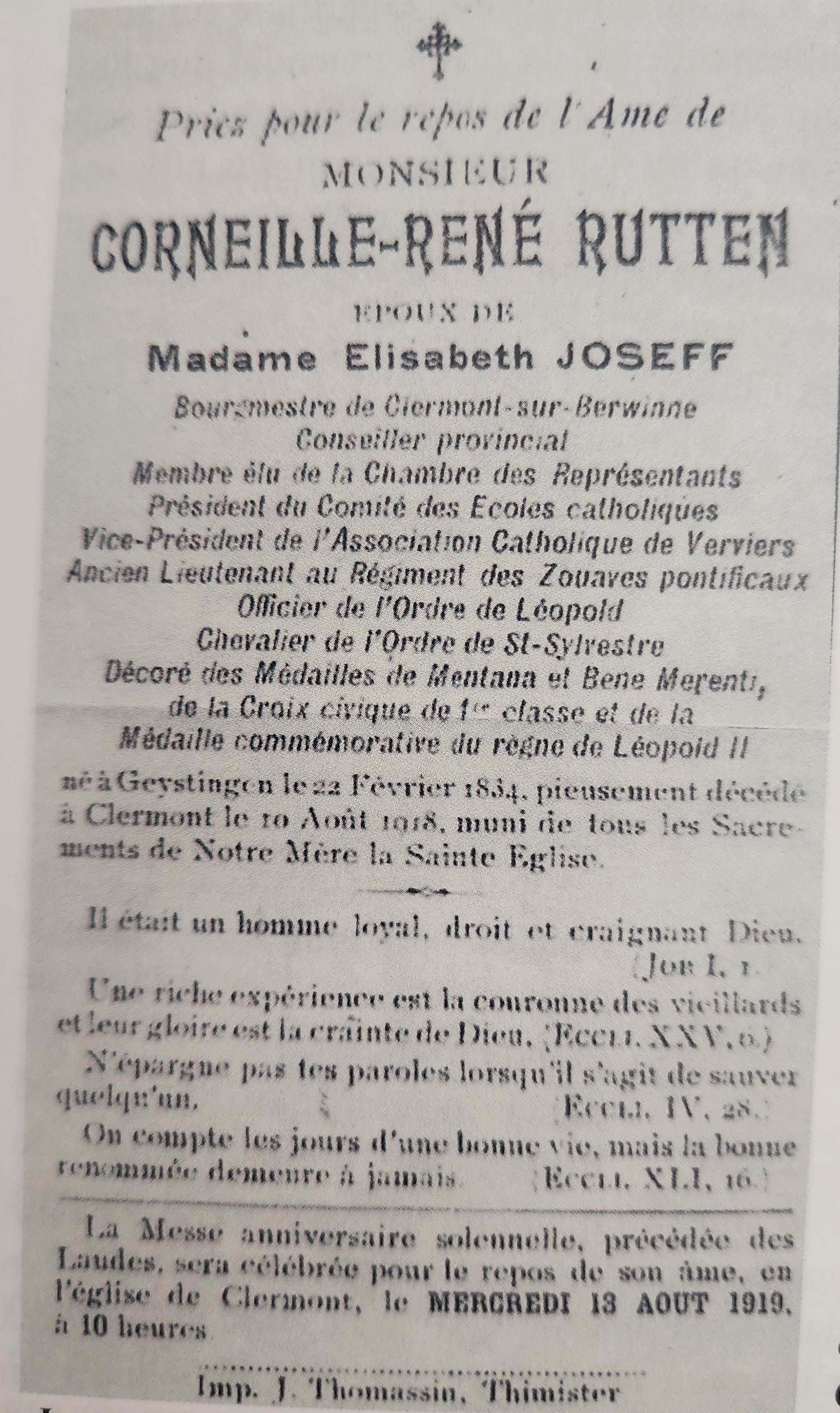
Memorial death card of Corneille-René Rutten, printed by Imp. J. Thomassin, Thimister. Source: G. Meessen, o.c., p.30
All these fatigues finally got the better of his robust health and from his 84th year he began to decline and died on 10.8.1918 in Clermont. But through the intermediary of the Apostolic Nuncio in Brussels, Pope Benedict XV deigned to send the dying man his apostolic blessing[45]. The funeral was celebrated in the church of Saint-Jacques on the 16th by the Father Abbot of Val-Dieu. The absolution was sung by Mgr. Laminne, vicar general. Among those present were his brother Mgr. Martin Rutten, Bishop of Liège, his brother-in-law Mgr. Gilles Joseff, dean of the chapter of the cathedral of Liège and dean of Saint-Martin, and Canon Rutten.
The councillors Coemans for Aubel, Jaminet for Limbourg, Lacroix for Verviers, and Monami for Dison represented the provincial council. Thomas Detry, member of the municipal council of Clermont, Joseph Nols, mayor of Aubel, the lawyer Coemans, Viscount Simonis and Monsieur Jumelle, schoolteacher at Clermont, gave speeches. He rests in the cemetery of Clermont where he is interred in the family vault of the Rutten family[46]. The solemn anniversary Mass, preceded by Lauds, was celebrated in the church of Clermont on Wednesday 13.8.1919 at 10 a.m. As a sign of recognition, a street in the village of Clermont bears his name.
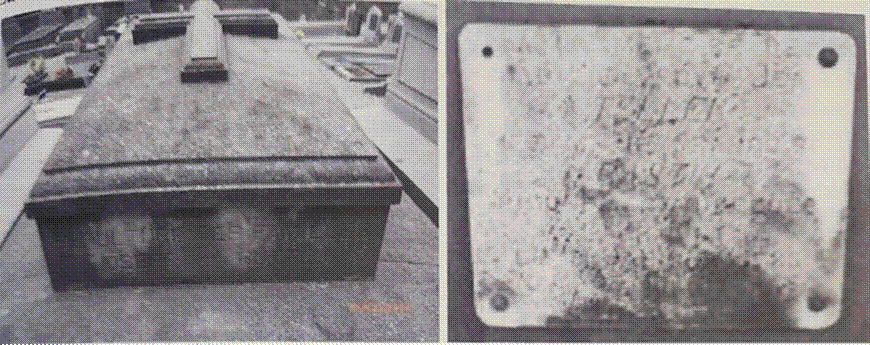
The Rutten family tomb at Clermont cemetery (left) and the weathered marble plaque on the rear of the vault (right). Photos: Hubert Judong, Fléron, secretary of the Cercle Historique de Fléron, 6.8.2014
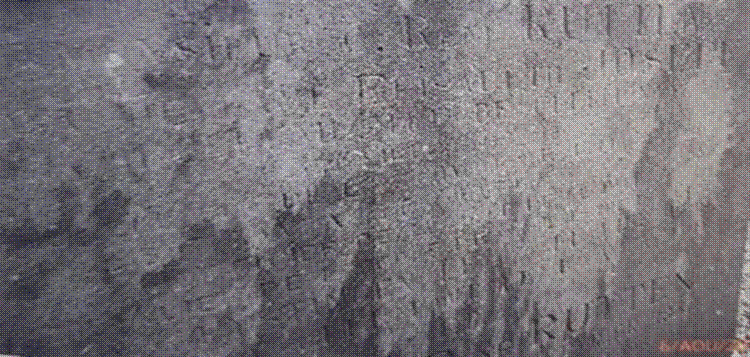
Close-up of the inscription on the left side of the tomb, recording Corneille René Rutten’s titles and dates
Mr. Hubert Judong of Fléron, secretary of the Cercle Historique de Fléron, kindly took for us on 6.8.2014 some photographs of the Rutten family tomb. As inscription, we read: “Sépulture des familles / Joseff et Rutten” (Burial vault of the Joseff and Rutten families). The texts are unfortunately barely legible. We nonetheless attempt to decipher them. At the rear is a white marble plaque with the text: “In memory of / Madame widow Jean / TELLER / née Marie Françoise / BASTIN / piously deceased / in Clermont / in – January 1925 / at the age of – years.”
On the left side: “Monsieur C. René RUTTEN / husband of Madame Elisabeth JOSEFF / mayor of Clermont / provincial councillor / elected member of the chamber of representatives / lieutenant in the Papal Zouaves / Officer of the Order of Leopold / Knight of the Order of St. Sylvestre / born in Geystingen on 22 February 1834 / died in Clermont on 10 August 1918 / and / widow René RUTTEN / born 2 February 1837 / died – April 1926.”
[1]Lieven Gorissen, Limburgse Pauselijke Zoeaven, in Vlaamse Stam, jrg.6, 1970; nr.8, p.554-560; nr.9, p.627-632; nr.10, p.663-670; & jrg.7, 1971; nr.4, p.247-256; nr.5, p.315-322; nr.6, p.411-414. Better illustrated and presented in: Lieven Gorissen & Mathieu Rutten, Limburgse Soldaten voor Kerk en Paus, Het Zouavenepos, Kapellen-Tongeren, sd. (1994); L.Gorissen, De Pauselijke Zoeaven uit Limburg, in Limburg, jrg.50, 1971, nr.2, p.49-62; L.Gorissen, Onze Limburgse Pauselijke Zoeaven, in Pro Petri Sede, jrg.20, 1972, nr.3, NL.p.12-13; jrg.21, 1973, nr.2, NL. p.17 & nr.4, NL. p.12-14; L.Gorissen & M.Gorissen, De Pauselijke Zouaven, in Catalogus van de Tentoonstelling “Maaslands Verleden” van 1 tot 18 mei 1970, Davidsfonds Mechelen-aan-de-Maas, 1970, p.17-22.
[2]René Deckers, De Pauselijke Zoeaven uit de kerkdorpen Kessenich, Kinrooi, Molenbeersel, Geistingen, Ophoven, sl.nd. (Kinrooi, 1977).
[3]L.Gorissen, Mathieu Rutten is niet meer, in Pro Petri Sede, 2012-1 p.42; L.Gorissen, Eredeken Jan Rutten is niet meer, in Pro Petri Sede, 2012-4 p.34; M.Rutten, De Ruttenstam in het Maasland, sl.nd. (Tongeren, 1973), p.92, 97; M.Rutten, De Rutten-kroniek, Tongeren, 1989, op jaartal.
[4]Lieven Gorissen, Limburgse Pauselijke Zoeaven, in Vlaamse Stam, 1970, p.627-628; L.Gorissen & M.Rutten, o.c., p.50; R.Deckers, o.c., p.64-68; M.Rutten, De Ruttenstam ..., o.c., p.80-81.
[5]M.Rutten, De Rutten-kroniek, o.c., p.140-142. The grandfather of the ZP had become a farmer at the Hoezerhof in 1804, and after his death in 1851 his son, the father of the ZP, renewed the lease on 26.11.1860 for 12 years at the price of 3,850 Fr. for 55 ha.: p.145, He moved in 1872 to the farm “Hoezer” in the village of Geistingen, which he had bought in 1847 for 1,048.14 Fr. After his death the brother of Corneille René, Jan Hubert (1844-1931), received “Hoezer” as his share of the estate, to return in 1901 to “Hoezerhof” as a farmer.
[6]C.Meessen, René-Corneille Rutten, Zouave pontifical, Bourgemestre de Clermont-sur-Berwinne (1834-1918), in Société d’Histoire et d’Archéologie du Plateau de Herve, Bulletin 68, 1996, p.25; Gaston Meessen, Gens de chez nous: Corneille-René Rutten, in Réverbère, 2009, p.28, erroneously mentioned as “the eldest”.
[7]C.Meessen, o.c., p.29, is mistaken: “It is around 13 November that René Rutten left his family” – whereas he was already in Brussels on the 6th!
[8]MRAB, X/390, nr.356.
[9]Archivo di Stato di Roma, Matricola Zuavi Pontifici, nr. 1392.
[10]Martin Hubert Rutten, Lettres d’un zouave pontifical de 1863 à 1870 (C.R.Rutten), Paris, 1949.
[11]Archivo di Stato di Roma, Matricola Zuavi Pontifici, nr. 3287.
[12]Translator’s note: The Compagnie Hors Rang (literally “Company Outside the Ranks”) was a headquarters and administrative company not assigned to a numbered battalion. It functioned similarly to a modern Headquarters Company, housing staff officers, armourers, and specialist personnel. Rutten’s posting there in charge of armament reflected his seniority as a commissioned officer.
[13]NN., Lettres d’un Zouave Pontifical René Corneille Rutten (30.12.1867), in PPS 1977-4, p. F 14-15.
[14]Description de la cérémonie du 9 & 23.12.1867 in L.Gorissen, Pauselijk Zoeaaf Martinus van Leeuwen, Kapellenbos, 2014, p.53-54; et celle du 23 in L.Gorissen, Pauselijk Zoeaaf Adriaan de Graaf, in PPS 2014-4, p.38-39. C.Meessen, o.c., p.35.
[15]Col. Attilio Vigevano, La Fine dell’Esercito Pontificio, Roma, 1920, p.489. Arch.L.Gorissen.
[16]Le Cte. De Beauffort, Histoire de l’Invasion des Etats Pontificaux et du Siège de Rome par l’Armée Italienne en Septembre 1870, Paris, 1874, p.288. Arch.L.Gorissen.
[17]Col. Attilio Vigevano, o.c., p.547, 615; Le Cte. De Beauffort, o.c., p.293.
[18]L.Gorissen, De Pauselijke Zoeaven uit Limburg, o.c., p.55.
[19]Le Cte. De Beauffort, o.c., p.333.
[20]F.Dellicour, Martin Jean-Marie-René, in Biographie Colonial Belge, sl., 1958, col.714-721.
[21]NN., Le Lieutenant Rutten, in L’Avant-Garde, Août 1921, NS. N°24, p.186; M.Rutten, De Rutten-kroniek, o.c., p.80-81; C.Meessen, o.c., p.38-40; NN., Clermont, ses commerces et ses maisons, éd. Comité culturel de Clermont, 25.10.2002, p.70.
[22]C.Meessen, o.c., p.36.
[23]Theo Luykx, Politieke Geschiedenis van België van 1789 tot heden, Amsterdam-Brussel, 1969, p.173-178.
[24]NN., La Belgique et le Vatican, documents et travaux législatifs concernant la rupture des relations diplomatiques entre le Gouvernement belge et le Saint-Siège (1878-1880), Bruxelles, 2 tomes 1880 & 1881, XCIII + 758 & LXVIII + 576 pages, t.I, p.LXXXVI-XCIV. Texte de Leo XIII du 2.4.1880 in extenso, t.I, p.326-327. Arch.L.Gorissen.
[25]Els Witte & Jan Craeybeckx, Politieke geschiedenis van België sinds 1830, Antwerpen, sd. (1981), p.97.
[26]Translator’s note: The French term doyen d’âge in Belgian parliamentary usage referred specifically to the longest-serving member of a council, who held the formal procedural role of chairing the opening session until a president was elected. It is not simply the oldest member present, though the two often coincided. The title carried a specific institutional dignity beyond mere seniority of age.
[27]NN., Le Lieutenant Rutten, in L’Avant-Garde, Août 1921, NS. N°24, p.186-187.
[28]Translator’s note: Belgium’s 1893 electoral reform introduced universal male suffrage but with a plural element: men over 25 received one vote, those over 35 with property or paying certain taxes received a second, and those with higher education or certain public positions received a third. The system was intended to counterbalance the mass working-class vote while maintaining the appearance of universal suffrage. It was replaced by simple one-man-one-vote suffrage in 1919.
[29]Translator’s note: A député suppléant was an alternate or substitute member of parliament who did not hold an active seat but was registered to take the place of a sitting deputy upon death, resignation, or appointment to government office. Rutten held this status from 1900 until 1916, when the death of Foreign Minister Davignon elevated him to an effective seat.
[30]NN., 1884-1909 Vingt-cinq années de gouvernement, le parti Catholique Belge et son œuvre, Libr.Albert De Wit, Bruxelles, p.93-94 (Représentants de Liège). Indique Sébastien Winandy comme remplaçant (aussi p.384).
[31]Paul Van Molle, Le Parlement Belge / Het Belgisch Parlement 1894-1972, Anvers, 1972, p.59-60.
[32]A.Ch.Borné, Distinctions honorifiques de la Belgique 1830-1985, Bruxelles, 1985: Croix civique p.152-155; Médaille commémorative du règne de Léopold II p.293-294.
[33]NN., Mémorial du centenaire de l’Ordre de Léopold 1832-1932, Bruxelles, 1933, p.371.
[34]L.De Vos, T.Simoens, D.Warnier & F.Bostyn, 14-18 Oorlog in België, sl.nd. (Leuven, 2014), p.87-94.
[35]René Lyr, Onze Helden gestorven voor het Vaderland, Belgiës epische strijd van 1914 tot 1918, Brussel, 1922, p.43-45.
[36]René Lyr, o.c., p.39.
[37]Translator’s note: The French original uses the word soudards, a contemptuous term meaning brutish or loutish soldiers — closer in tone to “thugs in uniform” than the neutral “soldiers” used here. The pejorative register reflects the author’s moral condemnation of the German troops’ conduct.
[38]NN., Le Lieutenant Rutten, in L’Avant-Garde, août 1921, NS. N°24, p.187.
[39]L.De Vos, T.Simoens, D.Warnier & F.Bostyn, o.c., p.92.
[40]Paul Verbraeken, Start WO I in België, Dood en verderf vanaf eerste minuut, in Gazet van Antwerpen, 2-3.8.2014, p.6; Eug. De Seyn, dans Geschied- en Aardrijkskundig woordenboek der Belgische gemeenten, Turnhout, sd., t.II, p.1340.
[41]Eug. De Seyn, o.c., t.I, p.84.
[42]Eug. De Seyn, o.c., t.I, p.578.
[43]Eug. De Seyn, o.c., t.II, p.1286; NN., België in de Grote Oorlog, Heldhaftige tegenstand in Luik, in Hij is verrezen, nr.71, 2014, p.14.
[44]NN., Le Lieutenant Rutten, in L’Avant-Garde, août 1921, NS. N°24, p.187-188.
[45]NN., Le Lieutenant Rutten, in L’Avant-Garde, août 1921, NS. N°24, p.188.
[46]C.Meessen, o.c., p.38.
No posts
Comments
Nothing yet. Say the first thing.
Sign in to join the conversation.