
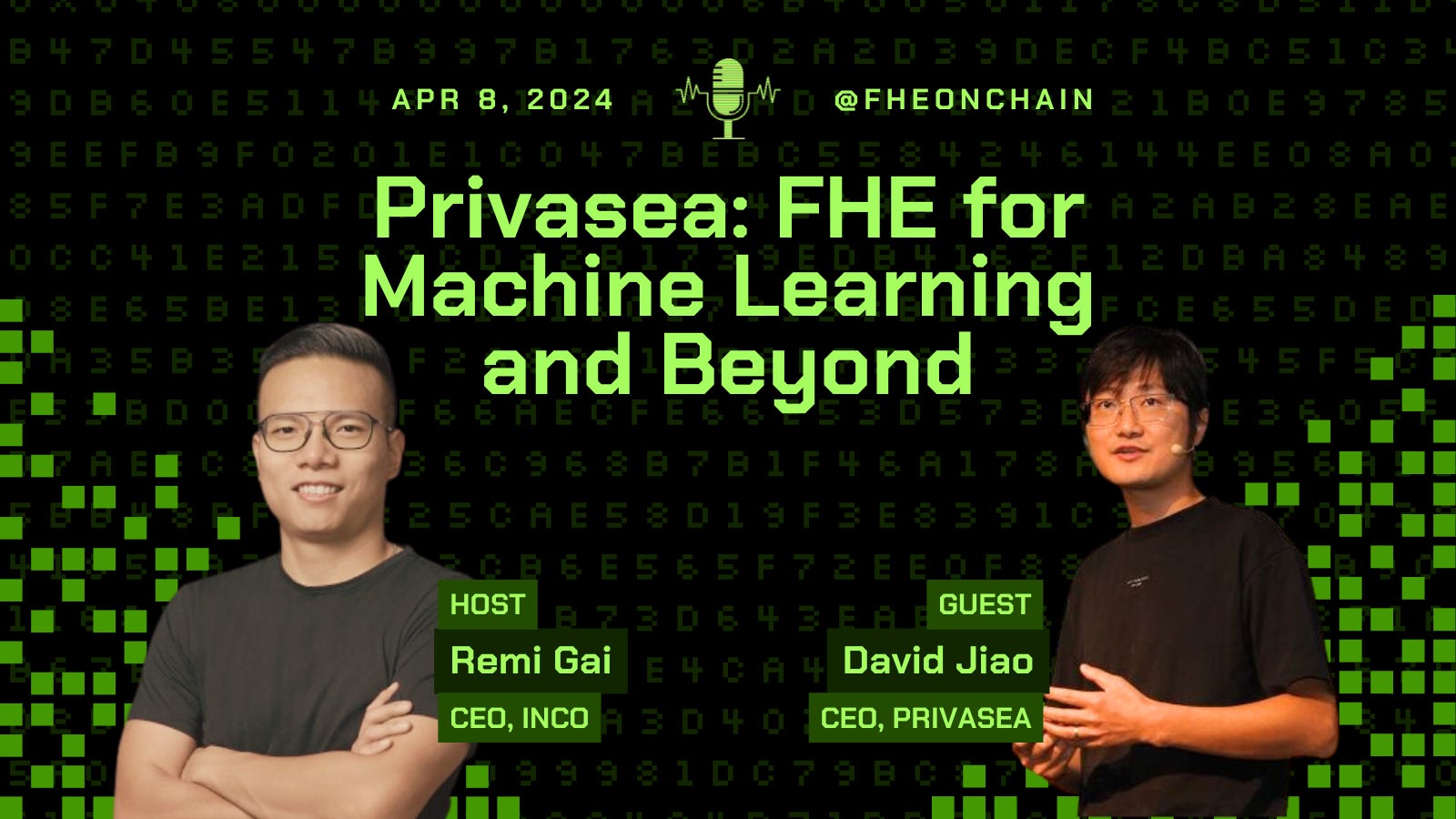
In this interview, Remi speaks with David Jiao, the Founder and CEO of Privasea, a company focused on onchain FHEML. Imagine being able to run powerful AI models on encrypted data without compromising confidentiality – that's the promise of FHE-ML.
In an age where data privacy concerns are at an all-time high, the intersection of Fully Homomorphic Encryption (FHE), Machine Learning (ML), and web3 offers an interesting solution to the problem.
Data stored on a centralized and isolated server has limited utility. However, by encrypting this data and distributing it across a decentralized network, while also allowing permissionless access for interaction, will significantly increase its value and usefulness.
Here is the detailed breakdown of the topics covered with timestamps for you to find the content in video form:
Introduction? 10 seconds →
David Jiao is the founder of Privasea, the world's first FHEML inference network.
David has worked in the AI space before entering the Web3 space, specifically self-driving cars.
Driven by his inspiration to build something at the intersection of AI and Blockchain, David began exploring FHE in 2022.
What is FHE-ML? 1 minute 10 seconds →
FHE-ML is defined by David as applying productional ML pipelines that leverage FHE to the ML process. This protects the security of the data during processing as well as when it is at rest.
Inference Definition 2 minutes 55 seconds →
Facial recognition is a good example. This works by showing a trained model a video or picture of a person’s face and the model can make inferences about the person’s mood or feeling.
The same also works for image recognition or classification.
How does FHE-ML solve problems with traditional inference models? 3 minutes 49 seconds →
There are no large problems unless the sensitive data is being used by an ML model, then there are privacy concerns.
Health data is hard to operate on for data privacy reasons which is the largest pain point that justifies FHE-ML.
The purpose of data is to be used, and if we can’t use it because it isn’t secure we need to find a way. That is where FHE-ML is great as it is perfect for ML models that contain highly sensitive data.
People can encrypt the data and build and run models on top of the data without it ever being leaked.
Privasea Architecture 5 minutes 55 seconds →
Privasea has a few core components: nodes hosting private models, some parts hosting the hidden data, and another part in charge of distributing the rewards.
Privasea is a great example of a DePIN project as it decentralizes ML operations.
DePIN + Privacy 9 minutes 11 seconds →
Through decentralization of ML operations Privasea can decrease the cost of this computation. The force multiplier here is that all the ML operations take place in a confidential state through FHE.
There are two sides to the network: supply and demand side. The supply side supplies hardware to the DePIN network, getting rewarded as they perform FHE computations. On-demand, users define ML models and pay gas fees for their models to run.
FHEML Example use case - Face Recognition 12 minutes 45 seconds →
One would encrypt the data which could be stored on IFPS, and the ML takes place which returns inferences, also encrypted. These can be decrypted by only you.
This system is also highly composable in that if you want to share the results of the ML operations that took place on your inputted dataset, you can simply permission access to another address. You could also gate this access in a variety of ways.
What are some models that work today with FHE? 16 minutes 10 seconds →
Given the hardware limitations of FHE, due to the weight of the computation, some FHE-ML use cases are not feasible yet. This will change as hardware accelerators release dedicated ASICs for FHE.
General image processing as well as analytics on financial data stand out as two use cases that are feasible today.
Ways to solve existing limitations of FHEML 17 minutes 31 seconds →
Hardware acceleration as previously discussed.
The second way for FHE-ML to accelerate regardless of hardware acceleration is through improvements in the efficiency of ML models.
What kind of models can be run in the future? 18 minutes 48 seconds →
Hopefully LLMs (like ChatGPT).
How will FHE-ML look like 3-5 years from now? 20 minutes 24 seconds →
Many of the models that work on Web2 will work on Web3 due to hardware acceleration.
We will see a focus on uses where the data needs to be confidential or compliant.
Training will also be enabled in addition to the current inference function.
Federated machine learning idea using FHE to be enabled in the future 24 minutes 26 seconds →
Confidential data analysis platform that leverages FHE 26 minutes 26 seconds →
It is feasible today to build a data plotting software where you can permission for others to use it to get certain insights. You can charge them for these insights that your model returns or gate it in some other way.
It is also possible to pay the people whose data you are using for the revenue their data generates.
In this insightful interview with David Jiao, the Founder and CEO of Privasea, we delved deep into the transformative potential of Fully Homomorphic Encryption (FHE) in Machine Learning (ML) – a realm where data privacy meets cutting-edge technology.
In today's data-driven world, privacy is paramount. Traditional AI inference models often raise concerns about data security, especially when handling sensitive information like health data. FHE-ML offers a solution by allowing encrypted data to be processed securely, without compromising confidentiality.
David provided a glimpse into Privasea's architecture, highlighting its decentralized nature and innovative approach to ML operations. By decentralizing ML computations and leveraging FHE, Privasea aims to revolutionize the way AI models interact with encrypted data.
From facial recognition to financial analytics, FHE-ML opens up a world of possibilities. By encrypting data and running ML models in a confidential state, organizations can derive insights while safeguarding sensitive information.
While FHE-ML holds immense promise, there are still challenges to overcome, particularly in terms of hardware limitations and model efficiency. However, advancements in hardware acceleration and model optimization are paving the way for a future where FHE-ML is more accessible and scalable.
As we peer into the future of FHE-ML, we envision a landscape where privacy and AI seamlessly coexist. With continued innovation and adoption, FHE-ML has the potential to transform industries, from healthcare to finance, and unlock new opportunities for secure data analysis and collaboration.
The journey towards privacy-enhancing technologies like FHE-ML is just beginning. With pioneers like Privasea leading the way, we are poised to witness a paradigm shift in how we approach data privacy and AI. As we embrace the power of encryption and machine learning, let us forge a future where privacy is not just a priority, but a fundamental right in the digital age.
The conversation about FHE Onchain and how it will change the future of Web3 and the world is happening now here and subscribe below for more content like this and make sure to follow our socials as well to stay up to date on the latest in the FHE Onchain space.
No posts
Comments
Nothing yet. Say the first thing.
Sign in to join the conversation.