
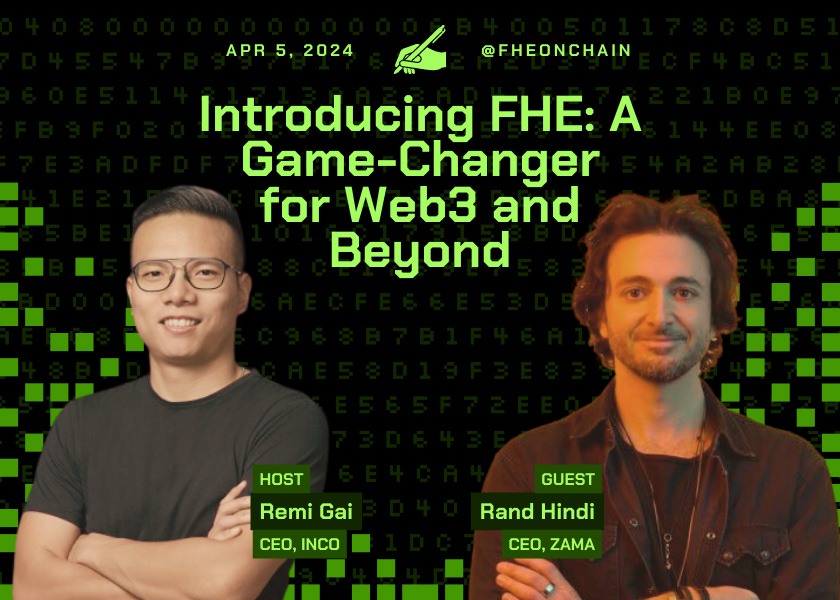
FHE Onchain has had a great first week since announcing our initiative and launching our first podcast with Rand Hindi and Remi Gai. As promised we have completed an in-depth write-up that covers everything Rand and Remi discussed during their alpha-packed, 45-minute interview. Enjoy and please share if you find the content to be educational!
Overview of the Podcast
Rand and Remi covered everything from the basics of FHE and the inception of Zama to the killer use cases they both envision and hope to see come to life in the coming years. They discussed hardware acceleration, how it will change the way FHE functions, and what use cases FHE has PMF for. Additionally, they also discuss what the long-term vision for FHE as a transformative technology looks like. The pair also deliberated on what being the founder of a deep tech company looks like and the general GTM strategy for FHE. This interview is the perfect primer for anyone new to the FHE x Blockchain space, and Rand and Remi made sure of that.
What is FHE? 25 seconds →
Defined by being able to compute on encrypted data without decrypting.
Enables highly secure operation on sensitive data as the data itself is never shown in plaintext, rather it is simply queried while still in cyphertext.
Known as the “holy grail of cryptography.”
History of FHE 1 minute 50 seconds →
“Private homomorphisms” have been around since the late 70’s with RSA (public key decryption scheme), but FHE (fully homomorphic encryption) has not been possible in its current and fully-fledged form until now.
Older versions of homomorphic encryption were unbelievably slower and far less useful in the operations one could do on encrypted data.
In 2010, Craig Gentry made a massive breakthrough with the theorem of bootstrapping. Bootstrapping solved the noise problem by recursively decrypting and re-encrypting data before the noise level got to a point at which it would compromise the quality of the data.
Pascal Paillier, the CTO and Co-Founder of Zama had a breakthrough that sped up the already more fully enabled homomorphic encryption now referred to as FHE.
Inception of Zama 2 minutes 42 seconds →
Rand was working at his previous company, working on confidential AI when he met Pascal. Around the same time, he learned of FHE and he called up Pascal, sure that this would be the future.
At the time, FHE was still incredibly inefficient, but a few years later they founded Zama, a company dedicated to making FHE commonplace.
GTM In Deep-tech Markets 4 minutes 2 seconds →
Any Go-To-Market strategy in the deep-tech sector is defined by the ability to create a market for the new technology you intend to bring to market.
The inherent nature of deep-tech necessitates that you get a product to market to test its fit, and really if the market you thought exists even does. In this respect, it took Zama a while to go from the whiteboard to having a working product they could offer builders.
Why FHE x Blockchain? -- Why FHE Onchain? 5 minutes 20 seconds →
Given that they are public by default, and many onchain use cases necessitate some sort of confidential state, introducing FHE is only the next natural step towards mainstream adoption for Web3.
New technologies tend to scale before they become secure or start considering user privacy in earnest. Venmo and the early internet are great examples of this trend.
With FHE x Blockchain you can maintain the upsides of blockchain (public verifiability, consensus, and decentralization) while adding the ability to program confidentiality right into any chain in a highly composable way.
Rand asked Remi a great question: “How many Web2 products that you use, would you use if all the data was publically available for anyone to see?” Remi predictably and rationally answered: “Not many.” This is the way we should think about building in an onchain space that has programmable confidentiality enabled: we are currently building use cases in that small “not many” subset of use cases.
The Use Cases 6 minutes 47 seconds →
One of the largest unlocks, as Rand sees it, is financial applications (DeFi). Simply put, if blockchain is going to become the financial rails of the world, every data point cannot be public by default. There needs to be ways to permission this data and mask it.
Payroll is another huge opportunity. Web2 payroll utilizes ACH payments and wires, both confidential, while Web3 payroll generally operates in stablecoins, directly onchain. This will continue to be a pain point as the number of people being paid in stablecoins grows.
Identity stands out as another incredible opportunity for FHE onchain.
Being able to hide sensitive user information onchain and then being able to operate on it without converting it to plaintext is a game changer.
Onchain credit, KYC, attestations and more...
Governance is another space for innovation as the current public paradigm has significant social consequences.
Consequences of the Public Paradigm 9 minutes 10 seconds →
Leaking sensitive data onchain is stopping mainstream adoption. Even in Web2 people’s data is not as secure as it should be.
If we want to use blockchain as the value layer of human coordination, revealing everyone’s bank (and other info) is quite a risky practice.
Fundamentally, people are very protective of two types of personal data: health nd finance. In the current public paradigm neither one of these industries can build in earnest onchain for this reason.
Cypherpunk Manifesto 11 minutes 32 seconds →
Was written by cypherpunks in the early 90’s laying out what precautions must be taken as the world enters the digital age. The two main points were the need for a digital financial system and confidentiality.
Satoshi the inventor of Bitcoin was a cypherpunk himself and solved the first point of a digital financial system. Confidentiality was solved by the early internet, but we have still not seen the combination of both.
Digital, decentralized, permissionless, confidential transactions are the answer to the Cypherpunk Manifesto.
Why Rand cares about Confidentiality 13 minutes 1 second →
Rand built a social network back in 1999 (before Facebook) and part of this application was the ability to send messages to other users. A bully at school was brought to the end of his misbehavior by Rand telling him all the embarrassing things that he had said on Rand’s app.
While Rand had stopped the bully, he felt that he had compromised something very important: user privacy. He also thought that if he was able to do this, who else was? Was someone watching him?
This was a formative experience and pushed him to work at the forefront of confidentiality-enhancing technologies. He says “I won’t stop until the whole internet is encrypted end-to-end.”
Roadmap of FHE 15 minutes 46 seconds →
The first step is to make FHE work: this means making it highly accessible to developers by abstracting the cryptography into a familiar language.
The markets for FHE are tricky because the tech is so new, but Zama sees blockchain as an incredible market for FHE because everything onchain is public, meaning the need for FHE is very black and white. Additionally, blockchains are very slow and expensive compared to centralized Web2 services, making them perfect for FHE while it is limited by computing power.
HTTPZ is the endgame: an end-to-end encrypted internet.
Roadblocks for FHE 19 minutes 24 seconds →
Back in 2020, FHE was very slow, hard to use, and very limited in the use cases it could be used for. Now with the TFHE-rs library, any developer who knows Solidity can leverage FHE in their smart contracts, any type of operation is possible, and Zama has made FHE 100x faster (without hardware acceleration).
Hardware acceleration stands out as the major roadblock to building the HTTPZ dream. FHE is computationally heavy, given the nature of conducting operations over cyphertext. FHE ASICs are coming in the next 18 months and are on track to bridge the final gap to make FHE possible for any application, no matter how high the throughput.
FHE x Blockchain (Use Cases) 22 minutes 43 seconds →
Having a way to verify someone’s identity onchain without seeing their information is going to be key for compliance and also anti-gaming measures (sybil-resistant airdrops). Checking credit scores is a great example of this and could enable many applications across the Web3 space. This could bring under-collateralized credit fully onchain.
The primary reason for blockchains is moving money, without some confidentiality, many people who haven’t used Web3 applications never will.
Healthcare onchain is another huge unlock. An onchain 23andMe will become possible with FHE x Blockchain.
Web2 x Blockchain 28 minutes 45 seconds →
Every SaaS company eventually will use FHE to minimize their risk of losing sensitive use data.
Most Web2 companies keep data encrypted at rest, but FHE will enable them to keep their data encrypted end-to-end.
Data marketplaces will be a huge market for FHE because you can store data, permission who gets to operate on it, and then only let them decrypt their result when they have paid whatever you are charging for operating on your data. The amazing thing is that none of the operators will ever see any of the data. The end of data leaks.
Gaming 31 minutes 45 seconds →
Without hidden states, bringing many games fully onchain will be impossible. Good examples are battleship, hangman, and poker.
Wordle and Geoguesser are interesting games to try to build with TFHE.
Check out this Arcade for some working FHE-enabled games.
Confidential DeFi 35 minutes 21 seconds →
Confidential DeFi has been discussed, but how do we do this? Tarun of Gauntlet has discussed this at length as well. The trick is not leaking confidential information through smart contract logic.
There are many ways to surmise confidential data without knowing it, but with FHE there are ways around this. Noise in the public data is one way of solving this problem.
For example: if the goal to to protect against MEV, then all we have to make confidential is the amount and price of the trade, and not the amount in the AMM.
Randomness 38 minutes 12 seconds →
Randomness is important for games, infrastructure, and other applications, and with FHE we can now generate encrypted random numbers. This means that people cannot see the number, which is very important in most applications where a random number is needed in the first place.
Seems like a simple thing, but confidential randomness that is fully onchain is a huge unlock for many use cases, especially in the gaming space.
Conclusion
After an exhilarating first week of unveiling FHE Onchain, highlighted by our inaugural podcast featuring Rand Hindi and Remi Gai, we are thrilled to present this comprehensive recap of their discussion. Covering a spectrum of topics from the fundamentals of FHE to the inception of Zama and its transformative potential in the realms of web3 and beyond, the conversation was nothing short of enlightening.
Delving into the intricacies of homomorphic encryption, Rand and Remi illuminated its evolution from its inception in the late 1970s to its current iteration, marked by exponential advancements and breakthroughs. With a keen focus on Zama's mission to democratize FHE, the discussion ventured into the nuances of GTM strategies in the deep-tech sector and the significance of confidentiality in the age of blockchain.
The discourse also touched upon the imperative of programmable confidentiality in revolutionizing various sectors, ranging from finance and identity verification to governance and healthcare. By bridging the gap between public verifiability and user privacy, FHE x Blockchain emerges as a pivotal paradigm shift poised to redefine the digital landscape.
With an eye towards the future, Rand and Remi envisioned a world where FHE seamlessly integrates into everyday applications, propelling us towards a future characterized by encrypted end-to-end transactions and the realization of the Cypherpunk Manifesto's vision.
From unlocking new possibilities in DeFi to revolutionizing gaming and ensuring confidential randomness, the potential applications of FHE are boundless. As we embark on this transformative journey, we invite you to join us in exploring the limitless possibilities at the intersection of FHE and web3. Together, let us champion a future where confidentiality and innovation converge to shape a more secure and empowered digital ecosystem.
The conversation about FHE Onchain and how it will change the future of Web3 and the world is happening now, join us here and subscribe below for more content like this.
No posts
Comments
Nothing yet. Say the first thing.
Sign in to join the conversation.