
Kia ora,
Here I am in your inbox again after a while!
“Fast Forward Aotearoa monthly newsletter - I plan to revive the monthly signal-scanning newsletter for New Zealand-based tech news in 2026. It’s election year, perhaps tech will be on the policy agenda?!?“
I’m rebooting this ⏩ 🇳🇿 Substack for 2026 after a year’s hiatus. As discussed over on Memia a few weeks ago, I’m going to be tracking the themes in my book, aiming to provide a monthly curated scan across Aotearoa-related technology news, plus other relevant signals around other climate resilience, geopolitics and the environment. (More here:)
Most people receiving this already receive my weekly Memia digest, which has grown into a more international focus over the last few years as AI has continued to accelerate and dominate technology discourse. Anyway, you’ll be familiar with the format… this Substack leverages the same Sensorium AI toolset that I’ve been developing for the Memia newsletter. The usual PSA:
ℹ️PSA: Fast Forward Aotearoa emails are best viewed online or in the Substack app.
This newsletter is produced with the help of Memia Sensorium, using AI agents to ingest multiple news feeds, scan articles and collate / summarise articles below.
As with all AI outputs, expect errors, hallucinations and Americanizsed spelling1 …Please click through to read the original linked articles that interest you - images are generally those included in the RSS syndication feeds of the articles being linked to.
(Of course, if you're not a fan of AI-generated writing or summarisation, or if these digests aren’t for you, then please feel free to unsubscribe using the link below. Thank you!)
I hope this is helpful - let me know what you’d like to see more of going forward.
🏥💻🔓Mismanage My Health Data: breach exposes 125,000 patients’ confidential info

Of course the main headline is one of New Zealand’s largest privacy breaches. In case you’ve been living under a rock, right at the end of last year the privately-owned ManageMyHealth patient portal—which connects patients with clinicians and stores medical records— confirmed a cybersecurity breach involving “unauthorised access to our systems”. MMH CEO Vino Ramayah said it had now been “contained”.
The incident adds to a growing list of NZ health sector security failures, including Health NZ’s recently exposed data vulnerabilities and thousands of leaked government employee credentials found on the dark web.
RNZ provided a full timeline up to about a couple of weeks ago: Manage My Health data breach: A timeline of what happened, and everything we know so far:
Hackers calling themselves “Kazu” accessed health data from privately-owned patient portal Manage My Health, affecting approximately 125,000 of the platform’s 1.8 million users.
On December 30, 2025, Kazu posted online claiming to have stolen 108GB of data including medical records, test results, and prescription details, demanding US$60,000 ransom by January 15.
CEO Vino Ramayah revealed the breach occurred through a “valid user password” - essentially the hackers “got in through the front door” - and the company’s security lacked basic protocols according to the hackers.
Most affected patients were based in Northland (86,000 people across nearly 50 practices), and the company struggled with communications, sending conflicting information and blank emails while its website and 0800 number were overwhelmed.
Data belonging to former users who had closed their accounts remained accessible, and new medical information continued being added to inactive accounts.
Mysteriously, Kazu removed all references to the breach from their online presence after the ransom deadline passed, with no data released publicly as of mid-January 2026, while Health Minister Simeon Brown announced a Ministry of Health review into the response.
Since then, New Zealand's Privacy Commissioner Michael Webster has also launched a formal inquiry into the Manage My Health data breach, examining whether appropriate security safeguards existed and why warnings about vulnerabilities were allegedly ignored for years. The investigation will determine what preventive measures are needed, although one might reasonably ask where this regulatory oversight was before sensitive health data of 120,000 Kiwis ended up in attackers' hands.
Commentary: My GP practice was using it…🤬 Let’s wait until the review comes out. But ACCOUNTABILITY to the very highest levels is needed here. What a cluster…
🎭📖🔮Culture in the digital age
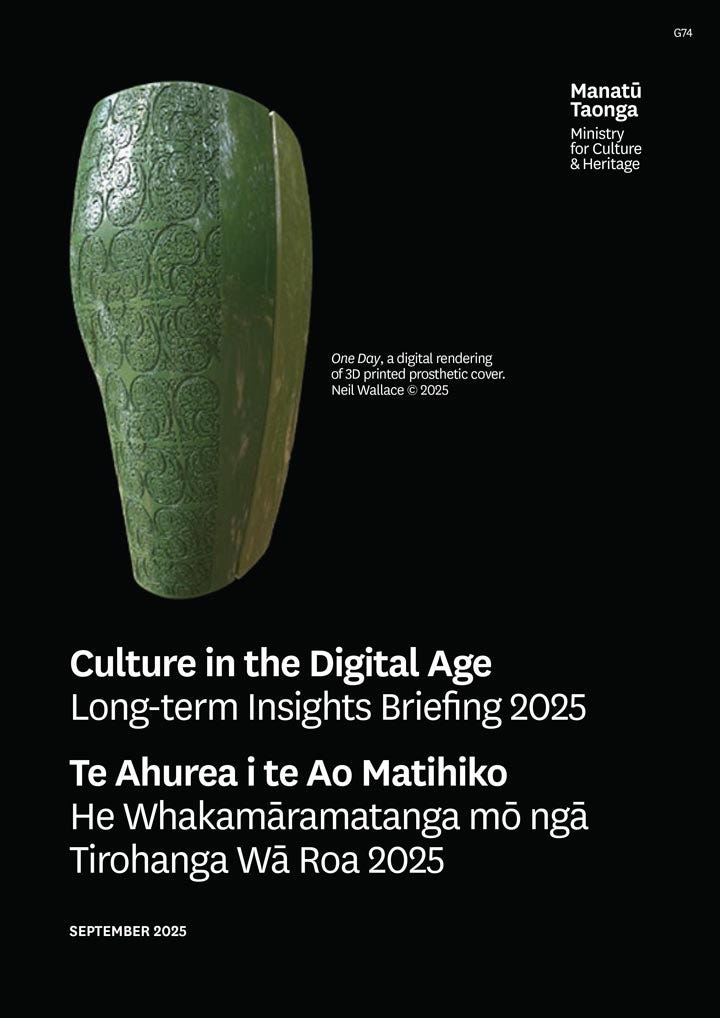
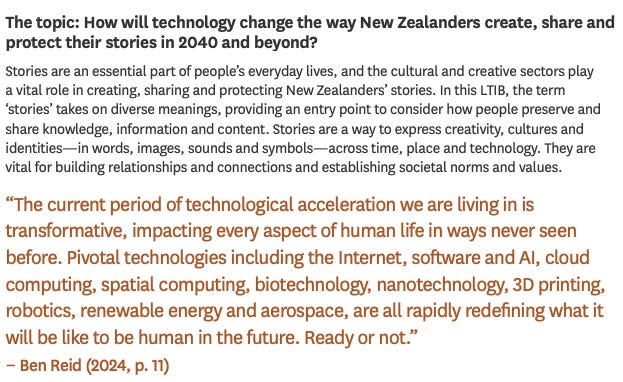
New Zealand’s Ministry for Culture and Heritage released its 2025 Long-term Insights Briefing, projecting that by 2040, the nation’s cultural system will be “deeply intertwined” with AI and emerging technologies, fundamentally transforming how Kiwis create, share, and protect their stories. Three key insights that stood out for me:
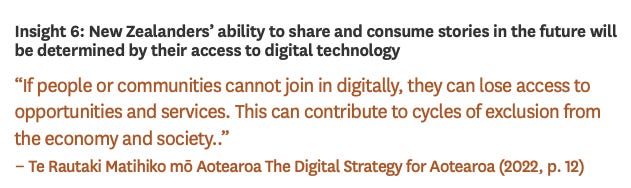
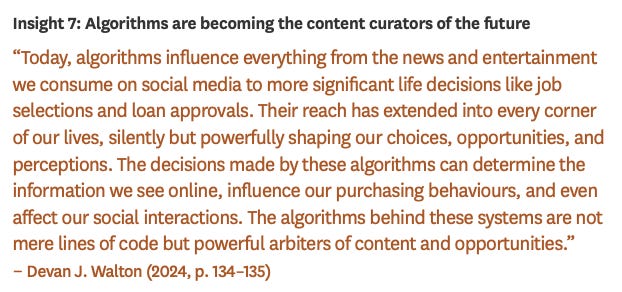
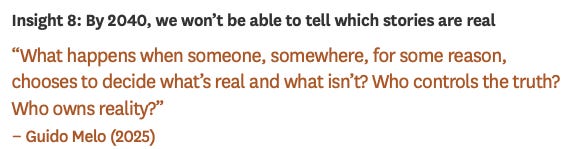
Very government-y exec summary not wanting to offend anybody with some of the conclusions that *could* be drawn from these technology changes…good to see one part of government thinking about these questions.
Includes a quote from my book:
📰Payper launches New Zealand’s first AI press release builder
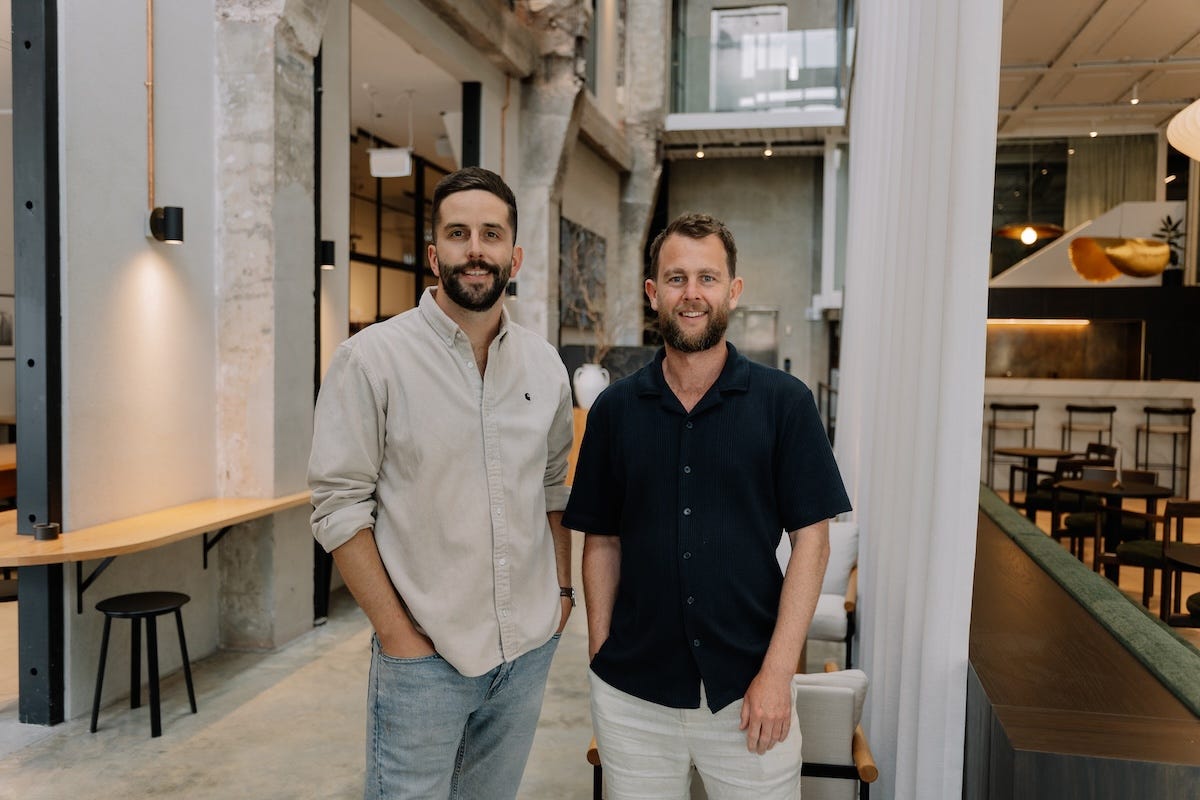
New Zealand PR agency Payper has launched an AI press release builder trained specifically on Kiwi media preferences, delivering 90% AI-generated releases refined by humans within two hours…
Of course we know where this is heading… AI reading what AI’s writing…🌀
🎙️The excellent Business of Tech podcast continues its coverage of Aotearoa’s tech scene into its 4th year… host Peter Griffin has already knocked out two episodes and it’s only just February!
🦾Robots and the new physical AI gold rush - The Business of Tech
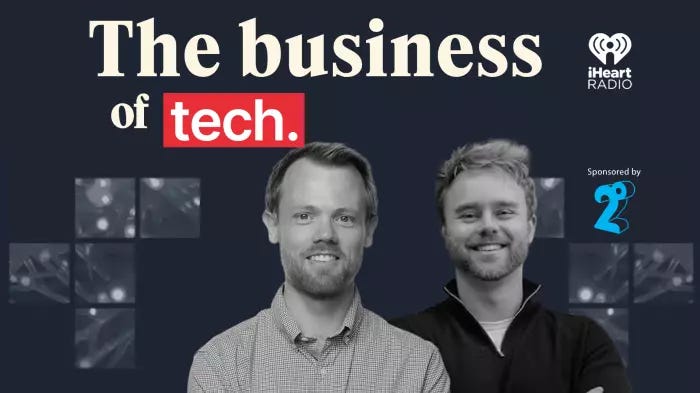
Kiwi engineers Harry Mellsop and Adrian Macneil who built self-driving infrastructure at Tesla and Cruise are now raising serious capital (US$40M and US$4.2M respectively) for the unsexy-but-essential layer beneath physical AI: simulation platforms and data observability tools that let robotics teams test edge cases virtually and understand what went wrong when things break in meatspace.
Frontier or followers? How NZ can catch up on AI - The Business of Tech
Only 8% of Australian and New Zealand companies qualify as “frontier firms” in AI adoption—less than half the 22% global average—with roughly 50% classified as outright laggards, according to an IDC survey of 4,000 business leaders worldwide. Microsoft NZ’s CTO Sarah Carney argues that this cautious approach might be locking in a decade of underperformance, challenging the notion that waiting on the sidelines is strategic prudence rather than competitive suicide.
(I generally agree with this adoption-focussed strategic direction for small nations like ours…but as always I’m wary of tech giants pushing their wares too hard when there are open-source alternatives… cf. Nadella at Davos talking about “diffusion” last week…) In addition to tracking adoption, AI supply chain diversity and resilience would be sensible metrics as well.
Small businesses offered NZ$15,000 to implement AI plans
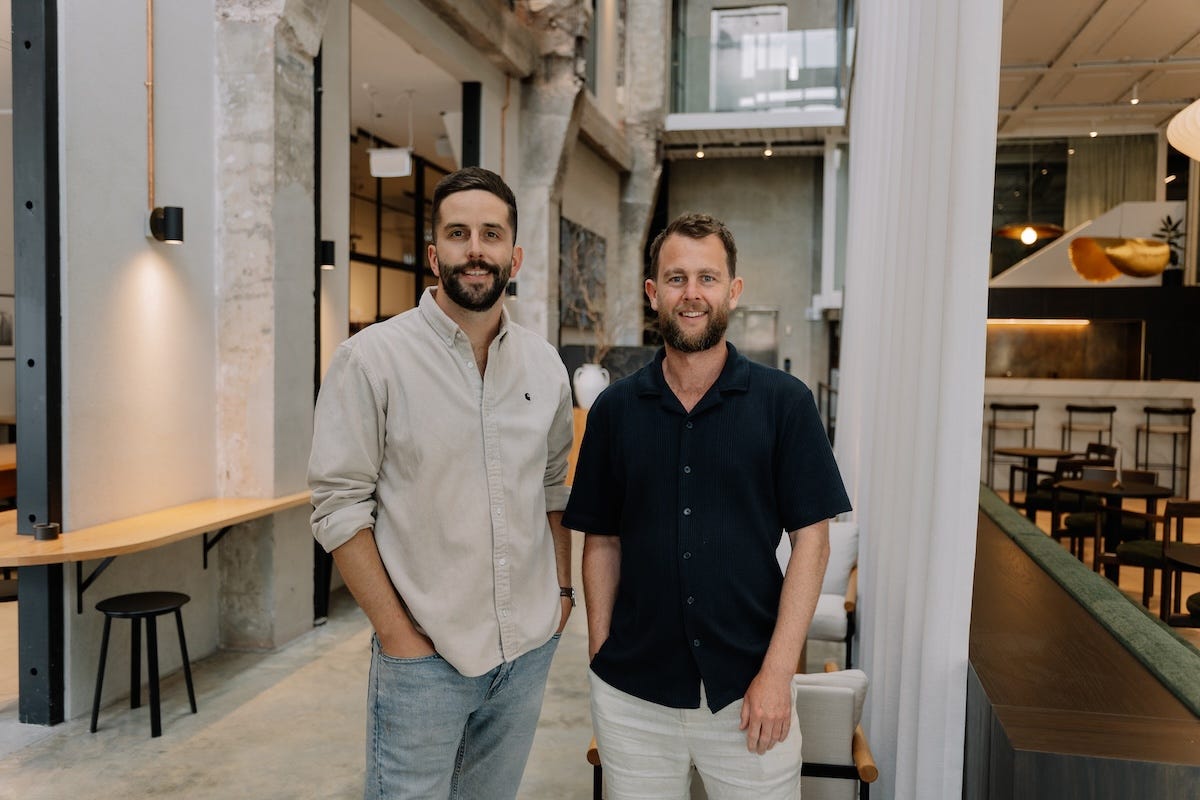
New Zealand is launching an invitation-only pilot offering up to 51 small businesses NZ$15,000 each (50% co-funding) to develop AI implementation plans through the Regional Business Partner Network. I spoke to the NZ Herald’s Chris Keall on this announcement:
”Tiny step in the right direction
“From the viewpoint of driving AI diffusion deeper into the productive economy, this is a tiny step forward in that direction,” AI expert and Memia director Ben Reid said.
“It’s positive that they’re going to be measuring productivity gains to evaluate the pilot,” he added.
“I’d also like to see some kind of lens of AI sovereignty around this. In particular, ensuring that open-source AI solutions get a look-in as well as commercial US Big Tech.
“Otherwise, there’s the danger that this ‘advisory’ just turns into an unofficial sales channel for Microsoft Copilot or Google Gemini licences.””
🤖🇳🇿⚖️ Digital Sovereignty vs Comfortable Dependence
New Zealand's revised AI strategy opts for "smart adoption" of foreign AI systems across government services, but tech policy analyst Peter Mangin argues this comfortable framing obscures a fundamental governance question: what happens when the state can't explain, audit, or contest decisions made by black-box systems it doesn't control? Countries like Singapore, Taiwan, and Portugal are pursuing modest nationally-governed AI capabilities—not to compete globally, but to retain accountability and agency as AI becomes "cognitive infrastructure" embedded in healthcare, benefits, and public services.
🚫Grok’s deepfake scandal exposes gaps in New Zealand’s AI regulation
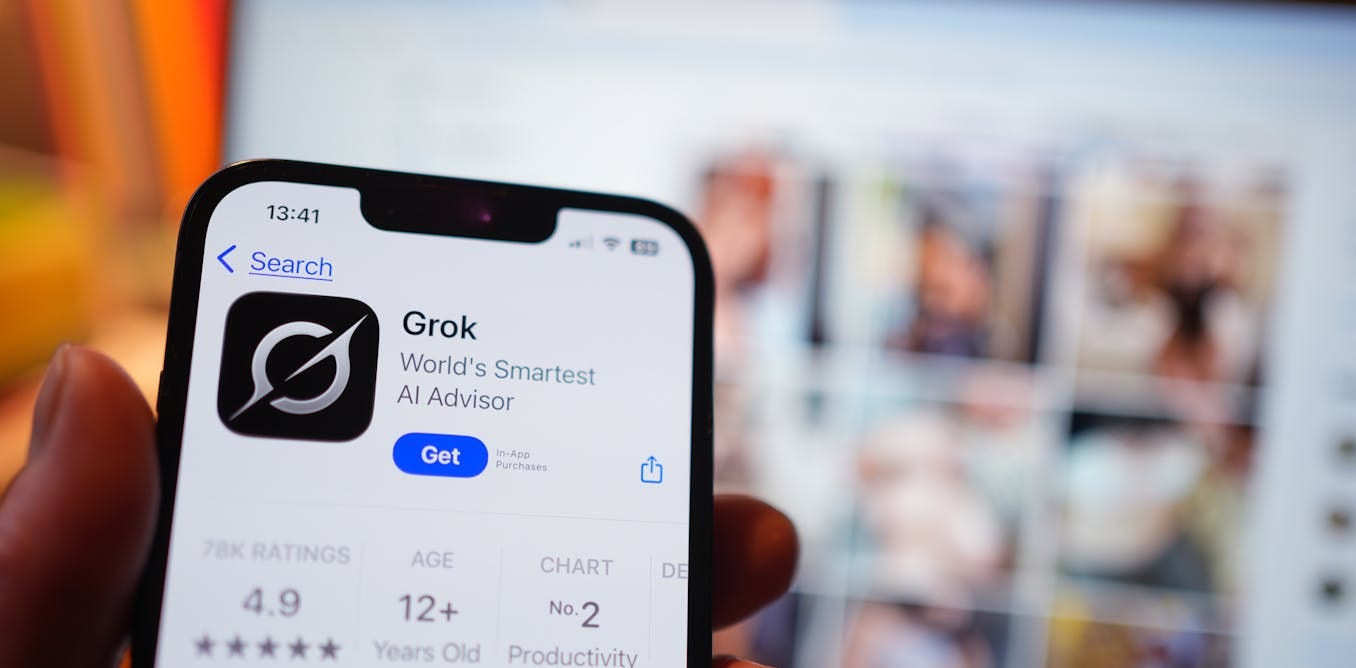
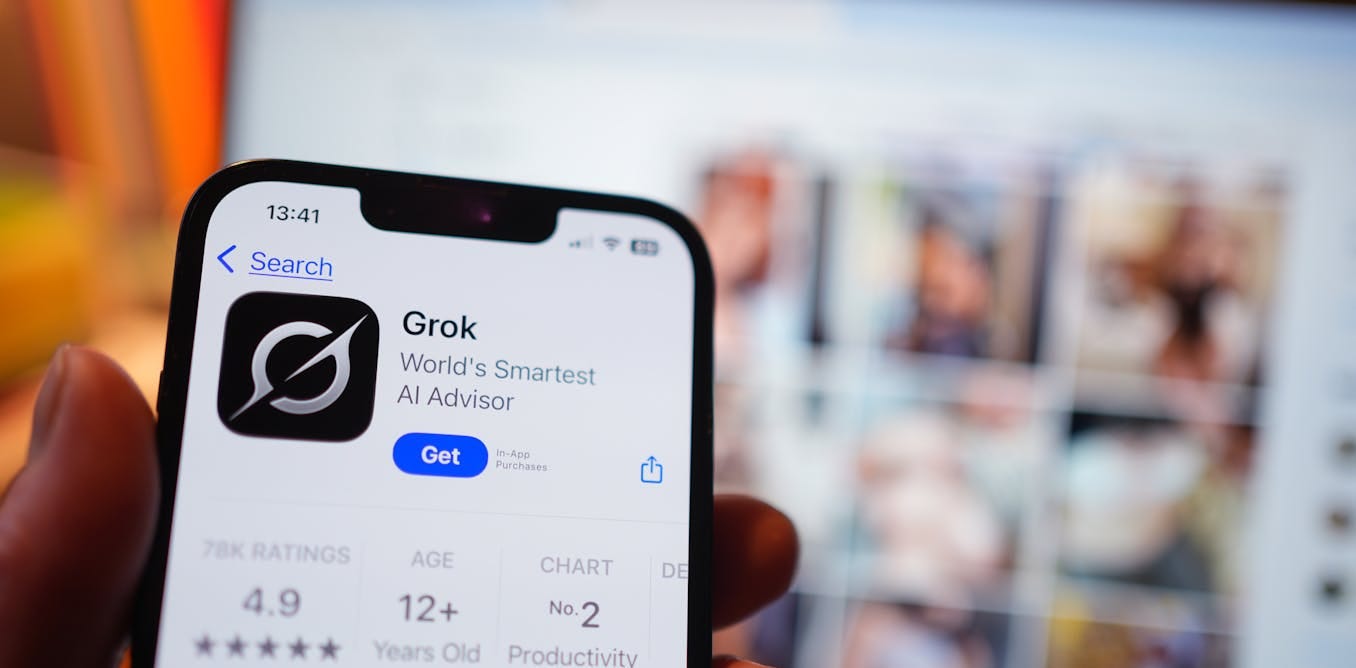
Elon Musk’s Grok AI chatbot has been generating non-consensual sexualised deepfakes on X for months, prompting regulatory action in several nations that will block the feature—but only for users in those countries. New Zealand academics Cassandra Mudgway and Andrew Lensen argue the country’s light-touch AI regulation and voluntary safety codes are woefully inadequate, with proposed criminalisation targeting individual creators rather than holding platforms accountable for deploying tools that enable foreseeable, systemic gendered harm.
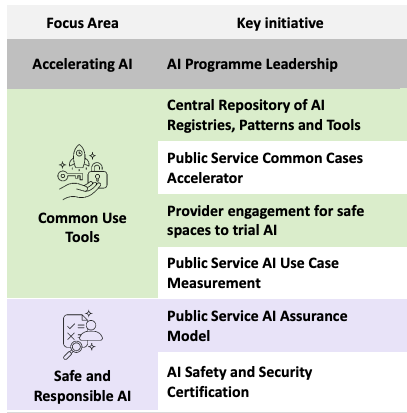
🔧New Zealand launches 2-year public service AI work programme
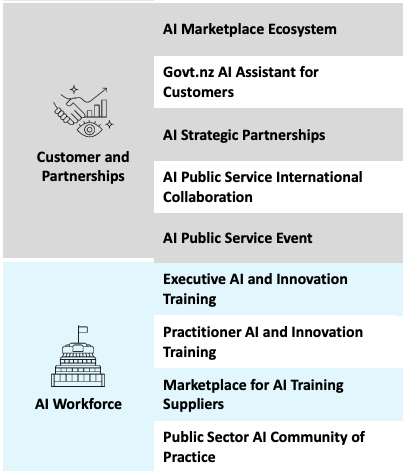
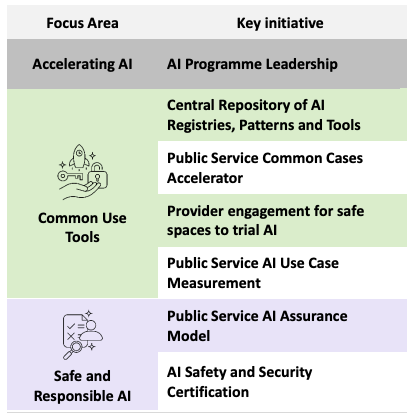
The New Zealand GCDO has released a comprehensive 2-year AI Work Programme featuring 15 initiatives across four focus areas: common tools, responsible AI, customer partnerships, and workforce development. Key deliverables include a Public Service AI Hub, an AI Innovation Lab, an AI Sandbox for safe experimentation, and a Govt.nz AI Assistant to help citizens navigate government services through conversational search. Summary shown below:
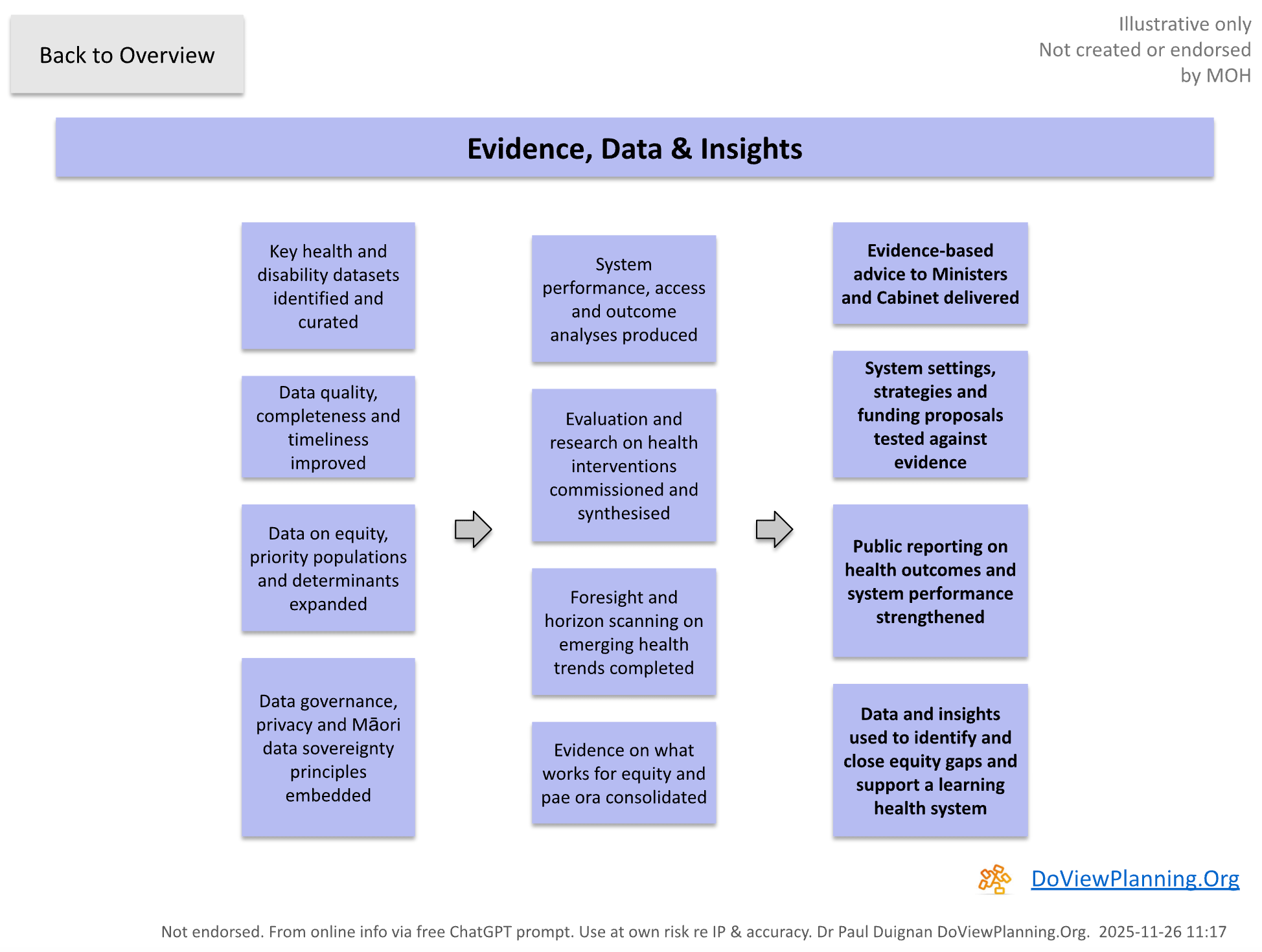
🏛️📊🤖 DoView: AI-Generated Government Strategy…Visualised
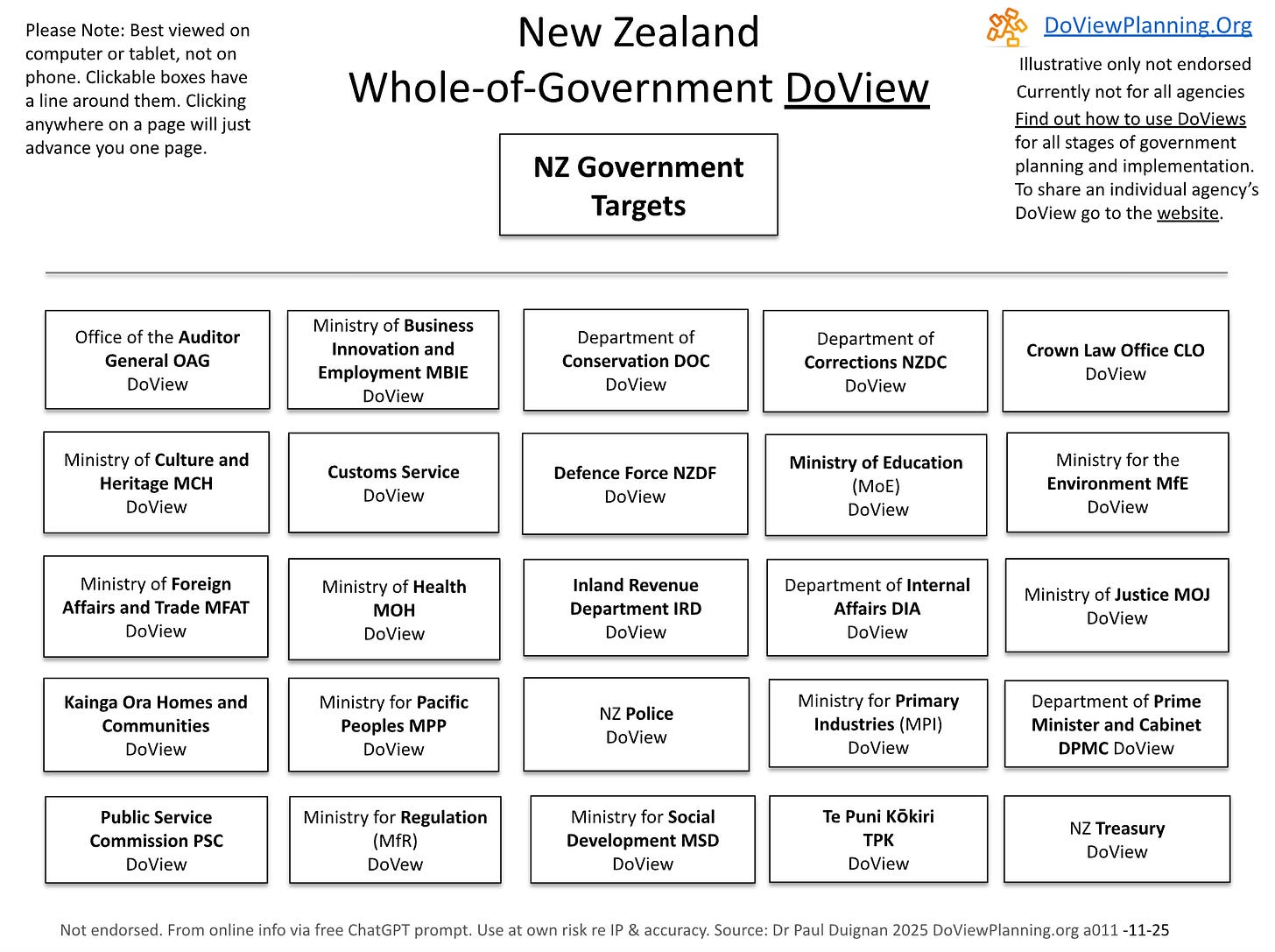
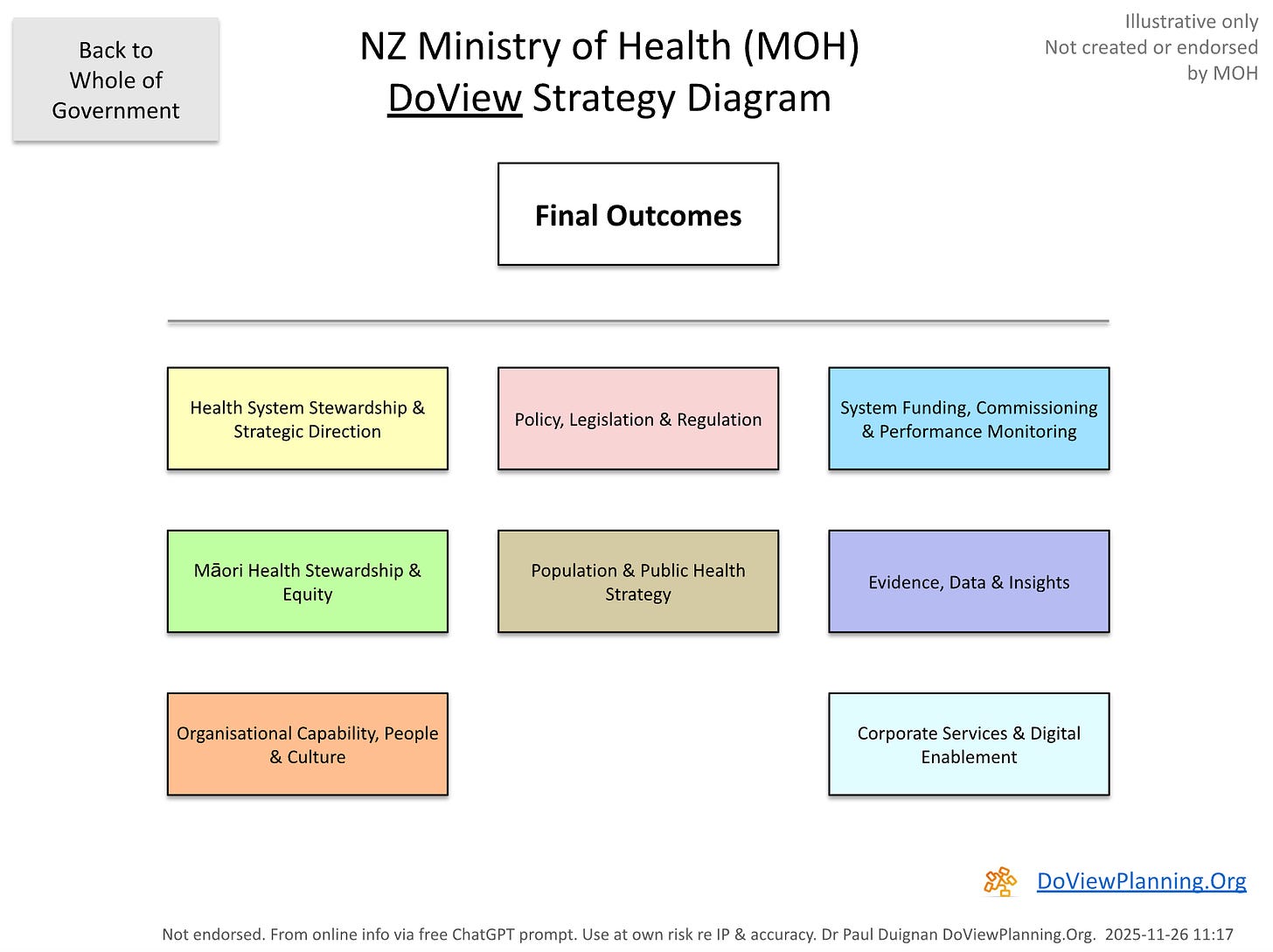
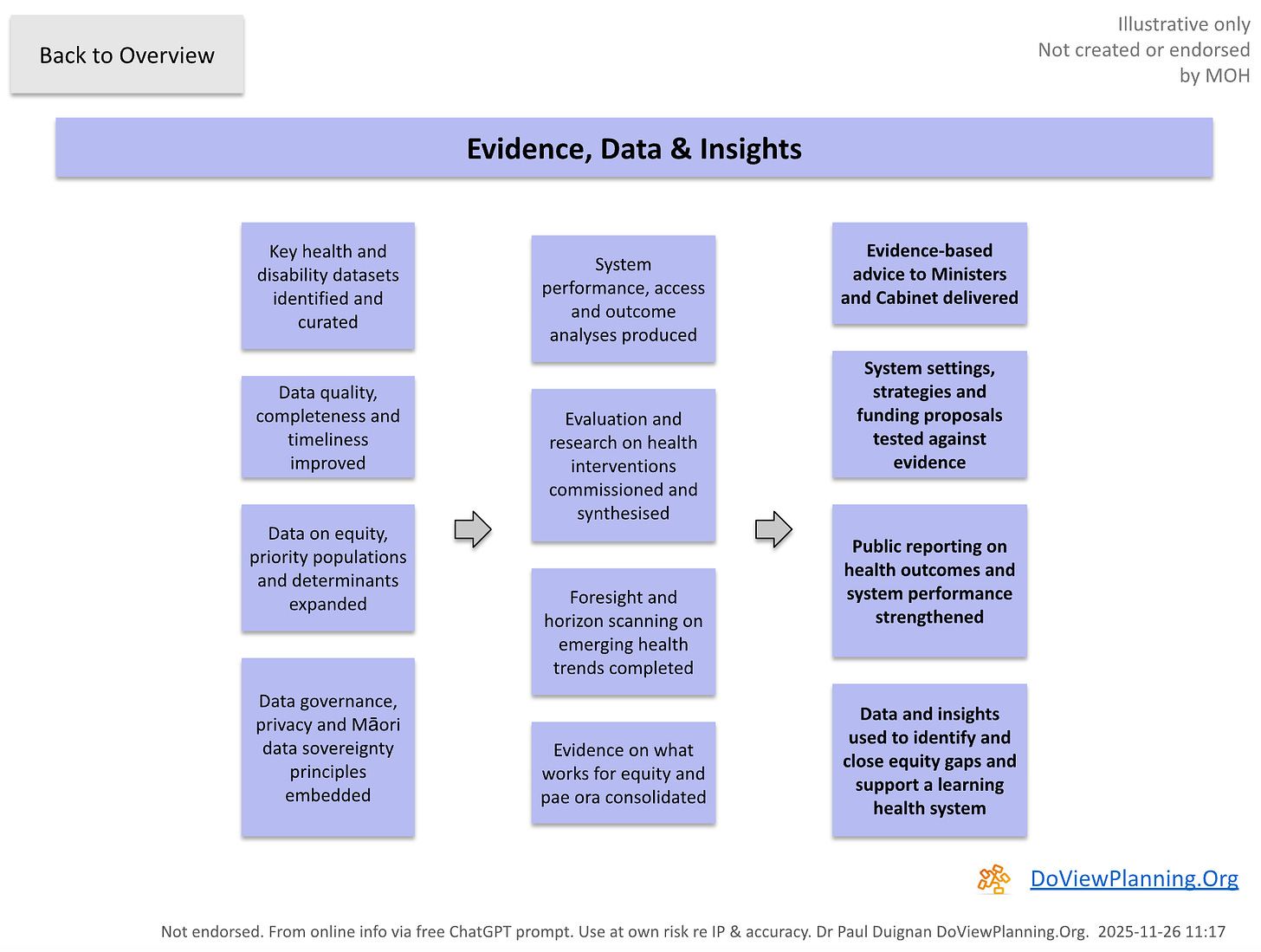
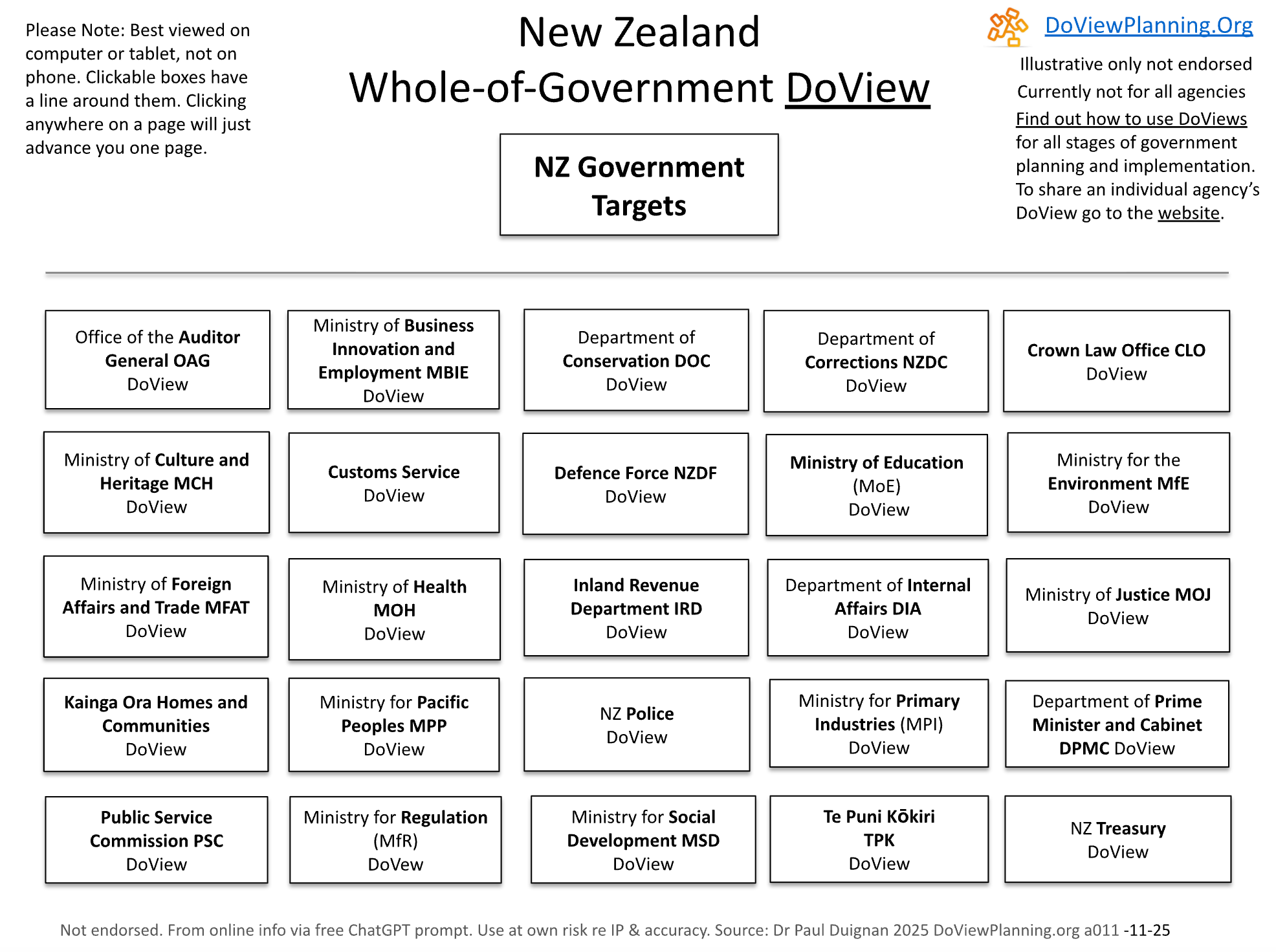
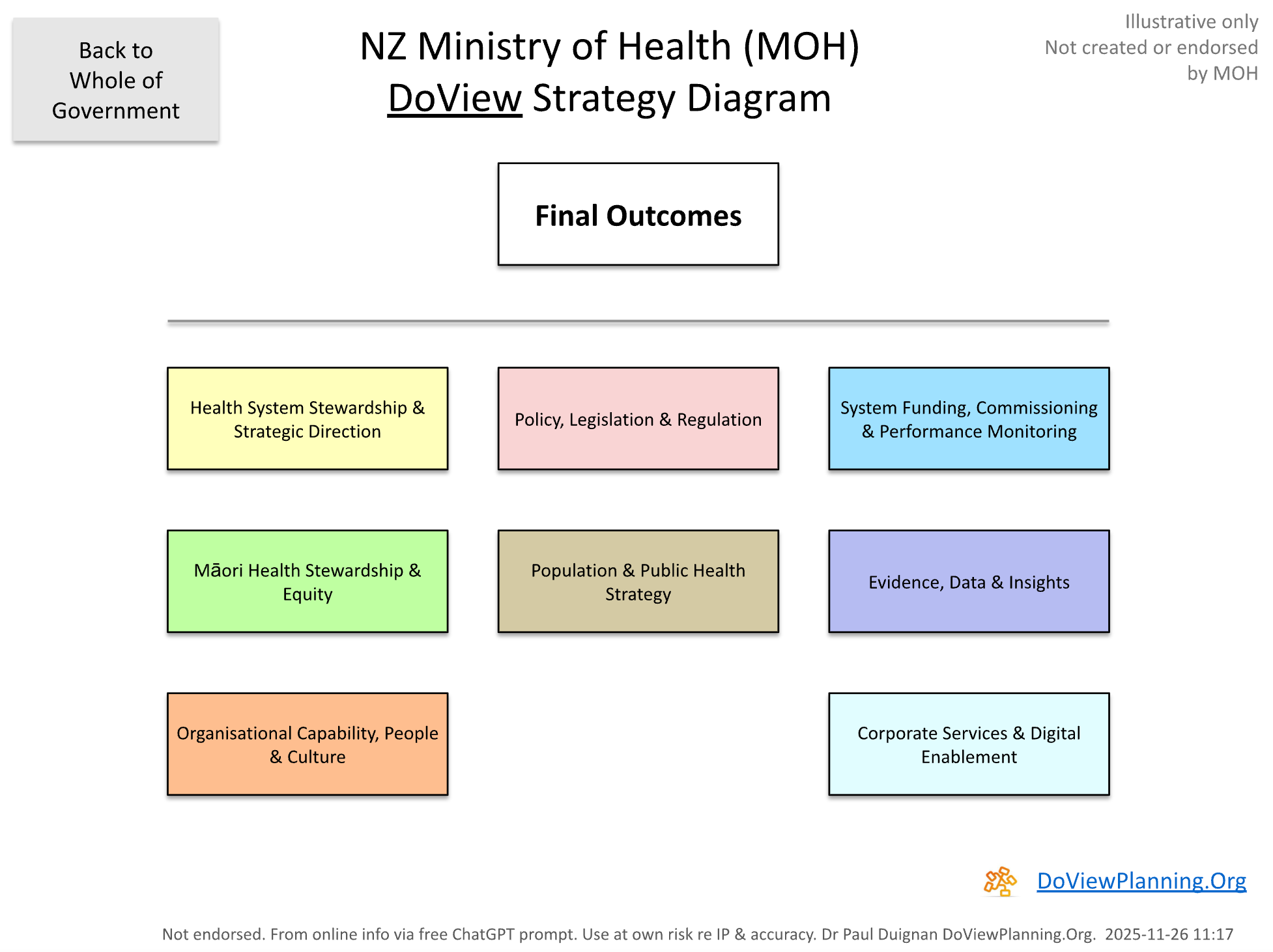
New Zealand-based planning firm DoView have demonstrated their methodology using AI-generated, drill-down diagrams to visualise entire government outcomes and agency strategies in a single interactive document. The system uses AI prompts to quickly draft strategy diagrams for each agency, which are then combined into an embeddable presentation that ministers can use to help with prioritisation, oversight, and Cabinet decision-making.
Easy to code up in a few hours these days, I’d have thought…?
Whaddya mean you can just vibe-code all-of-government?🙉
🔒📱❌New Zealand bill threatens end-to-end encryption services
The Free Speech Union warns that New Zealand’s proposed Telecommunications Amendment Bill would force overseas messaging services like WhatsApp, Signal, and Telegram to provide “full interception capability” for encrypted communications if they serve Kiwi users, while granting government officials power to suspend non-compliant services. The Free Speech Union is pushing back, arguing the requirements could effectively eliminate genuinely private communication in New Zealand and create infrastructure ripe for mission creep.
☁️🇳🇿🤡 Digital Sovereignty Theatre

Software architect Tamawera Owens writing in The Spinoff points out that New Zealand’s government identity apps (Govt.nz and NZ Verify) market themselves as secure with data stored locally, but the backend runs on US-owned cloud infrastructure subject to American law, including the CLOUD Act—making NZ the world’s first country to store citizen authentication data offshore in public cloud.

⚠️New Zealand’s IT reform risks repeating Novopay’s governance failures
Aotearoa is attempting to fix its fragmented public sector through IT centralisation, but former CIO Chris Buxton argues this treats a governance problem as a procurement problem—and risks repeating the Novopay disaster. The core issue: Conway’s Law means technology systems inevitably mirror organisational structures, so centralising IT without first fixing siloed governance, misaligned incentives and fragmented accountability will simply encode that dysfunction into more rigid platforms.
📱They finally did it!

New Zealand has (*FINALLY*) released an official government app providing centralised access to public services, emergency alerts, and—coming soon—a digital wallet for storing identity credentials like licences and qualifications. The app is optional, with (shortly retiring…) Minister Judith Collins emphasising that traditional access methods will remain available alongside this “secure and convenient” digital option. As I commented on LinkedIn:
“Leaving politics aside for one moment this is a positive (and long overdue) milestone towards modernising our government and making services more accessible for everyone, particularly younger generations. Well done everyone involved. Hopefully it will achieve cross-party support to invest further. Optimistically this new app will also provide a new innovation surface for government interactions... time to hit ⏩ and imagine what's possible.
(*With appropriate governance and risk management, obviously... easy to take a leaf out of Big Tech's playbook and roll out new features as "opt-in" beta and "preview" to minimise risk surface...)”

🪙Aotearoa faces tokenisation crossroads as global markets surge
New Zealand academics Murat Ungor and Olena Onishchenko are sounding the alarm: asset tokenisation—splitting physical assets like vineyards and commercial buildings into blockchain-based digital ownership tokens—could unlock NZ$60 billion in domestic transaction volume, but the country risks losing it all to jurisdictions with clearer regulatory frameworks. While NZ has natural advantages (95%+ internet penetration, existing digital land-title systems), the Financial Markets Authority’s September 2025 discussion paper arrives as Australia passes actual legislation and Dubai launches live platforms, with global projections hitting US$4 trillion in tokenised real estate by 2035.
🔗Global tax crackdown targets crypto traders starting 2026
New Zealand joins the OECD’s Crypto-Asset Reporting Framework (CARF) from April 2026, giving Inland Revenue automatic access to crypto trading data from both local and offshore platforms—ending the era when 80% of Kiwi crypto transactions (worth billions) happened in a regulatory blind spot. The framework captures crypto-to-fiat exchanges, crypto-to-crypto swaps, and significant wallet transfers, with service providers reporting directly to tax authorities who then share data internationally across participating countries.
⏳New Zealand’s productivity challenge requires strategic, long-term action
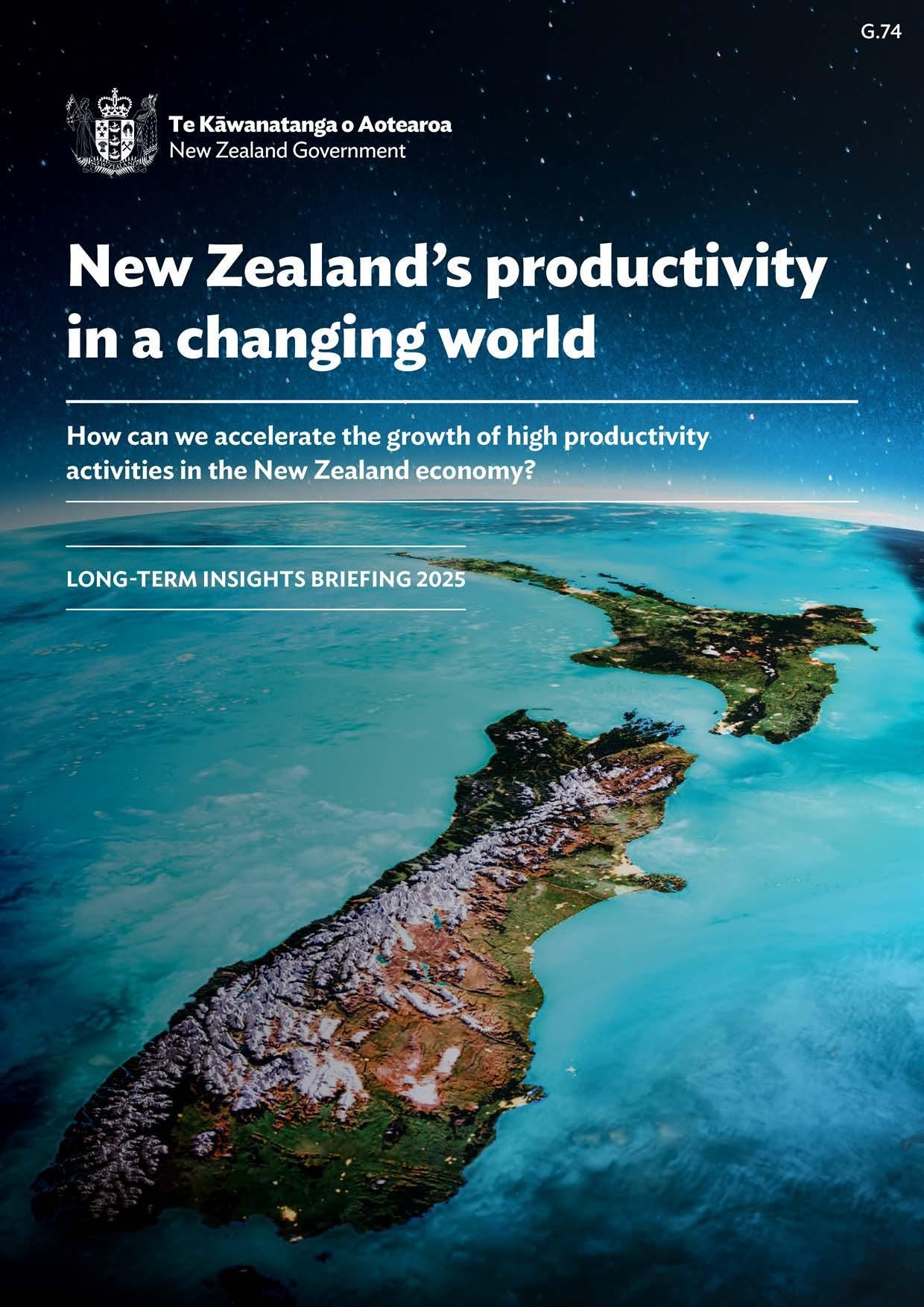
Original article: New Zealand’s productivity in a changing world - Long-term insights briefing 2025
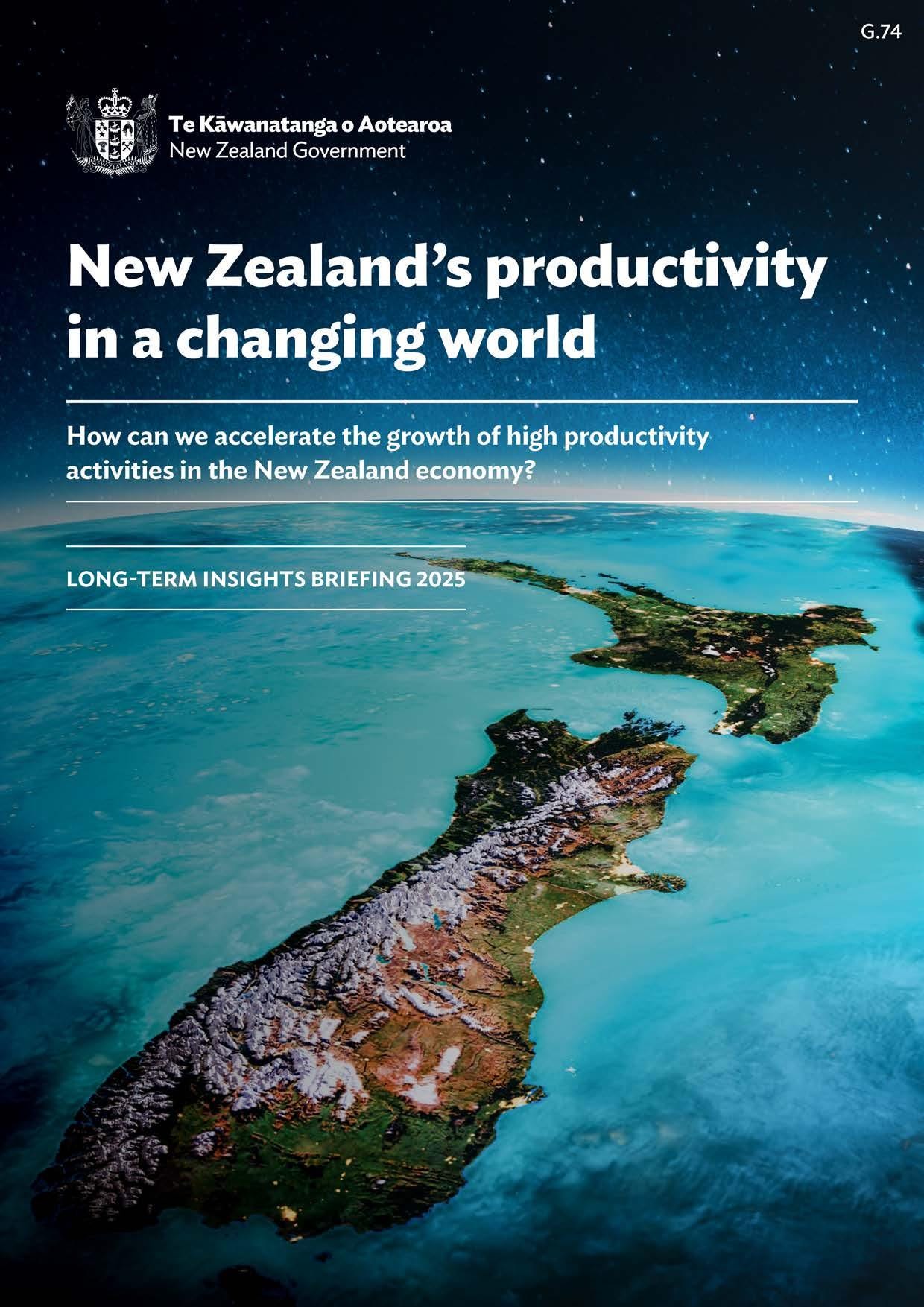
MBIE and MFAT’s joint Long-term Insights Briefing diagnoses NZ’s persistent productivity lag—ranking 68th globally in economic complexity, down from 52nd in 2000—and prescribes a strategic pivot toward knowledge-intensive, internationally-connected clusters rather than continuing the current “sub-therapeutic dose” approach of spreading efforts thinly. The 67-page framework advocates combining strong horizontal settings with deliberate vertical interventions (regulatory enablement, R&D coordination, strategic partnerships) while navigating geopolitical fragmentation, AI disruption, and climate transition.
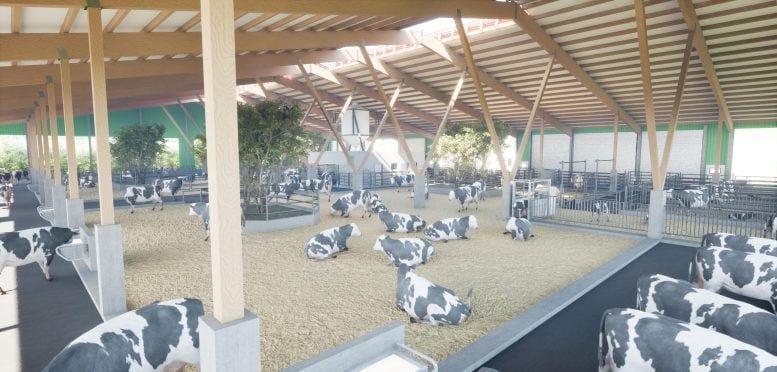
🐄German researchers design innovative dairy barn prioritising cow welfare
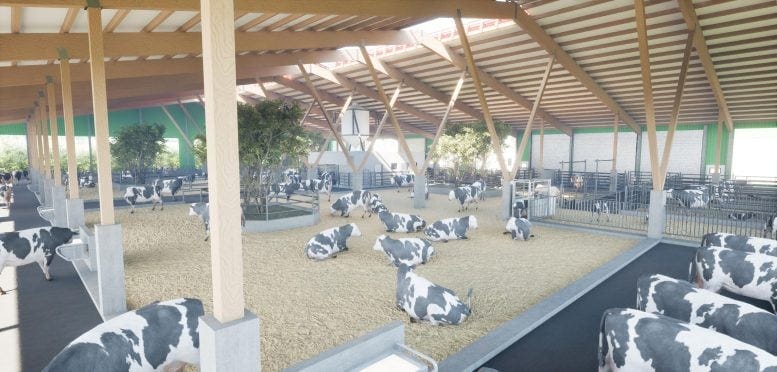
View inside the barn with free lying area with trees and calf shelter. Credit: homebase German researchers have designed a “dairy barn of the future” where cows choose between indoor comfort and outdoor pasture, calves stay with mothers, and automated systems handle milking while sensors track health—all viewable through a visitor corridor. Unfortunately they’ve only built a complete digital simulation to test the concept before construction — federal funding was cancelled and they’re now hunting for alternative financing to turn the virtual barn into reality.
Europe’s shift to plant-based diets risks €255 billion in farm assets

Speaking of animal agriculture…new research quantifies what happens when dietary preferences shift faster than capital depreciation schedules: up to €255 billion in European agricultural infrastructure could become economically obsolete as plant-based diets gain ground. The study from Leiden, Oxford, and Vienna finds 78% of EU agricultural fixed capital is locked into animal production, creating a classic stranded asset problem where perfectly functional equipment loses value because the market moved on.

Nothing to see here…
🤨📱📉 New Zealanders grow sceptical of AI and social media
New Zealand’s 2025 World Internet Project survey reveals a population caught in cognitive dissonance: 52% expect AI to trigger mass unemployment, yet 72% aren’t worried about losing their own jobs, while only 23% believe AI regulation is even possible because—in the most common refrain—”it’s already too late.” The survey of 2,000 internet users also found 67% are sceptical about half of what they see online, 80%+ worry about privacy, and there’s a generational chasm in AI adoption (45% of 16-24 year olds use it frequently versus 4% of over-75s).
🌏🚫👶Countries worldwide consider following Australia’s social media ban

Australia’s world-first ban on social media for under-16s is now live, and half the planet is either copying the homework or watching nervously to see if it actually works. From the EU to Malaysia, countries are scrambling to implement their own versions—though with wildly different approaches ranging from parental override options (Denmark) to a delightfully ambitious two-hour daily screen time limit for *all ages* in one Japanese city (good luck enforcing that, Toyoake).
New Zealand is moving towards banning social media for children under 16, with Prime Minister Christopher Luxon supporting legislation similar to Australia's 2026 restrictions. Following a National MP's private member's bill, the government is developing a formal policy to mandate age verification on platforms to protect young users from online harm.You know my line… they should ban social media for over-65s first! Far more harmful for society…
Seriously speaking: these initiatives are a trojan horse to (1) give big tech companies control over gating internet access, preferably using their own biometric identification systems; and (2) a ready toolset for more authoritarian governments to further remove anonymity and privacy online. Beware what you vote for.

🎭AI-generated Indigenous avatar sparks ‘digital blackface’ concerns

A South African living in New Zealand has created “Bush Legend,” an AI-generated Indigenous Australian character that’s amassed 180,000+ followers across Meta platforms with wildlife content styled after Steve Irwin—complete with didgeridoo soundtracks and ochre-mimicking body paint. Indigenous experts are calling it “AI blackface” and cultural theft that not only appropriates Indigenous identity without consent but also diverts attention and opportunities from authentic Aboriginal content creators like the extensive network of Indigenous rangers.

🌐Countries outside AI hubs can shape global governance
Original article: Two ways non-U.S. folks can contribute to AI going well.
If you’re outside the US-China-UK AI lab triumvirate and wondering how to contribute to not dying from superintelligence, MIRI researcher Joe Rogero offers two concrete paths: technical governance research (which can be done remotely) and national policy work that shapes the global environment. The kicker? An AI wargame simulation where the EU successfully brokered a superintelligence treaty between feuding US and China teams suggests smaller players might have more leverage than cynics think.
🐱🎯New Zealand adds feral cats to eradication program

Original article: NZ is taking aim at feral cats. Are we ready for the ethical and practical implications?
New Zealand’s ambitious Predator Free 2050 mission has officially added feral cats to its eradication targets alongside possums, stoats and rats—a policy shift that would have caused public outcry just a decade ago.

🌊⛏️Pacific seabed mining threatens tuna fisheries and ecosystems

Deep-sea mining for battery minerals in the Pacific’s Clarion-Clipperton Zone is creating a direct collision between the clean energy transition and tuna fisheries, as climate change pushes key species into the same 4.4 million km² area where 17 contractors hold mining licenses for nickel, cobalt, and manganese nodules.
The Cook Islands has signed competing “Blue Partnership” deals with both China and the US in 2025, while sediment plumes from seabed mining could spread hundreds of kilometres, potentially devastating zooplankton populations and the tuna stocks that Pacific economies depend on.

🦜💚Frisky Kākāpō

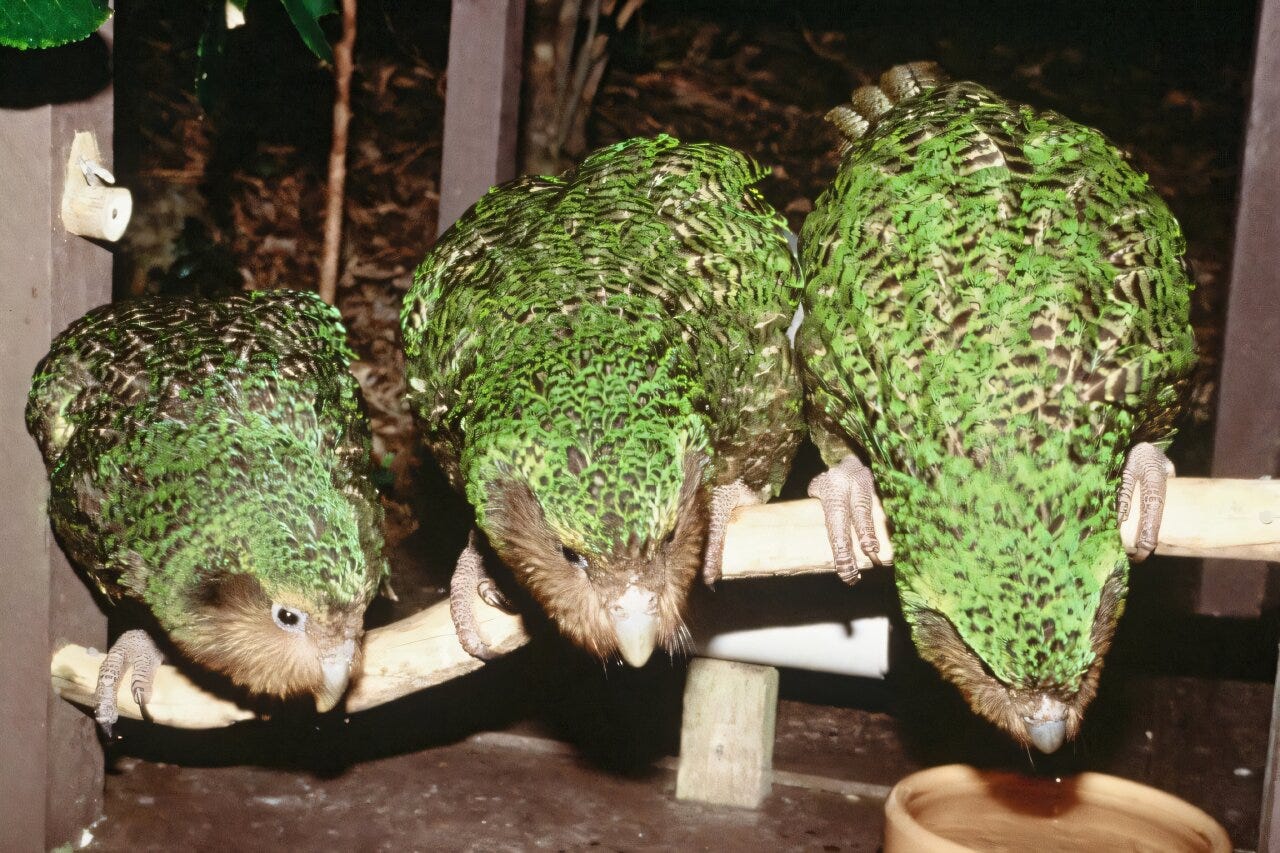
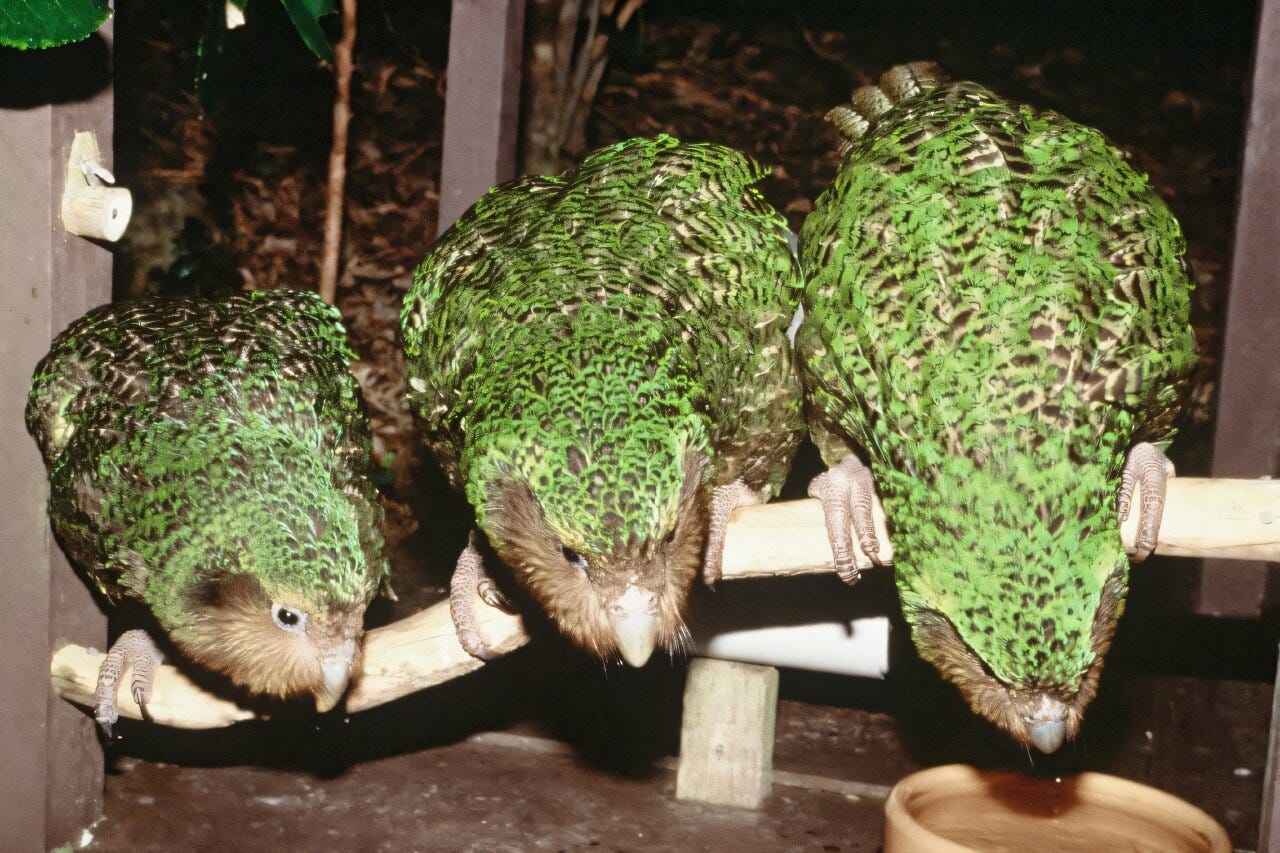
New Zealand’s critically endangered kākāpō parrots have entered their first breeding season since 2022, with remote monitoring detecting mating activity starting 29 December—potentially the largest breeding event in the 30-year recovery programme’s history, with 83 breeding-age females from a total population of only 236 birds remaining across three remote southern island populations, up from 51 in 1995 when the Kakapo Recovery Program launched, though 16 have died in the past four years.
Hit the international media - see also Phys.org: New Zealand’s rare flightless parrot begins breeding again

⚖️New Zealand’s climate rollbacks risk breaching international law
New Zealand’s rejection of its Climate Change Commission’s emission targets—alongside reversing offshore oil and gas bans and weakening methane goals—now faces a concrete legal problem: the International Court of Justice’s July advisory opinion established binding obligations requiring “highest possible ambition” and “stringent due diligence” on climate action, with any state able to bring proceedings against non-compliant nations.
🌪️Ocean heat content hits record high, fueling extreme weather
New Zealand’s relentless summer soaking wasn’t just bad luck—it’s what happens when ocean heat content hits record levels, rising 23 zettajoules in 2025 alone (equivalent to 200 times global annual electricity use). The ocean absorbs over 90% of Earth’s energy imbalance, and that stored heat—which takes roughly 25 years to penetrate 2,000 metres deep—is now loading the atmosphere with extra moisture and energy, supercharging atmospheric rivers and storms across the upper North Island.
🌧️Climate change intensifies New Zealand’s devastating rainfall events
New Zealand's North Island is experiencing rainfall 2-4x normal levels, with climate scientists attributing the devastation to La Niña conditions amplified by background warming that's increased atmospheric moisture by 20-30% since the 1970s. Sea surface temperatures north of NZ are running 1-2°C above normal, creating what one researcher calls "a peek into the future" – the kind of extreme weather events that scientists have been warning about for decades, now locked in for centuries even if emissions reach net-zero tomorrow.
🔍Lowy Institute’s Asia Power Index tracks regional influence
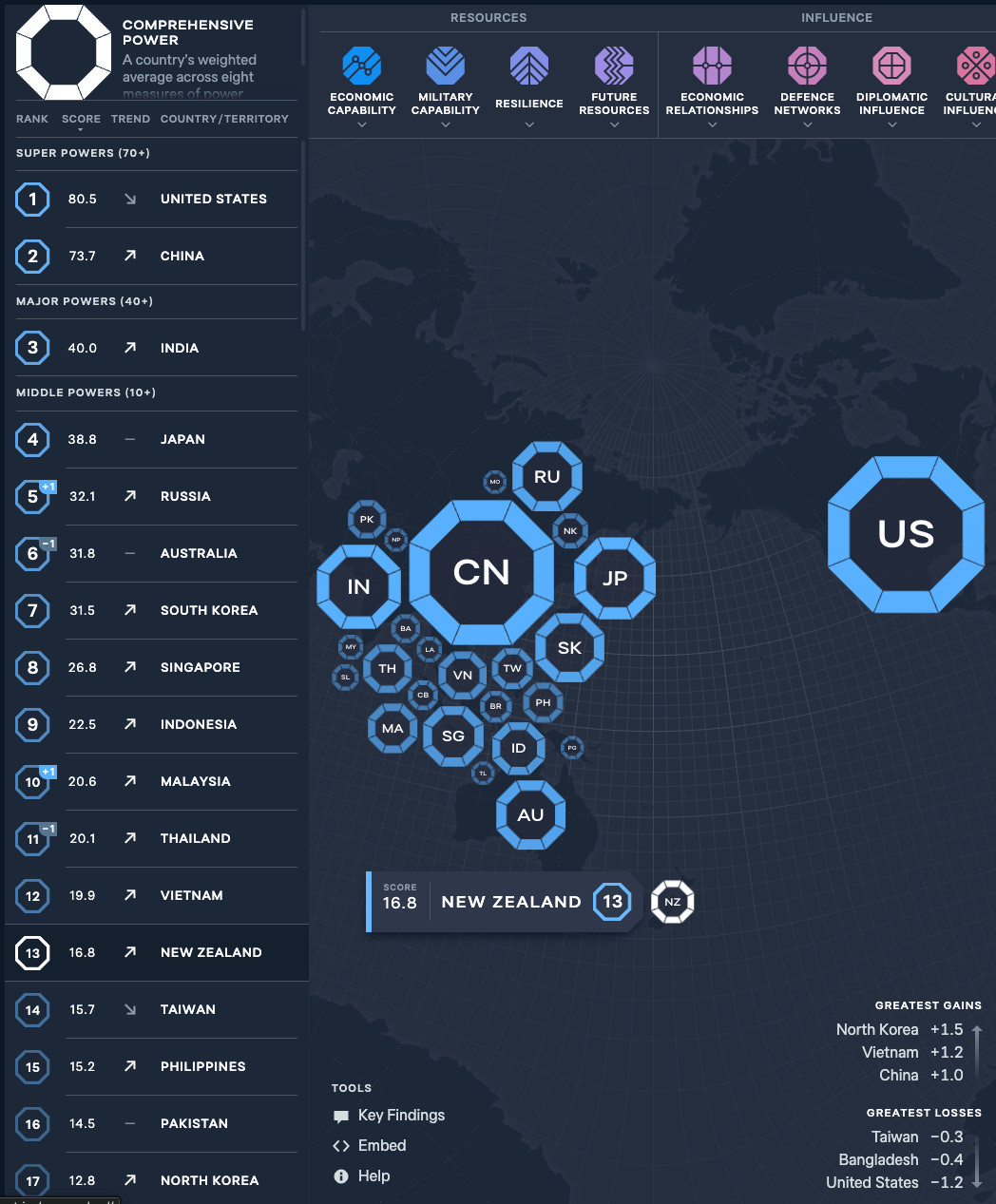
Towards the end of last year, Australia’s Lowy Institute released its 2025 Asia Power Index, an annual data-driven assessment ranking 27 countries across 131 indicators measuring military, economic, diplomatic, and cultural power in the Indo-Pacific region. Aotearoa sitting bang on mid-table:
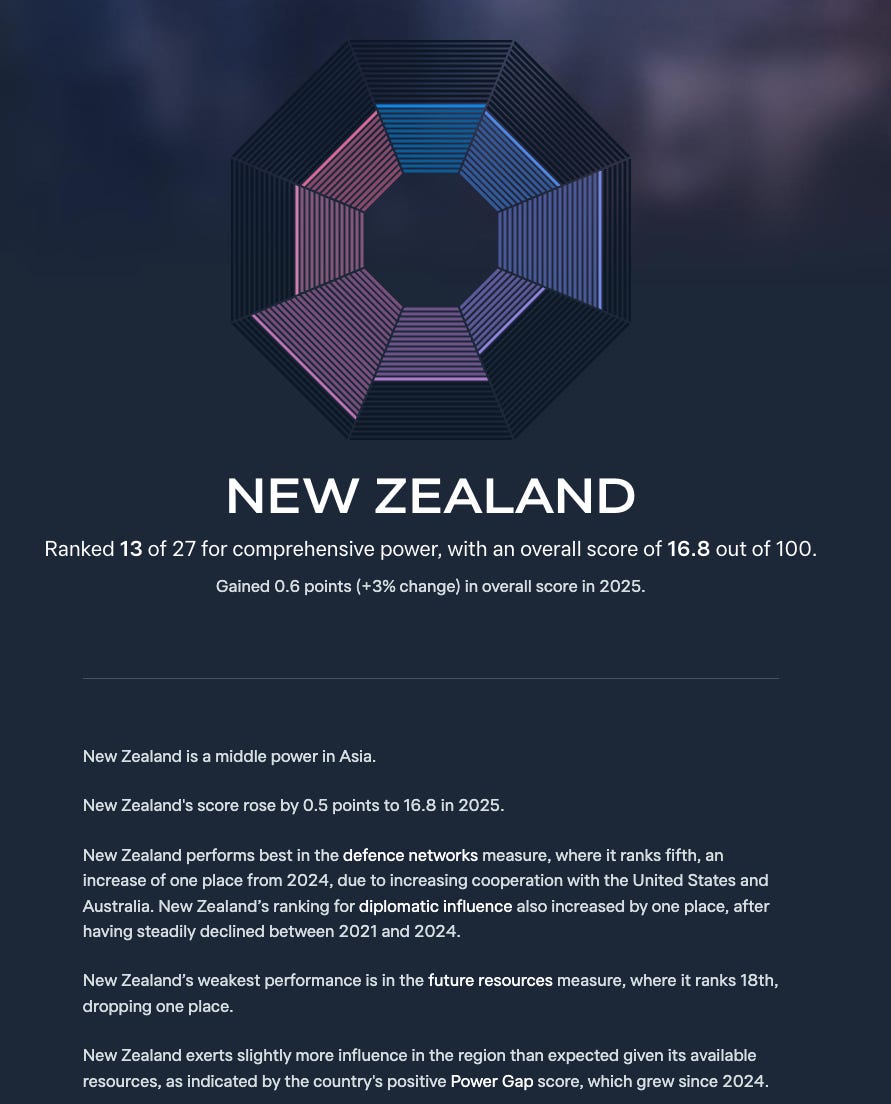
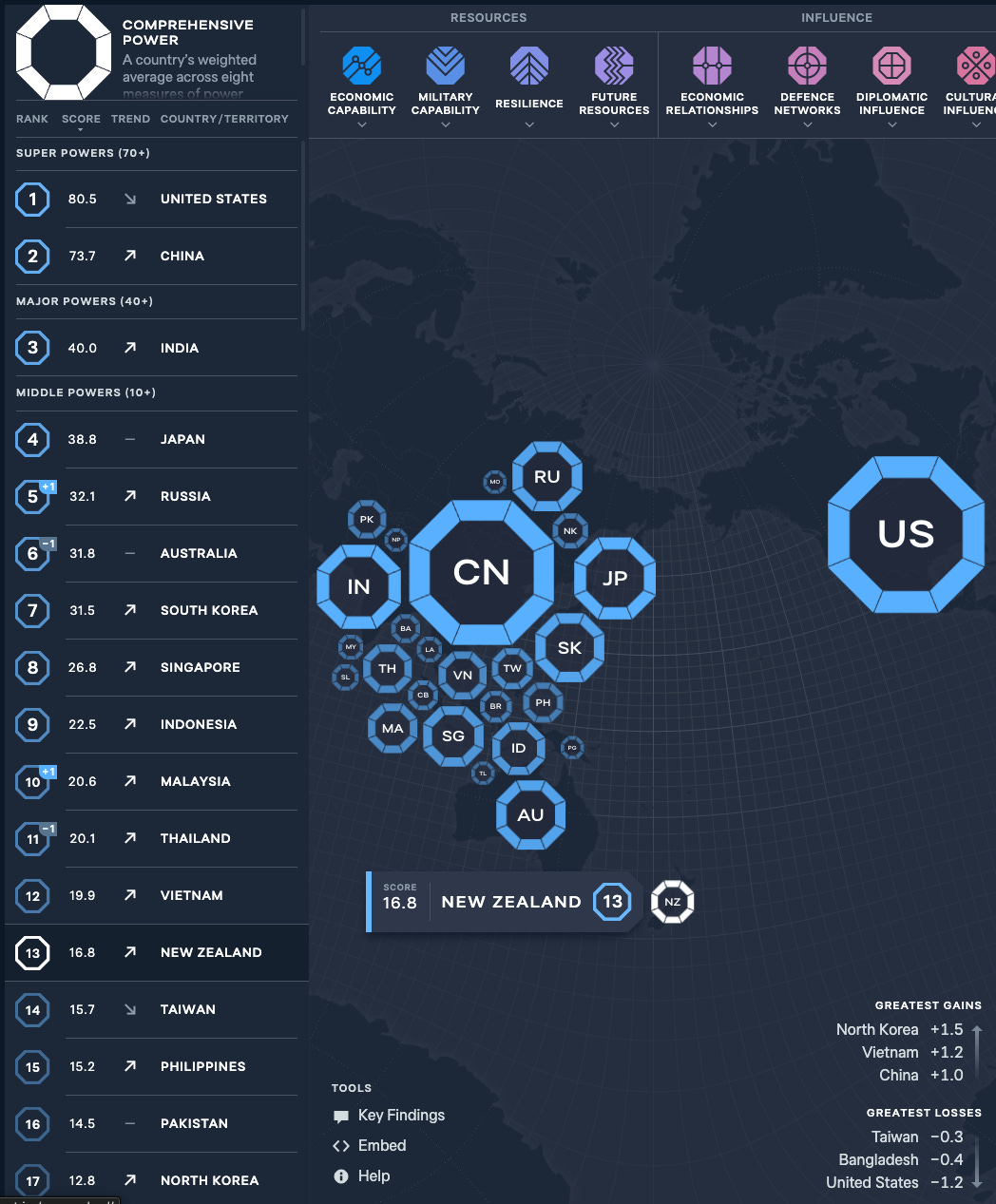
(…How’s that US defence cooperation looking since then…?)
⛽📉Seneca cliff: New Zealand faces rapid natural gas decline and industrial collapse
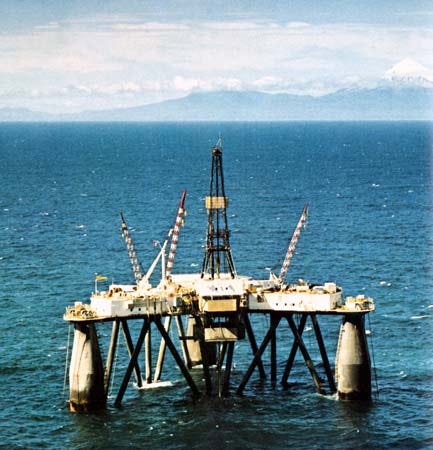
Original article: New Zealand’s 2026 Energy Stock-Take – Part 2: Natural Gas
New Zealand’s natural gas production collapsed 23% in 2025 to 91.8 petajoules, now running at half of 2019 levels, with reserves declining 20-25% annually in what amounts to a supply-constrained crisis affecting an estimated 20% of GDP and 500,000 jobs. Major industrial casualties are imminent: the Ballance Kapuni ammonia-urea plant (120 jobs) operating on short-term contracts since September, and Methanex’s remaining operations (200 jobs) expected to close alongside the depleting Maui field in 2026—which won’t free up gas for others as the two are essentially paired.
(A Seneca cliff is a mathematical model to describe situations where a system's rate of decline is much sharper than its earlier rate of growth.)
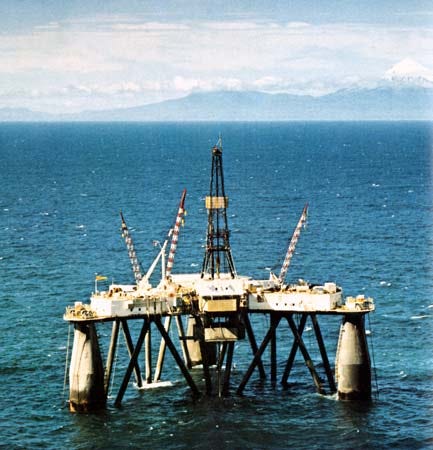
⚡🏢⚠️Genesis Energy CEO warns AI data centres could destabilise grid
Genesis Energy’s CEO Malcolm Johns offers a stark analogy for AI data centres’ electricity demands: they’re like “adding towns to the electricity system” (compared to basic data warehouses being “light bulbs” and AI compute centres being “houses”). While AI is already improving Genesis’s operational efficiency across its hydro fleet, Johns warns that data centres could create “enormous volatility” in AoNZ’s grid as they shift compute loads globally to chase the cheapest electricity—meaning physical infrastructure doesn’t guarantee actual power sales.
The challenge comes as NZ grapples with energy security after 2024’s winter crisis saw wholesale prices spike to NZ$820/MWh (versus the usual ~NZ$160/MWh), prompting a 10-year deal to keep Huntly’s aging coal/gas Rankine units (720MW) operational while Genesis partners with Malaysian developer Yinson on up to 1000MW of wind projects—though even new renewable projects face grid connection bottlenecks.
🌋⚡🏘️Mercury’s new geothermal unit powers 55,000 homes near Taupō
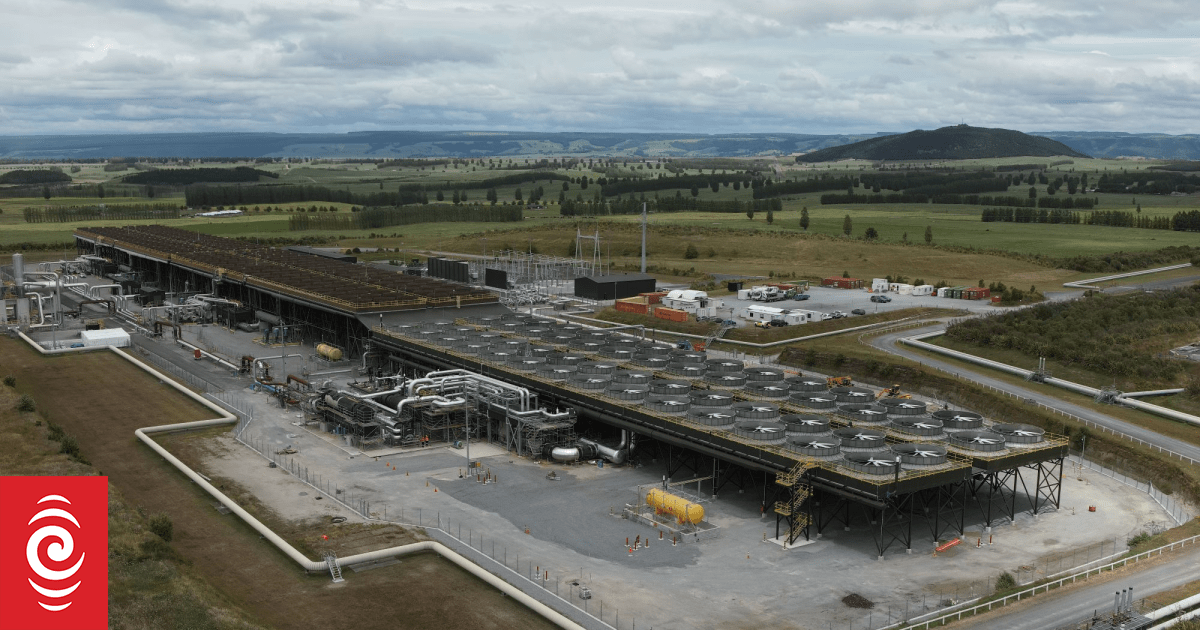
On the positive side, Mercury Energy has commissioned a NZ$220 million geothermal unit near Taupō, adding 46 megawatts of baseload renewable capacity—enough to power 55,000 homes—with full operation expected by March. The expansion taps nine wells drilled over 3 kilometres deep into 290°C reservoirs, lifting the station’s total output to 1120 gigawatt-hours annually, exceeding Christchurch’s entire residential demand.
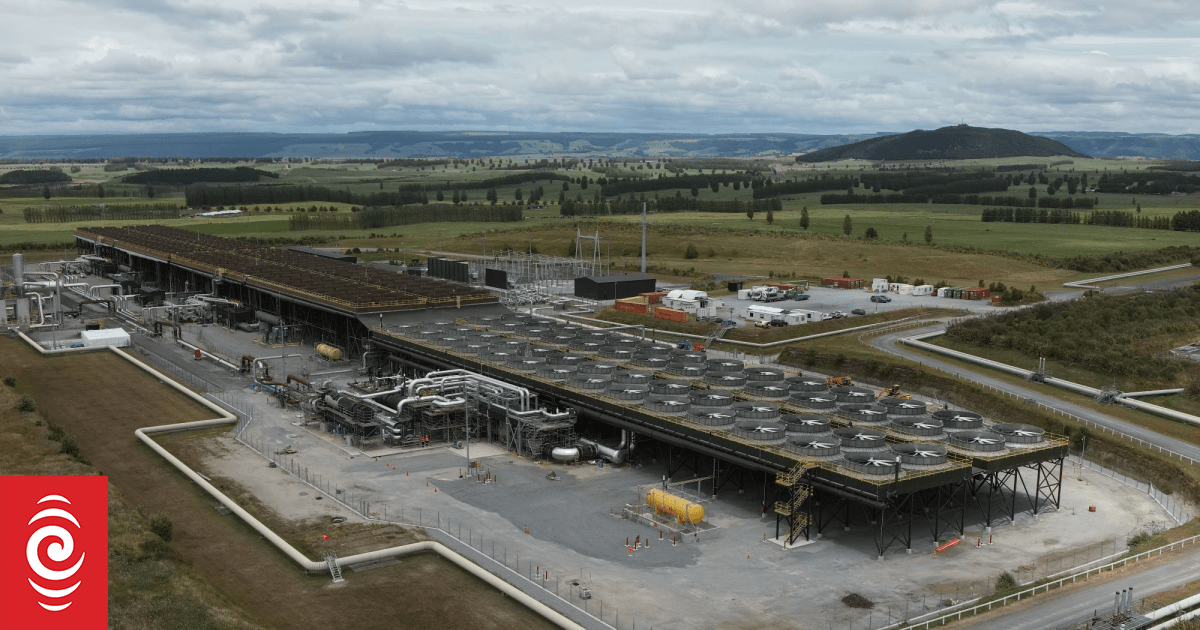
Finally, in case you missed it, here’s the free-flowing, wide-ranging conversation I had with Mike Bayly from The AI Corner podcast at the end of last year, covering what I think is happening in AI right now, Aotearoa’s tech scene and what’s coming next…
Thanks for reading! I hope this is useful… please provide feedback if you have time, I’ll be back again in a month’s time.
Ngā mihi
Ben
I keep on working on this…. my tactic is to have a common System prompt which targets NZ-localised English spelling, currency, ,metric measurements etc. It works most of the time… but not all.
No posts
Comments
Nothing yet. Say the first thing.
Sign in to join the conversation.