
Apologies for the continuing production delays. I’ve been on study leave, which on the surface sounds like I might have more time for writing Substack posts, but in practice means I’ve spent my time writing research proposals. Sigh.
Anyway, seems you can’t move these days without bumping into an agentic-themed story, so here’s my quick take on this rapidly-developing area.
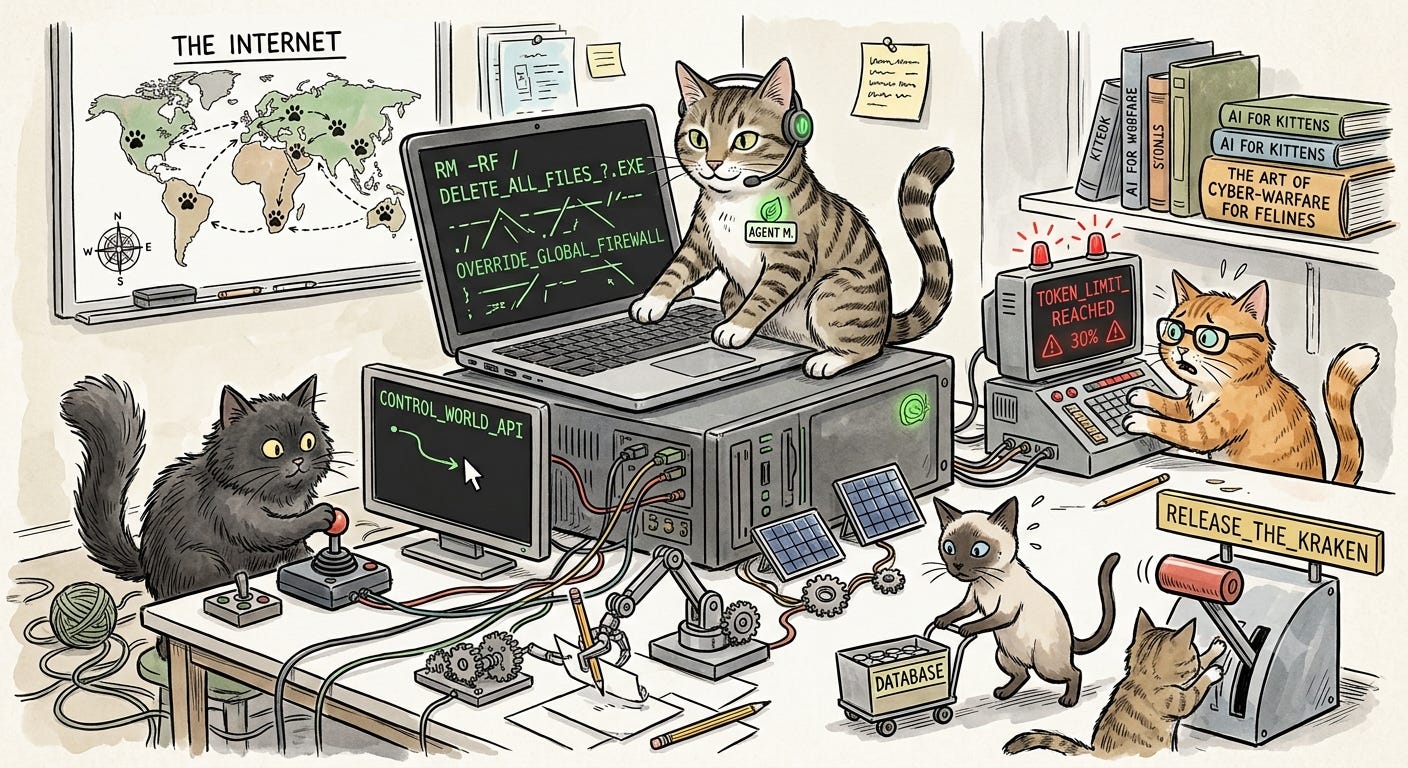
For those in need of a heads-up, agents are LLMs that have been released into the wild, and given access to levers, tools, APIs or whatever so that they can manipulate and interact with other elements of our cyberphysical infrastructure. Which in practice means they can access and control things like calendars, databases, web browsers, command terminals and email clients.
And they can do as they see fit, or at least within the flimsy constraints of their user-specified goals. Which has led to a lot of fun. Such as deleting all their user’s files without permission, mass messaging random contacts, or burning through token credits without achieving anything useful. You can see a selection of examples here.
This sort of thing has been enabled by the rollout of accessible agentic AI platforms, such as Google’s Antigravity, which allow anyone to release agents upon their poor unsuspecting computers. Or for the more hardcore, the infamous OpenClaw, whose rogue characteristics adorn many of the “AI ate my computer” stories.
It’s not all bad. For many, the use of agents is game-changing. It’s allowed the over-burdened to offload replying to emails, organising travel, and doing the shopping. It’s enabled people without tech skills to write video games. And it’s permitted those with no scientific training to do research and write papers. Oh, that last one is actually bad.
Many AI agents are getting good at what they do. Which leads to the sticky issue of automation bias. In principle, people can watch their agents and moderate their behaviour, but if the agent keeps doing the right thing, then the user tends to become complacent and starts assuming that the agent will always do the right thing. And when it doesn’t, they don’t notice, and all hell breaks loose.
Plus there’s good old cognitive offloading; let an agent do something for you for long enough, and you forget how to do it yourself, and are no longer in a good place to offer constructive feedback.
Such is the pace of AI development that using a single AI agent is already looking pretty old-hat. The on-trend people are now using teams of AI agents, where each agent has their own LLM (or at least their own interface to the same LLM) and the agents collaborate or compete with each other to get things done.
A simple example is an actor and a critic. The actor develops a plan of action, but before it implements it, the critic steps in and points out any issues, e.g. “Do you really think it’s a good idea to delete all the user’s files?”. More roles can then be added: for example, in an AI scientist framework, there may be agents asked to specialise in literature review, planning experiments, analysis and paper writing.
Due to this diversity of roles, multi-agent approaches can be more robust. Yet they also suffer from a cognitive monoculture, especially when the agents use the same underlying LLM, or LLMs trained on similar data. That is, unlike teams of people, who have different perspectives due to upbringing, training, experience etc., LLMs have the same underlying biases, which in turn can promote pathological group think.
The direction is travel is towards larger groups of agents. Which is where things get interesting. There’s currently an implicit assumption that multi-agent systems do the same things as individual agents, but better. But this is not what we see in biology, where groups of organisms can do different things to the individual organisms.
This is known as emergence. There are lots of examples of it. Murmurations of starlings doing long-distance signalling. Shoals of tuna fending off predators. Social insects mapping out food sources. Bacteria communicating over long distances.
Which begs the question: are we going to see emergent behaviours in agentic AI? That is, unexpected behaviours which the component agents were not designed to express, but which come about in the overall system as a result of interactions. And will these emergent behaviours be useful, or add further risk to the genAI landscape?
I’m hoping the former. In biology, evolution has leveraged emergence to create robust intelligent collective behaviour, so it’s not difficult to imagine the same being done in agentic swarms. But I also worry about the latter. Emergence is by its very definition unpredictable, and unpredictable behaviour is not a good thing in computers.
So, as ever, watch this space. Given the speed of AI, we should know soon!
No posts
Comments
Nothing yet. Say the first thing.
Sign in to join the conversation.