
Fenbendazole Can Cure Cancer presents Case Reports of people who have treated their own cancers along with other articles to help understand how fenbendazole works to treat cancer. Previous articles covering other cancers are in the Archives link.
Last Tuesday, a paper landed in Nature that stopped me mid-sentence. I was working on the revision of my academic manuscript on the Cancer-as-Parasite hypothesis when the alert came in. I had to read it twice to confirm what I was seeing.
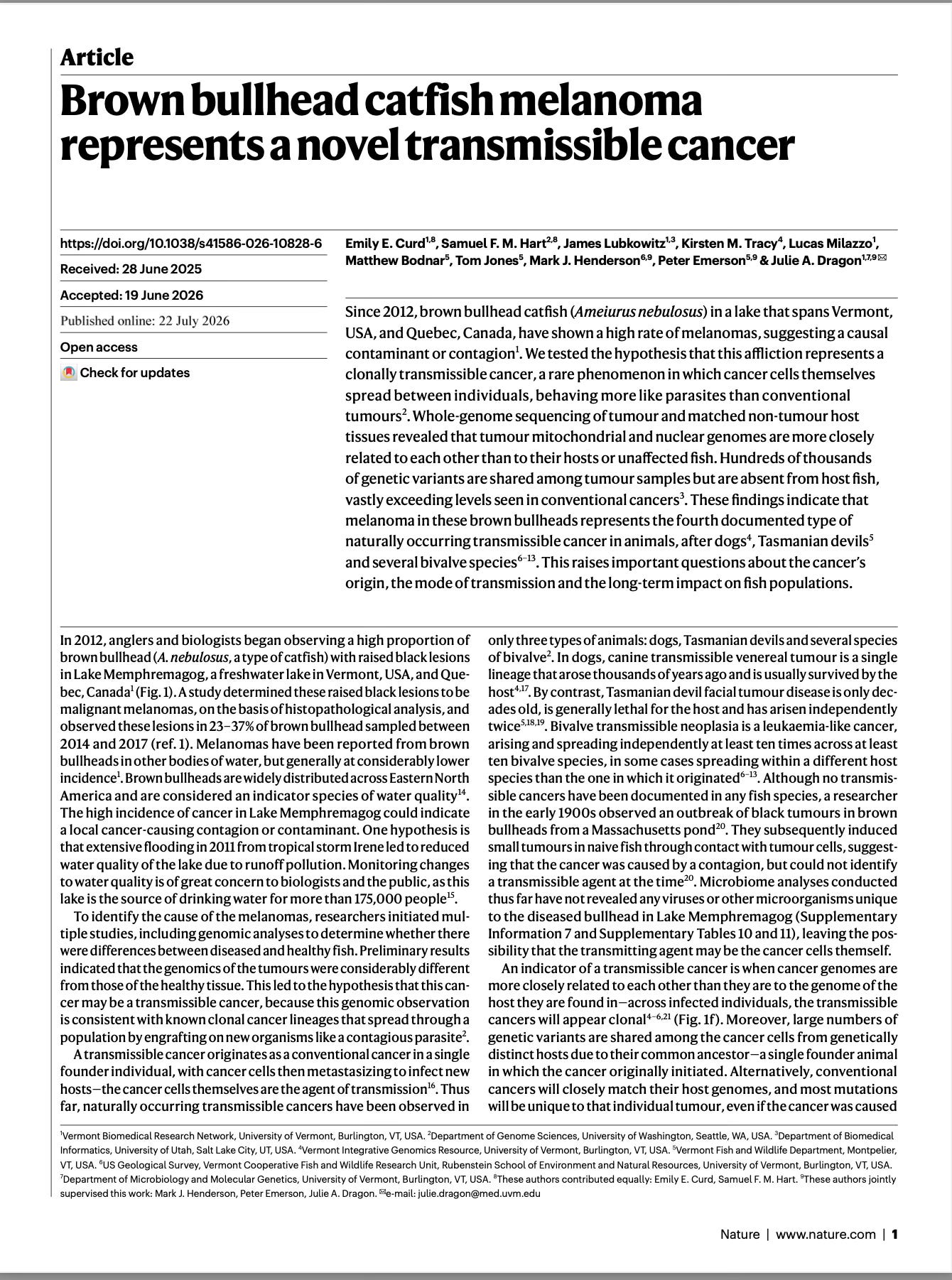
Researchers at the University of Vermont, led by Julie Dragon and her team, have confirmed that brown bullhead catfish (Ameiurus nebulosus) in Lake Memphremagog — a freshwater lake straddling Vermont and Quebec — have been dying of a transmissible cancer. Not a virus. Not a chemical carcinogen. The cancer cells themselves are jumping between fish. One tumor. Many victims. A parasite disguised as a disease.
This is the fourth time in the history of science that a naturally occurring transmissible cancer has been confirmed in animals. The first was in dogs over a century ago. The second was in Tasmanian devils in the 1990s. The third was in bivalve shellfish. Now it is in fish — the first vertebrate outside the mammal class, and the first freshwater ecosystem ever documented.
Every one of these discoveries has expanded the boundaries of what we thought possible. Together, they are telling us something that I believe medicine has not yet fully absorbed: the capacity for cancer to behave like a parasite may be more universal than anyone imagined.
The cancer cells themselves are the infectious agent. Not a virus. Not a bacterium. The tumor.
What the Paper Actually Found
The bullhead melanoma story began in 2012, when anglers and biologists started noticing an unusually high proportion of brown bullhead catfish with raised black lesions in Lake Memphremagog. By 2014–2017, between 23% and 37% of sampled fish carried these melanotic lesions — malignant melanomas confirmed by histopathology. That is a staggering rate by any standard. Human melanoma incidence in the United States is roughly 0.02% of the population per year. These fish were showing rates a thousand times higher in a single lake.
The obvious explanations — a local chemical carcinogen, a viral agent in the water — were investigated and ruled out. No microorganism unique to the diseased fish could be identified. The water quality hypothesis couldn’t account for the specificity of the pattern. What remained was the most unexpected possibility: the cancer itself was spreading between fish.
The Dragon lab tested this hypothesis with whole-genome sequencing. They compared the mitochondrial and nuclear DNA of tumor tissue and healthy tissue from the same fish, and from healthy fish across multiple reference populations in Vermont, New Hampshire, and Maine. The results were unambiguous. Tumor mitochondrial genomes from fish collected across the lake — and across eight years — clustered together into a single monophyletic clade. They were more closely related to each other than to the healthy tissue of the fish they were growing inside. Hundreds of thousands of genetic variants were shared across all tumors but absent from all healthy host tissue. In human melanomas from The Cancer Genome Atlas, 99.9% of mutations are unique to a single cancer. In these bullhead fish, the majority of tumor-specific mutations were shared by every tumor in the study.
There is only one explanation consistent with all of this data: a single founder cancer, arising in one fish at some point before 2015, has been spreading clonally through the population of Lake Memphremagog for over a decade. The cancer cells themselves are the infectious agent. The tumor is, in the precise language of the paper, behaving “more like a parasite than a conventional tumor.”
The tumor is, in the precise language of the paper, behaving “more like a parasite than a conventional tumor.”
Why This Should Shake the Field
Let me be direct about what is significant here, because I think the implications can be undersold if we focus only on the fish biology.
Prior to this paper, naturally occurring transmissible cancers had been confirmed in three groups: dogs, Tasmanian devils, and bivalve mollusks. You could tell yourself that these were unusual circumstances — the canine transmissible venereal tumor (CTVT) is 11,000 years old and globally distributed, an extraordinary evolutionary outlier; devil facial tumor disease is a consequence of extreme genetic uniformity in an isolated island population; the bivalve cancers occur in shellfish with unusual immune biology. Each case, looked at in isolation, could be filed under “exotic exception.”
The bullhead case is harder to dismiss. Brown bullhead catfish are one of the most widely distributed freshwater fish in North America. They are found from the Great Plains to the Atlantic coast, from southern Canada to the Gulf of Mexico. The lake where this cancer was discovered supplies drinking water to 175,000 people and is monitored intensively by environmental agencies. And the paper’s authors note that melanotic lesions have been observed in brown bullhead populations in other water bodies across the northeastern United States going back more than a century — with a documented outbreak of black tumors in a Massachusetts pond in the early 1900s that was tentatively attributed to a “contagion” at the time.
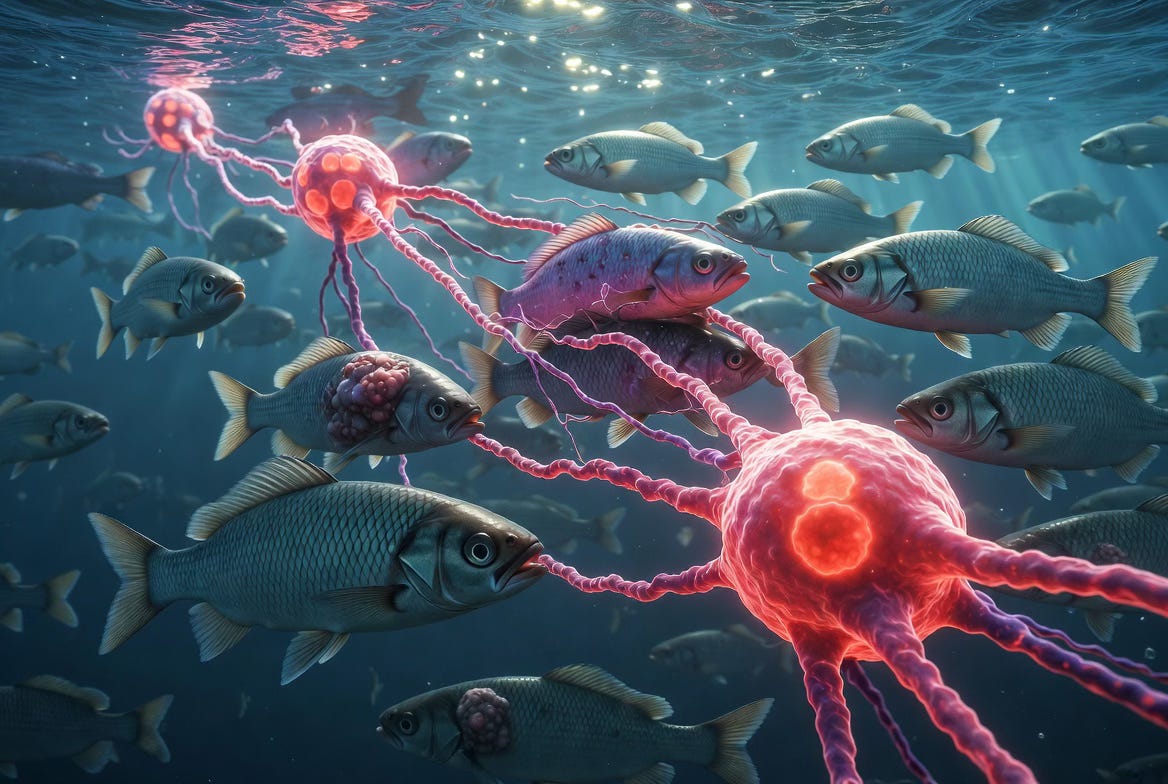
We now have four confirmed transmissible cancer lineages, spanning dogs, marsupials, mollusks, and fish. They arose on independent evolutionary trajectories, in different host species, on different continents, across different taxonomic classes. The paper’s authors explicitly ask whether transmissible cancers in other fish species may await discovery — and note several other fish species with melanotic lesions of unknown cause.
Four independent origins. Dogs. Devils. Shellfish. Fish. The same outcome every time. That is not coincidence. That is a pattern.
The Connection to the Cancer-as-Parasite Framework
Regular readers of this Substack will recognize immediately why this paper matters for the work we have been covering for several years.
The argument I have been making — most recently in my book Cancer is a Parasite — is that cancer and parasitic organisms represent convergent biological solutions to the same problem: how to survive indefinitely inside a hostile host that is actively trying to kill you. That convergence, I argue, is not just conceptually interesting. It has therapeutic consequences. It explains why an antiparasitic drug like fenbendazole can inhibit cancer cell division by the same mechanism it kills parasitic worms — because both depend on tubulin polymerization, and fenbendazole disrupts tubulin polymerization.
The bullhead paper provides the most direct empirical confirmation yet that cancer transmissibility — the defining feature of parasitism — is not a biological freak accident. It is something cancer cells can evolve toward. And the paper offers a particularly striking detail for those of us focused on hormonal biology and immune suppression:
The authors observe that the bullhead melanoma has not been documented in fish younger than reproductive age. They propose that the cancer spreads during spawning aggregations, when fish cluster together in physical contact — and when reproductive hormones are known to suppress fish immune responses. The window of vulnerability, in other words, is hormonal. The cancer exploits the same endocrine-driven immune suppression that makes reproduction possible, using it as a gateway for cell-to-cell transmission. Host hormonal exploitation is yet another characteristic shared between parasites and some cancer cells.
This is precisely what the Cancer-as-Parasite framework predicts. In the book, I document how both cancer and classical parasites exploit hormonal signals — estrogen, glucocorticoids, reproductive hormones — to lower host immune defenses. The bullhead case is not just consistent with this framework. It is a real-world, peer-reviewed, Nature-published demonstration of it operating in a wild animal population.
What This Means for Human Cancer
I want to be precise here, because precision matters and because this subject is one where overstatement can cause problems.
This paper does not suggest that human cancer is contagious in any ordinary sense. It is not. You cannot catch cancer from a cancer patient. The conditions required for cell-to-cell tumor transmission — direct cellular inoculation, immune suppression or evasion, low genetic diversity between donor and recipient — are not present in normal human social contact.
What this 2026 Nature paper does suggest, when read alongside the CTVT, DFTD, and bivalve literature, is something more subtle and more important: the capacity for cancer to transmit between hosts is a latent property of malignant cells, not a categorical impossibility. It has evolved independently at least four times across the animal kingdom. In every case, the mechanism is the same: the cancer “learns” to evade host immune recognition, usually by downregulating the MHC molecules that mark cells as self or foreign.
In humans, the closest analogs are well-documented. A surgeon accidentally inoculated his hand with a patient’s sarcoma during an operation in 1996; the tumor grew at the injection site and was confirmed by genetic analysis to be derived from the patient’s cells (Gartner et al., 1996). Donor-derived cancers have been transmitted via organ transplantation. Maternal-fetal cancer transmission, while rare, has been reported. In every case, the mechanism involves the same MHC downregulation seen in CTVT and DFTD.
The human immune system is more diverse and more vigilant than the systems in fish or Tasmanian devils. That diversity is protective. But it is not absolute, and the new bullhead data suggest we should not treat the boundary between “ordinary cancer” and “transmissible cancer” as a fixed categorical line. It is, instead, a spectrum — and cancers can move along it.
We should not treat the boundary between ‘ordinary cancer’ and ‘transmissible cancer’ as a fixed categorical line. It is a spectrum — and cancers can move along it.
The Fenbendazole Connection
Here is what I keep coming back to when I think about the bullhead paper in the context of this newsletter’s broader mission.
Fenbendazole was developed as an antiparasitic drug. It kills parasitic worms by binding to their tubulin and preventing cell division. It turns out to also kill cancer cells — by binding to their tubulin and preventing cell division. The same mechanism. The same target. Different organisms, identical vulnerability.
For years, the conventional explanation for this cross-activity was essentially “lucky accident” — fenbendazole happens to hit tubulin, and tubulin happens to matter in cancer. The Cancer-as-Parasite framework offers a different explanation: it is not an accident. Cancer cells and parasite cells share this vulnerability because they face the same evolutionary challenge — rapid cell division inside a hostile host — and tubulin-dependent cell division is one of a finite number of solutions to that challenge.
The bullhead paper strengthens this argument significantly. If cancer can independently evolve full parasitic transmissibility four times across the animal kingdom, then the shared molecular machinery between cancer and parasites is not a superficial resemblance. It reflects deep convergent biology. And if the biology converges, so does the pharmacology. A drug that targets the convergent mechanism works against both.
This is the scientific foundation for why antiparasitic drugs — fenbendazole, mebendazole, ivermectin, and others — deserve serious investigation as cancer treatments. Not because they are magic bullets. Not because I said so. But because the biology is pointing in that direction with increasing clarity, and papers like the one published last Tuesday in Nature are part of that evidence.
The Lake Next Door
There is one more thing I want to say about this paper, and it is less scientific than the rest.
Lake Memphremagog is not a remote wilderness lake. It is a working freshwater body. It is a drinking water source. It has been monitored by environmental agencies for decades. The cancer in its fish population has been spreading, the authors estimate, since before 2015 — possibly much longer, given the century-old historical reports from similar populations. It was not discovered because someone was looking for transmissible cancer. It was discovered because the melanoma rates were so abnormally high that they couldn’t be ignored, and because the Dragon lab had the genomic tools and the scientific imagination to ask the right question.
How many other lakes? How many other fish populations? How many other species carrying transmissible cancer lineages that no one has thought to look for? The authors ask this question explicitly, noting several other fish species with unexplained melanotic lesions that might warrant clonality testing. How many other instances of transmissible cancers are out there that we just are not looking for?
The history of science suggests that when something is found to occur in four independent places, after previously being thought to occur in zero, the real answer is often: everywhere, and we just weren’t looking. I am not predicting that transmissible cancer will be found to be ubiquitous. But I am saying that the weight of evidence has shifted, and the prior assumption — that cancer transmissibility is vanishingly rare — deserves serious reexamination.
The Cancer-as-Parasite hypothesis is not a fringe idea anymore. It is a working framework, supported by converging evidence from molecular biology, pharmacology, evolutionary theory, and now — as of last Tuesday — population genomics of fish in a Vermont lake.
Cancer, parasites and antiparasitic drugs that are also anticancer agents cannot be ignored any longer.
Further Reading
Curd EE et al. Brown bullhead catfish melanoma represents a novel transmissible cancer. Nature (2026). https://doi.org/10.1038/s41586-026-10828-6
Gärtner, H. V., et al. Genetic analysis of a sarcoma accidentally transplanted from a patient to a surgeon. The New England journal of medicine, 335(20), 1494–1496 (1996). https://doi.org/10.1056/NEJM199611143352004
Murgia C et al. Clonal origin and evolution of a transmissible cancer. Cell 126, 477–487 (2006).
Pearse AM, Swift K. Allograft theory: transmission of devil facial-tumour disease. Nature 439, 549 (2006).
Metzger MJ & Goff SP. A sixth modality of infectious disease: contagious cancer from devils to clams and beyond. PLoS Pathog. 12, e1005904 (2016).
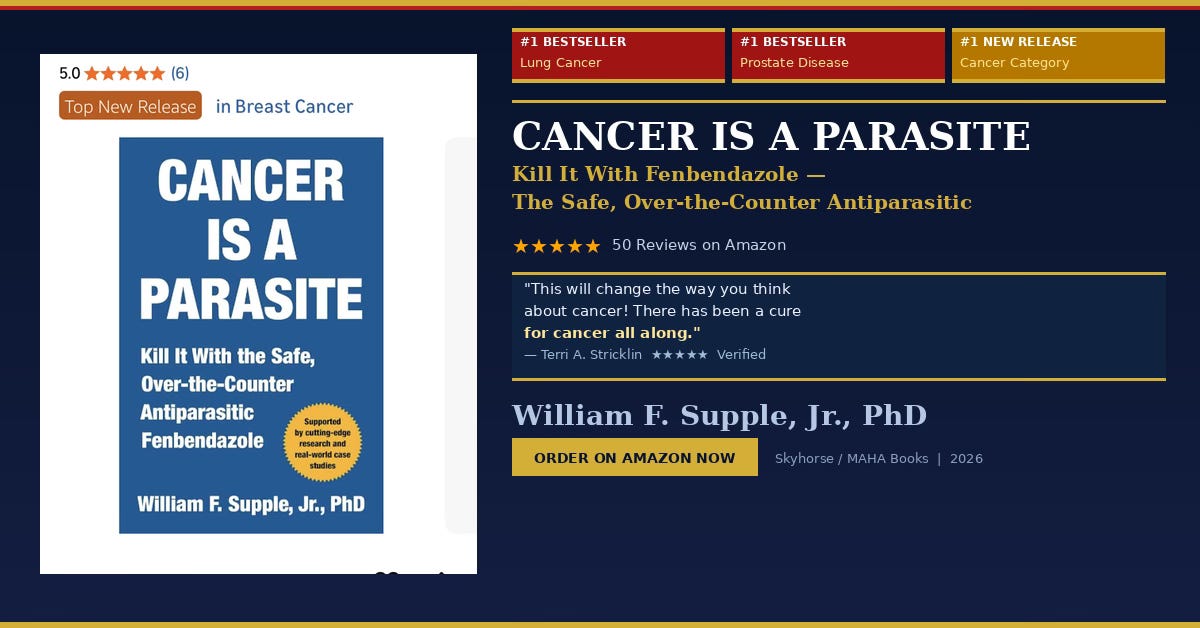
Supple WF Jr. Cancer Is a Parasite: Kill It with the Safe, Over-the-Counter Antiparasitic Fenbendazole. Skyhorse Publishing / MAHA Books (2026).
Cancer is a Parasite Book Notes
Cancer is a Parasite is the #1 book in many Amazon categories like breast, lung and prostate cancer! If you buy it on Amazon, please post your reactions and review on Amazon - a few words is all it takes. I think you can post comments on Amazon even if you obtained the book elsewhere. I would also ask that you comment here as well and as always, ask any questions that arise.
We are truly at a moment in time where a legitimate cure for cancer is about to enter the mainstream. The stars are aligned and the time is ripe for a real cure like fenbendazole. The ball is now in the court of the revamped Health and Human Services public health infrastructure. It is my hope that the shackles impeding progress from entrenched interests have been loosened enough to find the political will and courage to act in humanity’s best interests. It is truly a great time to be alive!
Thanks for reading Fenbendazole Can Cure Cancer! Feel free to share this article with someone who could benefit.
Items Included in All Posts
Fenbendazole vs. Mebendazole vs. Albendazole vs. Flubendazole: The benzimidazoles are very similar chemically and they have very similar mechanisms of action with respect to disrupting microtubule function, specifically defined as binding to the colchicine-sensitive site of the beta subunit of helminithic (parasite) tubulin thereby disrupting binding of that beta unit with the alpha unit of tubulin which blocks intracellular transport and glucose absorption (Guerini et al., 2019). If someone asks you how fenbendazole kills the cancer cells, the answer is in italics in the previous sentence.

The class of drugs known as benzimidazoles includes fenbendazole, mebendazole, albendazole and flubendazole. Mebendazole is the form that is approved for human use while fenbendazole is approved for veterinary use. The main difference is the cost. Mebendazole is expensive ~$555 per 100 mg pill, while fenbendazole is inexpensive ~48 cents per 222 mg free powder dose (Williams, 2019). As you may recall, albendazole is the form used to treat intestinal parasites in India and these cost 2 cents per pill. FYI, to illustrate how Americans are screwed by Big Pharma, two pills of mebendazole cost just $4 in the UK, 27 cents per 100 mg pill in India and $555 per 100 mg pill in the US.
While most of the pre-clinical research uses mebendazole, probably because it is the FDA-approved-for-humans form of fenbendazole, virtually all of the self-treating clinical reports involve the use of fenbendazole. Because the pre-clinical cancer studies use mebendazole (ironically the human form of fenbendazole) and humans self-treat their cancers with fenbendazole (the animal form of mebendazole) it is very reasonable to assume that mebendazole and fenbendazole are functional equivalents with respect to cancer. It would be helpful if future pre-clinical and clinical investigations simply used fenbendazole as a practical matter. For the purposes of this Substack, fenbendazole, mebendazole and albendazole are used interchangably.
Where to get fenbendazole
In our experience and the experiences of those that write in, it appears that the three readily available brands of fenbendazole (Panacur-C, FenBen Labs, Happy Healing Labs) are equally effective. Panacur-C can be obtained locally in pet stores, while they all can be obtained from Amazon. The article on Questions & Answers discusses the brands of fenbendazole in detail and shows photos of the various brands referenced.
If you would like to report your experiences with fenbendazole you can do so privately by email myfenbendazole@proton.me or more publicly in the Comments section in any of the articles.
Disclaimer:
Statements on this website have not been evaluated by the Food and Drug Administration. The contents of this website is for educational and informational purposes only and is not intended to be a substitute for professional medical advice, diagnosis or treatment. This website does not provide any kind of health or medical advice of any kind. Always seek the advice of your physician or other qualified health provider with any questions you may have regarding a medical condition. The case reports presented reflect the real-life experiences and opinions of other readers or users of the website. The experiences of those readers or users are personal to those particular readers/users and may not necessarily be representative of all readers/users. We do not claim, and you should not assume, that all other readers/users will have the same experiences. Do you own research, consult with relevant medical professionals before attempting to self-treat for any condition.
Comments
Nothing yet. Say the first thing.
Sign in to join the conversation.