
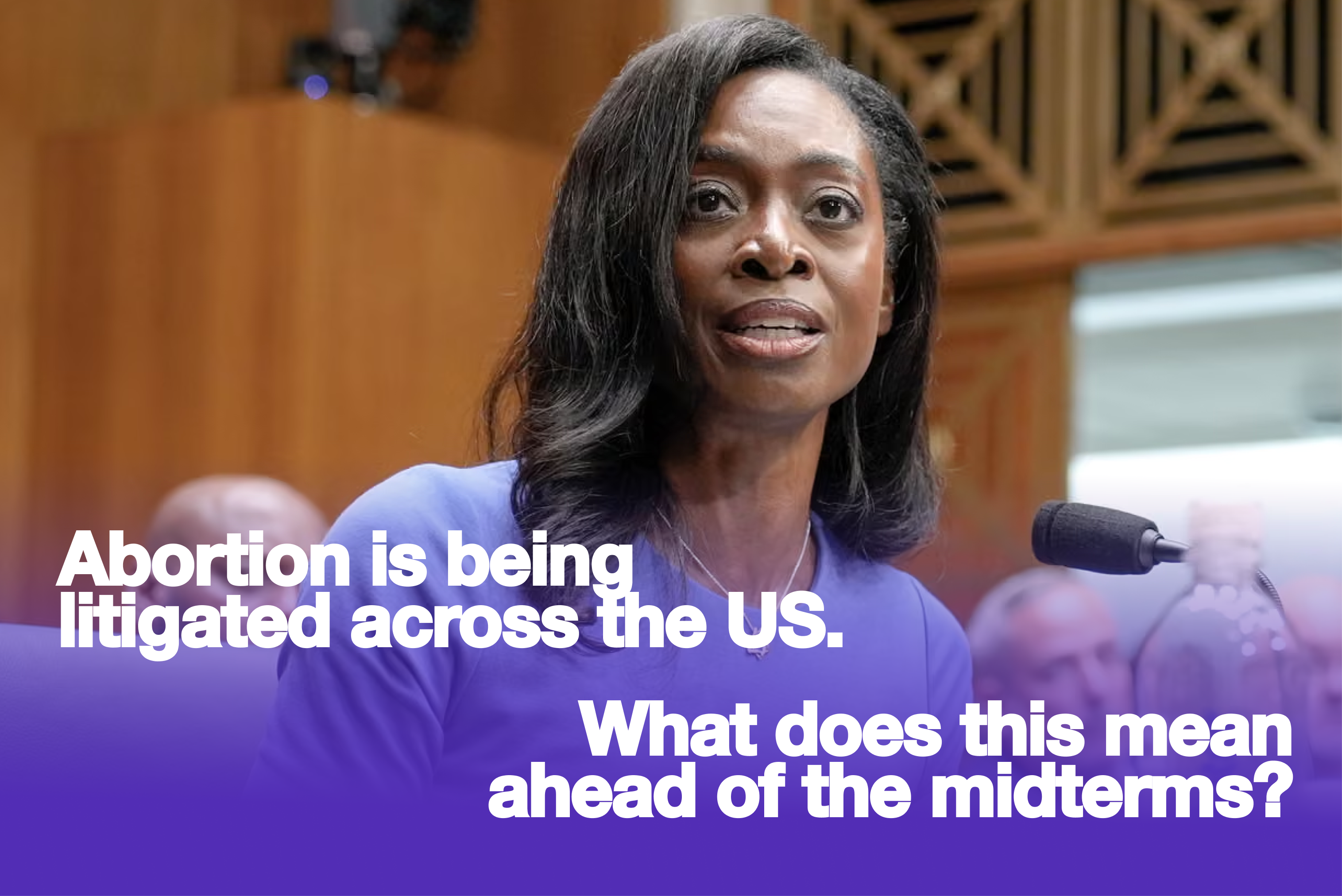
Four years after Dobbs, the fight over abortion access is moving beyond bans and courtrooms. It is also becoming a fight over data: who is tracking abortions, what information is being collected, and how that information could be used. The recent confirmation of CDC Director Erica Schwartz, who called abortion surveillance “a critical component” of the agency’s work, is the latest sign that abortion policy is being shaped not only by lawmakers and judges, but by the systems that touch reproductive health care.
Since the repeal of Roe v Wade in 2022, reproductive freedom has been made illegal in 13 states and is currently at risk of being banned or remains without protection in 17 others, according to the Center for Reproductive Rights. In many instances, abortion access is being decided through the courts. A Pennsylvania court ruled in late April that access to abortion is a fundamental right to be protected under the state’s constitution. A few weeks later, a Louisiana court attempted to restrict the distribution of the abortion pill Mifepristone nationwide. The U.S. Supreme Court blocked the order and is expected to make a final ruling on the issue. Recent litigation on abortion access comes ahead of the 2026 midterms, which are set to be pivotal regarding the issue.
State legislature is central to abortion access since the repeal of Roe v Wade, says Gaby Goldstein, the founder and president of State Futures, a nonprofit that helps support policymakers nationwide.
“The 2026 elections will shape abortion access for millions. Don’t just focus on Congress - the real fight is in state capitols, where the spotlight is dimmest and the stakes are highest,” she tells FEMINIST. “Whether women have autonomy over their bodies increasingly depends on who controls their state legislature.”
So, where will abortion be on the ballot? Goldstein says to look out for legislators of color in districts affected by the recent gutting of the Voting Rights Act. Supporting them is the best way to support pro-choice policies. “The through-line to reproductive freedom is direct: many of these legislators are the fiercest champions of abortion access,” she says. “Eliminate the champions, eliminate the fights they lead.”
Abortion access doesn’t exist in a silo. It is inherently linked to health care, economic security, voting rights and the freedom to decide whether, when and how to build a family, says Mini Timmaraju, the president and CEO of Reproductive Freedom for All, an organization that advocates for abortion access.
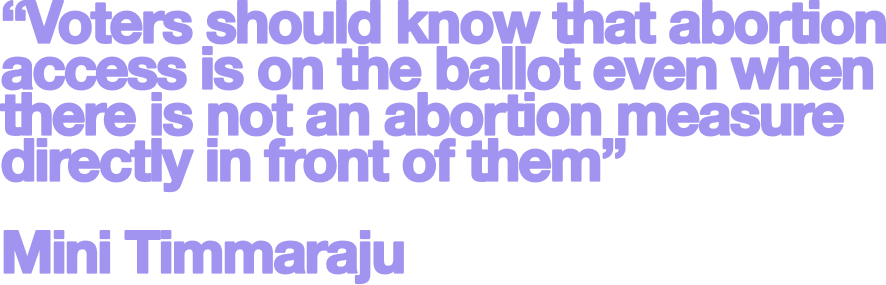
“Voters should know that abortion access is on the ballot even when there is not an abortion measure directly in front of them,” she tells FEMINIST. “The fight for abortion access is playing out in the courts and state legislatures, and the people who sit in those seats can shape whether care is protected or restricted.”
“The stakes are very real: voters have the power to elect leaders who trust people to make their own decisions about their bodies, lives, and futures,” adds Timmaraju.
The divide between Democrats who champion reproductive freedom and Republicans who have defunded Planned Parenthood or Medicaid has never been more clear.
“Voters already expect Democrats to support abortion rights as a baseline, but they also want to hear clearly how candidates will protect access, lower barriers to care, and hold anti-abortion politicians accountable,” says Timmaraju. “The candidates who can connect reproductive freedom to the real pressures people are facing in their daily lives will be the strongest messengers in this midterm cycle.”
The repeal of Roe v Wade made it clear that reproductive freedom is not a theoretical issue. Bans and changes in legislation have had a real-life impact, not just on those seeking abortion access but also on those encountering medical issues and emergencies during their pregnancies. This has drawn voters to the polls in favor of pro-choice policies, according to Goldstein.
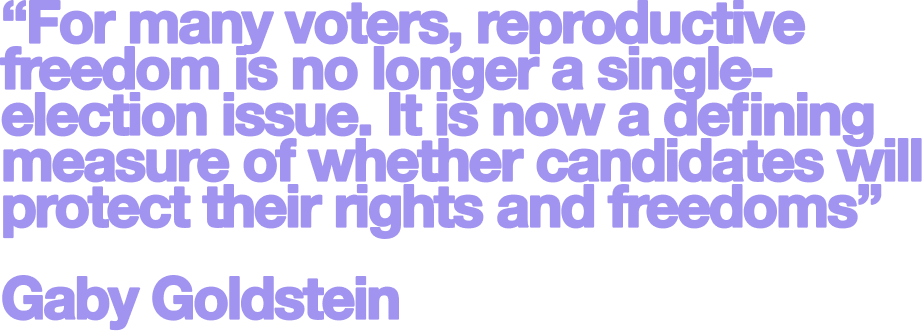
“When abortion is on the ballot, it wins. In fact, abortion is more popular than either political party,” she says. “For many voters, reproductive freedom is no longer a single-election issue. It is now a defining measure of whether candidates will protect their rights and freedoms.”
Timmaraju agrees. “Eight in ten Americans support access to abortion,” she says. “If anti-abortion lawmakers continue to ignore that, voters will hold them accountable.”
Despite the magnitude of current anti-abortion measures existing across the country, states are fighting for reproductive freedom. The midterms are a real chance to flip the script in favor of abortion access and reproductive health care.
Goldstein points to at least 15 state legislative chambers being competitive in 2026, with many state seats and chambers that have very thin margins, such as in Arizona, Michigan, Wisconsin, New Hampshire, Minnesota and Pennsylvania. In 2022, Democrat Melissa Cerrato flipped the Pennsylvania House of Representatives blue by just 63 votes in her district, she notes.

The opposition is counting on people not to show up at the polls: abortion policy is being decided in statehouses and courtrooms, often by small margins. It’s important to play a role in deciding your state legislature and judicial seats, check your voter registration, and show up to the polls to decide whether abortion care is protected or punished.
“There is hope,” Goldstein says. And hope looks like participation.
Read more from Gaby on Substack.
Reproductive Freedom for All can be found here.
Comments
Nothing yet. Say the first thing.
Sign in to join the conversation.